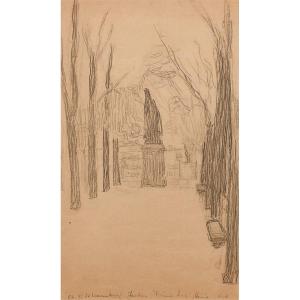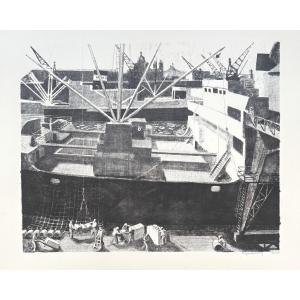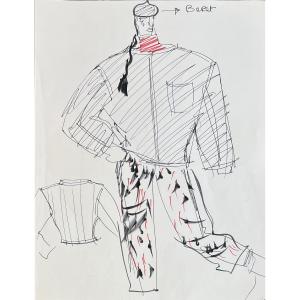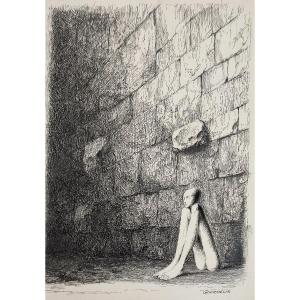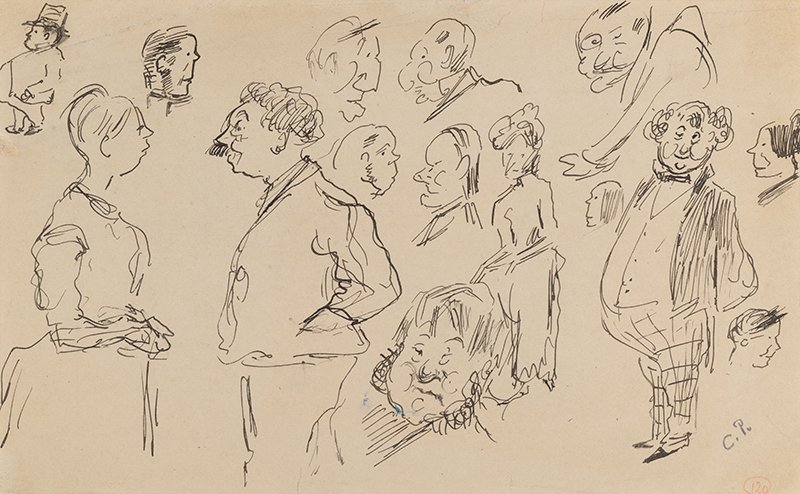
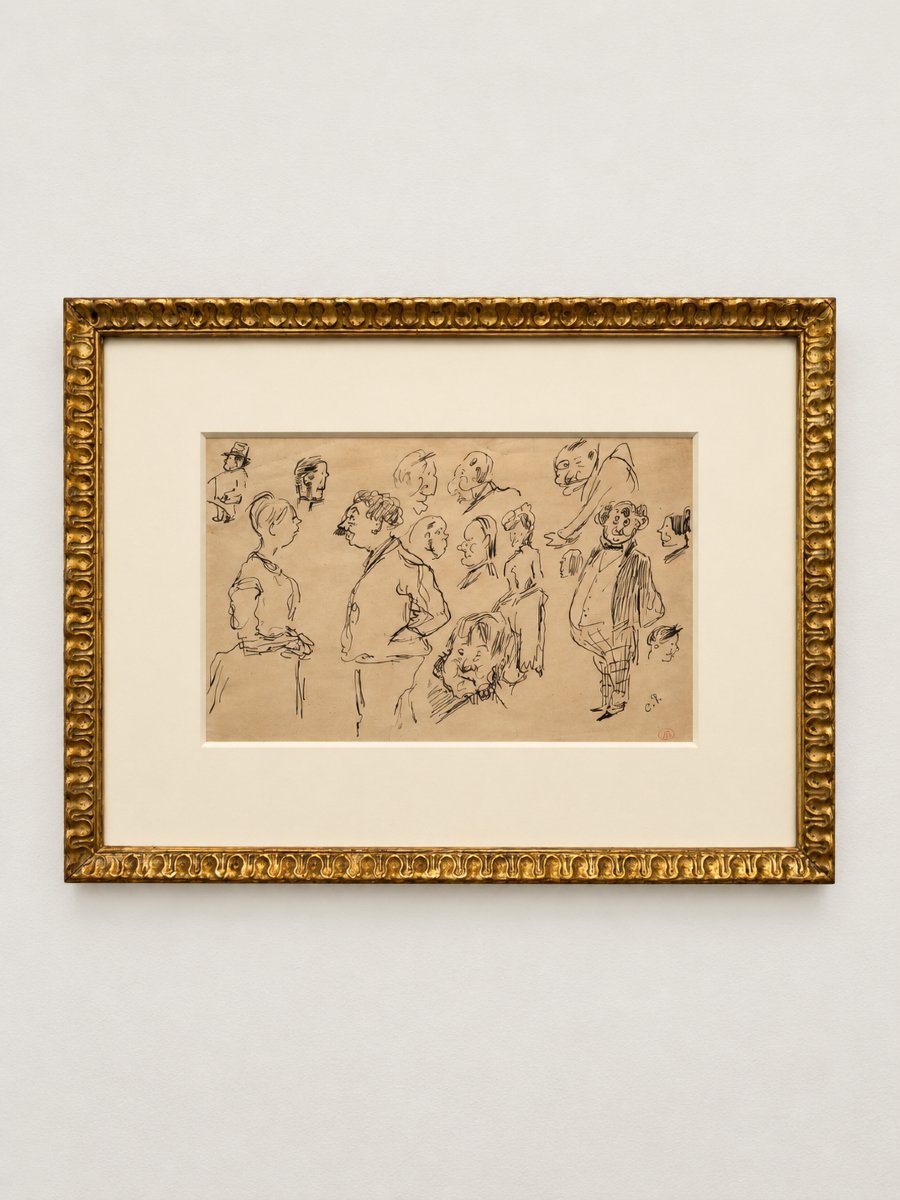

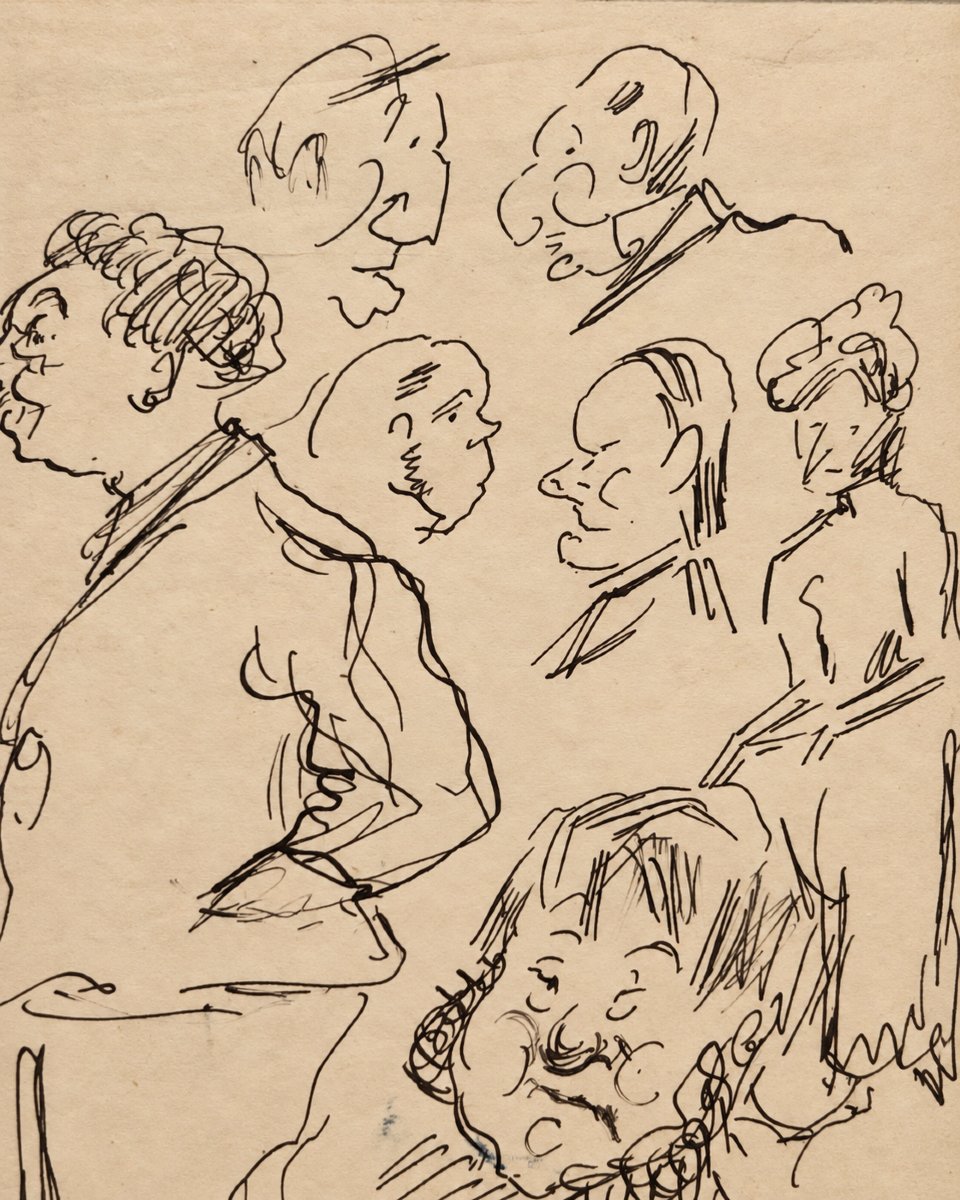


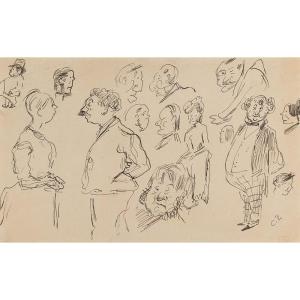


Camille Pissarro (1830–1903) - Figures, Circa 1883–84
Artist: Camille Pissarro (1830-1903)
Camille Pissarro (1830–1903)
Figures, circa 1883–84
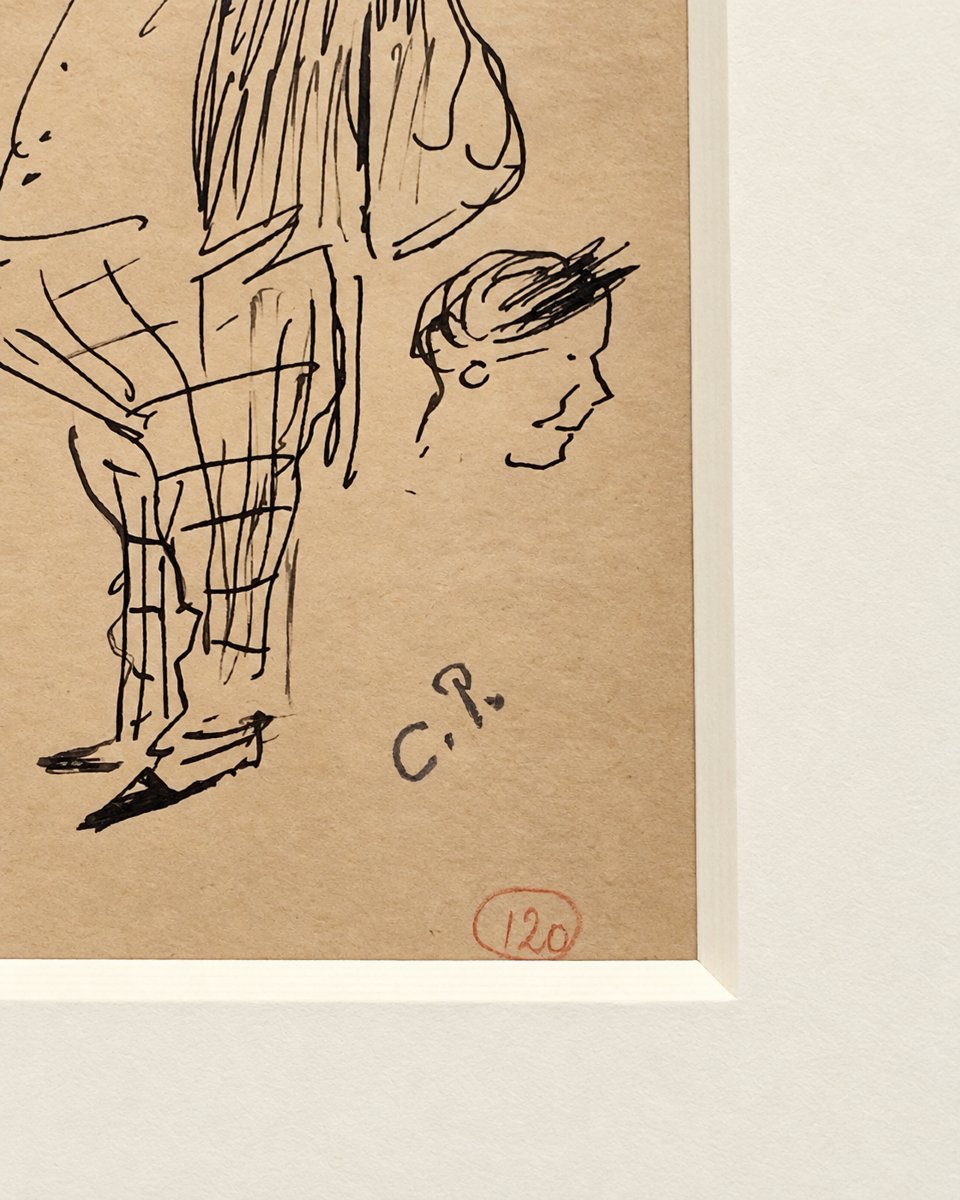
Ink on paper bearing the stamp with the initials “Lugt 613e” in the lower right corner, inventory number 120 written in red pencil.
16 x 25 cm
Provenance :
From the Bonin family estate, passed down through the family.
Certificate of authenticity issued by Mr. Joachim Pissarro.
A Franco-Danish painter born in the West Indies, Camille Pissarro is one of the founding figures of Impressionism. As the eldest member of the group, he was the only artist to have exhibited in all eight Impressionist exhibitions (1874–1886), and later one of the few to haA Franco-Danish painter born in the West Indies, Camille Pissarro is one of the founding figures of Impressionism. As the eldest member of the group, he was the only artist to have exhibited in all eight Impressionist exhibitions (1874–1886), and later one of the few to have experimented, alongside Seurat and Signac, with Neo-Impressionism. Cézanne said of him that he had been like a father to him.
From the West Indies to Paris (1830–1855)
Jacob Abraham Camille Pissarro was born on July 10, 1830, in Charlotte Amalie, on the island of St. Thomas, then a Danish colony. His father, a merchant of French nationality and Portuguese Jewish descent, and his mother, who came from a Jewish family on the island with Provençal roots, intended for him to pursue a career in business. At the age of twelve, he was sent to boarding school in Passy, near Paris, where his teacher encouraged him to draw from life. Upon his return to Saint Thomas, he worked in the family business while drawing whenever he could. In the early 1850s, his encounter with the Danish painter Fritz Melbye sealed his calling: he followed Melbye to Venezuela (Caracas, La Guaira) for about two years, then settled permanently in France in 1855.
Early Training and the Birth of Impressionism (1855–1884)
In Paris, Pissarro took classes at the École des Beaux-Arts and the Académie Suisse, but found academic instruction stifling. He sought advice from Corot, who encouraged him to paint from life, and became friends with Monet, Guillaumin, and Cézanne. His first landscape was accepted into the Salon in 1859; in 1863, he was among the exhibitors at the Salon des Refusés. Settling in Pontoise in 1866, then in Louveciennes, he was praised by Zola, who, as early as 1868, ranked him among the few true painters of his time. The war of 1870 forced him to seek refuge in London, where in 1871 he married Julie Vellay—a domestic worker in his parents’ home and the mother of his children—and met the art dealer Paul Durand-Ruel, who would become his primary patron. Upon his return, he discovered that a large portion of the paintings he had left behind in France had been destroyed. Settling in Pontoise (1872–1882), he worked there alongside Cézanne. In 1873, he helped found the Société anonyme des artistes, peintres, sculpteurs et graveurs (Anonymous Society of Artists, Painters, Sculptors, and Engravers), which organized the first Impressionist exhibition in April 1874 in Nadar’s former studios; he presented five landscapes there. A conciliatory figure within the group, he advised Gauguin, whom he met in 1877, and invited him to participate in the fourth exhibition in 1879.
A socially conscious artist, a family of artists
Of Jewish descent but an atheist and freethinker, Pissarro embraced anarchist ideas: a subscriber to *Le Révolté* and in contact with Jean Grave, Signac, and Cross, he produced the album of satirical drawings *Turpitudes sociales* in 1889. A staunch supporter of Dreyfus from the very beginning, he joined in the tribute paid to Zola in 1898. The father of a large family, he trained his children in painting: Lucien, Georges Manzana, Félix, Ludovic-Rodo, and Paul-Émile, in particular, would become artists, continuing a lineage that still includes painters today.
Legacy
Nicknamed “Father Pissarro” by his peers, he played a pivotal and mediating role within the Impressionist group, and his teachings left a lasting mark on Cézanne, Gauguin, Seurat, and Signac; in 1906, Cézanne was listed in a catalog as “a student of Pissarro.” Although he received little commercial recognition during his lifetime and struggled financially until his sixties, his work is now featured in the world’s greatest museums. A major retrospective, *The Honest Eye*, was dedicated to him in 2025 at the Barberini Museum in Potsdam, and later at the Denver Art Museum.
ve experimented, alongside Seurat and Signac, with Neo-Impressionism. Cézanne said of him that he had been like a father to him.
Discover more works by this artist on the gallery's website : https://www.galeriepentcheff.fr/fr/peintre-camille-pissarro#Oeuvres
8 500 €
Period: 19th century
Style: Modern Art
Condition: Good condition
Length: 16
Width: 25
Reference (ID): 1844450
Availability: In stock
Print