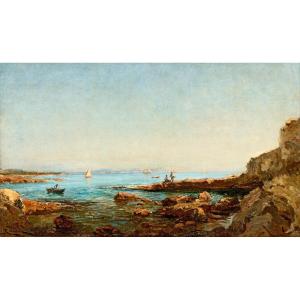
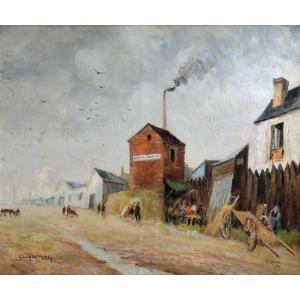
Gustave Surand (1860–1937) - Returning From A Hunting Trip In Asia
Returning from a Hunt in Asia
Painting, oil on canvas, signed lower right
54 x 65 cm
Provenance:
Private collection, France
Origins and Academic Training of Excellence
Born in Paris in 1860, Gustave Surand showed a remarkable aptitude for the visual arts from an early age. Admitted to the École Nationale Supérieure des Beaux-Arts in Paris, he joined the studio of the prestigious master Jean-Paul Laurens. Through this mentorship with one of the leading figures of French history painting, Surand acquired an absolute rigor in anatomical drawing, a keen sense of theatrical drama, and a pronounced taste for grand historical and biblical frescoes.
From his debut at the Salon des Artistes Français in 1881, the young artist distinguished himself through a powerful style and compositional boldness that quickly earned him the attention of academic critics and the government.
The Painter of Wild Beasts and Imperial RomeWhile Surand excelled at mythological and religious subjects, it was above all his fascination with the animal kingdom—and particularly with large predators—that cemented his artistic uniqueness:
A masterful depiction of feline anatomy: a frequent visitor to the menagerie at the Jardin des Plantes in Paris, he studied the musculature, nervous postures, and raw power of lions, tigers, and panthers with scientific precision.
The spirit of the ancient arena: combining his mastery of wild beasts with his training as a historian, he specialized in the grandiose and tragic scenes of the Roman Empire, depicting Christian martyrs and gladiators thrown to the beasts within the Colosseum.
The Orientalist Journey: Following in the footsteps of the masters of his generation, he traveled to North Africa, particularly Tunisia. These travels infused his palette with a new luminosity and enriched his repertoire with Mediterranean landscapes and scenes of vibrant Orientalism, devoid of sentimentality.
With his vigorous brushwork, generous impasto, and sculptural treatment of the paint, Gustave Surand was naturally sought after for major public decorative projects at the turn of the century.
Among his most famous monumental works is his contribution to the decor of the legendary restaurant Le Train Bleu (then known as the Buffet de la Gare de Lyon) in Paris, inaugurated for the 1900 World’s Fair. There, he created an impressive composition depicting Provence and the Mediterranean, demonstrating his ability to design works of architectural scale that combine monumentality, elegance, and a vibrant color palette.
Official Recognition and Legacy in MuseumsA member of the Salon des Artistes Français and a medalist at the Salons of 1884 and 1889, Surand received an honorable mention at the 1889 World’s Fair before being awarded the Legion of Honor in 1910.
An iconic figure in the transition from historical academicism to early 20th-century animal naturalism, Gustave Surand died in Paris in 1937. Today, his paintings are housed in notable public museum collections—notably at the Musée des Beaux-Arts in Rouen, the Béziers Museum, and the City of Paris’s art collection—and are highly sought after for their evocative power, dramatic tension, and masterful depiction of animals.
Period: 20th century
Style: Modern Art
Condition: Good condition
Material: Oil painting
Length: 54 cm
Width: 65 cm
Reference (ID): 1847582
Availability: In stock