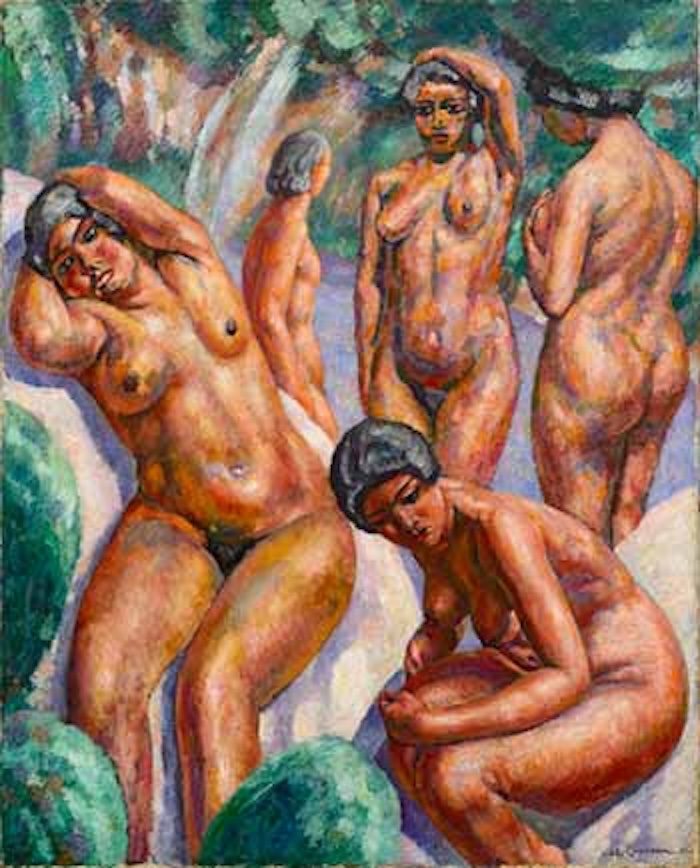
Augustin Carrera (1875–1952) - Women Bathing, 1931
Women Bathing, 1931
Painting, oil on canvas, signed and dated 1931 lower right
150 x 118 cm
History:
Augustin Carrera Studio Sale, Claude Robert, December 20, 1967, lot no. 91, titled “Les Grandes Baigneuses” (erroneously dated 1930).
Bibliography:
Camille Rouvier, Augustin Carrera, Imprimerie Nouvelle, 1962, reproduced (n.p.).
Augustin Carrera – A French Painter Between Academicism and the Light of the East
Born on April 3, 1878, in Madrid to French parents, Augustin Carrera showed a talent for drawing from a very early age. He quickly enrolled in art schools, first at the École des Beaux-Arts in Marseille, where he studied under Alphonse Moutte, and then at the École des Beaux-Arts in Paris, in the studio of the famous Léon Bonnat. As a scholarship recipient from the City of Marseille, Carrera distinguished himself as one of the most brilliant students in his class and was noted for his promising talent.
After his marriage, Augustin Carrera went through a difficult financial period. He had no choice but to make a living from his art, which strengthened his determination. He drew with renewed fervor, inspired by his observations of the masters in galleries and museums: Cézanne, Gauguin, Seurat, but above all Degas, Toulouse-Lautrec, Monet, Van Gogh, and Pissarro, who had a lasting influence on his practice. Landscape became a central subject in his works, in which he employed a vivid color palette and a renewed pictorial approach.
In 1912, Carrera was awarded the Indochina Fellowship, marking a decisive turning point in his career. He spent eight months in Asia, returning with powerful works inspired by temples, the banks of the Red River, and scenes of local life. The King of Cambodia commissioned him to create decorative panels for his palace, which he installed during a second trip in 1928.
Drafted during the war of 1914 and wounded, he recovered in Allauch in 1916. A trip to Spain exposed him to the masterpieces of El Greco and Velázquez, prompting him to settle in Montparnasse, then the new artistic heart of Paris. Carrera, a private man, continued his work in a personal and understated style. He formed a close relationship with the politician Albert Sarraut, who actively supported his career.
Beginning in 1910, Carrera exhibited at the most prestigious salons: the Salon des Tuileries, the Salon des Indépendants, the Salon des Artistes Français, the Musée des Arts Décoratifs, the Triennale Quai Malaquais, and the 1937 International Exposition, where he won a gold medal. He was also championed by the art critic François Thiébault-Sisson in the pages of the newspaper Le Temps, and represented by the Druet and Georges Petit galleries, which allowed him to exhibit female nudes—a theme he explored with finesse and sensuality.
Carrera developed a varied body of work, in which exotic landscapes, luminous nudes, and monumental sets took center stage. In 1924, he designed the sets for the Marseille Opera, surrounded by his friends from the Provençal school, notably Hurard, Eichacker, De Groux, Audibert, and Verdilhan.
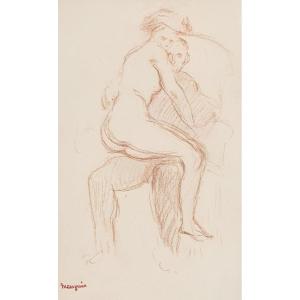
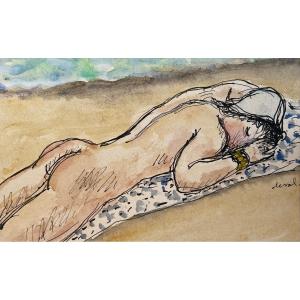
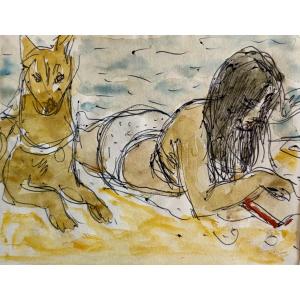
While his landscapes reveal his mastery of color, it is in the female nude that Augustin Carrera truly asserts his uniqueness. In these works, he combines sensuality, anatomical precision, and chromatic refinement. Light sculpts the flesh, revealing a restrained eroticism, thick impasto, and colored grays with an almost sculptural quality. Antoine Bourdelle put it this way: “Carrera has found a way in his painting to combine bold use of color with the exquisite subtlety of atmosphere. People of Marseille, you have a great painter! Take good care of him!”
Carrera was named a Knight of the Legion of Honor in 1920, then an Officer in 1928. He left behind a prolific, sensitive body of work, open to the world beyond, imbued with humanism and light.
Period: 20th century
Style: Modern Art
Condition: Good condition
Material: Oil painting
Length: 150
Width: 118
Reference (ID): 1847525
Availability: In stock