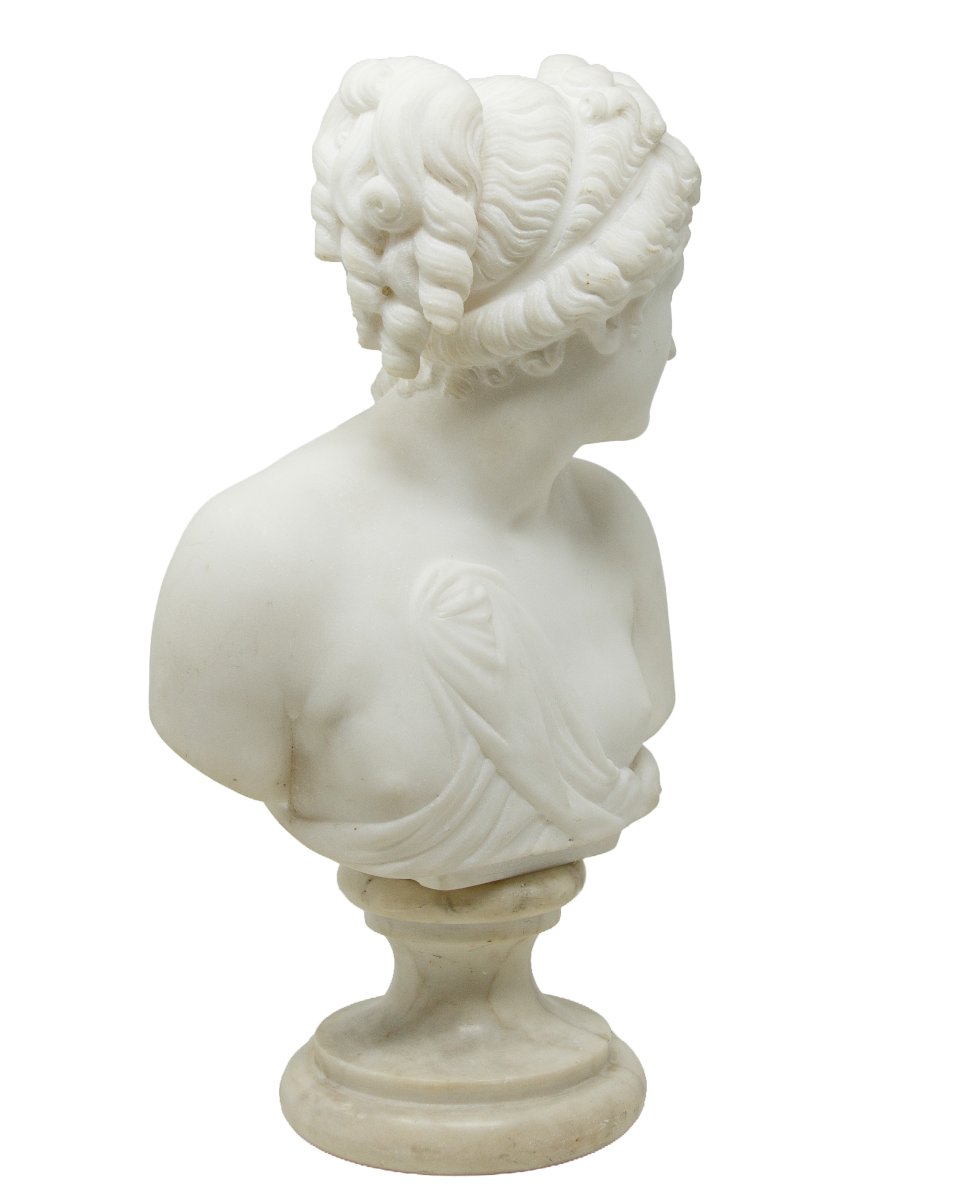
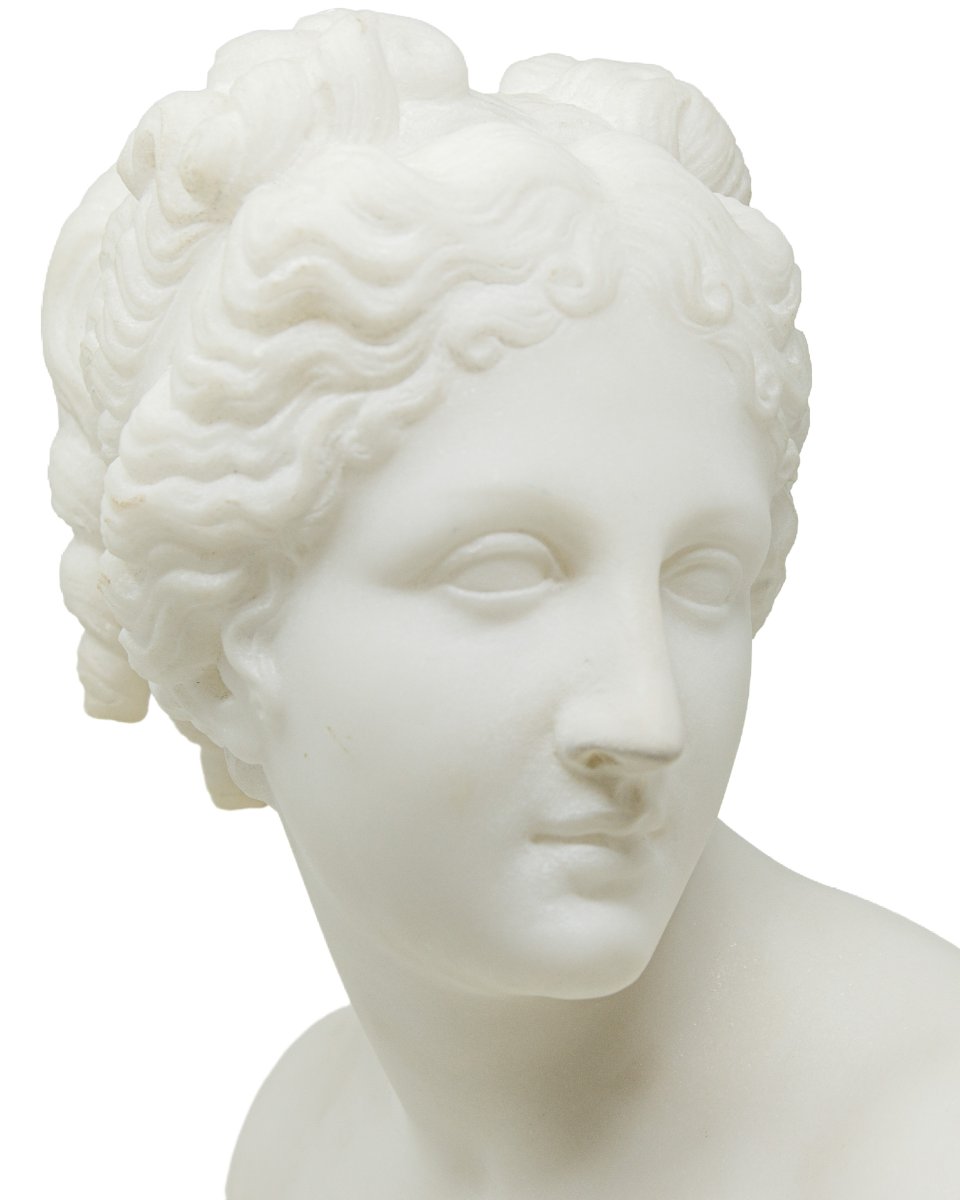


19th Century, Bust Of The Venus Italica
19th century
Bust of the Venus Italica
Marble, 42 x 23 x 13 cm
This 19th-century white marble bust depicts a young woman with her head slightly tilted back and her gaze turned to the side, her expression serene. Her hair, gathered in soft braids at the top of her head and in wavy locks across her forehead, is rendered with a delicate chiaroscuro effect that contrasts with the smoothness of her face and shoulders. A fold of drapery slides down over her chest, leaving her torso exposed. The work rests on a small circular pedestal of veined marble, in the style typical of collectible busts.
The sculpture echoes the face of Antonio Canova’s Venus Italica, now housed in the Palatine Gallery of the Pitti Palace in Florence. The original was created as compensation for the transfer to France of the Medici Venus, which had been seized by Napoleonic troops during the plundering of Italian artworks, and the sculptor drew his inspiration from that model. Placed in 1812 in the Tribuna of the Uffizi, in the very spot where the Medici Venus had stood, it was later moved to Palazzo Pitti. Canova depicted the goddess in the act of covering herself with a cloth, perhaps startled by someone’s arrival, following the classical theme of the Venus pudica, for which there were famous ancient precedents.
This sculpture is a product of the Neoclassical movement: it reflects adherence to the theories of Johann Joachim Winckelmann, who identified in Greek art the pursuit of ideal beauty and “noble simplicity and quiet grandeur.” Far removed from the turmoil of passions and emotions, the face is composed and serene. Idealization remains the hallmark of 19th-century sculpture in the Canovian tradition, which for decades continued to replicate the models of the master and of antiquity.
Works of this type—small in size and often carved from white marble or alabaster—were produced by Italian workshops, particularly in Florence and Rome, for travelers on the Grand Tour, who purchased them as mementos of the masterpieces they had admired during their stay in Italy. The bust presented here thus bears witness both to the popularity of a Canovian icon and to the collecting tastes of an era that made antiquity an object of remembrance and a means of domestic dialogue with classical antiquity.
Period: 19th century
Style: Other Style
Condition: Good condition
Material: Marble
Width: 23
Height: 42
Depth: 13
Reference (ID): 1847476
Availability: In stock