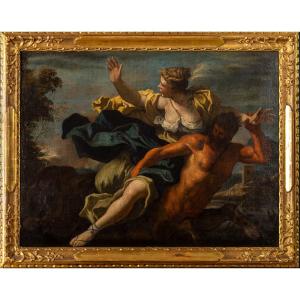


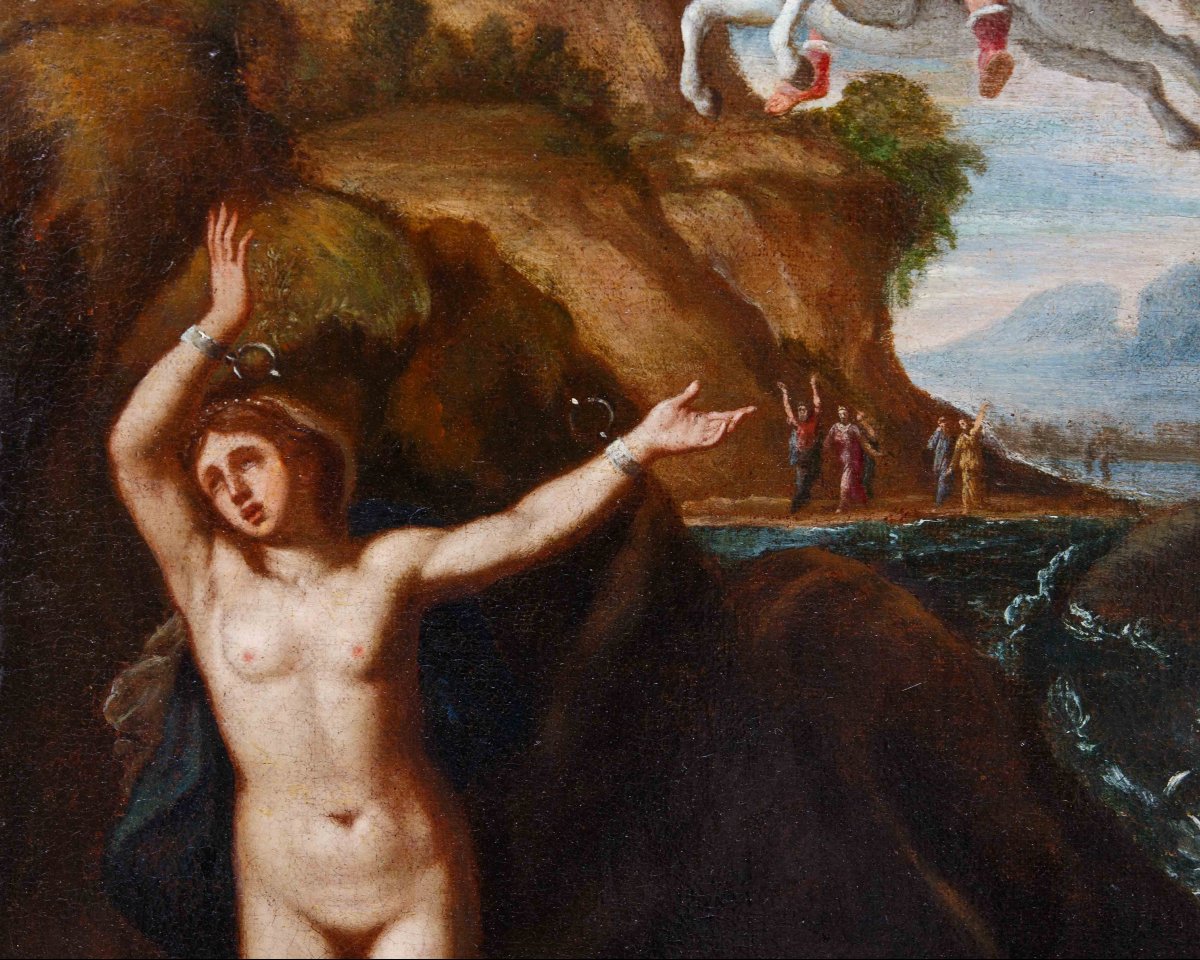

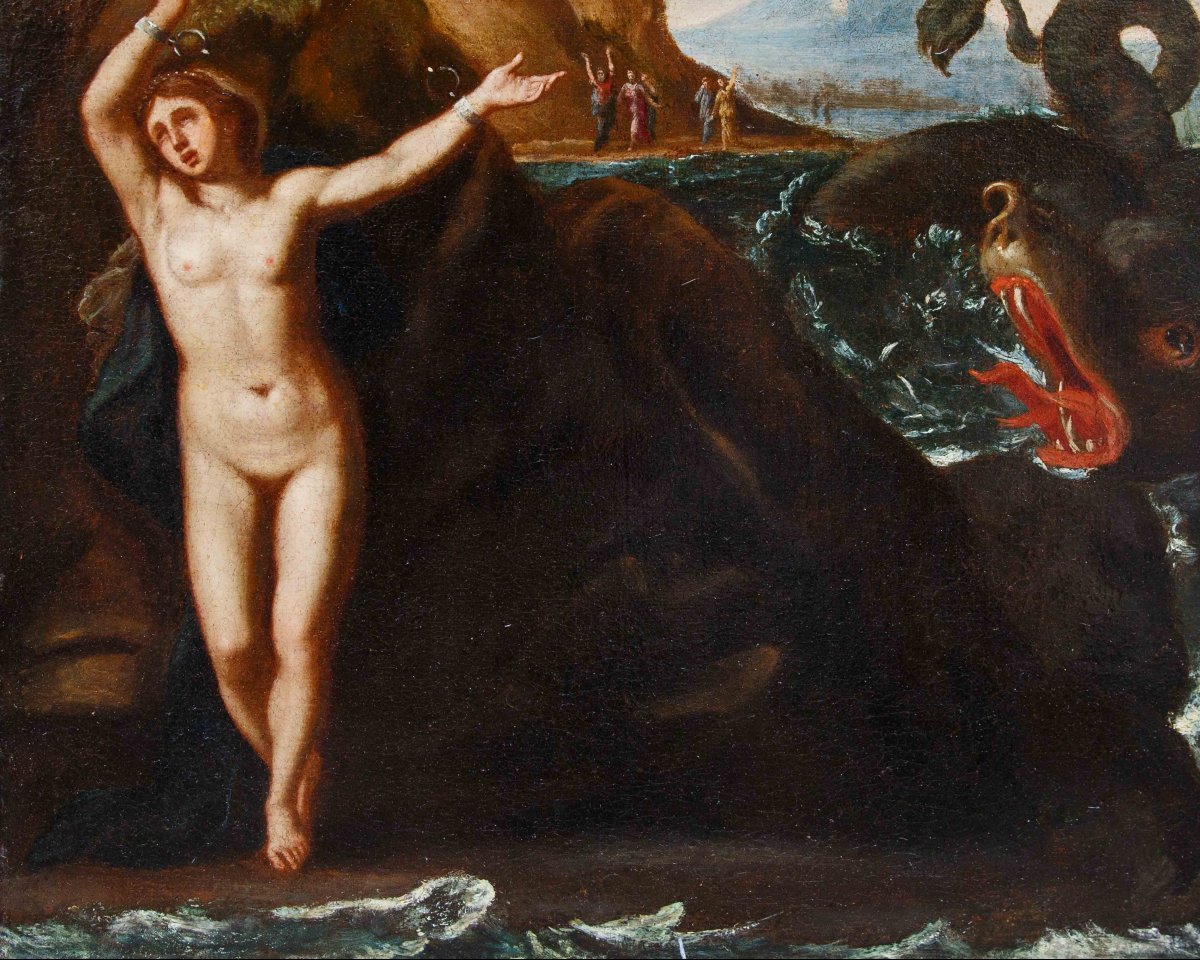


Workshop Of Domenico Zampieri, Known As Domenichino (1581–1641), *perseus Frees Andromeda*
Workshop of Domenico Zampieri, known as Domenichino (Bologna, 1581 – Naples, 1641)
Perseus Frees Andromeda
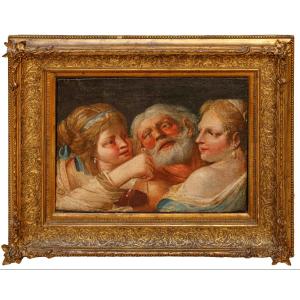
Oil on canvas, 48 x 38 cm
With frame, 60 x 49 cm
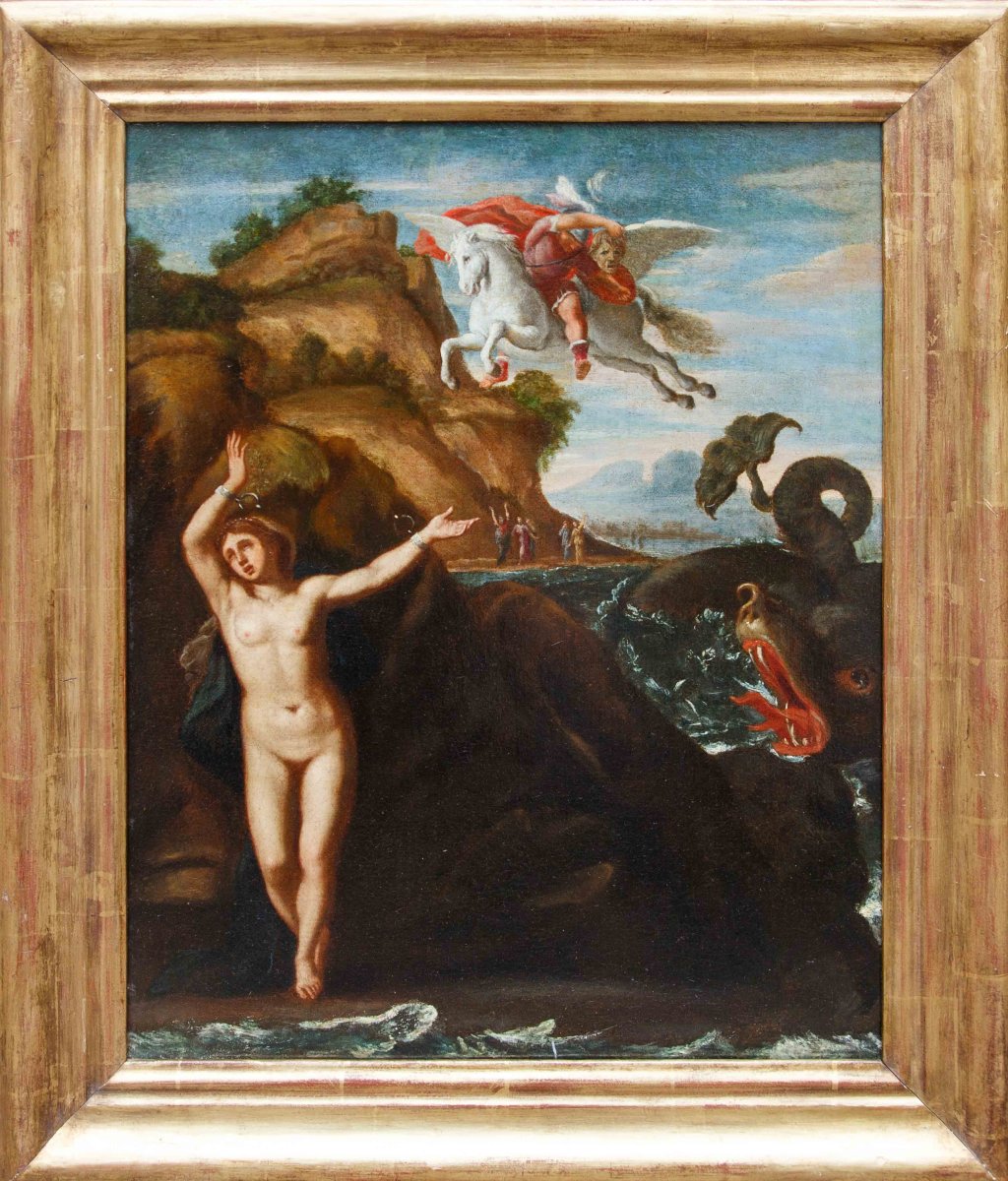
Within the vast mythological repertoire of seventeenth-century Rome, the episode of Perseus freeing Andromeda enjoyed renewed popularity: The tale, handed down by Ovid in *Metamorphoses*, tells of Andromeda, daughter of Cepheus and Cassiopeia, who was offered as a sacrifice to a sea monster sent by Neptune to punish her mother’s arrogance—Cassiopeia had boasted that her beauty surpassed that of the Nereids. Chained to a rock, the maiden is saved by Perseus, who, riding the winged horse Pegasus and fresh from slaying Medusa, defeats the monster and is rewarded with the young woman’s hand in marriage. The oil-on-canvas painting presented here captures the moment of anticipation, just before the battle: the hero plunges from the sky in his red cloak, helmet, and Medusa’s head in hand, while Andromeda stretches her chained arms toward her savior, facing the monster that emerges from the waves with its jaws wide open. In the background, the girl’s parents watch the scene from afar in despair, beneath a stormy sky and a landscape of brown rocks.
The painting, dating from the 17th century, belongs to the circle of Emilian painters active in Rome and, in particular, to the artistic legacy of Domenico Zampieri, known as Domenichino. Born in Bologna, the son of the shoemaker Giovan Pietro and Valeria, the artist first trained in the humanities before entering the studio of Denijs Calvaert, where his fellow students included Guido Reni and Francesco Albani, with whom he formed a close friendship and shared a classicist orientation. In 1601, he joined Annibale Carracci in Rome, where his career took a decisive turn. His participation in the decoration of Palazzo Farnese—led by Annibale alongside other painters who had come from Emilia—marked the culmination of his apprenticeship, which was highly regarded by the master himself. It was precisely in the Farnese Gallery that the theme of Perseus and Andromeda appeared, which Domenichino thus had the opportunity to study up close. This was followed by the frescoes depicting the Stories of Saint Nilus in Grottaferrata (1608–1610), commissioned by the commendatory abbot Odoardo Farnese, and, after Annibale’s death in 1609, his definitive establishment as one of the leading painters of the time, with a series of masterpieces on canvas for public and private patrons, such as The Communion of Saint Jerome, now in the Vatican Museums, and Timoclea Before Alexander, now in the Louvre.
Moreover, at least two versions of this composition are known to exist: one in oil on copper in a private German collection and one in oil on onyx, now in a private Milanese collection, both with a composition and iconography entirely comparable to those of our canvas: the differences are limited to minor details, such as the slightly different rendering of the mountain in the background and the arrangement of the clouds. The subject enjoyed great popularity in Rome during the height of the 17th century, as evidenced by the versions by Cavalier d’Arpino at the Rhode Island School of Design Museum and the Metropolitan Museum of Art in New York, and that by Rutilio Manetti at the Galleria Borghese.
Period: 17th century
Style: Other Style
Condition: Good condition
Material: Oil painting
Width: 38
Height: 48
Reference (ID): 1847445
Availability: In stock