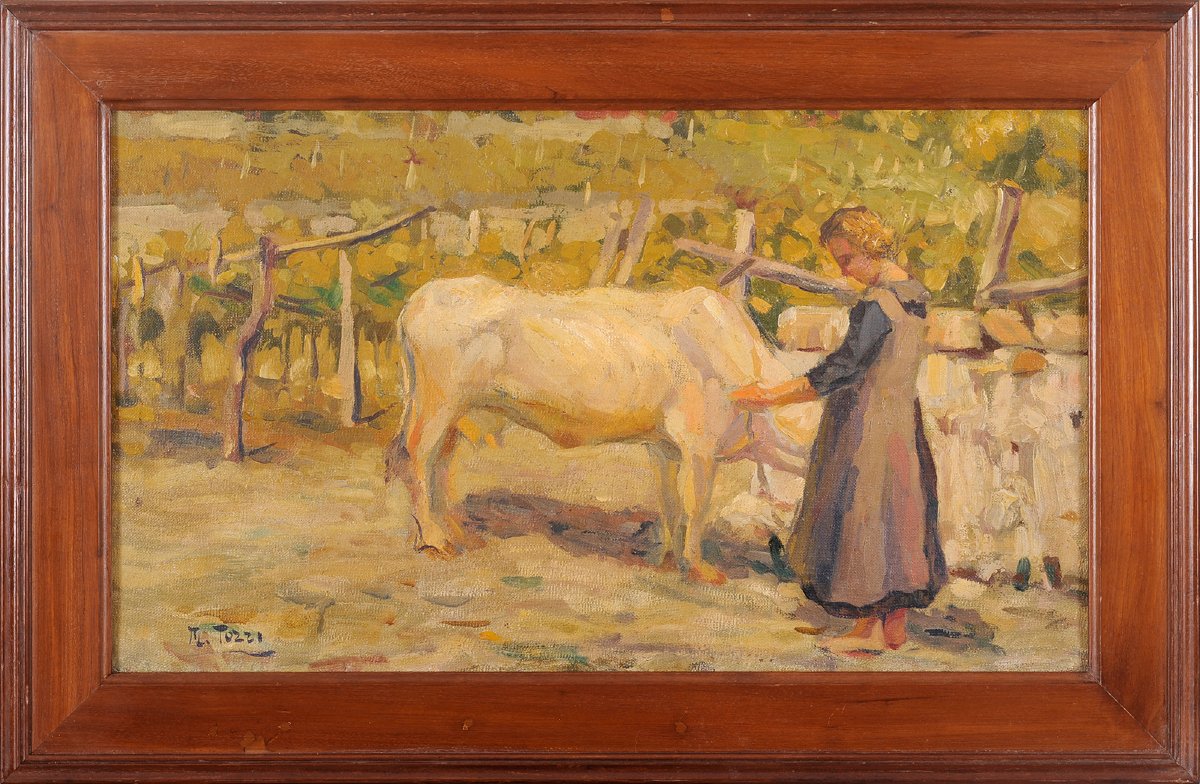
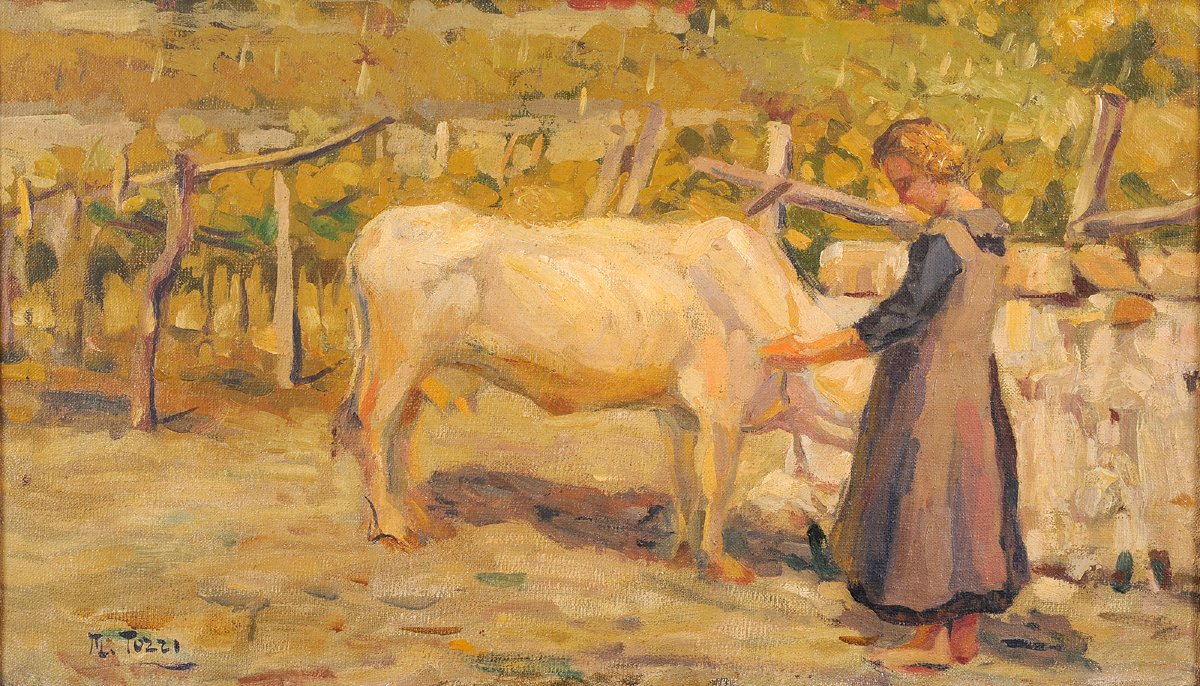


Mario Tozzi (1895–1979), *peasant Woman And Her Cow*, Ca. 1920
Artist: Mario Tozzi
Mario TOZZI
(Fossombrone, Italy 1895 – Saint-Jean-du-Gard 1979)
Peasant Woman and Her Cow
Oil on canvas
H. 34 cm; W. 58.5 cm
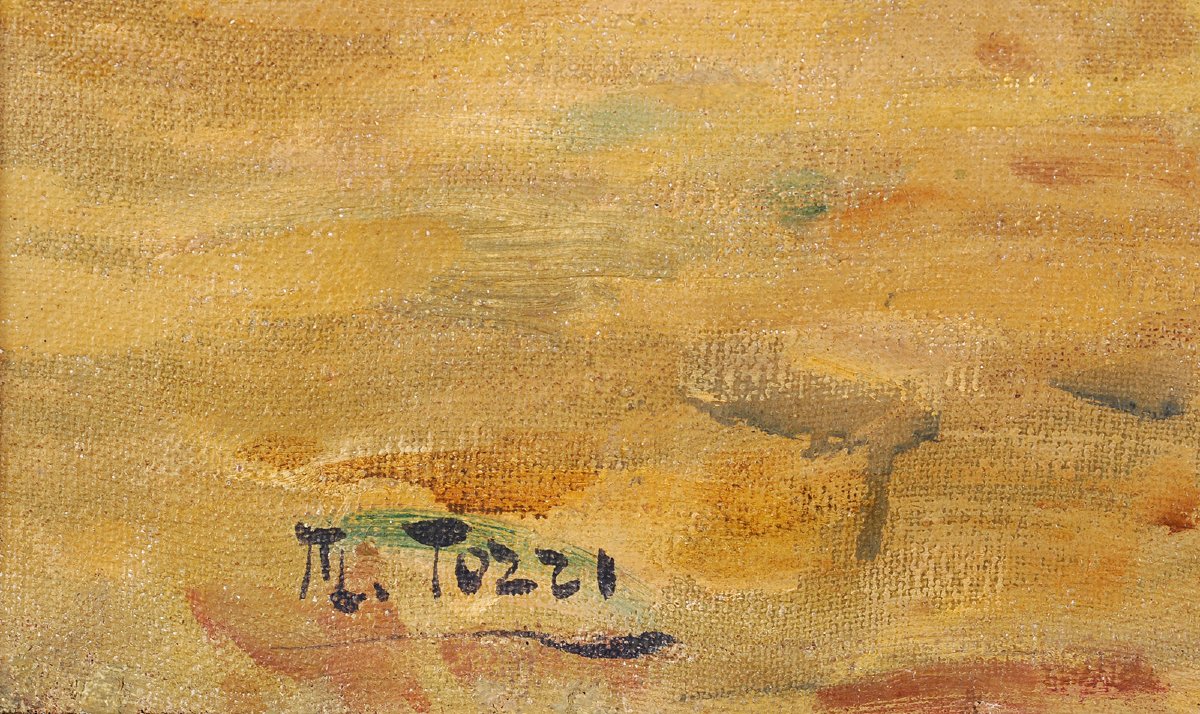
Signed lower left
Mario Tozzi was born in the Marche region of Italy. Drawn to drawing and painting from an early age, he abandoned his chemistry studies to enroll at the Academy of Fine Arts in Bologna in 1913. There, he associated with figures such as Giorgio Morandi and Osvaldo Licini—artists who would each, in their own way, contribute to the renewal of Italian painting. After graduating in 1915, Tozzi served in the First World War before resuming his artistic career once the conflict had ended.
In 1919, he married Marie-Thérèse Lemaire, who would become a significant presence in both his personal and artistic life. The couple moved to Paris in 1920, where Tozzi encountered a particularly stimulating artistic environment. He participated in the Salon des Indépendants, the Salon d’Automne, and the Salon des Tuileries, all the while developing a pictorial language that gradually moved away from the naturalism of his early work. The simplification of forms, the construction of volumes, and the pursuit of a balance between the observation of reality and idealization became the cornerstones of his oeuvre.
From the mid-1920s onward, Tozzi established himself on the European art scene. In 1926, he joined the "Group of Seven"—also known as "The Italians of Paris"—alongside Massimo Campigli, Giorgio de Chirico, Filippo de Pisis, Alberto Savinio, René Paresce, and Gino Severini. Aligned with the explorations of the *Valori Plastici* and *Novecento Italiano* movements, he developed a style of painting with classical and metaphysical undertones, characterized by monumental figures and silent, still atmospheres. Following his return to Italy in 1936, he continued his work, though serious health issues caused long interruptions to his output. He resumed painting in the late 1950s, eventually moving toward a more geometric and synthetic mode of expression.
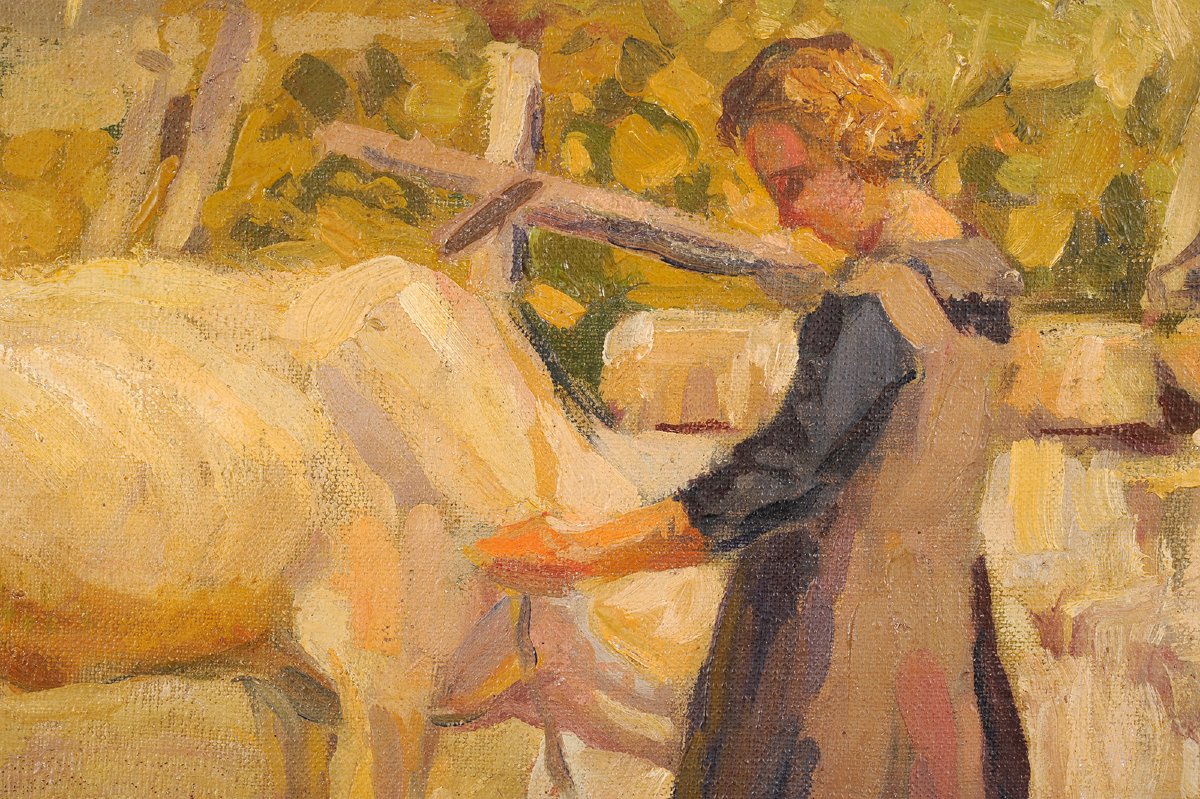
Our canvas depicts a peasant woman beside her cow, set against rows of grapevines. The scene evokes daily life in the countryside with a sense of simplicity. The composition is anchored by the cow, whose light-colored hide contrasts with the woman’s long, dark dress—all set amidst warm tones of ochre, golden yellow, brown, and green. In the background, a low wall and the stakes supporting the vines provide structure to the space. The brushwork is free and expressive; the individual strokes remain visible, prioritizing color and volume over fine detail.
Created around 1919–1920, this work dates from Mario Tozzi’s early career. It reflects his interest in rural scenes and the direct observation of nature. The way the forms are constructed reveals a keen focus on volume and compositional balance—a precursor to Tozzi’s later evolution toward the more synthetic, geometric language that would emerge fully during the 1920s. The piece thus serves as an intriguing record of his initial artistic inquiries, which, while still rooted in naturalism, already hint at a more structured approach to painting.
Envoyer des commentaires
4 200 €
Period: 20th century
Style: Modern Art
Condition: Perfect condition
Material: Oil painting
Length: 34 cm hors cadre
Width: 58,5 cm hors cadre
Reference (ID): 1845143
Availability: In stock
Print