


Charles-baptiste Schreiber (1847-1902) Pompeii The Way Of The Tombs - Via Dei Sepolcri
Artist: Charles-baptiste Schreiber
Charles-Baptiste Schreiber
(Paris, 1847 – Paris, 1902)
Pompeii, the Way of the Tombs (Via dei Sepolcri)
Oil on canvas
H. 26 cm; W. 35 cm
Located and dated lower right
June 1875
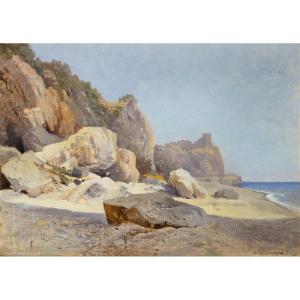
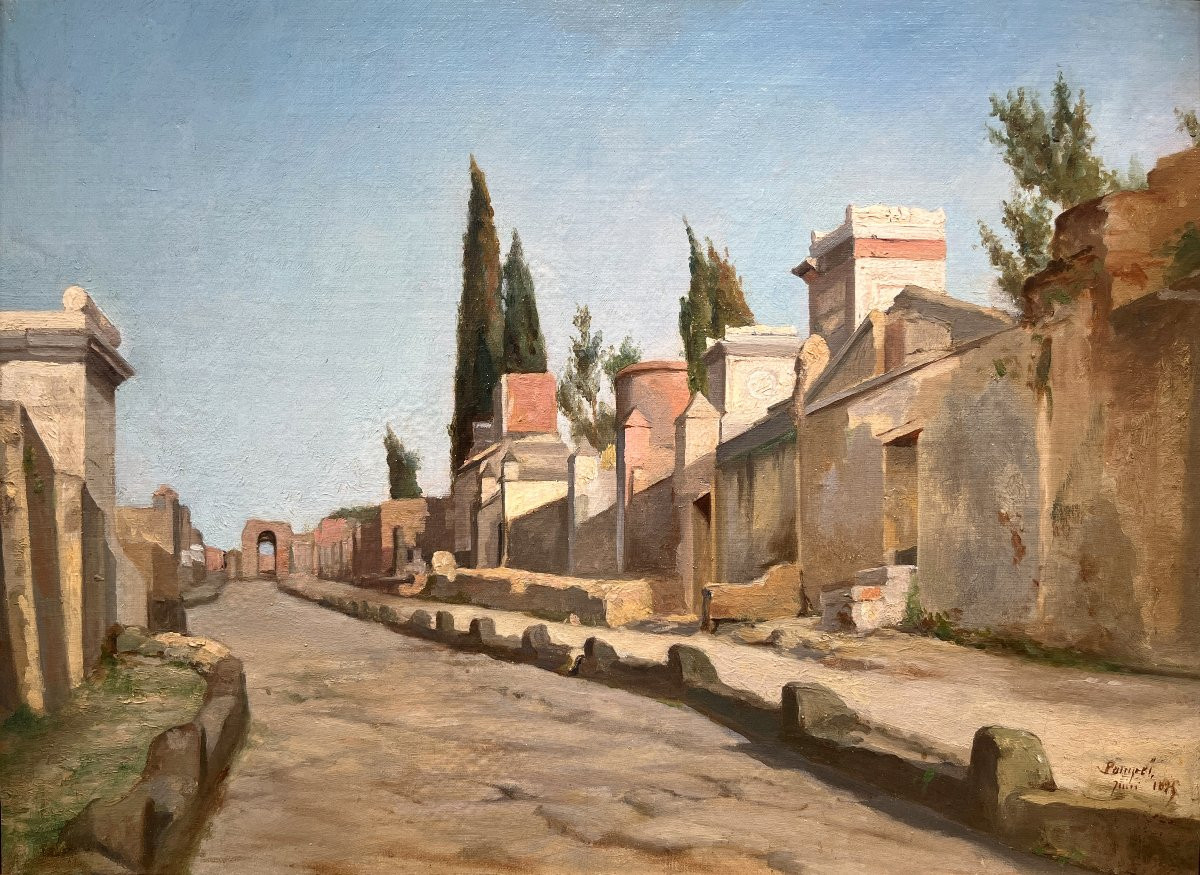
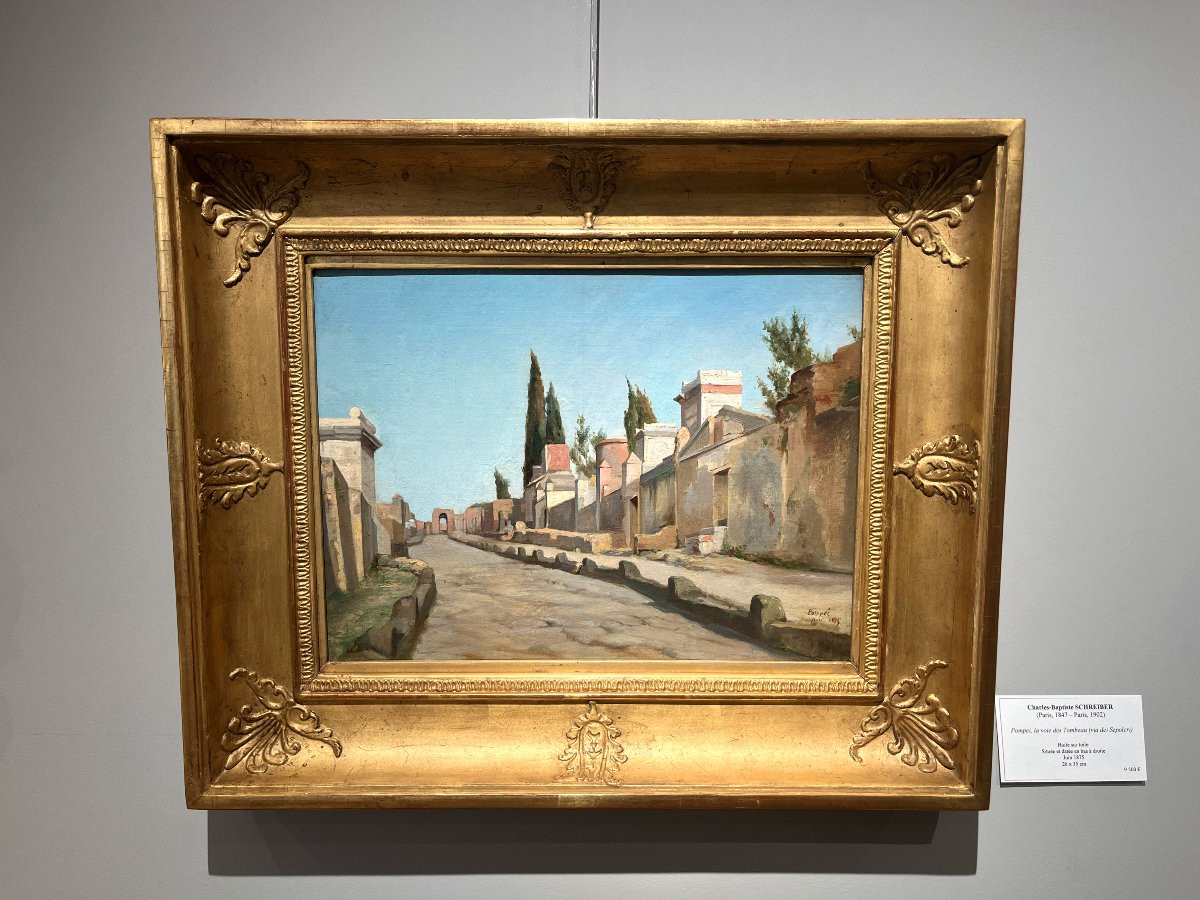
Situated in the northwestern suburbs of Pompeii, the so-called Way of the Tombs begins at the city gate and extends towards Herculaneum for nearly 250 meters. Apart from funeral celebrations, the Pompeians enjoyed strolling among the tombs in the shade of the cypress trees, or sitting on the tombstones and playing dice or knucklebones. In our painting, the viewpoint is from north to south; on the left, the junction with the Via Superiore can be seen. In the background stands the silhouette of the Herculaneum Gate, which provides entry into Pompeii proper, with, a little further on to the right, Cicero's villa. This view was rather seldom depicted by painters at the beginning of the 19th century, even though Prosper Barbot and Caruelle d'Aligny made a few sketches of it, respectively in 1821 and 1822; on the other hand, at the end of the century, it was very often chosen by photographers. In 1843, Alexandre Dumas gave a lovely description of it in Le Corricolo: "This street of tombs is a magnificent peristyle for entering a dead city; Then all these funerary monuments, placed on both sides of the consular road at the end of which the Pompeii gate gapes open, not rising above the layer of sand that covered them, have remained intact as on the day they came from the artist's hands: only time has deposited on them, in passing, that beautiful dark tint, that varnish of centuries which is the supreme beauty of all architecture.” Our luminous painting, with its only horizon an immaculate blue sky covering an assemblage of buildings with almost geometric forms, evokes at first glance the plein air studies carried out by Corot and his friends in the years 1825-1830, and in particular Caruelle d'Aligny; it also bore an apocryphal red signature “COROT” in the lower right corner. But its author, Charles-Baptiste Schreiber, was in fact a student of Edouard Brandon (1831-1897), the latter better known for his synagogue interiors and portraits of rabbis, but who stayed in Rome, Italy, between 1856 and 1863, and produced traditional scenes with luminous skies, with which the style of our work shares some reminiscences. From humble origins, Schreiber used his artistic talents to produce "bread and butter" paintings between the ages of 11 and 15, his first teacher being his godfather. In 1862, he decided to pursue a more academic training by enrolling for six years at the École Nationale de Dessin (National School of Drawing), where he received guidance from the sculptor Pierre-Louis Rouillard. It was in 1869 that he became Brandon's pupil, who guided him to his first success at the Salon of 1870 (he had already exhibited two portraits, including his own, in 1868), with a painting entitled "Pious Reading"; this painting allowed him to meet Léon Bonnat, who wished to become his teacher. In 1873, Schreiber left for Italy to further study the masters, a stay that would last three years. Based in Rome, he visited the Naples region in the spring of 1875; Apart from our painting, we know of another view of Pompeii, dated May 31, 1875, and one of Capri, dated June 12, 1875. But it is picturesque and poetic Italian subjects, similar to the genre scenes of Brandon, that he sent to the Salons of 1874, 1876, 1877, 1878 and 1879. His career was now launched, and Schreiber would exhibit at every edition of the Salon until his death, more than fifty works in total, essentially genre scenes representing ecclesiastics, which place him alongside painters like Jean-Georges Vibert or Henri Brispot.
(Paris, 1847 – Paris, 1902)
Pompeii, the Way of the Tombs (Via dei Sepolcri)
Oil on canvas
H. 26 cm; W. 35 cm
Located and dated lower right
June 1875
Situated in the northwestern suburbs of Pompeii, the so-called Way of the Tombs begins at the city gate and extends towards Herculaneum for nearly 250 meters. Apart from funeral celebrations, the Pompeians enjoyed strolling among the tombs in the shade of the cypress trees, or sitting on the tombstones and playing dice or knucklebones. In our painting, the viewpoint is from north to south; on the left, the junction with the Via Superiore can be seen. In the background stands the silhouette of the Herculaneum Gate, which provides entry into Pompeii proper, with, a little further on to the right, Cicero's villa. This view was rather seldom depicted by painters at the beginning of the 19th century, even though Prosper Barbot and Caruelle d'Aligny made a few sketches of it, respectively in 1821 and 1822; on the other hand, at the end of the century, it was very often chosen by photographers. In 1843, Alexandre Dumas gave a lovely description of it in Le Corricolo: "This street of tombs is a magnificent peristyle for entering a dead city; Then all these funerary monuments, placed on both sides of the consular road at the end of which the Pompeii gate gapes open, not rising above the layer of sand that covered them, have remained intact as on the day they came from the artist's hands: only time has deposited on them, in passing, that beautiful dark tint, that varnish of centuries which is the supreme beauty of all architecture.” Our luminous painting, with its only horizon an immaculate blue sky covering an assemblage of buildings with almost geometric forms, evokes at first glance the plein air studies carried out by Corot and his friends in the years 1825-1830, and in particular Caruelle d'Aligny; it also bore an apocryphal red signature “COROT” in the lower right corner. But its author, Charles-Baptiste Schreiber, was in fact a student of Edouard Brandon (1831-1897), the latter better known for his synagogue interiors and portraits of rabbis, but who stayed in Rome, Italy, between 1856 and 1863, and produced traditional scenes with luminous skies, with which the style of our work shares some reminiscences. From humble origins, Schreiber used his artistic talents to produce "bread and butter" paintings between the ages of 11 and 15, his first teacher being his godfather. In 1862, he decided to pursue a more academic training by enrolling for six years at the École Nationale de Dessin (National School of Drawing), where he received guidance from the sculptor Pierre-Louis Rouillard. It was in 1869 that he became Brandon's pupil, who guided him to his first success at the Salon of 1870 (he had already exhibited two portraits, including his own, in 1868), with a painting entitled "Pious Reading"; this painting allowed him to meet Léon Bonnat, who wished to become his teacher. In 1873, Schreiber left for Italy to further study the masters, a stay that would last three years. Based in Rome, he visited the Naples region in the spring of 1875; Apart from our painting, we know of another view of Pompeii, dated May 31, 1875, and one of Capri, dated June 12, 1875. But it is picturesque and poetic Italian subjects, similar to the genre scenes of Brandon, that he sent to the Salons of 1874, 1876, 1877, 1878 and 1879. His career was now launched, and Schreiber would exhibit at every edition of the Salon until his death, more than fifty works in total, essentially genre scenes representing ecclesiastics, which place him alongside painters like Jean-Georges Vibert or Henri Brispot.
9 500 €
Period: 19th century
Style: Louis Philippe, Charles 10th
Condition: Perfect condition
Material: Oil painting
Length: 26 cm hors cadre
Width: 35 cm hors cadre
Reference (ID): 1717259
Availability: In stock
Print