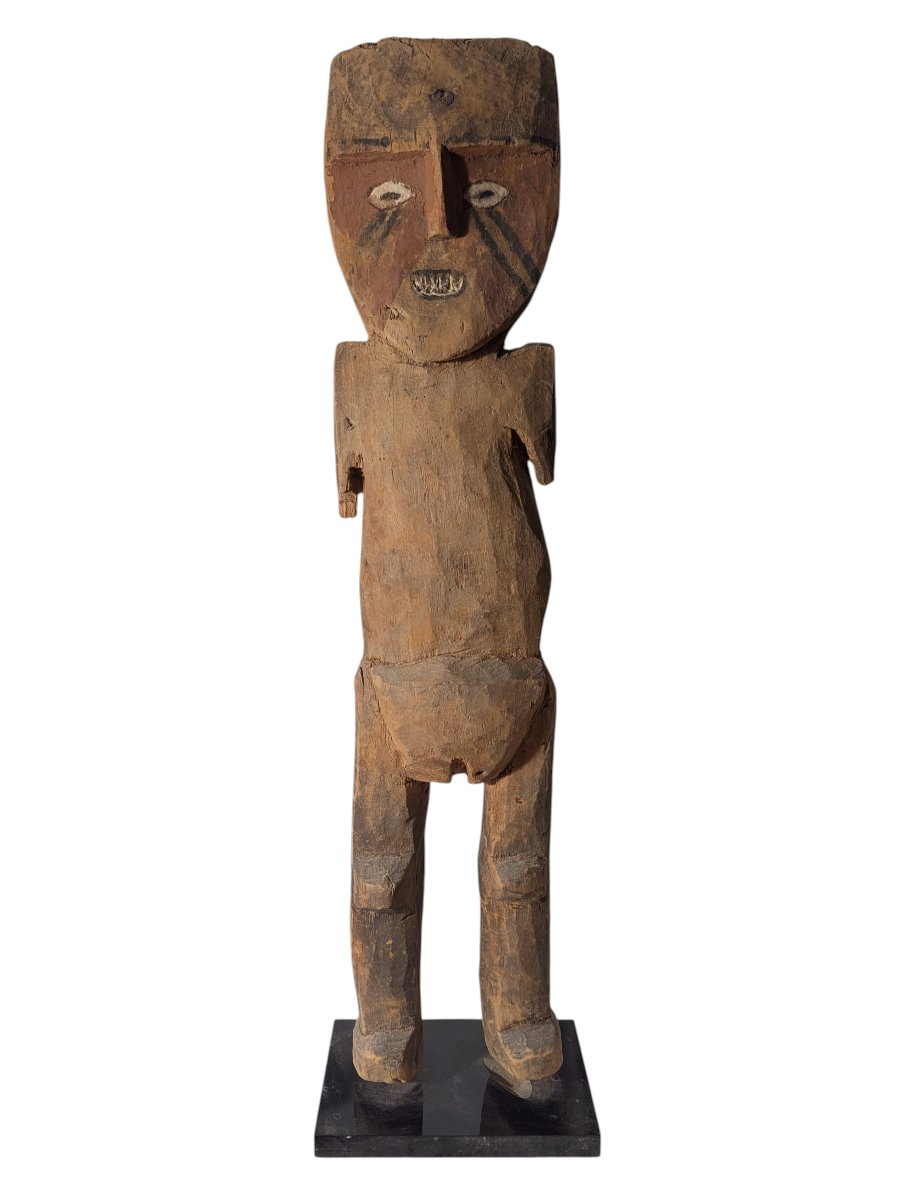




Polychrome Wooden Anthropomorphic Female Statue—peru, Northern Coast, Chimú—c. 1100–1470
Polychrome wooden anthropomorphic female statue – Peru, northern coast, Chimú style, Late Intermediate Period (c. 1100–1470)
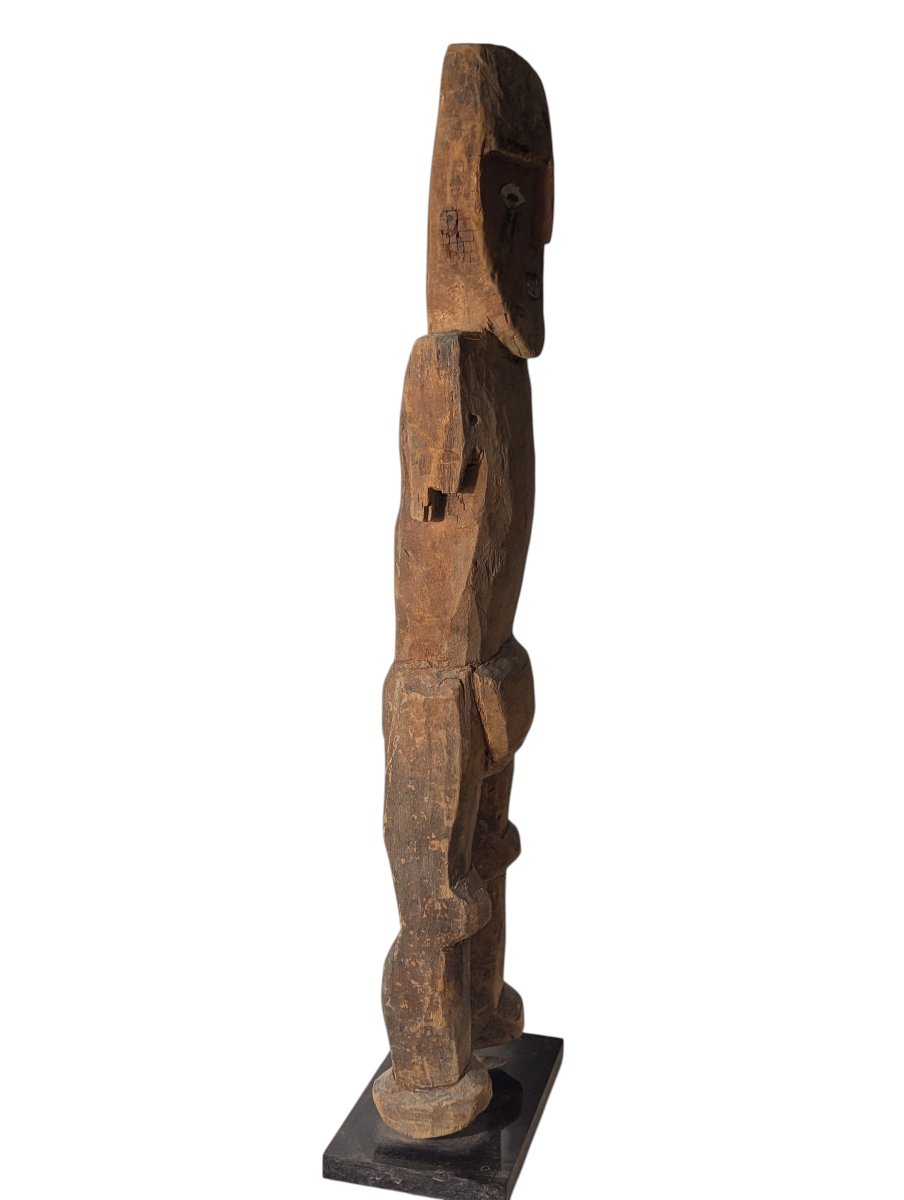
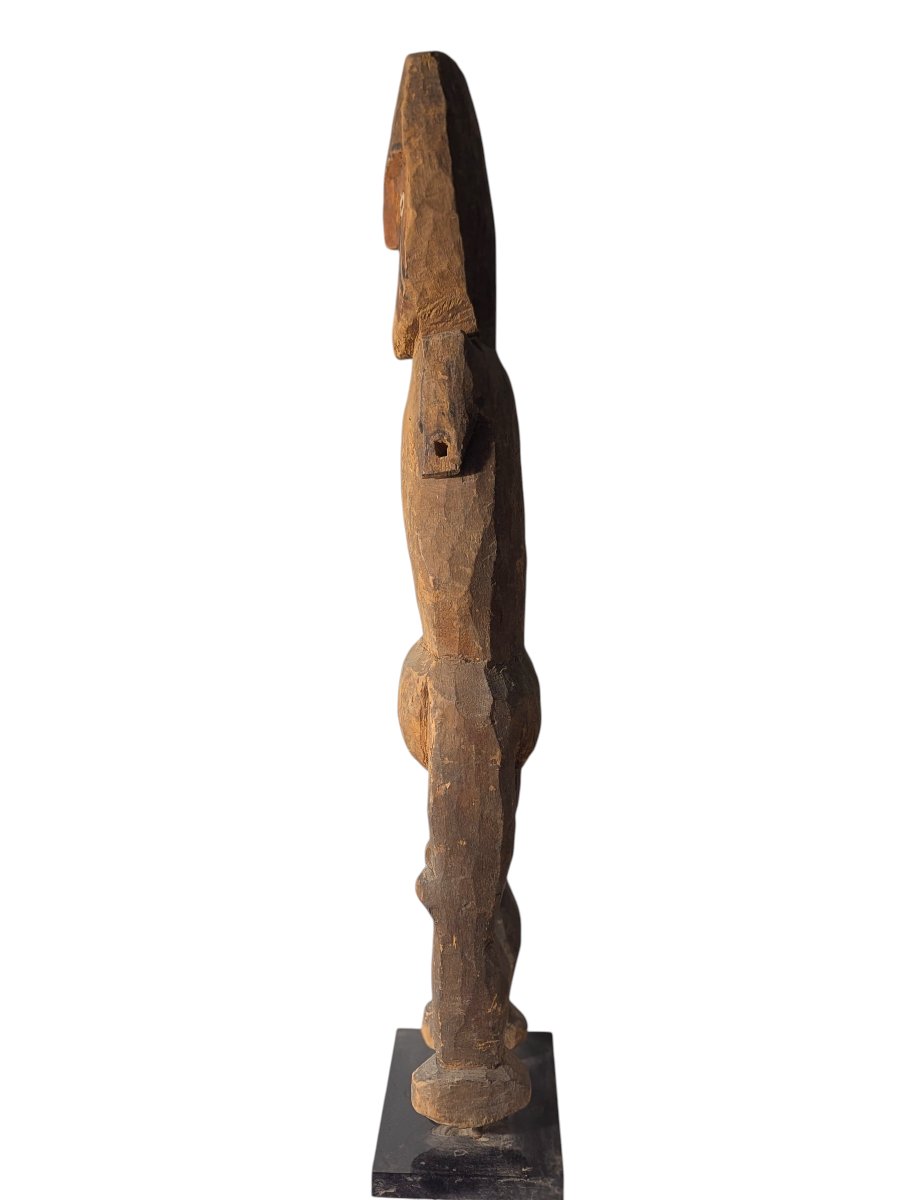
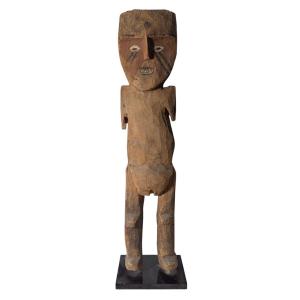
Large standing female figure, carved from a single block of hardwood in the shape of a thick plank: broad from the front, narrow in profile.
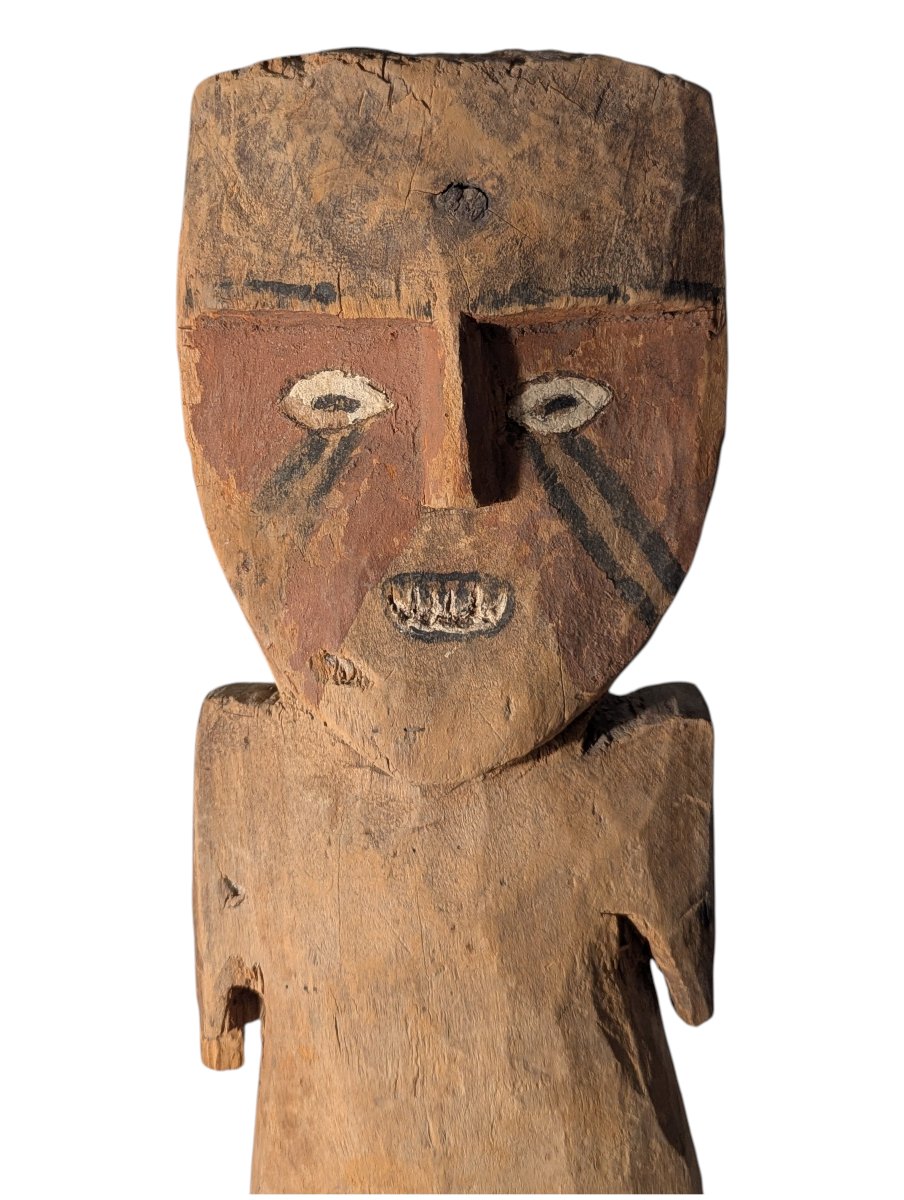
The flat, spatula-shaped head occupies nearly one-third of the figure’s height. Its horizontal top resembles a headdress or forehead band, closed by a black line at eyebrow level. The face wears a mask painted in a matte earthy red, shaped like a trapezoid, from which a protruding rectangular nose stands out, forming a T-shape with the brow ridge. The eyes are painted white, outlined in black, with almond-shaped pupils. Two diagonal black stripes extend from each eye down toward the jaw: either ritual facial paint or “tears.” The mouth is a hollowed-out oval where the teeth, carved in relief, are highlighted in white. The temples are pierced where the ears would be, likely to attach ornaments that are now missing. The forehead also has a perforation.
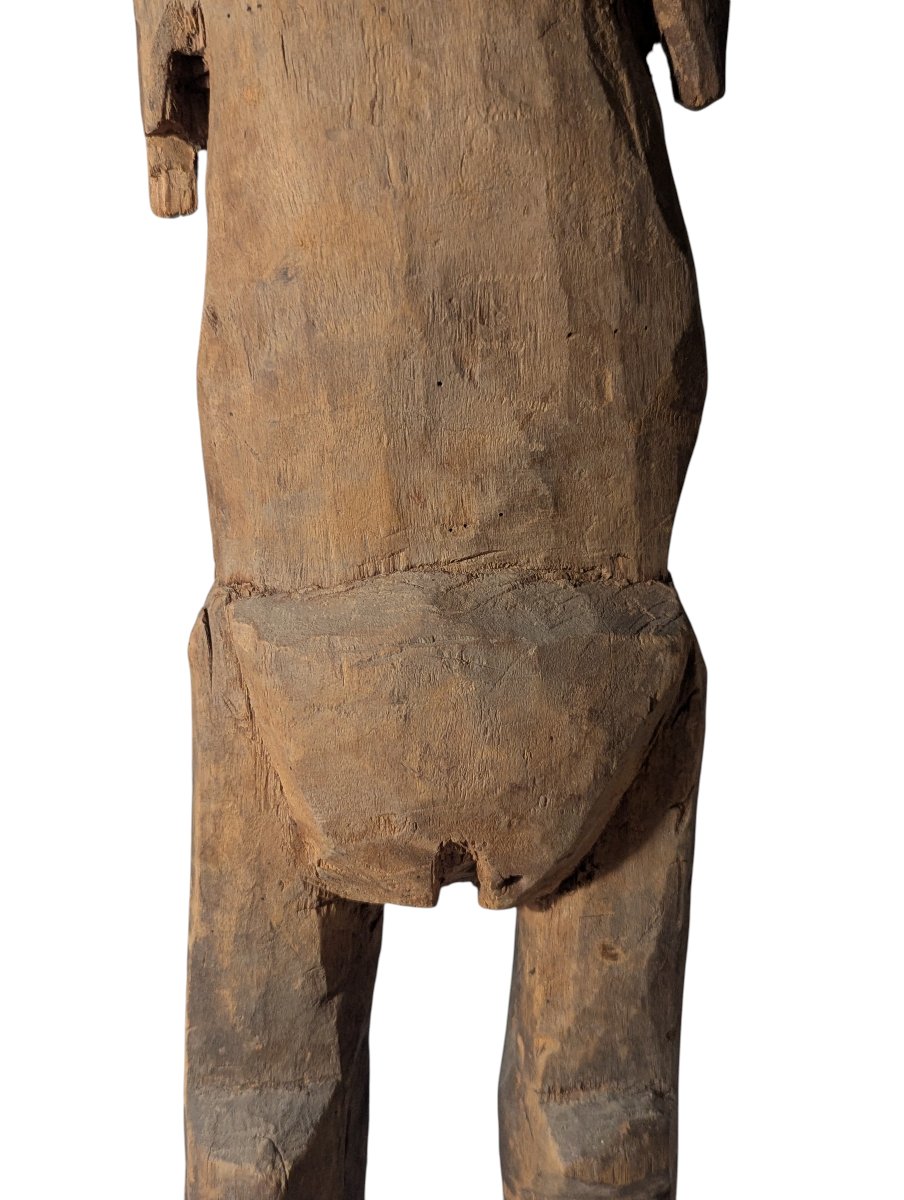
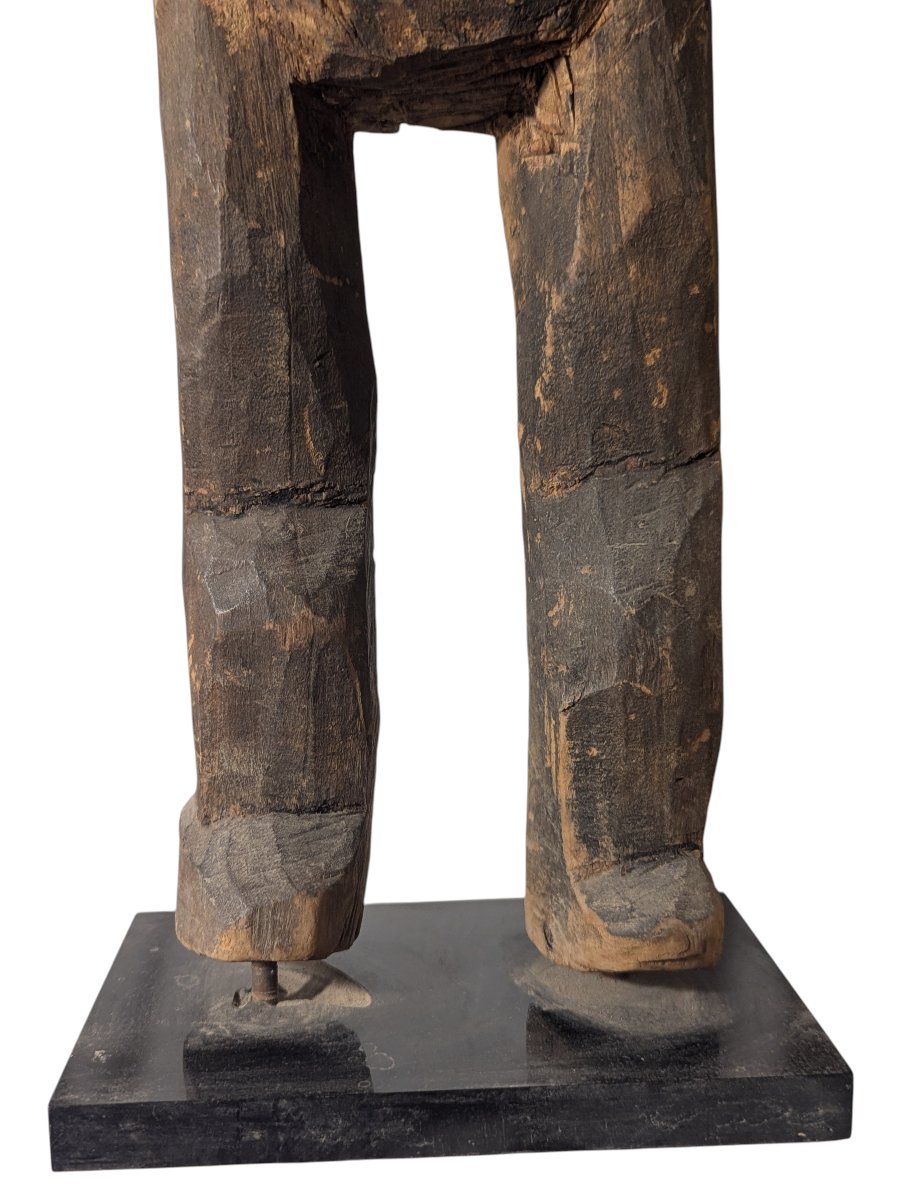
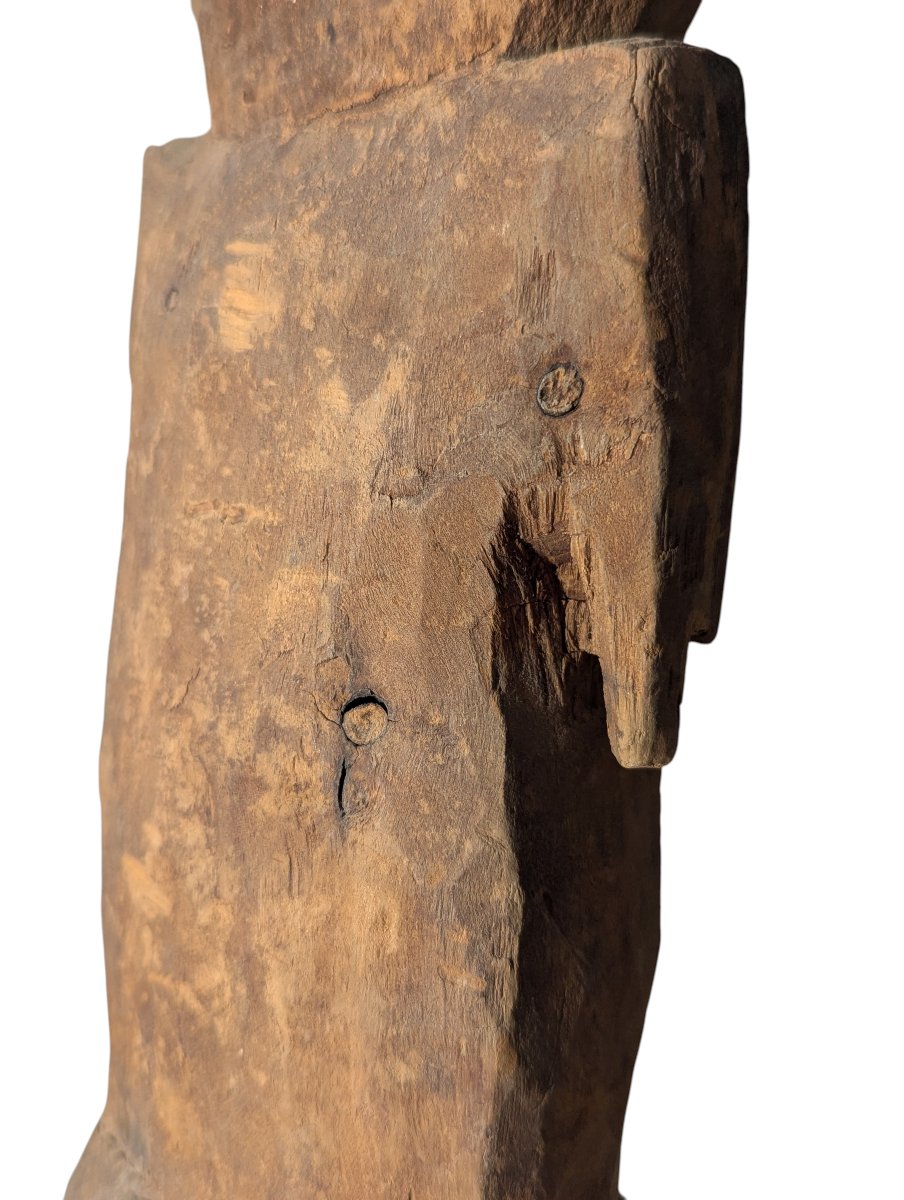
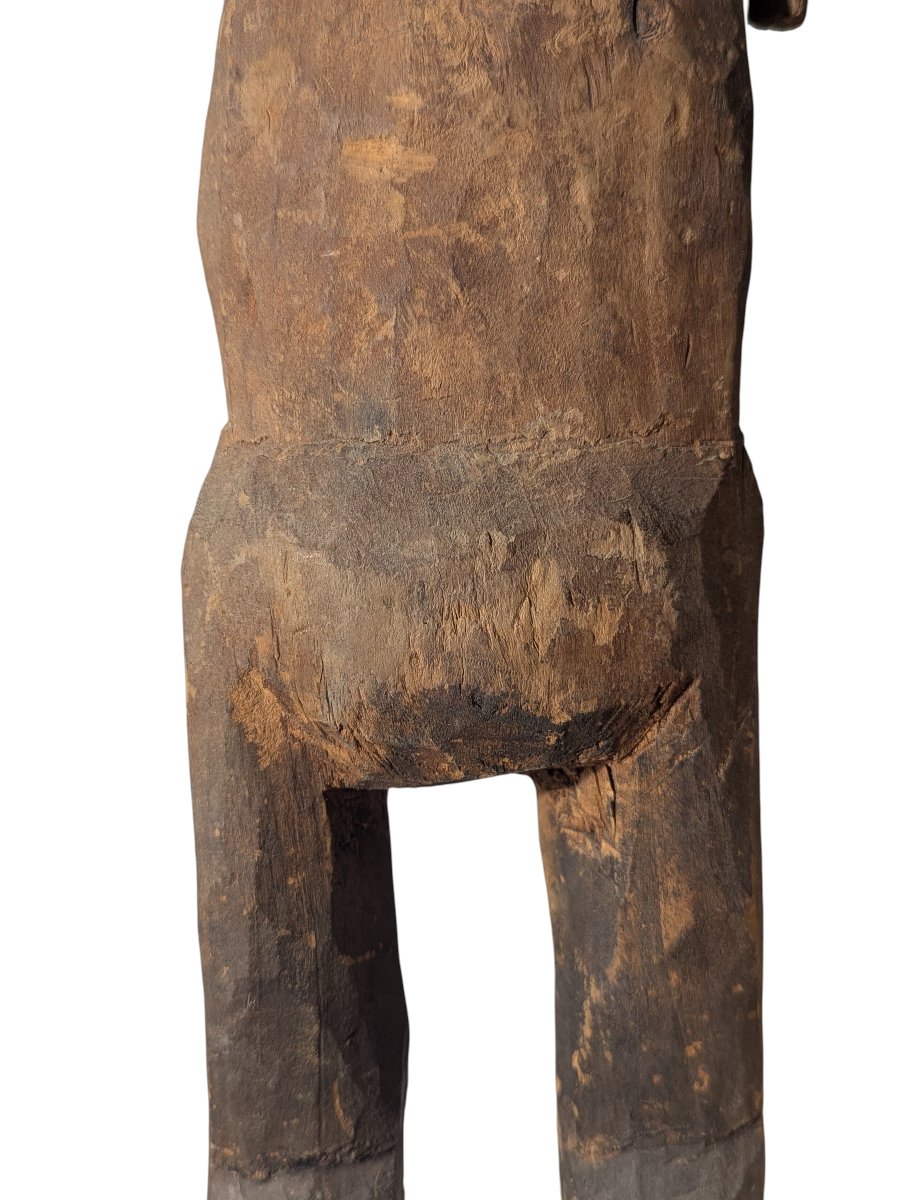
The head rests directly on square shoulders. The arms are reduced to stumps attached to the torso. The forearms project forward and end in a mortise: they were intended to hold hands or an attached attribute. The lower abdomen forms a raised triangle, marked by a vertical incision representing the vulva and clearly indicating a female figure. The legs are long, separated by a distinct recess, and rest on massive, disc-shaped feet. The back is flat, as befits a figure intended to be viewed from the front, in a niche or a burial site. It bears several flush wooden pegs.
Uniform patina of age. Below the knees, the wood is grayer and more eroded, suggesting prolonged partial burial. Old, cube-shaped rot on one side of the head, with visible shrinkage cracks and missing sections. Displayed on a modern base.
Its typology links this figure to the statues of guardians and funeral attendants from the Chimú culture. The most famous is the statuette in the Art & History Museum in Brussels (inv. AAM 5713), which is of nearly identical height (55 cm). Curator Henri Lavachery purchased it in Lima in 1934 and exhibited it the following year. Hergé used it as the famous arumbaya fetish in The Broken Ear, the object stolen from the museum that kicks off Tintin’s fifth adventure. It can also be compared to the figure at the Museum of Fine Arts in Houston (inv. 2001.1149, 55.9 cm) and those at the Metropolitan Museum of Art in New York (inv. 1979.206.346).
Dimensions
Height: 57 cm
Provenance
Armand Avril (1926–2025) Collection, a painter and sculptor from Lyon.
Born in Lyon in 1926, Armand Avril discovered his artistic calling after World War II. Introduced to art, painting, and African art by his father—a member of Lyon’s artistic avant-garde in the 1930s—he was nonetheless self-taught.
After spending his youth playing rugby, he developed a unique body of work, hailed from the very beginning by gallery owner Paul Gauzit, who already saw in it a style “marked by primitive arts, timeless.” The critic Jean-Jacques Lerrant wrote that Avril brought out “in wood and cork not only their nobility but also their quirkiness.” Today, Armand Avril’s works are included in the collections of the Musée des Beaux-Arts de Lyon, where they are displayed in the section dedicated to the Moderns, as well as in the finest private collections, such as those of the late Jacques Gairard and Antoine de Galbert.
Period: Before 16th century
Style: Tribal Art
Condition: Good condition
Material: Painted wood
Height: 57
Reference (ID): 1842020
Availability: In stock