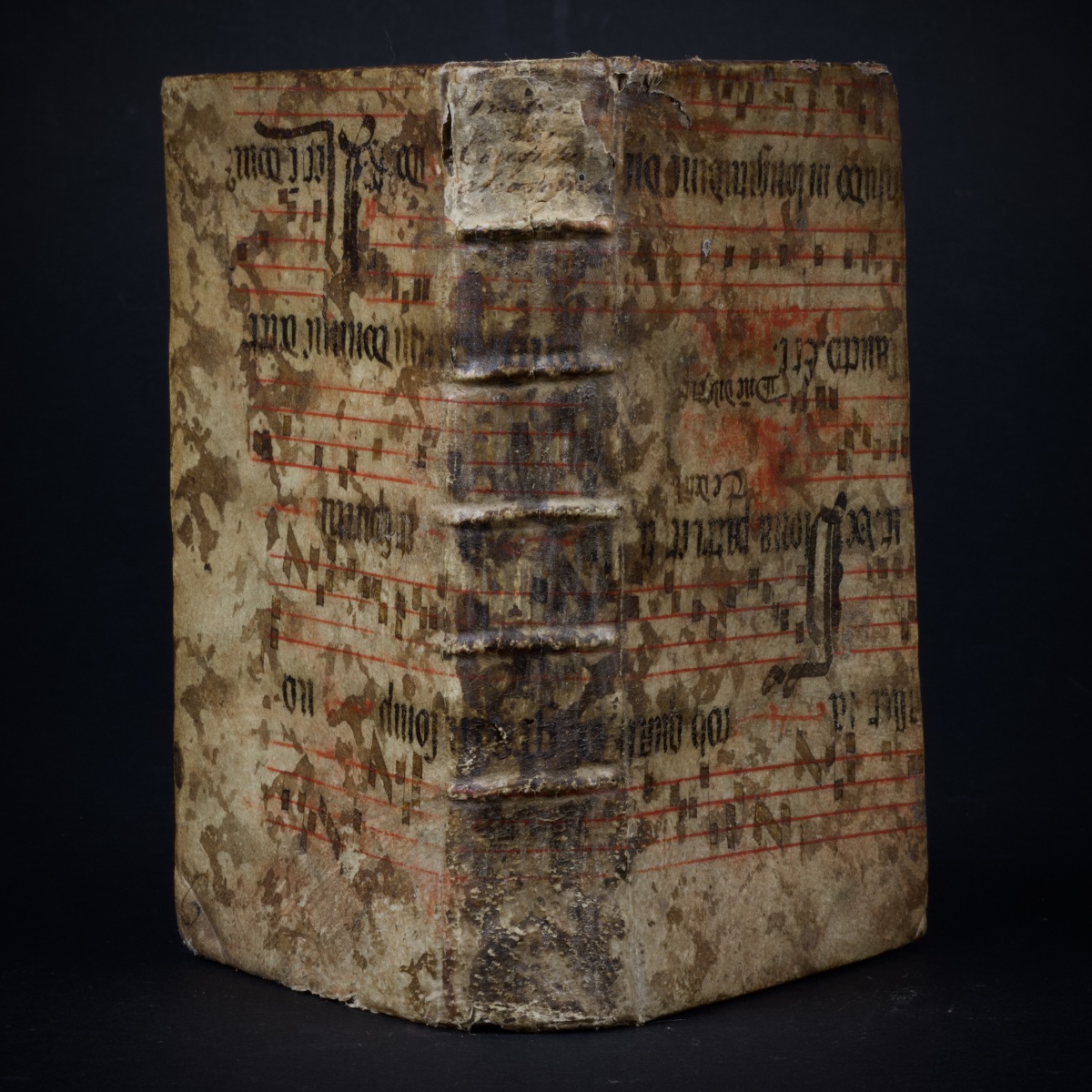


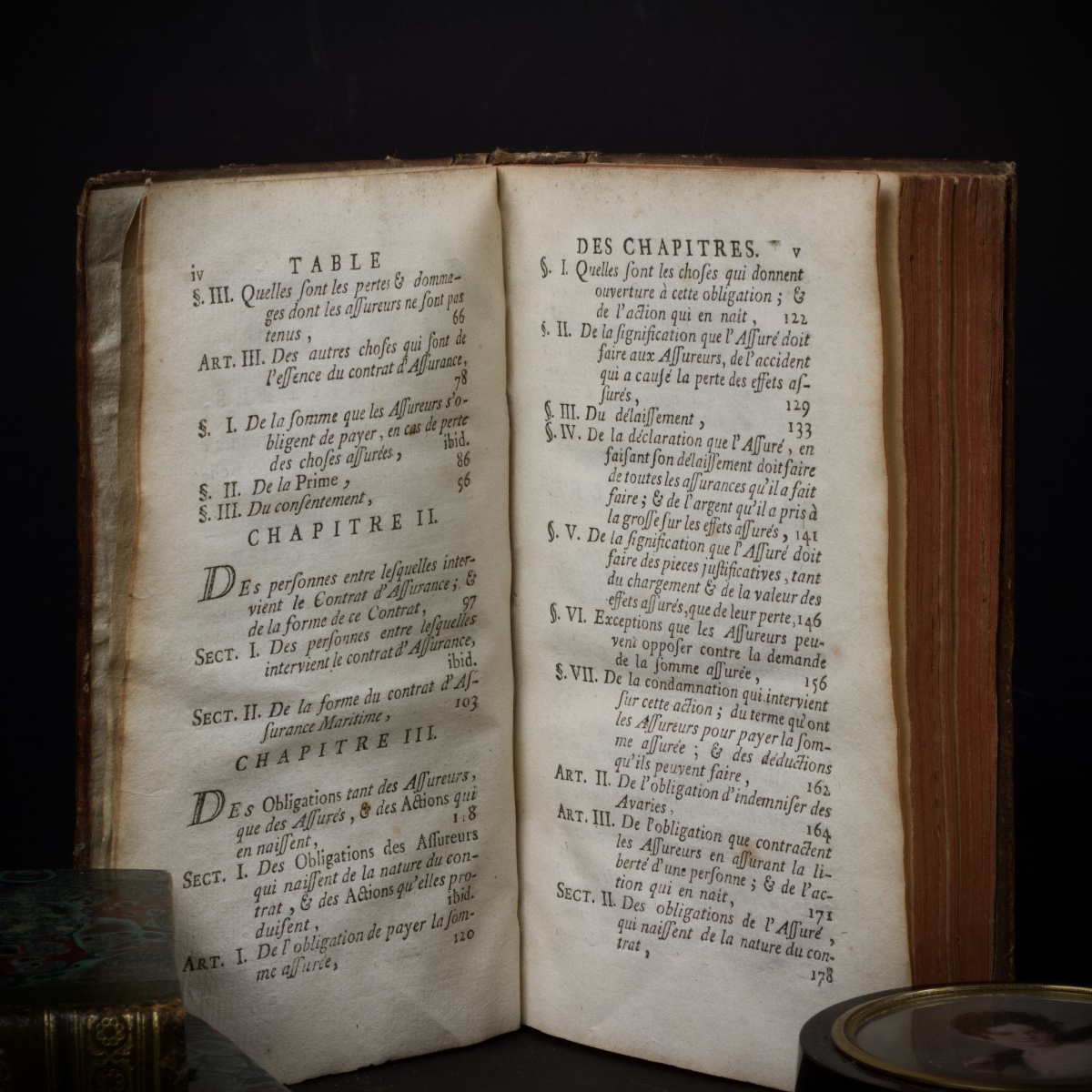

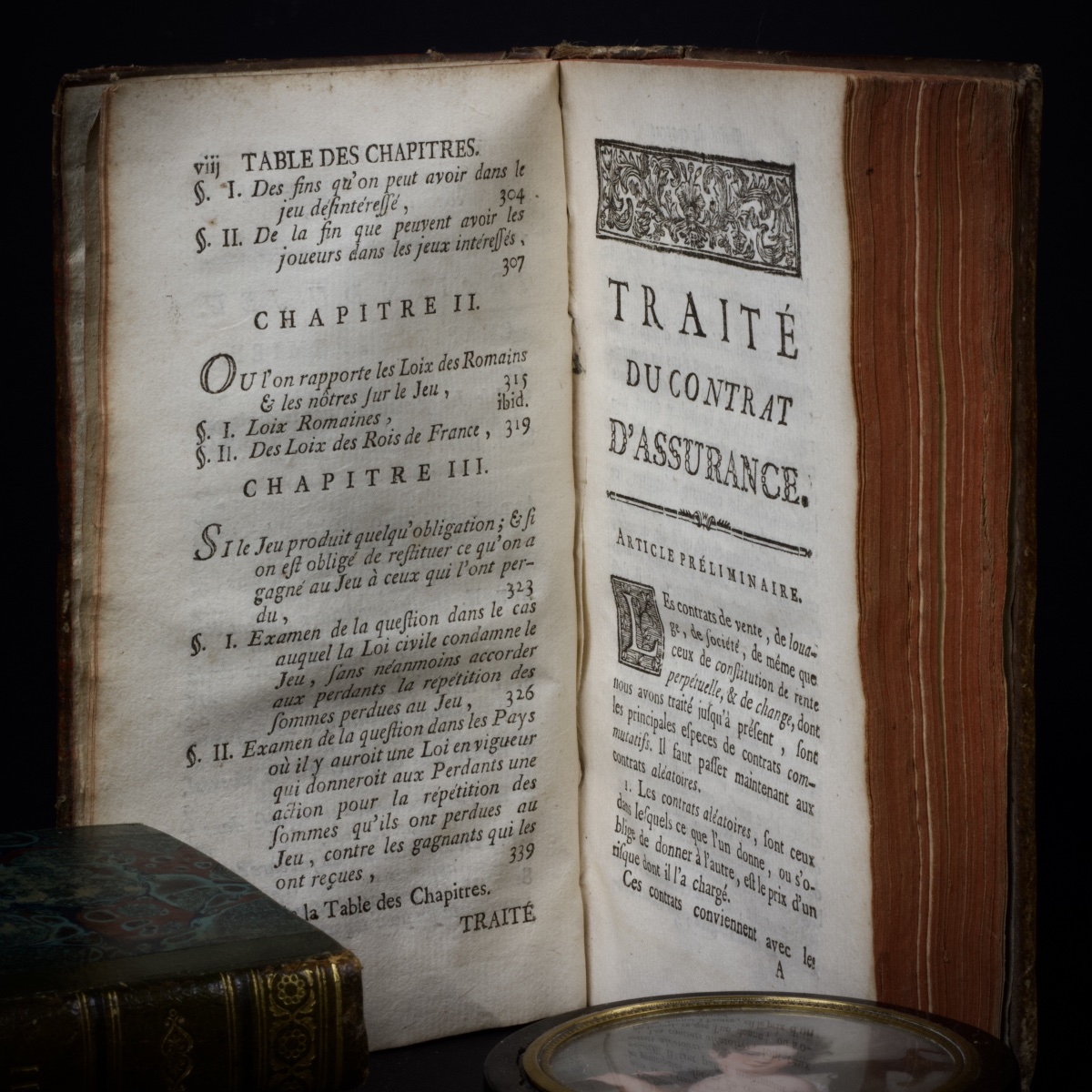




Pothier, *treatise On Contingent Contracts*, 1775, Reused Binding, 15th-century Antiphonary Page.
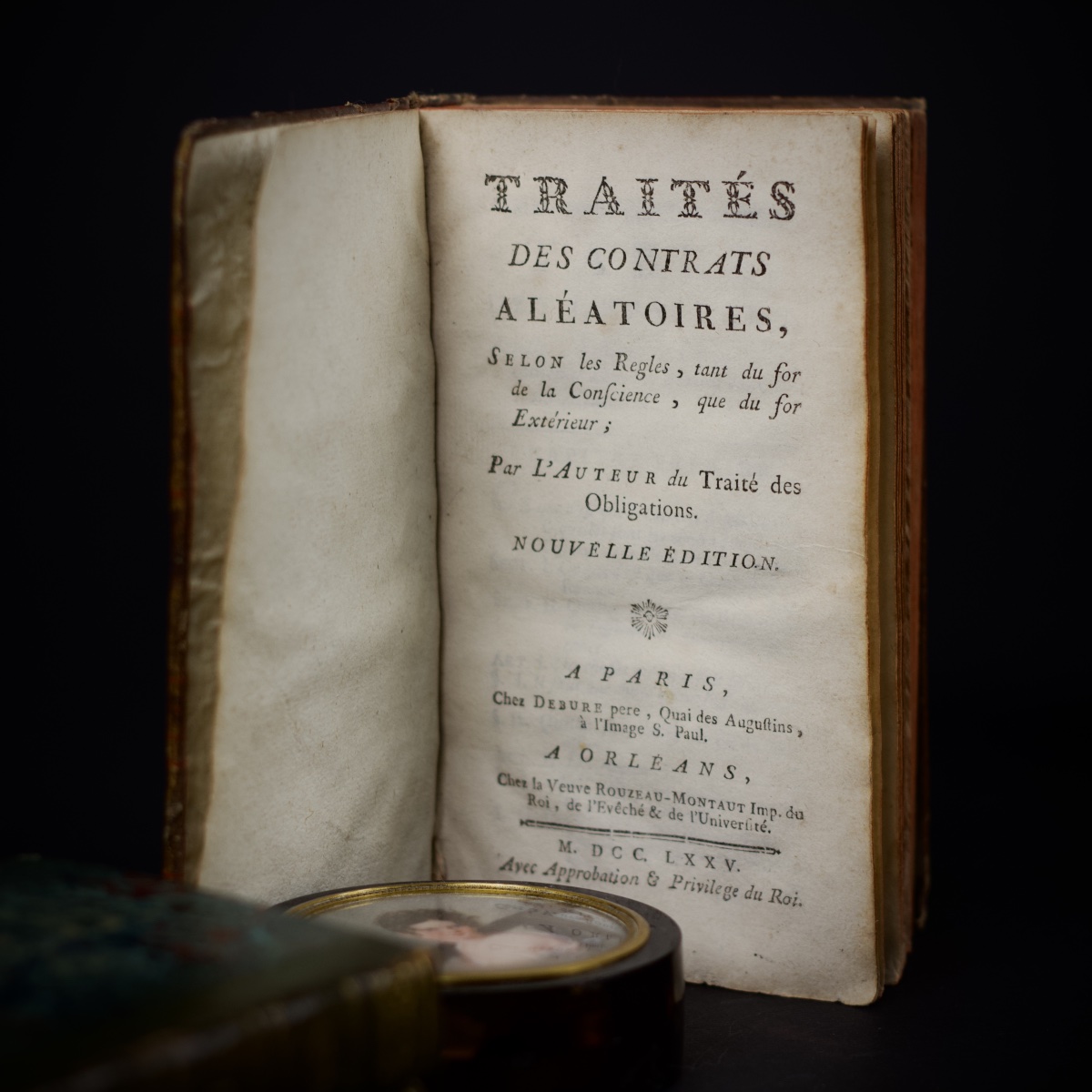
Robert-Joseph POTHIER, Treatise on Contingent Contracts, According to the Rules of Both the Forum of Conscience and the External Forum, New Edition, Paris, Published by Debure/Orléans, Published by the Widow Rouzeau-Montaut, 1775, in-12 format.
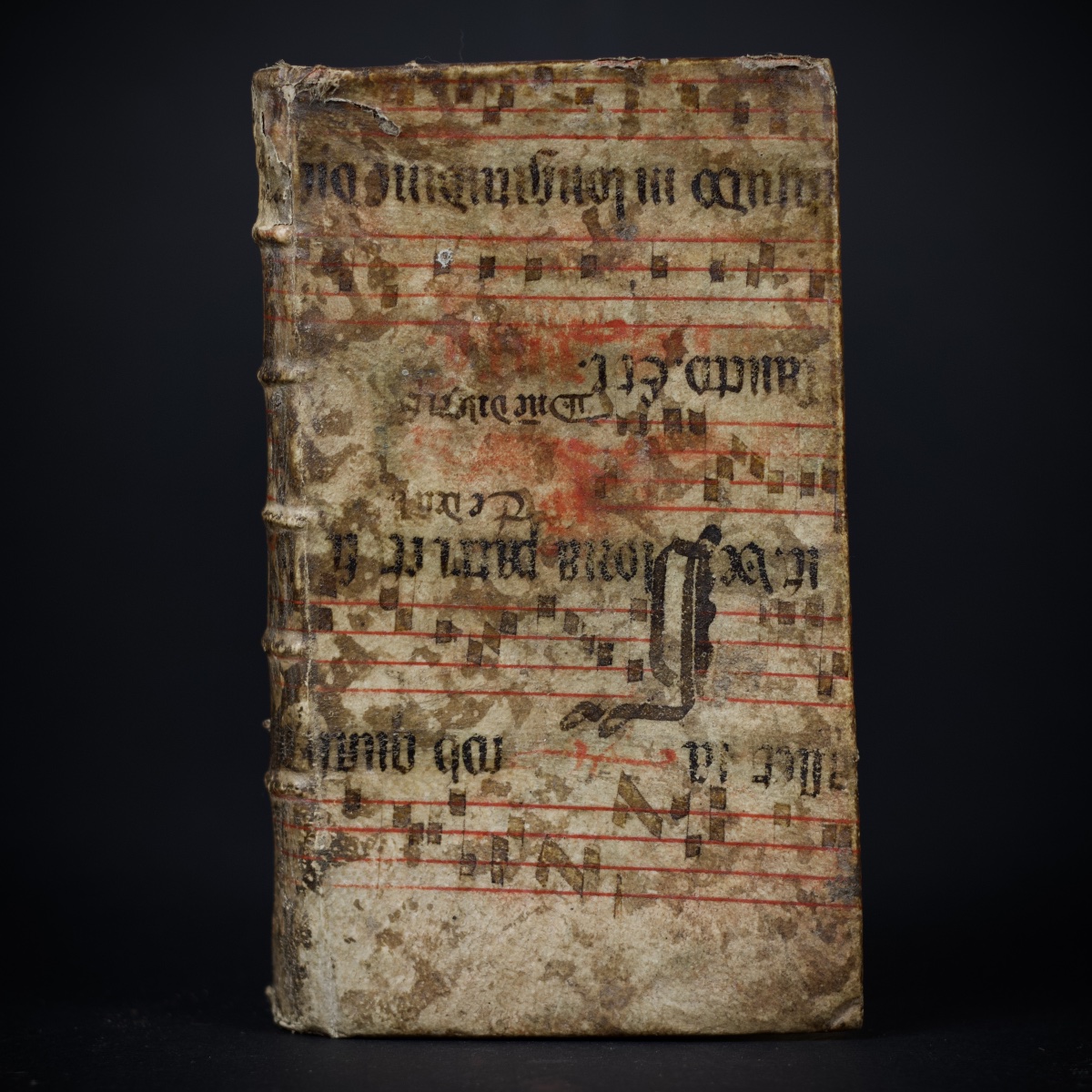
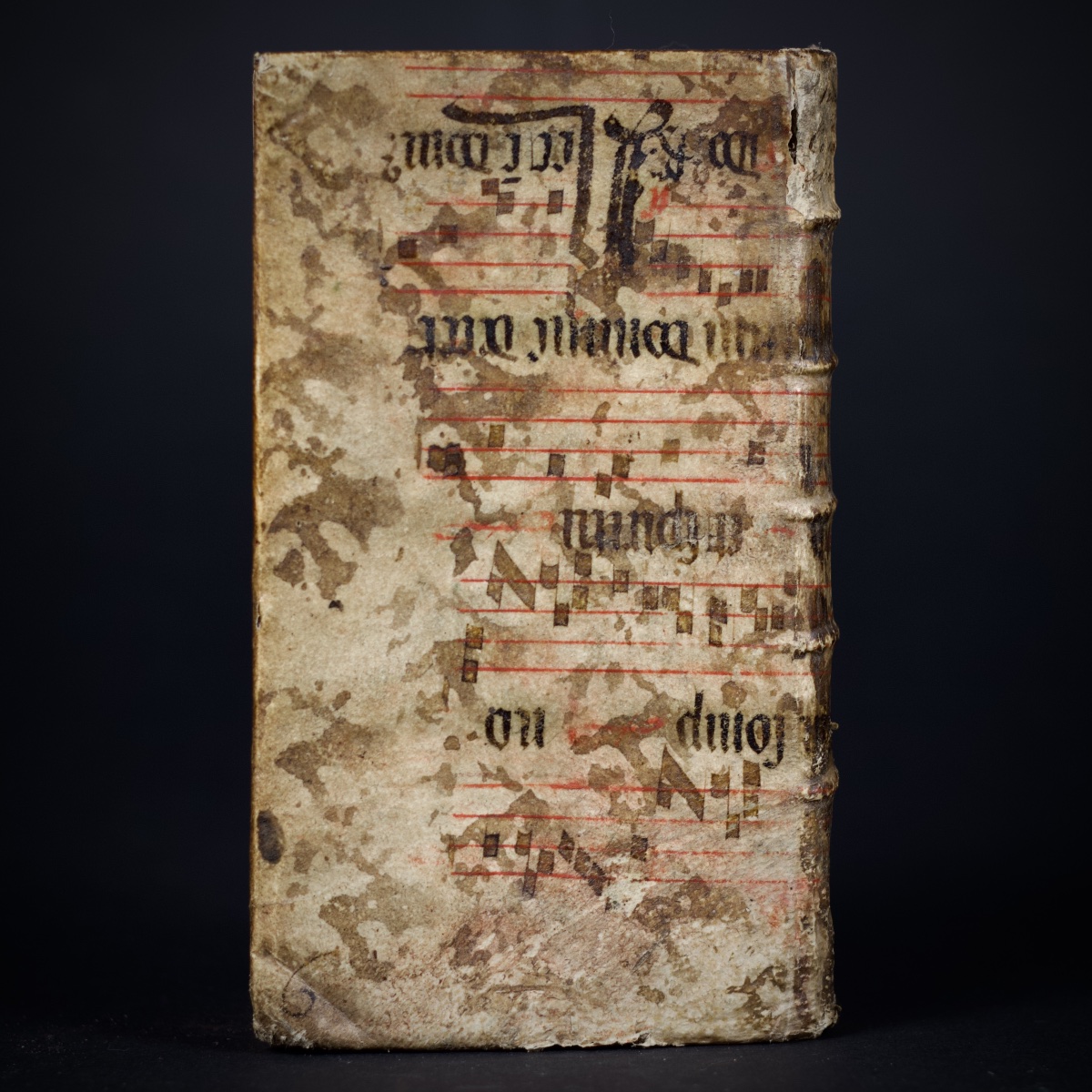
Book bound using a reused leaf from a 15th-century antiphonary on parchment, in good overall condition: featuring interesting Gothic calligraphy in black ink, embellished with two large initials and depicting musical staves with four red lines and square notes.
The binding is sturdy, and the parchment has a lovely patina from age; there are a few rare ink smudges, as shown in the photographs. The interior of the volume remains in very good condition.
Pothier (1699–1722) was a French jurist, a counselor at the Presidium of Orléans, and later a alderman of that same city from 1747 until his death.
His work is seminal in the French legal landscape, both in the field of comparative international law and in its comprehensive synthesis of the principles and maxims of Roman law, which until then had been compiled in Justinian’s (rather confusing) collections. It was under the guidance of Chancellor d’Aguesseau that Pothier set about dusting off this imposing body of work.
In 1749, he was appointed by Louis XV—without having applied for the position—to the chair of French law at the University of Orléans. In his later writings, he would focus on the issue of customary law (particularly the comparison between the law of the Langue d’oc and Langue d’oil regions), laying the groundwork for a unified national legal system—an ambition that grew steadily stronger by the end of the century.
Far from being interested solely in customary law and public law, Pothier distinguished himself through his writings on property law and the law of obligations, to the point of having a lasting influence on the drafters of the Civil Code under Napoleon Ier and on American legislators and the “Founding Fathers” of the late 18th century.
This treatise will appeal to enthusiasts of private law due to its unique subject matter; insurance law features prominently in it (along with issues of the time—such as maritime transport and cases of shipwreck, for example)—as well as more specific and arguably lesser-known topics: for instance, gambling, which includes an interesting chapter on comparative law between contemporary legislation and Roman law.
Beyond its subject matter, this work will particularly appeal to discerning bibliophiles, with its 15th-century binding in reused parchment, adorned with initial letters and musical scores, which will find its place in a cabinet of curiosities.
Book bound using a reused leaf from a 15th-century antiphonary on parchment, in good overall condition: featuring interesting Gothic calligraphy in black ink, embellished with two large initials and depicting musical staves with four red lines and square notes.
The binding is sturdy, and the parchment has a lovely patina from age; there are a few rare ink smudges, as shown in the photographs. The interior of the volume remains in very good condition.
Pothier (1699–1722) was a French jurist, a counselor at the Presidium of Orléans, and later a alderman of that same city from 1747 until his death.
His work is seminal in the French legal landscape, both in the field of comparative international law and in its comprehensive synthesis of the principles and maxims of Roman law, which until then had been compiled in Justinian’s (rather confusing) collections. It was under the guidance of Chancellor d’Aguesseau that Pothier set about dusting off this imposing body of work.
In 1749, he was appointed by Louis XV—without having applied for the position—to the chair of French law at the University of Orléans. In his later writings, he would focus on the issue of customary law (particularly the comparison between the law of the Langue d’oc and Langue d’oil regions), laying the groundwork for a unified national legal system—an ambition that grew steadily stronger by the end of the century.
Far from being interested solely in customary law and public law, Pothier distinguished himself through his writings on property law and the law of obligations, to the point of having a lasting influence on the drafters of the Civil Code under Napoleon Ier and on American legislators and the “Founding Fathers” of the late 18th century.
This treatise will appeal to enthusiasts of private law due to its unique subject matter; insurance law features prominently in it (along with issues of the time—such as maritime transport and cases of shipwreck, for example)—as well as more specific and arguably lesser-known topics: for instance, gambling, which includes an interesting chapter on comparative law between contemporary legislation and Roman law.
Beyond its subject matter, this work will particularly appeal to discerning bibliophiles, with its 15th-century binding in reused parchment, adorned with initial letters and musical scores, which will find its place in a cabinet of curiosities.
280 €
Period: 18th century
Style: Louis 16th, Directory
Condition: Some scratches and chips
Material: Parchment
Width: 10 cm
Height: 17 cm
Depth: 3,5 cm
Reference (ID): 1839424
Availability: In stock
Print