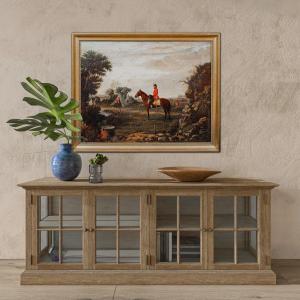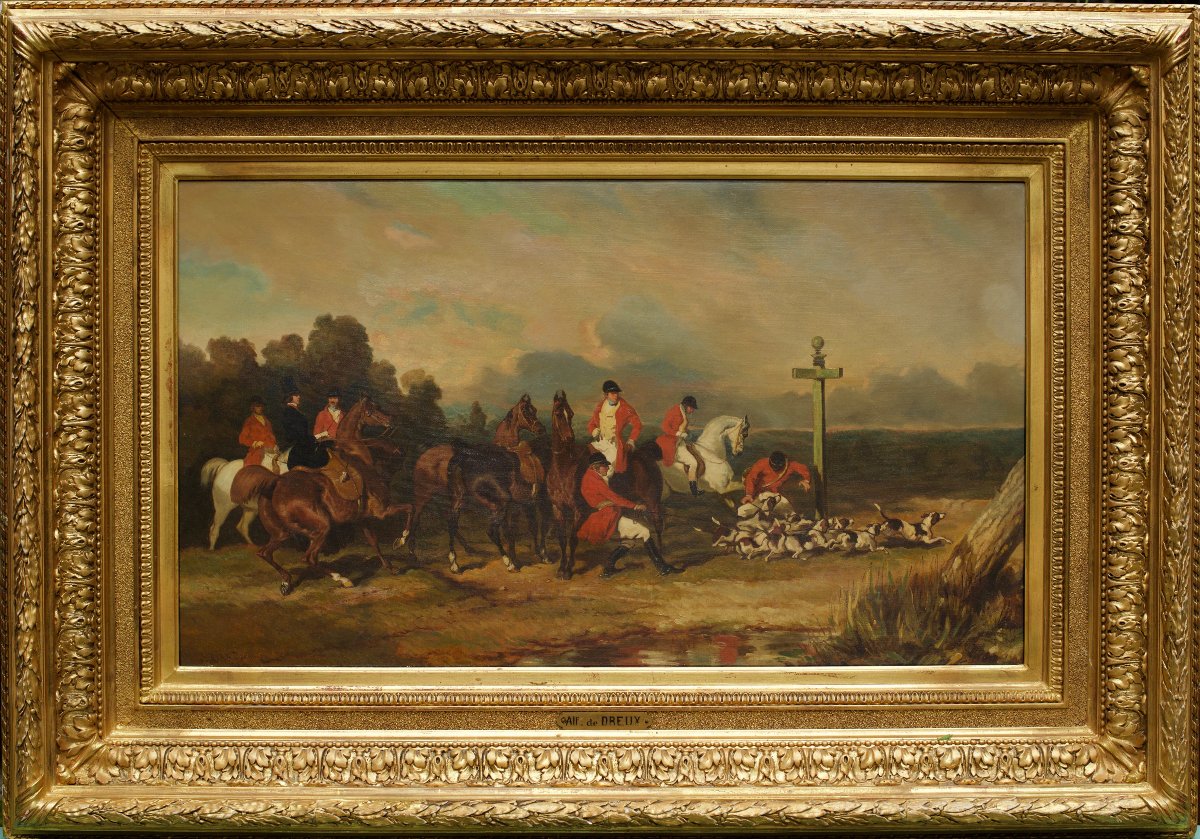
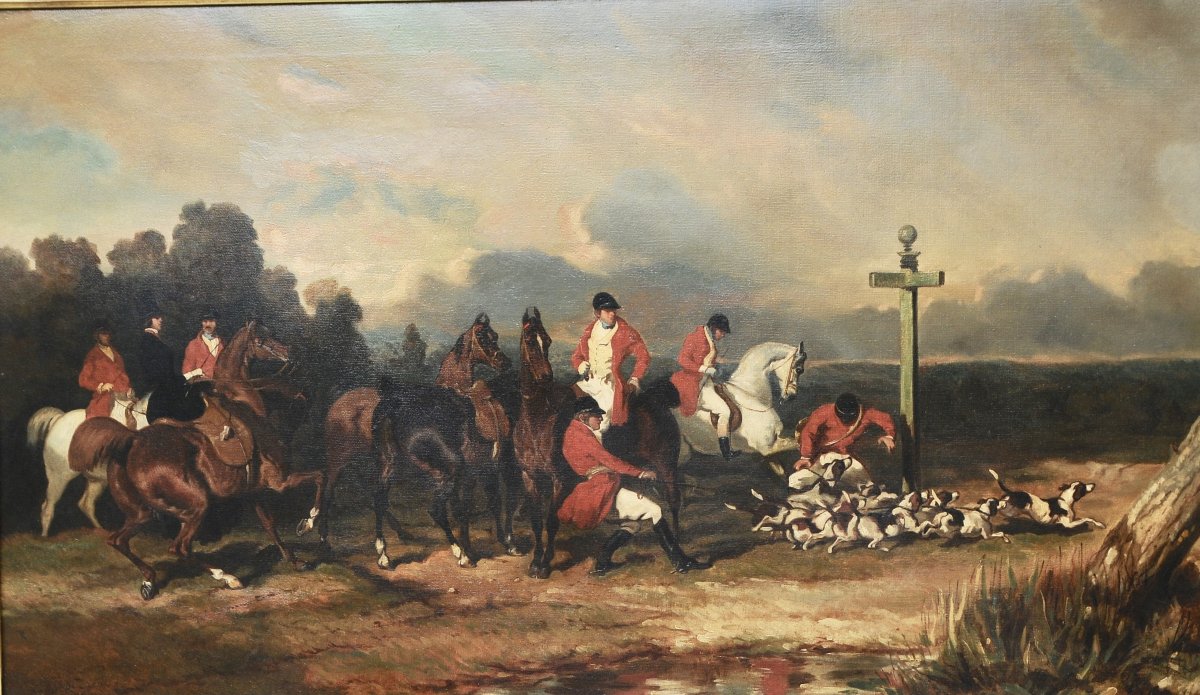

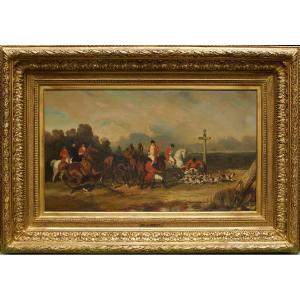


Alfred De Dreux, "scene Of A Hunt With Hounds," Oil On Canvas, Circa 1850
Artist: Alfred De Dreux
This work is a fox-hunting scene, a subject that was a favorite of Alfred de Dreux (1810–1860). This major 19th-century French painter is world-renowned for his equestrian portraits and depictions of fox hunts.
1. Description and Stylistic Analysis
The letter describes in detail the chain of family transmission of the workThe original owner: Hippolyte Martin de La Bastide, mayor of Limoges, explicitly referred to in the letter as a “ friend of Alfred de Dreux”. The transfer: His granddaughter, Marie-Thérèse Martin de La Bastide. Direct inheritance: Her daughter, Henriette Carrier-Bresson (mother of the letter’s author). Confirmation: Hubert de L., who inherited the painting through succession. In the art market, a “traceable provenance” (the ability to trace a painting’s history from generation to generation back to the artist’s circle) is one of the most sought-after criteria. It strongly supports the work’s authenticity. The fact that Hippolyte de La Bastide was a friend of Alfred de Dreux perfectly explains how this hunting scene came into the family’s possession.
Previous restoration evidenced by a vertical line in the middle of the canvas that is barely visible
1. Description and Stylistic Analysis
- Subject: The painting depicts a break taken by hunters in traditional red frock coats during a fox hunt. They are gathered at the foot of a signpost marking a forest crossroads, while the pack of hounds bustles on the ground.
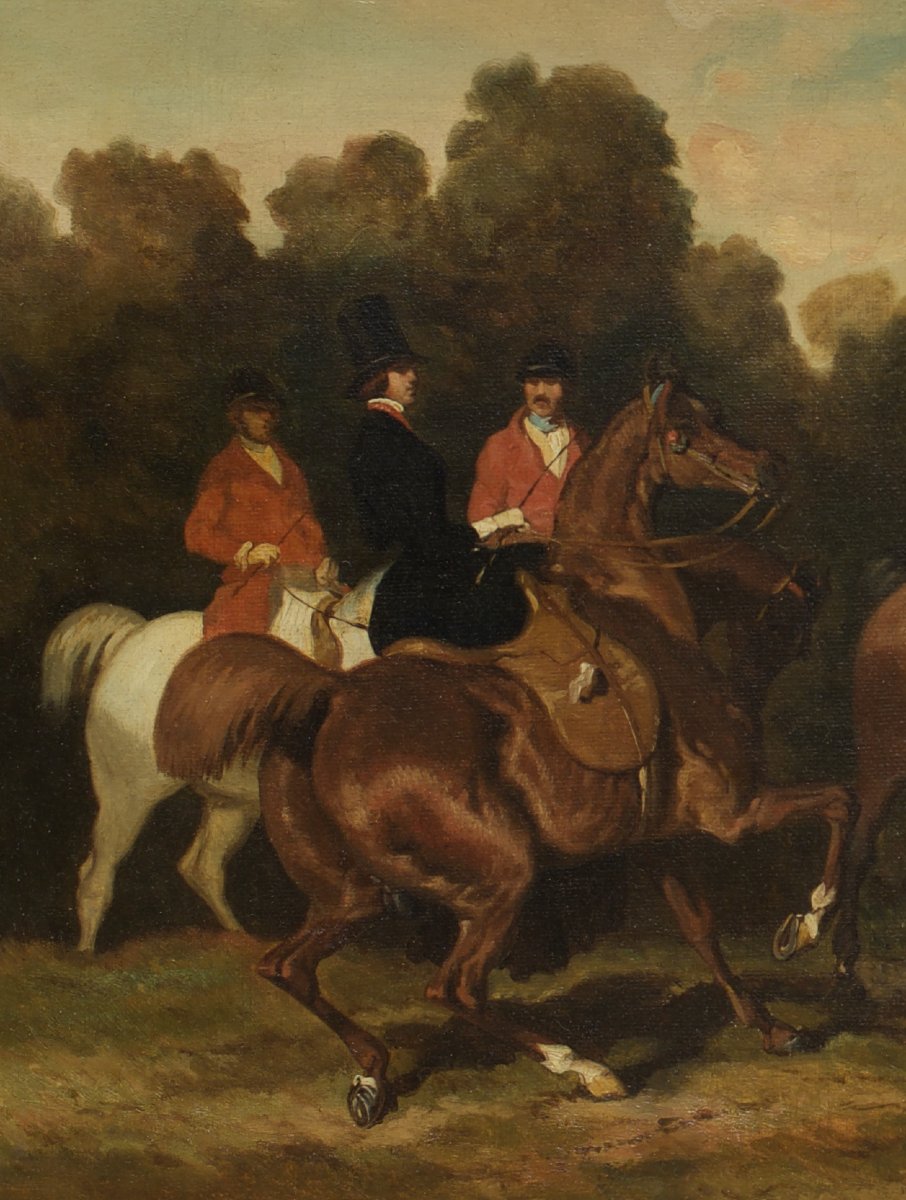
- Composition: The poses of the horses (particularly the one seen in a three-quarter rear view on the left) as well as the liveliness of the pack are directly inspired by the tradition of Sporting Painting in England, of which Alfred de Dreux became the leading exponent in France.
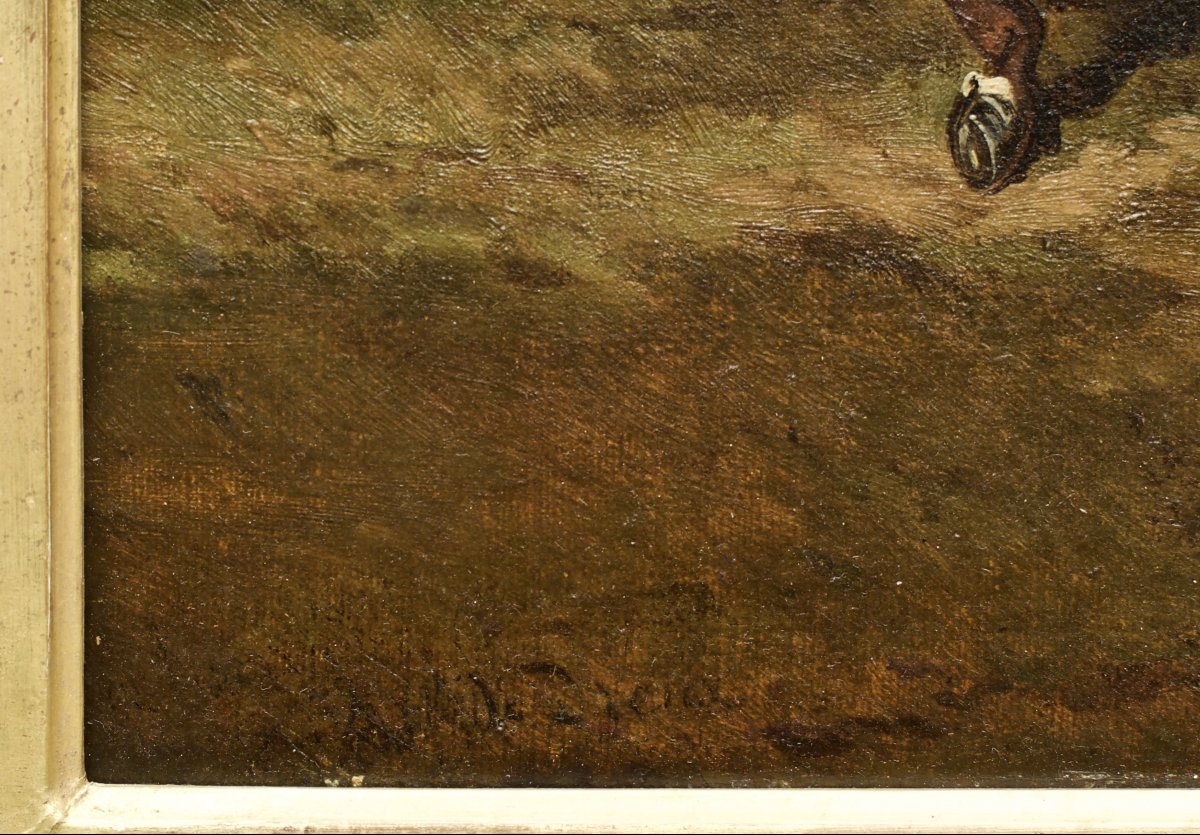
- Signature and Cartouche: A nameplate reading “Alfd. de DREUX” is affixed to the frame. A close-up of the canvas reveals a cursive signature painted in the lower left corner.
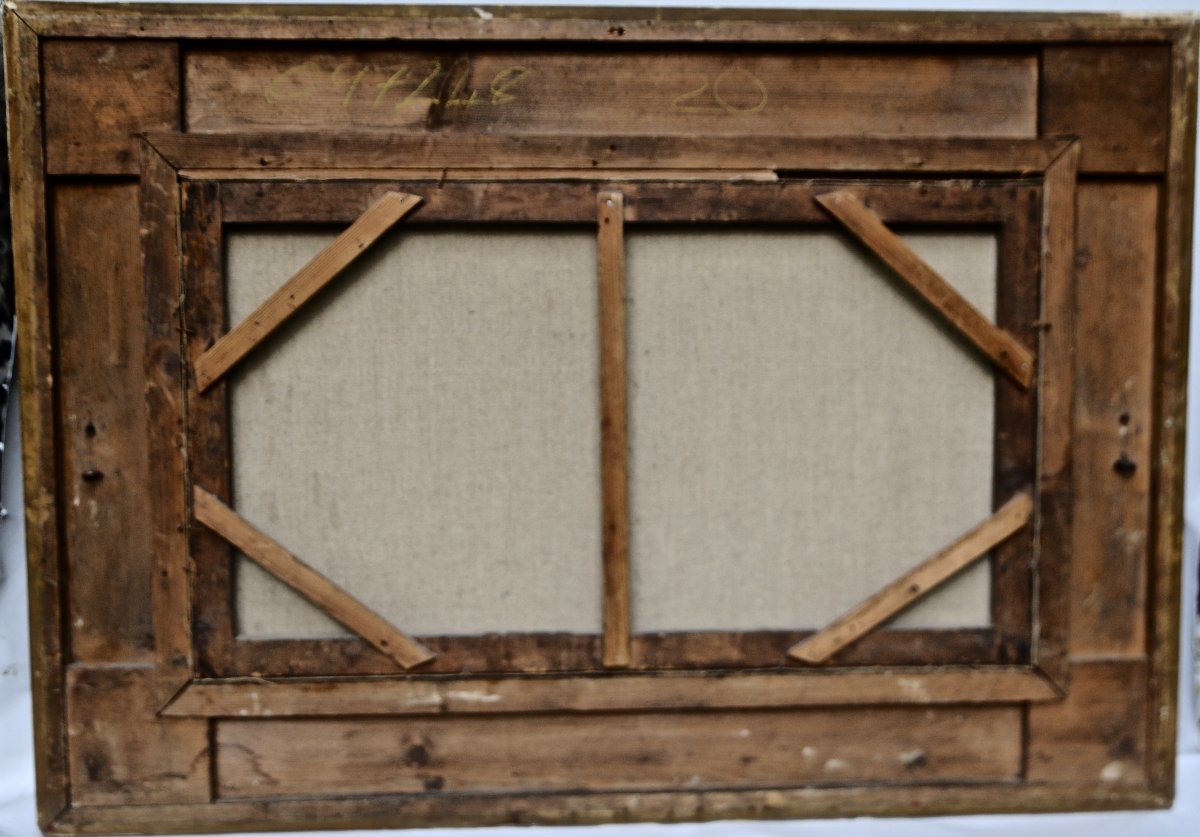
- Support and Stretcher (44 x 76 cm): Photos of the reverse side show an antique wooden stretcher with key-type tensioning, typical of the 19th century. The original linen canvas is stretched over this stretcher with corner reinforcements (gussets). Yellow chalk inscriptions are also visible on the back (C97248 and 20), often indicating inventory numbers or a history of ownership transfers or sales.
The letter describes in detail the chain of family transmission of the work
Previous restoration evidenced by a vertical line in the middle of the canvas that is barely visible
- Technical origin: This line most likely corresponds to the repair of a previous tear in the canvas or the splicing of a previous fold. On the back, on the stretcher, the presence of a central vertical wooden crossbar may have created an area of tension or friction over the decades, contributing to this type of damage. However, as long as the paint layer has not been altered by crude overpainting, this is entirely normal in the conservation of a mid-19th-century painting.
- The period frame enclosing the painting exhibits the typical characteristics of large-format salon paintings of the era. Its exterior dimensions are 107 x 74 cm; it has a molded oak or fir wood frame, covered with stucco (a mixture of plaster, animal glue, and chalk, cast while hot), which made it possible to create these very rich, relief-like decorations. Its deep molding (known as “channel molding”) is adorned with classical plant motifs, often consisting of acanthus leaves, heart-shaped leaves, and laurel friezes. The corners are generally “filled” (the floral motifs are arranged to conceal the miter joints).
12 500 €
Period: 19th century
Style: Louis Philippe, Charles 10th
Condition: Good condition
Material: Oil painting
Reference (ID): 1838786
Availability: In stock
Print