


Flemish Painter Active In Italy In The 17th Century, *pietà* And *prayer In The Garden*
Flemish painter active in Italy in the 17th century
Piety and Prayer in the Garden
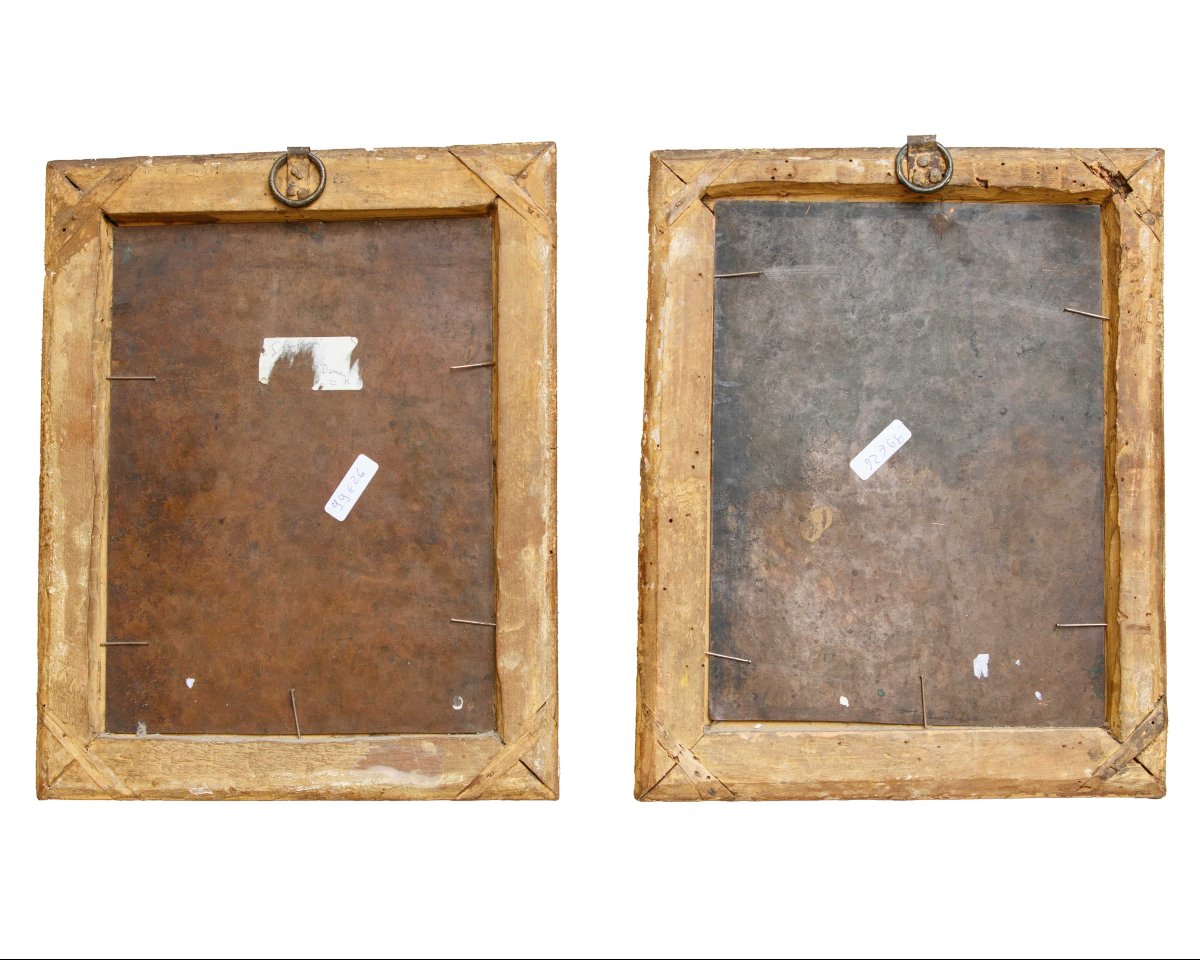
(2) Oil on copper, cm 24 x 19
Frame cm 30 x 24.5
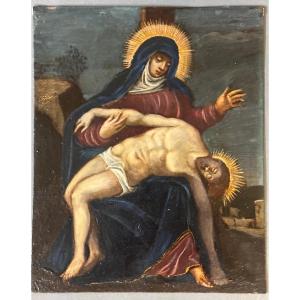
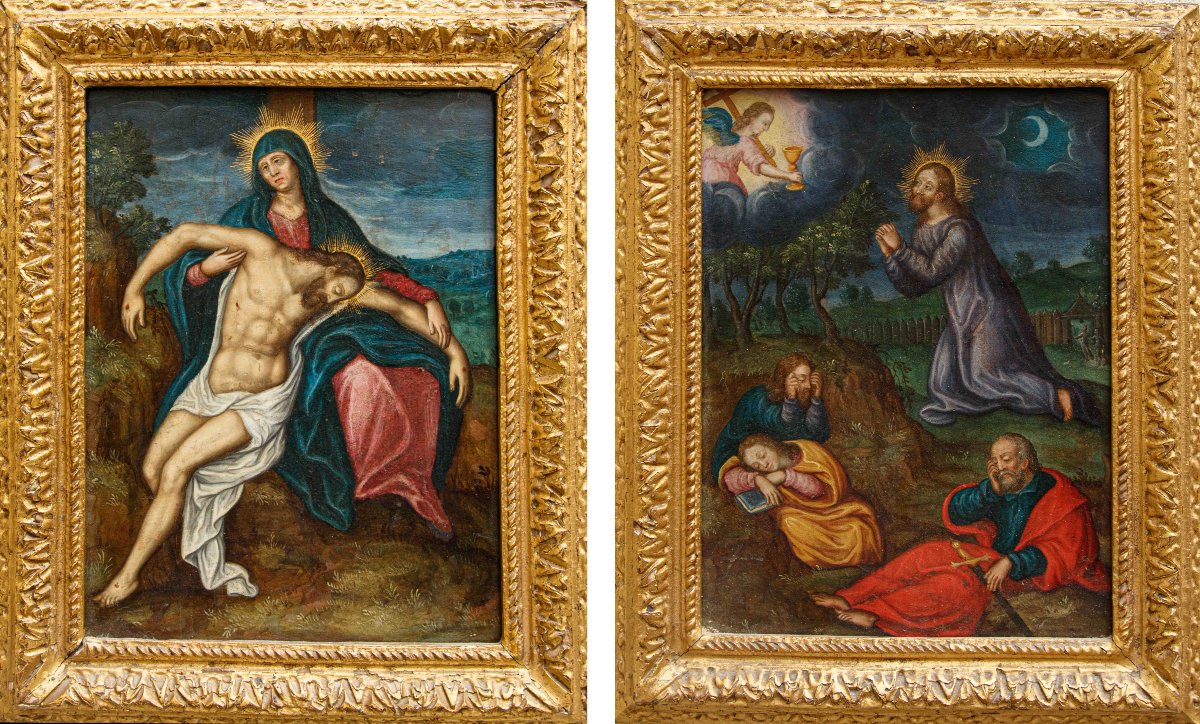
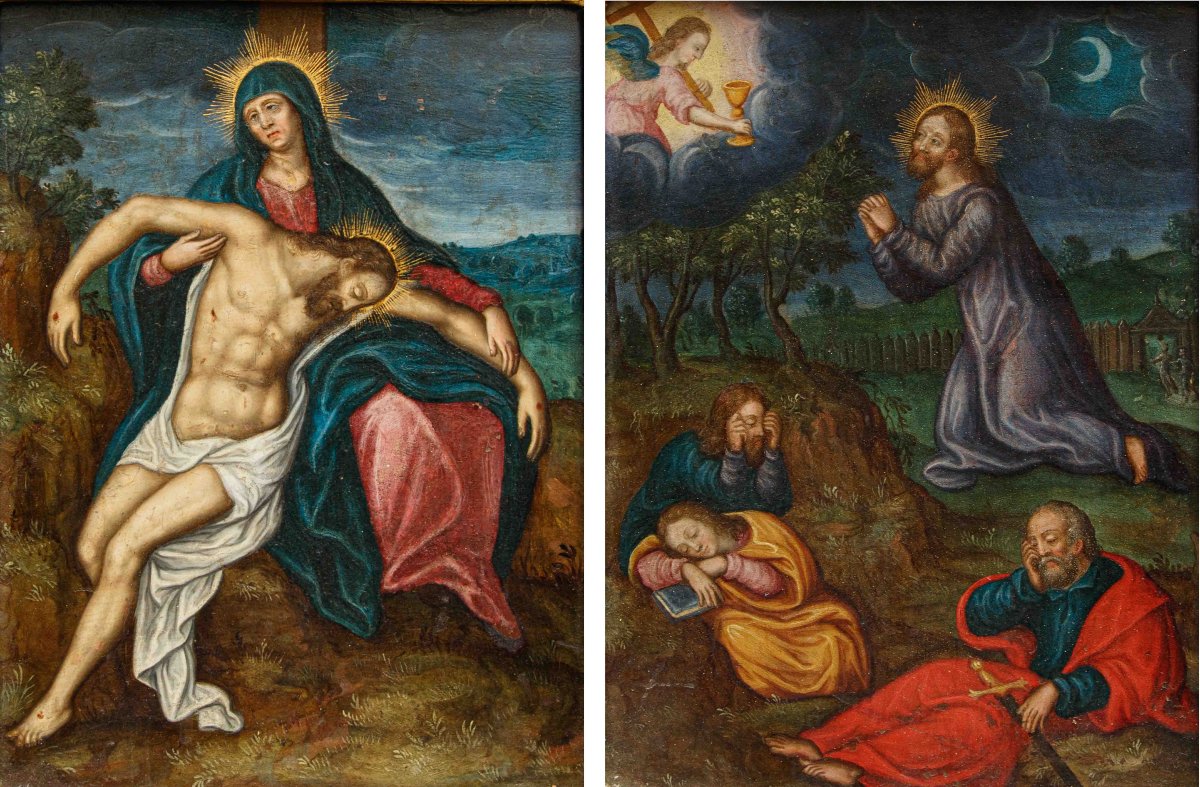
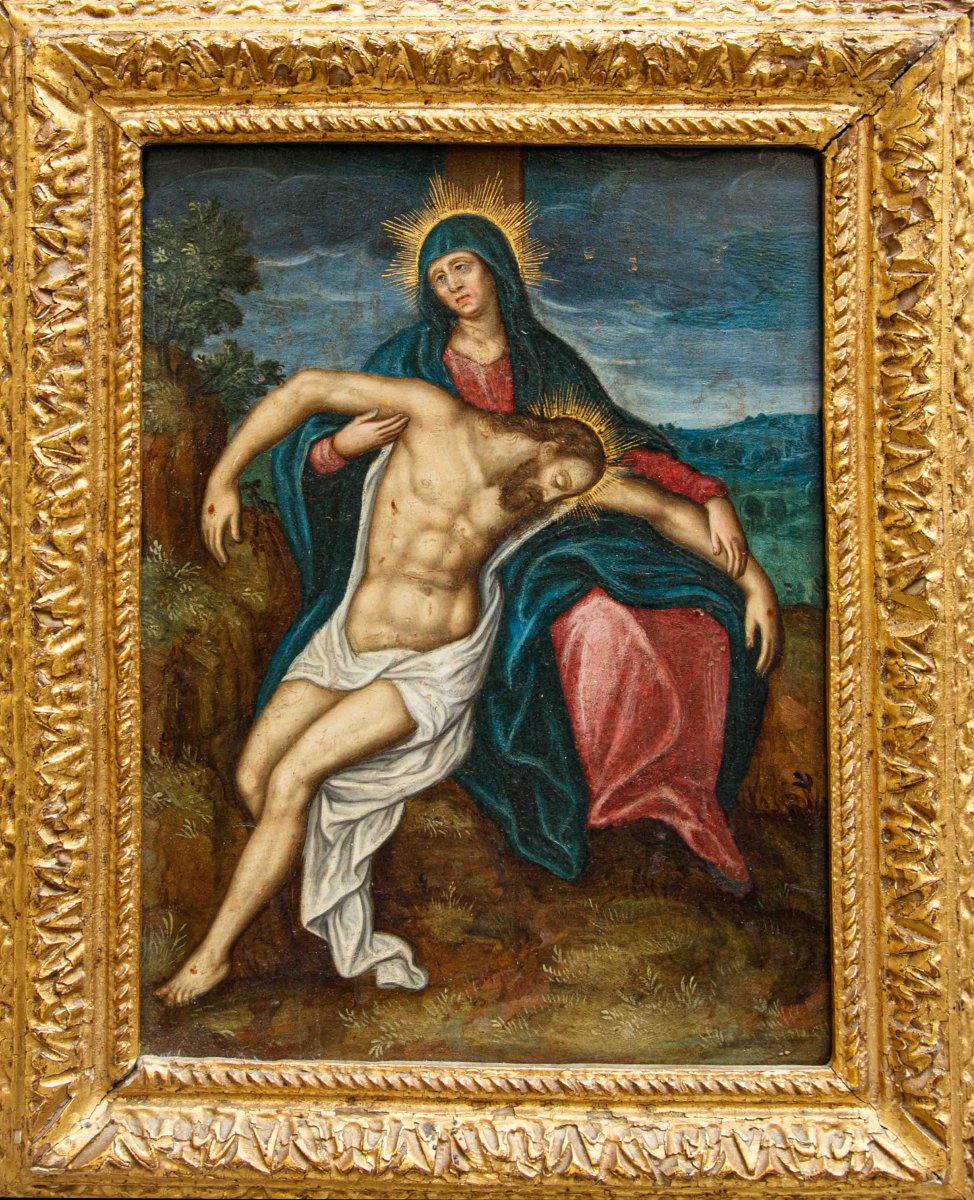
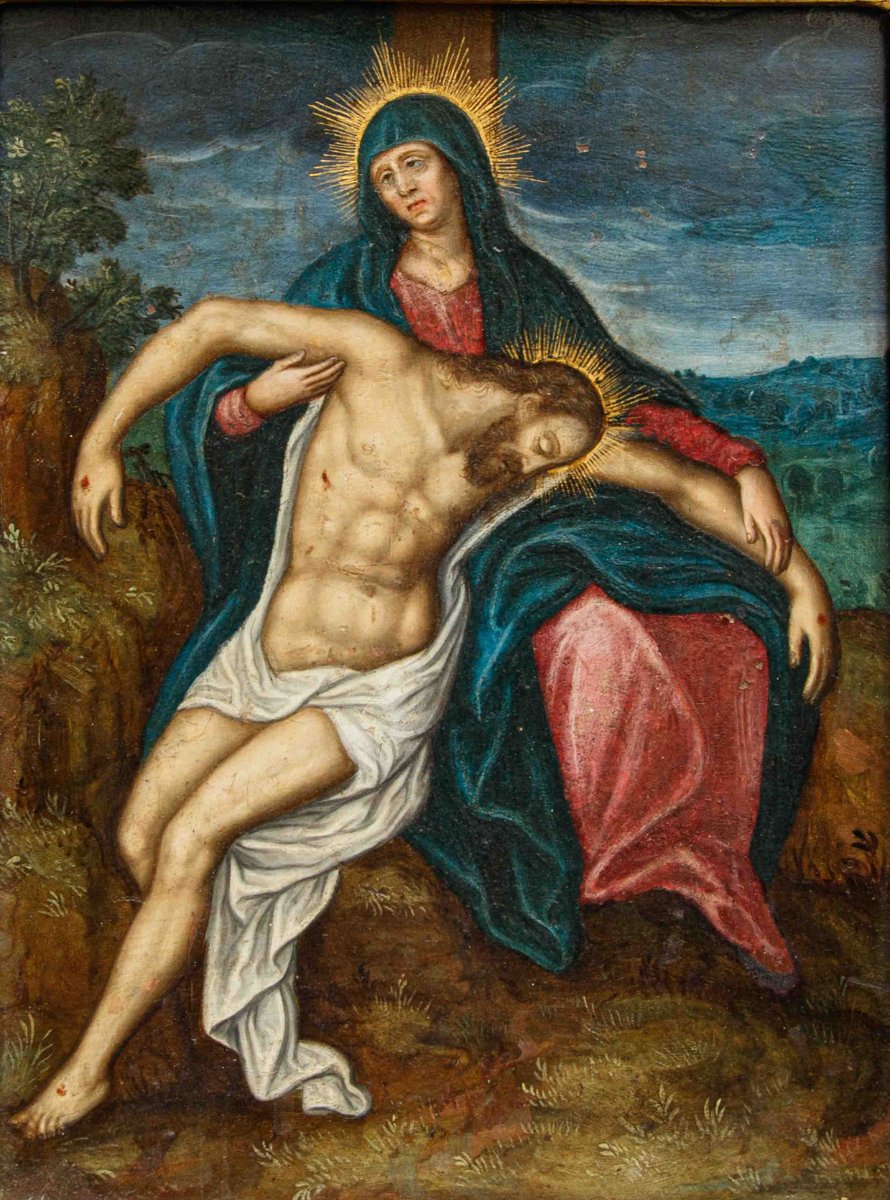
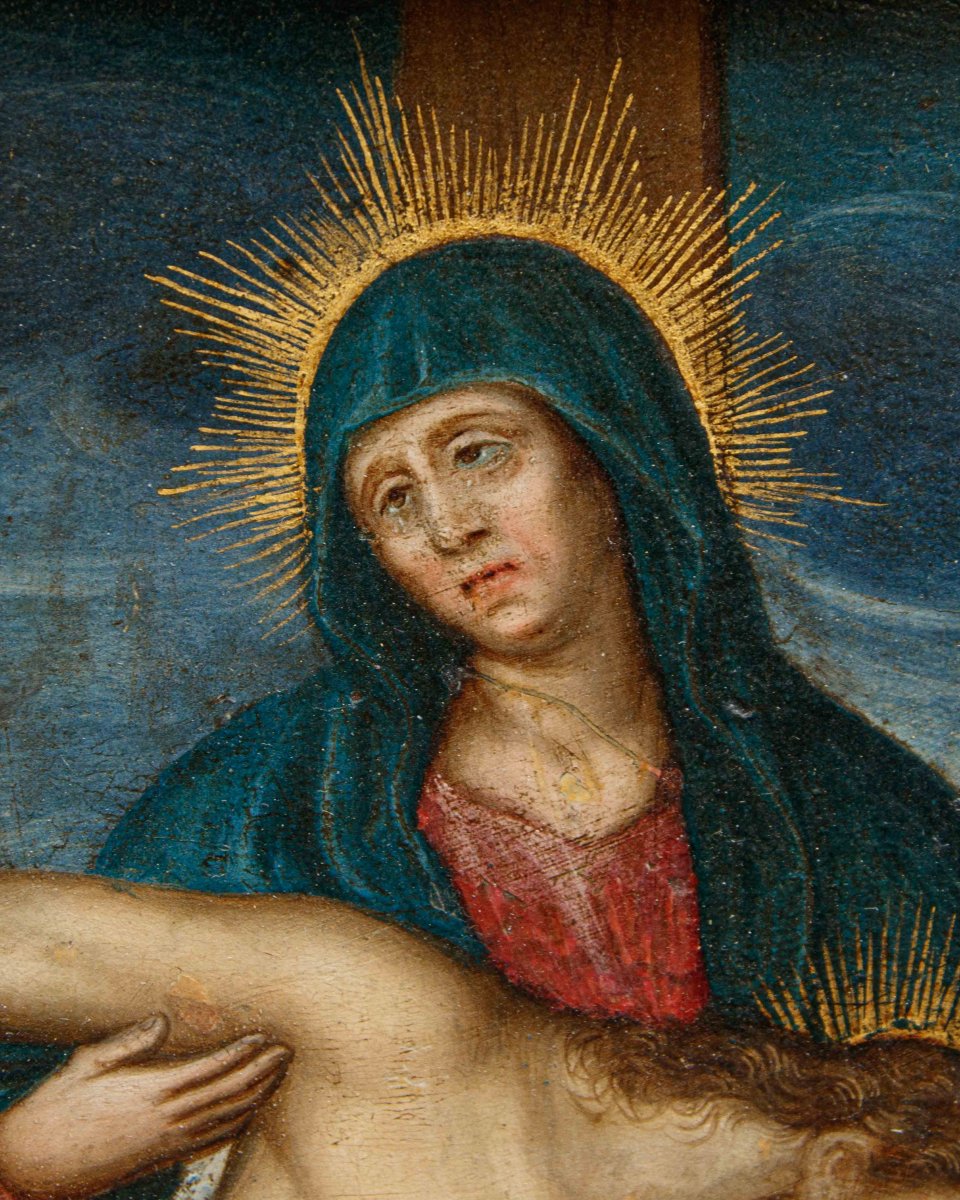
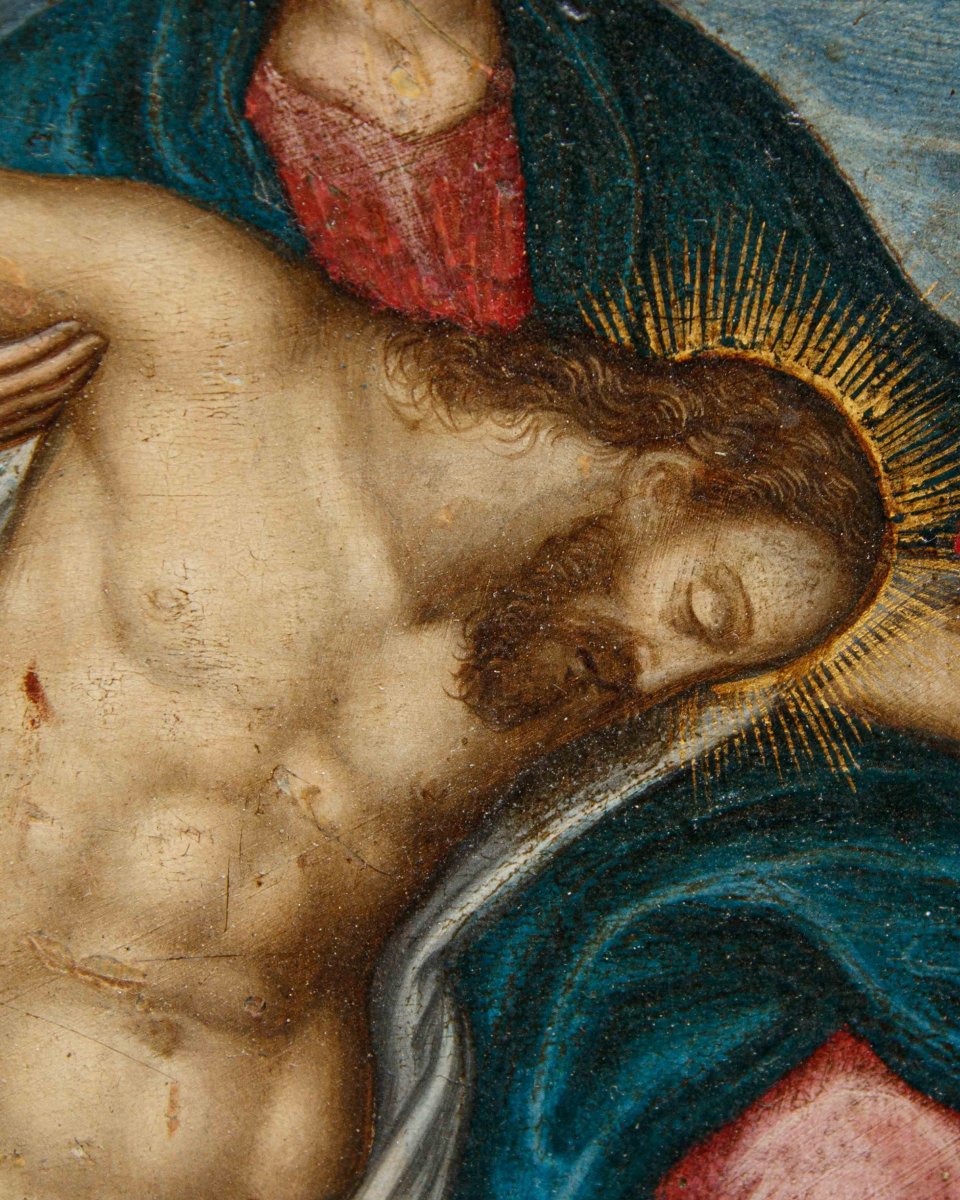
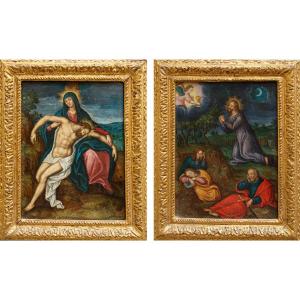
This refined copperplate arrangement depicts the sacred theme of the Pietà, according to a composition of profound dramatic and monumental intensity that contains within itself one of the most complex and fascinating chapters in the history of Early Modern art.
For a long time, and again in nineteenth- and twentieth-century exegesis, this specific compositional typology —characterized by the figure of the Virgin supporting Christ's lifeless torso lying between her legs — was frequently compared to the circle of Annibale Carracci and the famous season of Emilian classicism of the late sixteenth century, thanks to the success of Farnese prototypes and the extraordinary diffusion of translation engravings. Undoubtedly “the iconography of the painting expresses a heterogeneous figurative culture, dictated by Tuscan-Roman suggestions taken from models by Andrea del Sarto, Pontormo, Francesco Salviati and of course Michelangelo and which are equally evident are the late Mannerist influences of the artists active in Rome during the last years of the sixteenth century and the first years of the seventeenth century, we remember for example Federico Zuccari and Jacopino del Conte”. A painting that appeared on the market in 2020 having the exact same subject but created on canvas, has attracted considerable debate regarding its attribution. Delivered to Michelangelo's brush, it was later a valuable replica of a subject that enjoyed enormous success towards the mid-sixteenth century (the most famous is on bronze, designed by Guglielmo della Porta), although it is not known which was the original.
In reality, it is likely that the true creative matrix of the work dates back to a very specific prototype: the iconic drawing executed around 1538-1540 by Michelangelo Buonarroti for the Marchioness of Pescara, Vittoria Colonna (now preserved at the Isabella Stewart Gardner Museum in Boston). In that sheet, conceived within the intense spiritual and theological dialogue linked to the circle of the Spirituals, Michelangelo defined a powerful meditation on Redemption, crowned on the cross by the famous Dante quote «You don't think about how much blood it costs».
Since the Tuscan master did not like to paint in oils in his later years (and on canvas at that), the pictorial translation of the drawing was immediately entrusted to his Roman collaborators and followers —primarily Marcello Venusti—, who started a very successful chain of replicas. The subsequent mediation of translation prints (including the burins of Nicolas Beatrizet and Giulio Bonasone) spread the Colonna Pietà throughout sacred Europe, transforming it into a primary reference model for private devotion.
The copper in question fits squarely into this figurative tradition, configuring itself as a cultured reworking of Michelangelo's invention by an Italian artist and then re-proposed by a Flemish master probably active in Italy during the 17th century.
The anonymous painter demonstrates a profound assimilation of the Italian figurative language, expertly fused with the characteristics of Nordic painting: the use of copper plates, the preferred medium and small format painting medium among French masters working in Italian centers (Rome and Venice first and foremost), allows for a compact, porcelain-like pictorial application rich in luminous details.
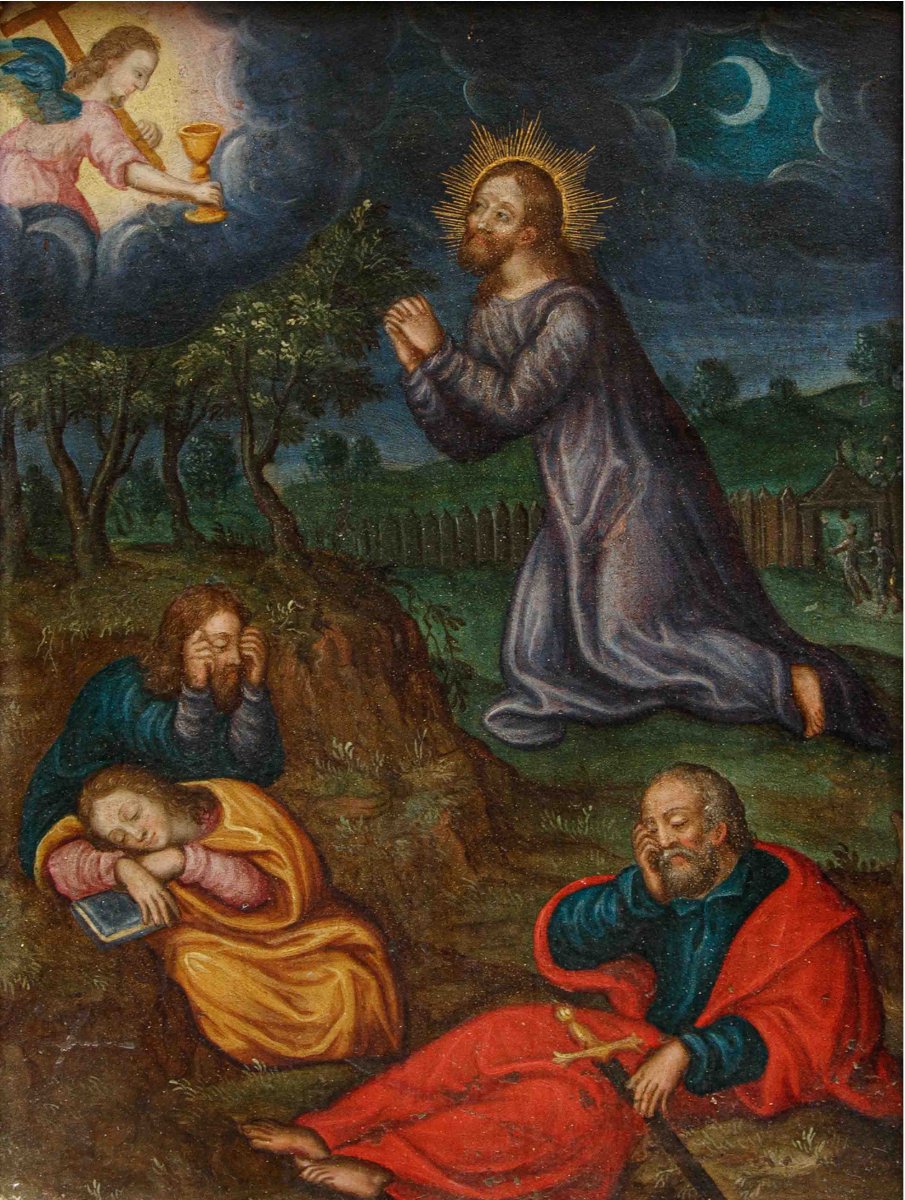
The present composition, executed with descriptive minutia on the surface of a copper of reduced format, depicts the Gospel episode of the Prayer in the Garden of Gethsemane. The work is part of that rich current of devotional production of Nordic and European origin which, between the end of the sixteenth century and the beginning of the seventeenth century, drew heavily on the vast figurative repertoire conceived by Lucas Cranach the Elder (1472–1553) and subsequently reworked and disseminated by the flourishing Wittenberg workshop led by his son, Lucas Cranach the Younger (1515–1586).
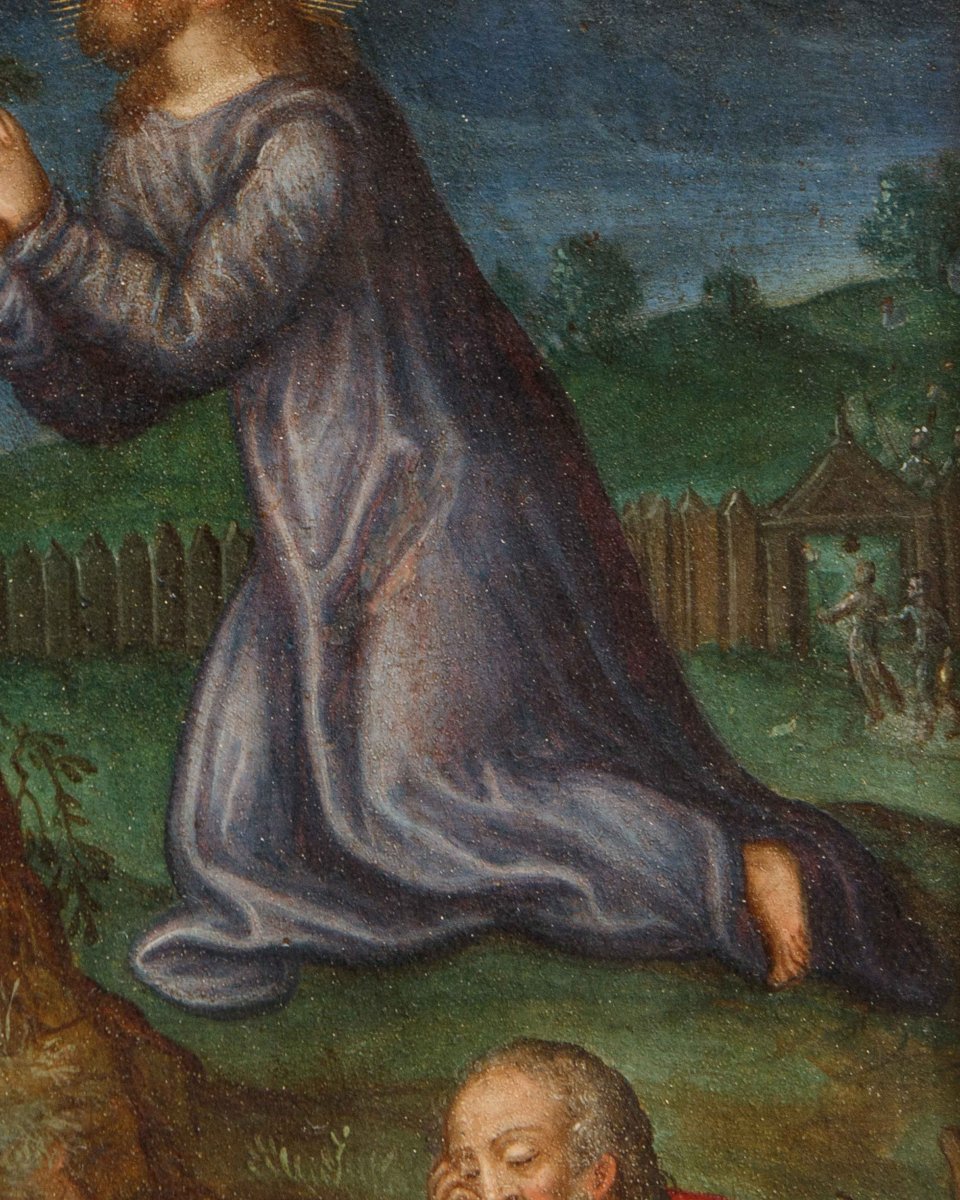
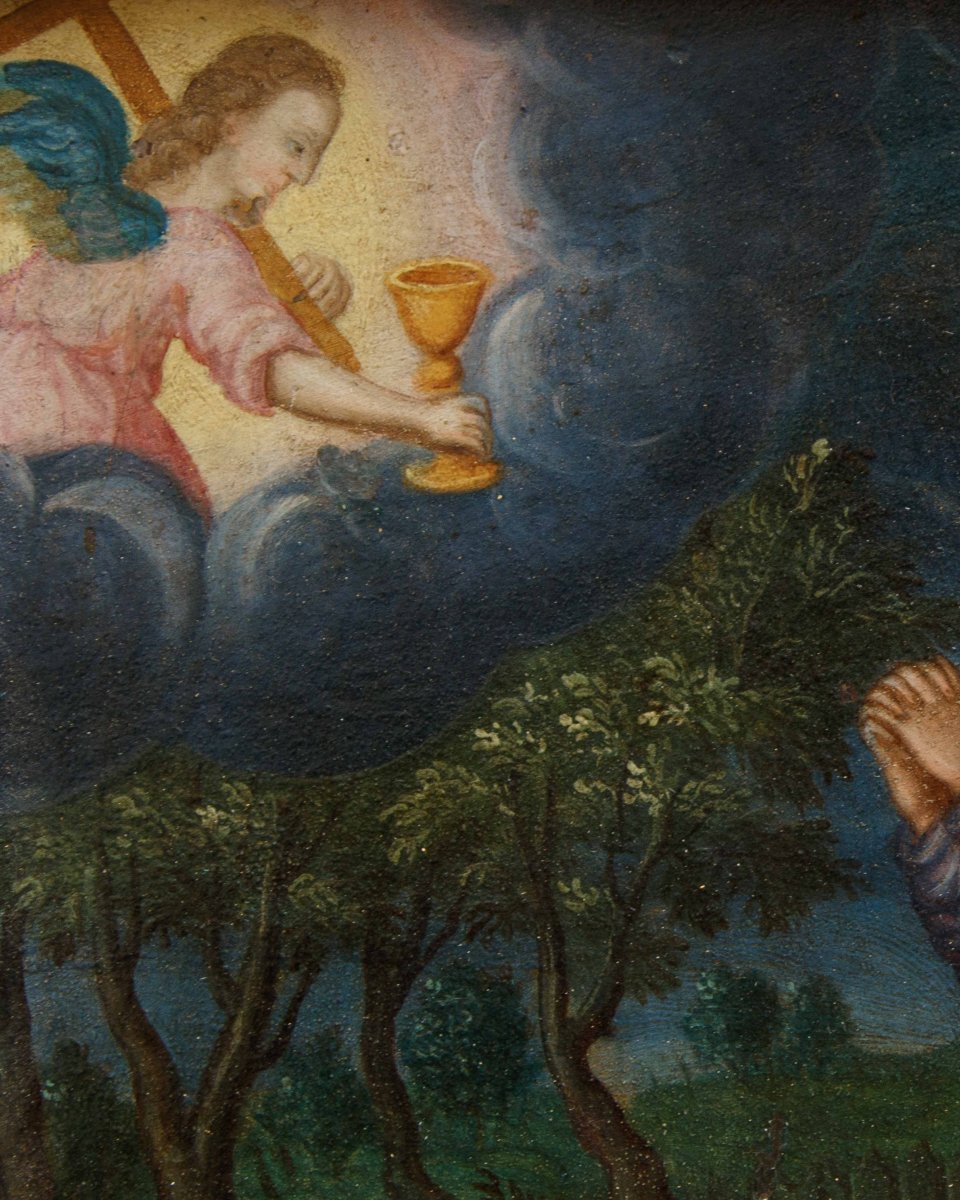
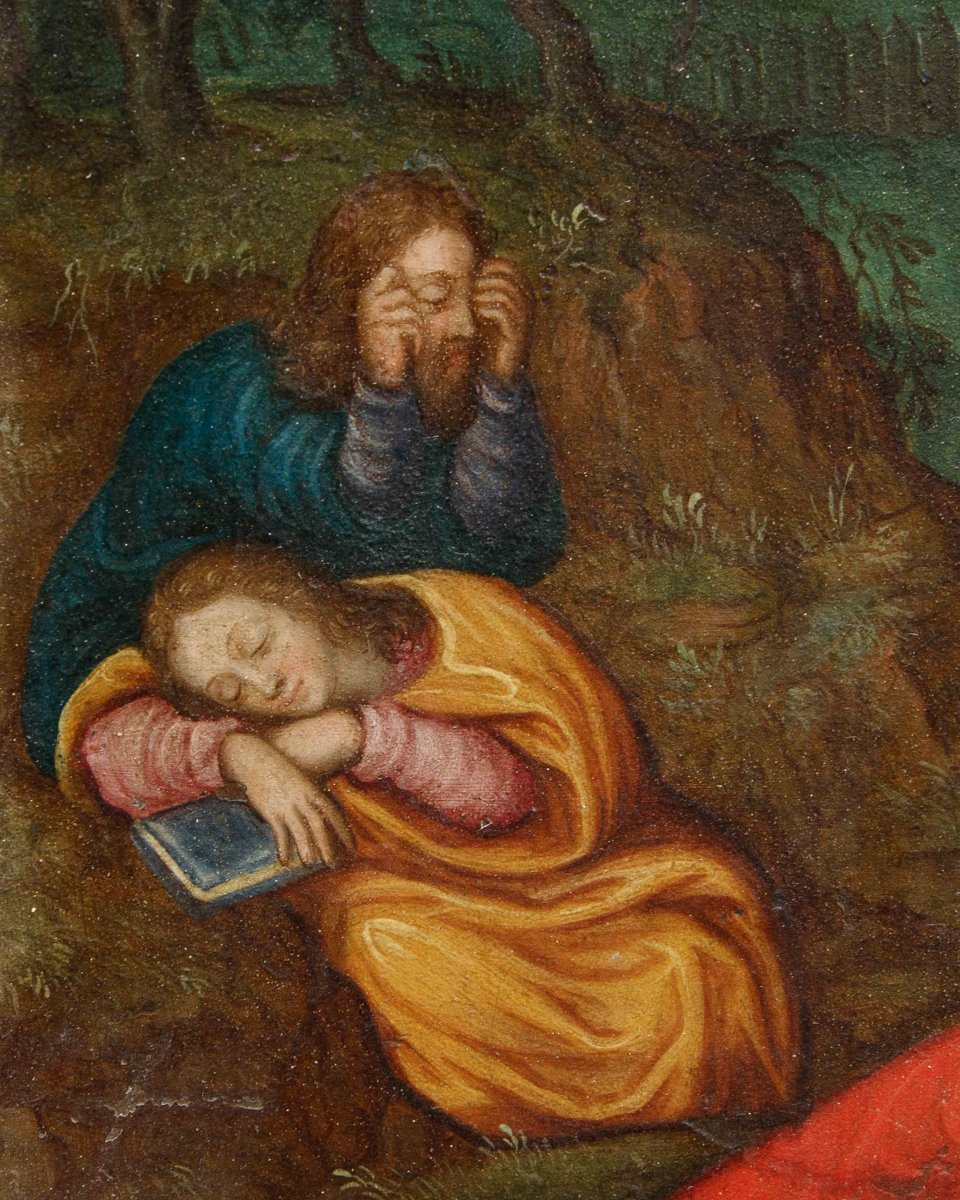
The compositional structure is based on a rigorous diagonal and pyramidal approach. At the top right, Jesus is depicted kneeling, wrapped in a loose purple robe with sharp, metallic folds, his hands clasped in prayer and his ecstatic face turned toward heaven. To collect his inner anguish, an angel arrives in the upper left, emerging from a luminous cloud, who offers him the chalice of the Passion. In the lower register, lying on steep ground bordered by a mound of earth and small olive trees, sleep the three favorite apostles: John, kneeling and reclining to the left with the sacred book beside him; James, holding his tired head; and Peter, in the foreground on the right, wrapped in a lively red cloak, who gives in to sleep by clutching his sword, premonition of the gesture he will perform upon arrest.
The primary prototype from which the invention derives can be found in the famous panel by Lucas Cranach the Elder preserved at the Gemäldegalerie in Berlin (Christus am Ölberg, inv. n. 580, dating back to around 1518). In this original matrix, Cranach established the founding iconography: the diagonal pose of Christ kneeling, the scaled arrangement of the three dormant apostles in the foreground, and the architecture of the nocturnal landscape. This invention met with extraordinary editorial and pictorial success, becoming an essential model both for the workshop's wood and copper engravings and for numerous replicas on panel and canvas.
The invention was taken up and updated by Lucas Cranach the Younger, as evidenced by the important editorial staff that passed on to the collector's market and was preserved in a private collection. The son introduced sensitive variations aimed at greater atmospheric dramatization and a more plastic and dynamic rendering of the draperies. In the Young Man's work, as in the present copper, the nocturnal landscape is enriched by a dark and stormy sky crossed by a waning crescent moon, while in the background, beyond the wooden fence of the garden of Gethsemane, one can glimpse the opening of the city gate from which the guards led by Judas arrive in the distance.
The copper support, typical of Flemish, German and Italo-Nordic production between the late 16th and 17th centuries, allows the painter to obtain an almost enameled pictorial application. The chiaroscuro contrast between the brown tones of the earth and the night sky brings out the pure colored fields with lively luminosity: the flaming red of Peter's cloak, the golden ochre of John's robe and the pure gold highlights that define the rays of Christ's halo. The variants found in this copper version —such as the slightly raised position of the angel and the softer, staccato rendering of the figures of the apostles — suggest that the author did not mechanically copy a single work, but drew on a drawing or translation print derived from Wittenberg's prototypes, reinterpreting it with a marked sensitivity to precious detail, intended for the private devotion of a cultured patrician collection.
3 400 €
Period: 17th century
Style: Other Style
Condition: Good condition
Material: Oil painting on copper
Width: 19
Height: 24
Reference (ID): 1838574
Availability: In stock
Print