


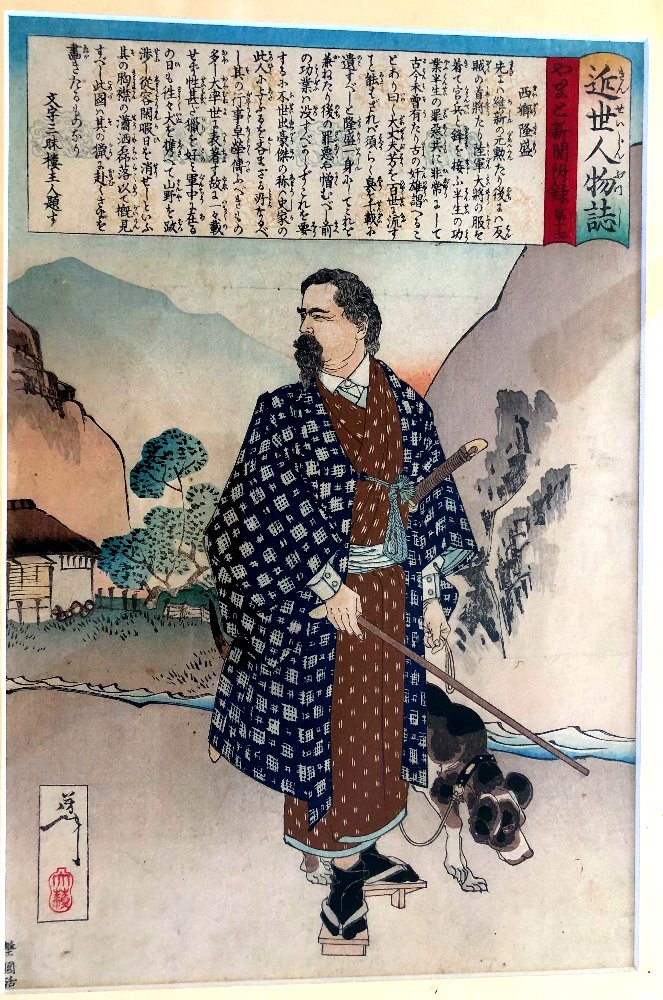


Portrait Of Saigo Takamori, The Last Samurai, Woodblock Print, 1888 By Tsukioka Yoshitoshi
Artist: Tsukiokayoshitoshi
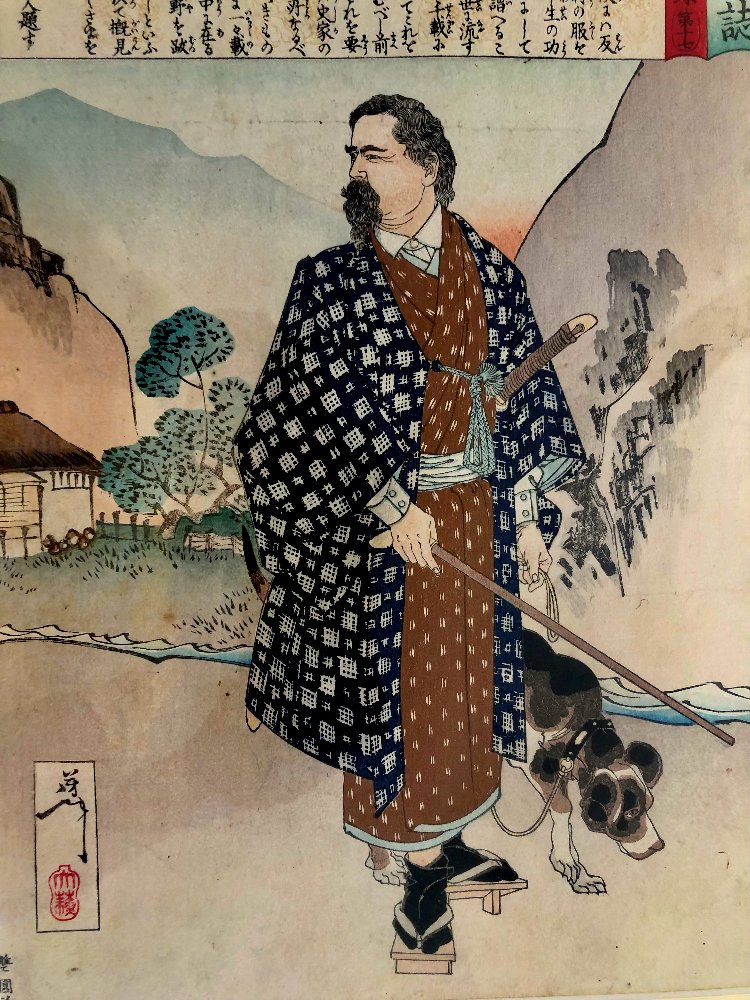
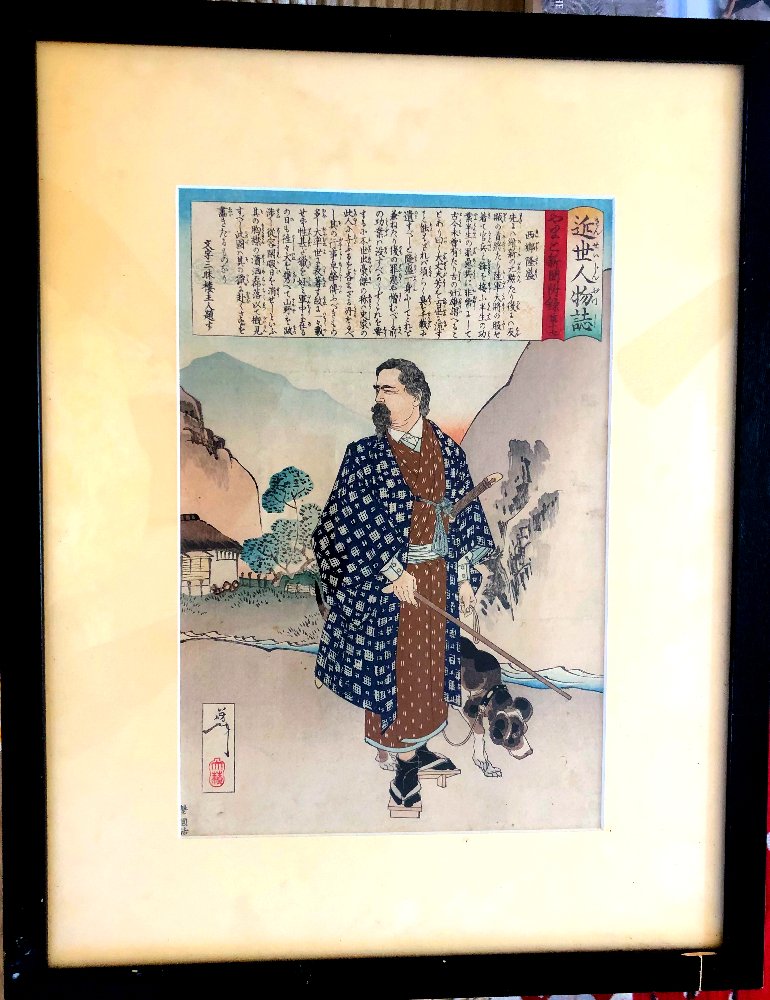
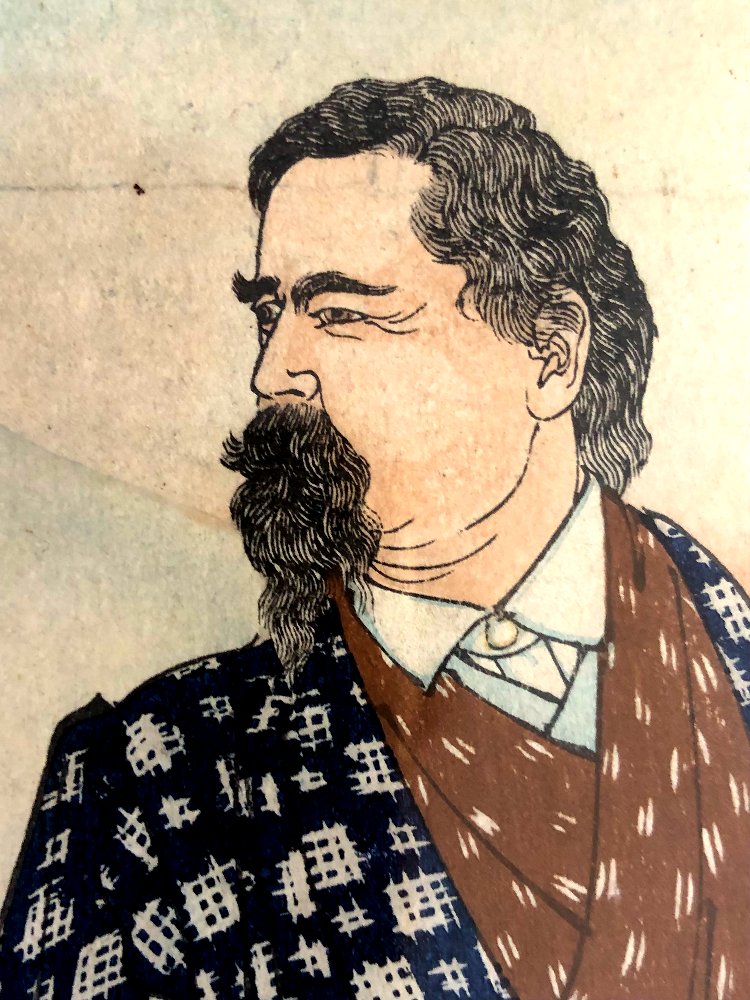
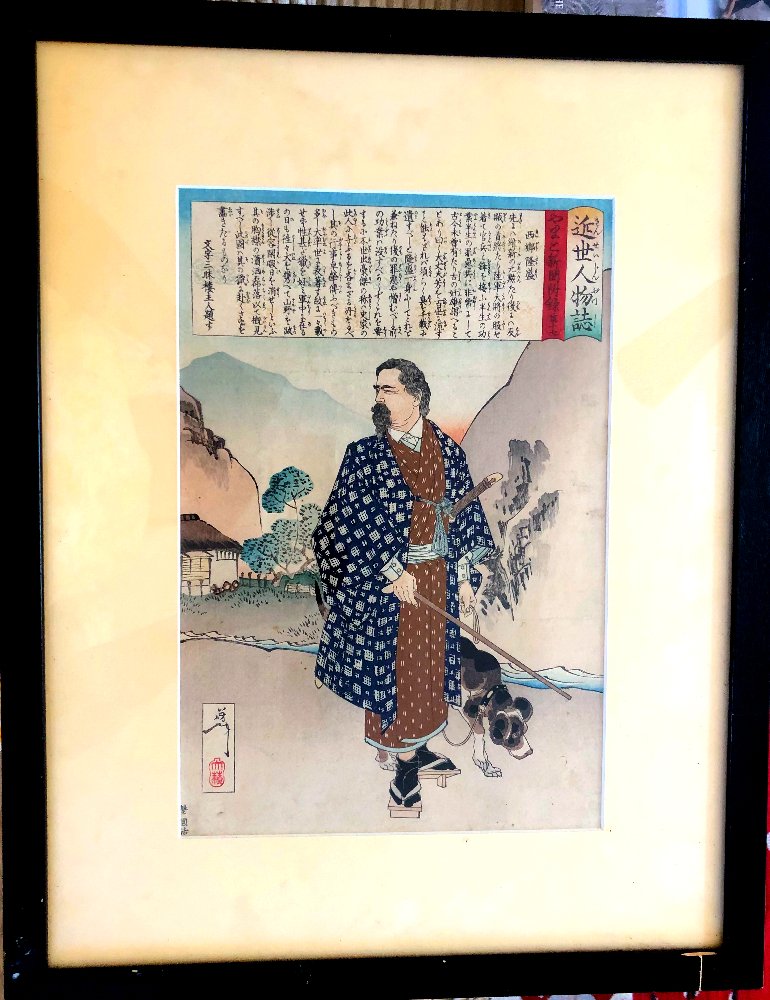
Japanese print (ukiyo-e) from the series “Biographies of Men of Modern Times” (Kinsei Jinbutsu Shi - 近現代人物誌), created in 1888 by the famous master Tsukioka Yoshitoshi (1839–1892). The text refers to Saigō Takamori (1828–1877), an iconic figure of the Meiji Restoration often nicknamed “the last samurai.” The print depicts Saigō in the guise of a Westerner (with European features and an imposing beard), dressed in traditional Japanese attire (kimono, haori, geta sandals), with a sword at his side, walking with his hunting dog, since no portrait of him exists.
This print was created in 1888, at the height of Japan’s rapid modernization (the Meiji era). The artist Yoshitoshi illustrates this cultural contrast through Saigō’s hybrid attire.
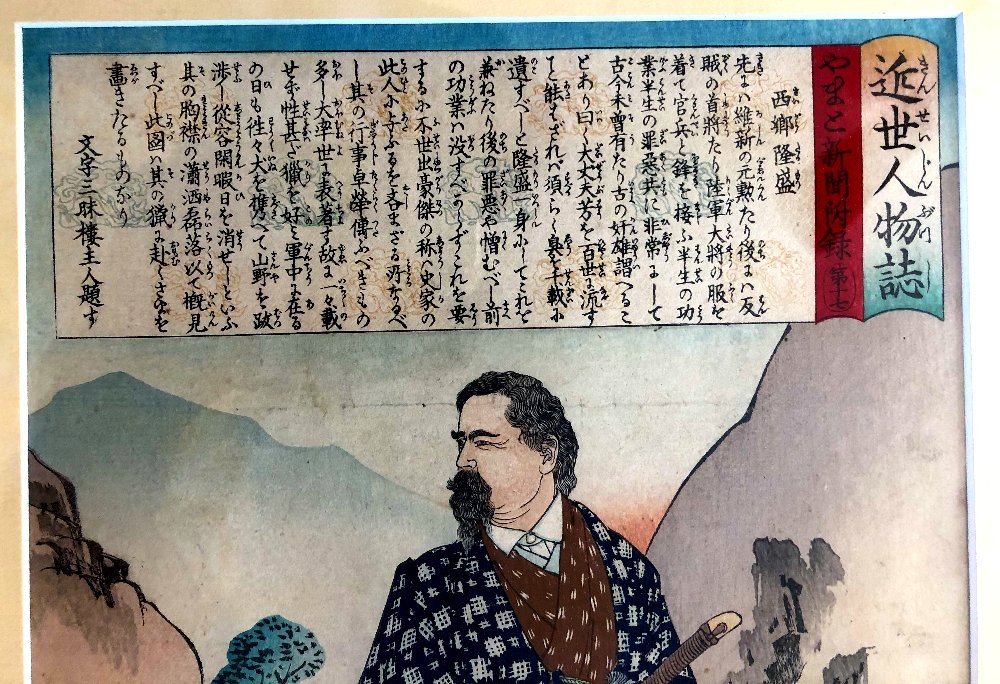
Transcription of the text: Saigo Takamori; He was first a great architect of the [Meiji] Restoration, then the leader of the rebels [during the Satsuma Rebellion]. Wearing his army general’s uniform, he crossed swords with government troops. The accomplishments of the first half of his life, as well as the crimes of the second, are extraordinary and unprecedented in history. A hero of old once said: “If a great man cannot leave a glorious name for a hundred generations, he must leave an infamous reputation for a thousand years.” Takamori embodied both of these fates in a single person. While we may deplore his later faults, we cannot erase his past exploits. In short, historians cannot deny him the title of a hero of rare historical significance. Since most of his deeds are already known to all, we will not list them here. He was passionately fond of hunting, and it is said that even in the midst of a military campaign, he would often take his dogs to roam the hills and valleys, thus spending his free time in complete serenity. This attests to the greatness and freedom of his spirit.
This print was created in 1888, at the height of Japan’s rapid modernization (the Meiji era). The artist Yoshitoshi illustrates this cultural contrast through Saigō’s hybrid attire.
Transcription of the text: Saigo Takamori; He was first a great architect of the [Meiji] Restoration, then the leader of the rebels [during the Satsuma Rebellion]. Wearing his army general’s uniform, he crossed swords with government troops. The accomplishments of the first half of his life, as well as the crimes of the second, are extraordinary and unprecedented in history. A hero of old once said: “If a great man cannot leave a glorious name for a hundred generations, he must leave an infamous reputation for a thousand years.” Takamori embodied both of these fates in a single person. While we may deplore his later faults, we cannot erase his past exploits. In short, historians cannot deny him the title of a hero of rare historical significance. Since most of his deeds are already known to all, we will not list them here. He was passionately fond of hunting, and it is said that even in the midst of a military campaign, he would often take his dogs to roam the hills and valleys, thus spending his free time in complete serenity. This attests to the greatness and freedom of his spirit.
This illustration depicts him as such, setting out on a hunt.
Written by the master of the Moji Sanmai-rō pavilion.”
450 €
Period: 19th century
Style: Asian art
Condition: Excellent condition
Material: Paper
Length: 32 cm/ 49 cm avec cadre
Width: 22 cm/ 39 cm avec cadre
Reference (ID): 1833197
Availability: In stock
Print