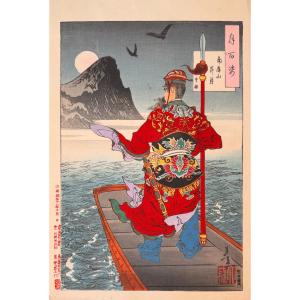
Japanese Print By Yoshitoshi: Moonrise Over Mont Nanping
Or: Cao Cao
Nanpeizan shogetsu - Soso
N°3 From the suite: Tsuki No hyakushi ( The Hundred Aspects of the Moon )
1885
Seal:Taiso
Engraver: Enkatsu
Oban
nishiki-e
Beautiful proof with fresh coloring.
This print is inspired by a famous episode from Sanguo yanyi, the novel of thethe Three Kingdoms, a semi-historical tale written in the 14th centurywidely read by modern Chinese.
It evokes the civil wars that toretorn China apart in the early 3rd century, when the Han Empire into three kingdoms.
The main character, Cao Cao (Sösõ in Japanese), was the son of in Japanese), was the son of a second-rate soldier. He made hisby crushing the Yellow Turbans revolt in 184. After drivingthe rebels out of Shandong province, in northeastern China, he soughtChina, he sought from that base to seize the imperial throne - he failedhe failed, but his son became the first emperor of the Wei dynasty. Cao Cao lived his life for intrigue and treachery, and althoughan anti-hero, he's one of the story's most appealing protagonists.protagonists of the story, portrayed as courageous and determined. seen here crossing the Changjiang (Yangtze or "Blue River") at nightRiver"), on the eve of the decisive battle of the Red Cliff. At theat the head of a fleet numbering some 830,000 men, he stands at thebow of his ship: Yoshitoshi signs a figure of admirable poise.
Fabric flutters in the wind, mist covers the river's waters.the river. The moon rises in the distance behind the cliff, and two ravens fly across the sky.in the sky.
In the novel, Cao Cao holds a grand banquet on the eve of battle.the eve of battle, in the company of his generals. Annoyed by the by the cawing of some ravens, he wants to know why the birdsbirds make this ominous cry in the night.because the full moon prevents them from sleeping. Quitedrunk, he dismisses the ominous omen by brandishing the large spearHe will triumph, he proclaims, as he has always triumphed. triumphed. One of his men reminds him that the circumstancesCao Cao kills him, then, in the suddenly gloomy atmospheresuddenly gloomy atmosphere, his orders for the battle. It will be a crushing defeat.defeat.
The cultivated Japanese of Yoshitoshi's time werewere familiar with such borrowings from the great Chinese literature,whose sovereign influence had permeated Japanese culture for centuries.centuries. One fifth of the stories illustrated in the series refer to China.China.
In the title cartouche, Cao Cao's name is carefullyCao is neatly written in regular classical Chinese characters.characters. According to a Chinese saying, "Let Cao Cao be mentioned, and Cao Caoappears"
In: ONE HUNDRED ASPECTS OF THE MOON, John STEVENSON, 2018, Editions Citadelles et MAZENOD
The sequel to "A Hundred Aspects of the Moon", inspired by historical storiesstories from China and Japan, is Yoshitoshi's most famous seriesYoshitoshi's most famous series, begun in 1885 and completed just before his death in 1892. Aeven then, every new print published was an event, as print runs oftenoften sold out on the morning of publication.
- Image width: 220.00
- Image height: 330.00
- Sheet width: 250.00
- Sheet height: 370.00
Period: 19th century
Style: Asian art
Condition: Good condition
Material: Paper
Width: 250 mm
Height: 370 mm
Reference (ID): 1742690
Availability: In stock