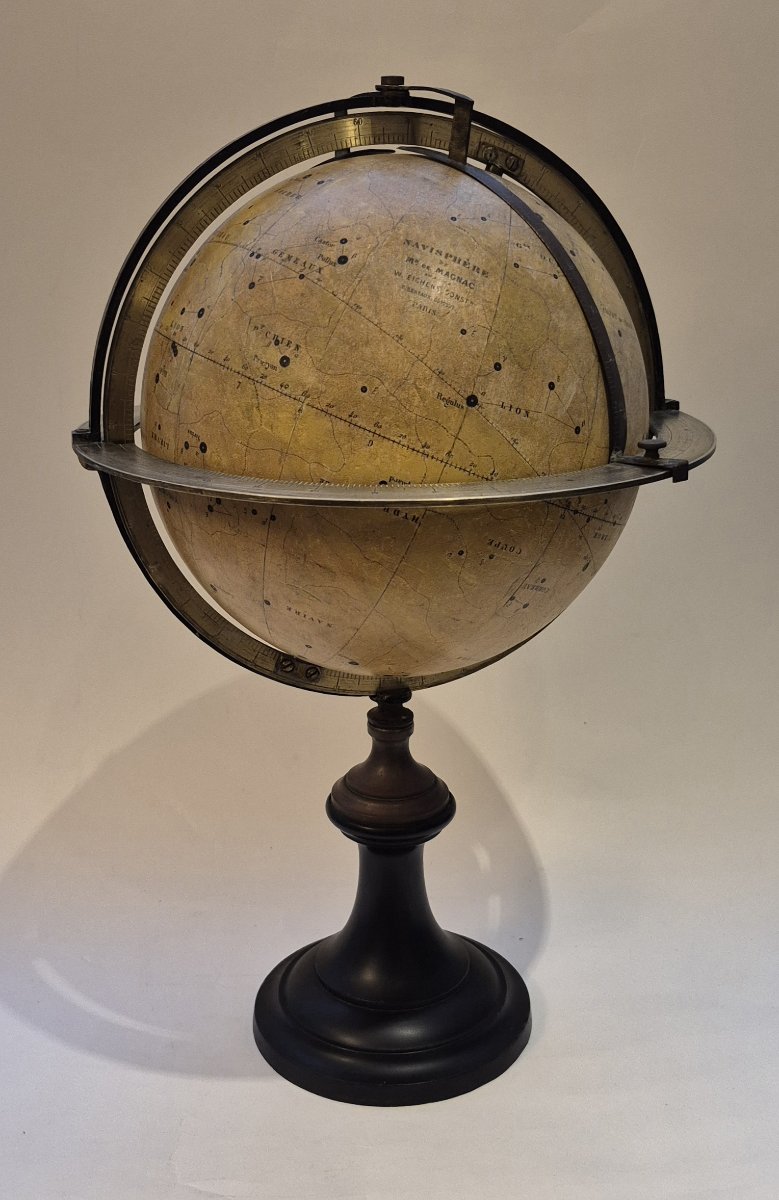
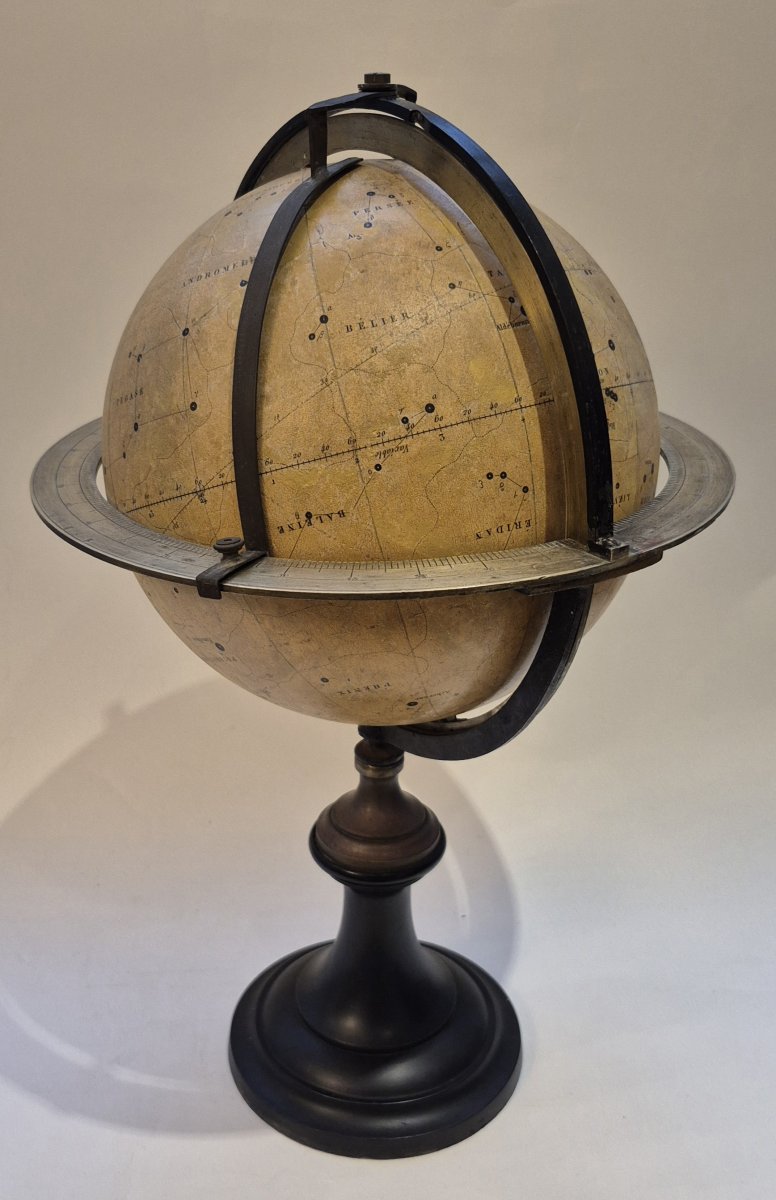


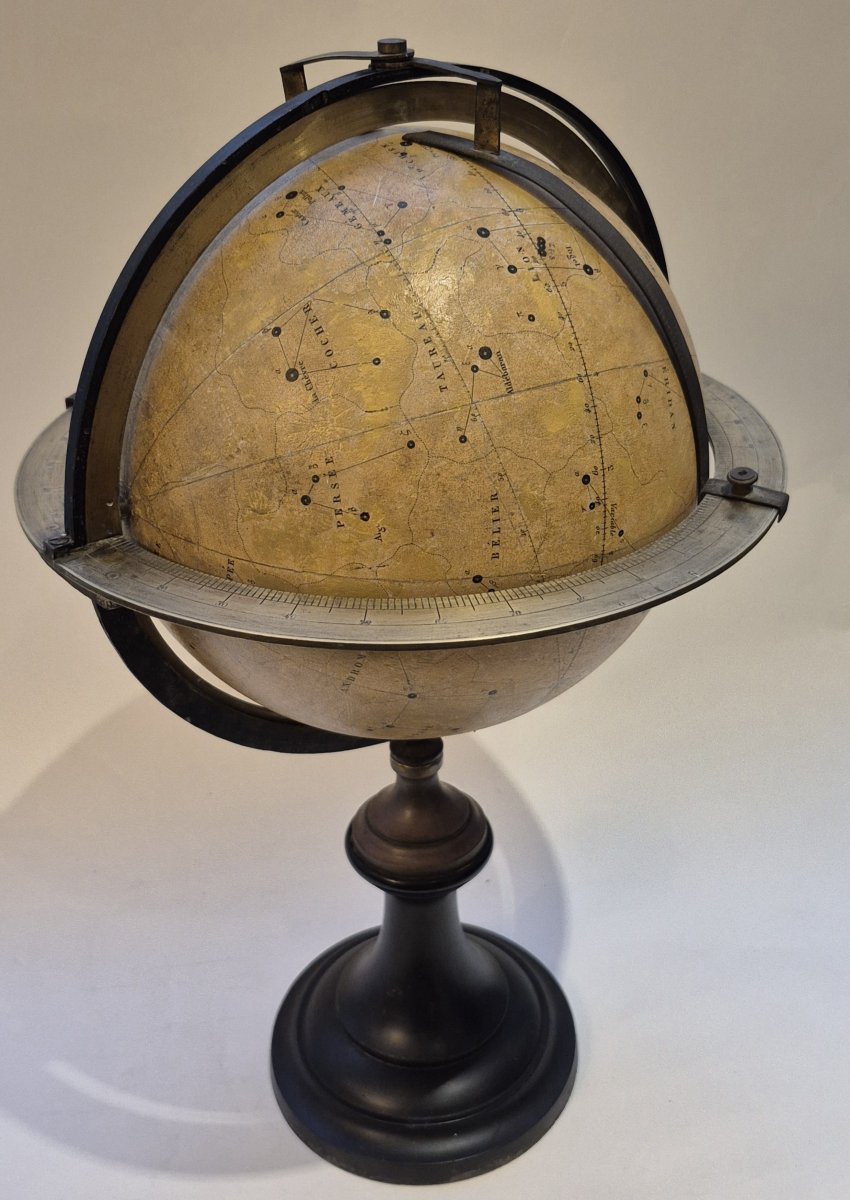

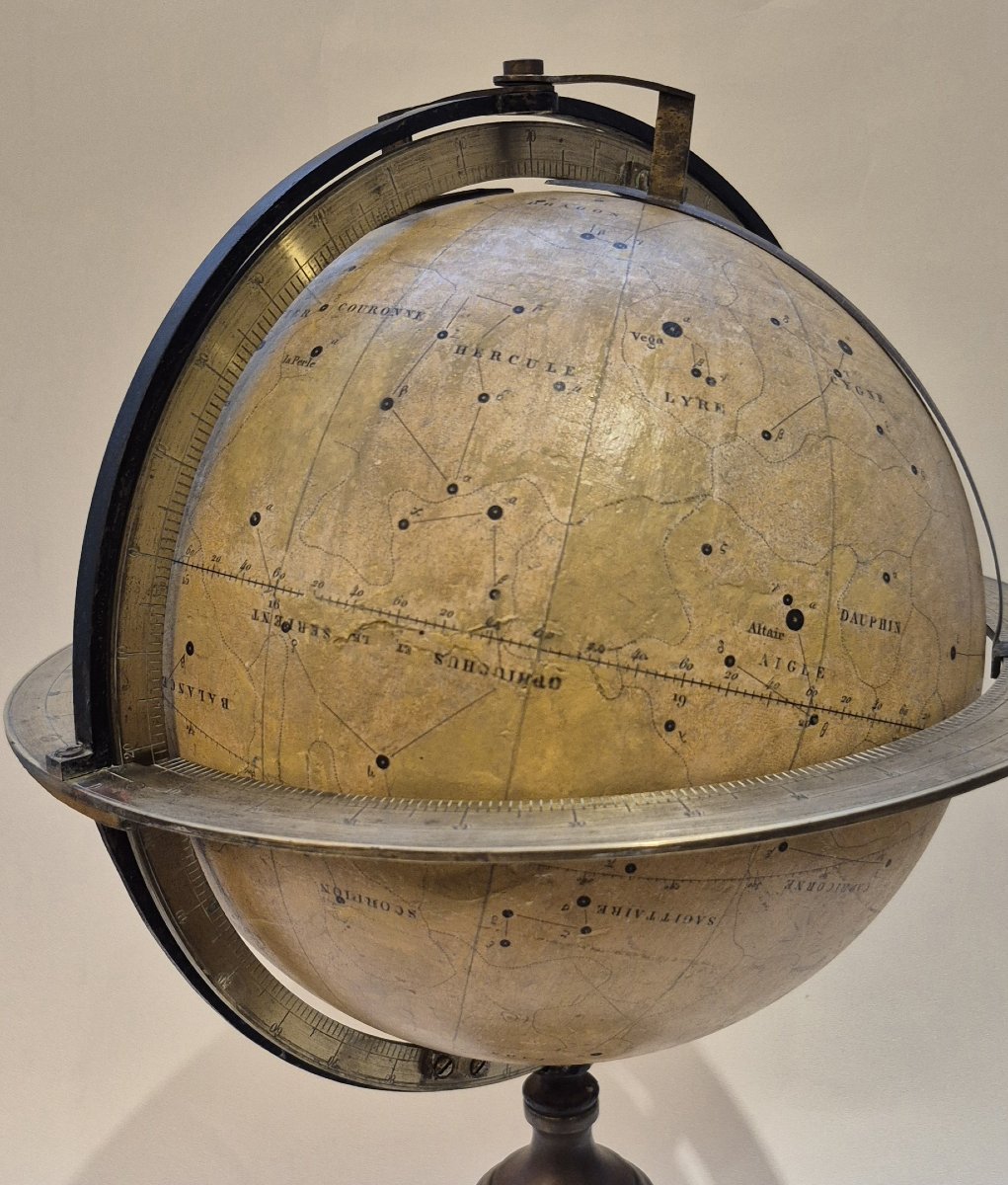


"navisphère De Magnac" By Eisen, Circa 1880
"A spherical nautical instrument with black-and-white prints, 22 cm in diameter and 34 cm in height. The sphere features two semicircles and a quarter circle made of copper, a copper arc with a shell, and is mounted on a wooden base with a metal cradle.
In 1879, Henry Julien Avec de Magnac was a lieutenant in the French Navy (where he eventually rose to the rank of captain in 1887) and also an inventor of nautical instruments. One of his most famous creations was designed that year: the Navisphère, nicknamed “Tête de Veau” by sailors. Faced with the need for sailors to make the most of all possible observations of the celestial bodies while navigating—in order to calculate their courses—he designed this spherical instrument, which allows users to identify celestial bodies and determine their altitude and azimuth. It could also be used for the sun, the moon, and the planets. De Magnac envisioned, in particular, the use of his instrument—published by Émile Bretaux—on board during overcast conditions, which prevented clear observation of the sky and made it difficult to calculate the altitudes of celestial bodies. The center of the celestial sphere is the Earth; the principal stars are depicted on it, as are the constellations, indicated by dotted lines. A copper arch surmounts the sphere to keep it in place during rolling motion. Before its publication, the instrument was tested during several round trips between France and Mexico but remains less common than terrestrial and celestial globes due to its specialized nature.” (see the BnF website).
The copper arch with a shell around the celestial globe is missing; a dent has been restored, but the cartography is perfectly legible.
Period: 19th century
Style: Other Style
Condition: Fully restored
Material: Paper
Reference (ID): 1830832
Availability: In stock