

Curiosa Drawing Lesbian Homosexuality 20th Century Ink And Watercolor Cahout Alice Rousseau Drouard
Artist: Cahout (pseudonyme D'alice Rousseau Drouard)
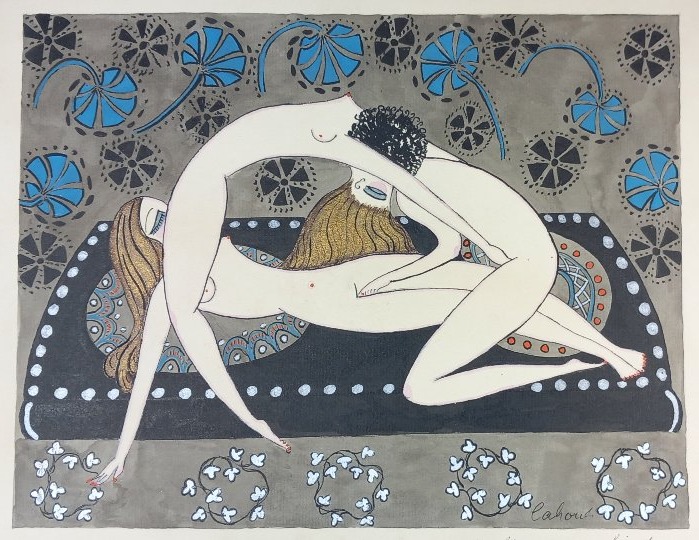
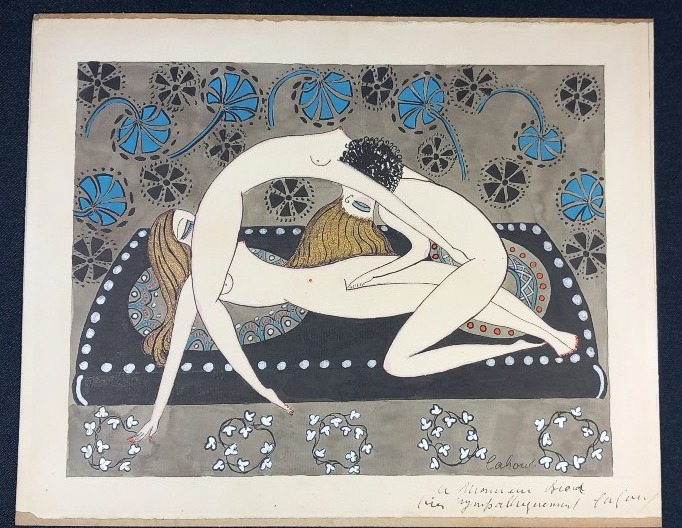
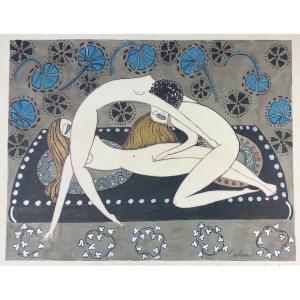
This drawing by Cahout (Alice Rousseau-Drouard) isin an erotic graphic style inspired by Art Deco and Jugendstil.
The drawing depicts three naked women entwined on a rugadorned with geometric patterns and white beaded borders. The three women, with chestnut and brown hair, are depictedengaged in a sexual act, in a swirling motion.
The gray background is richly decorated with floral andstylized plant motifs, including blue flowers or half-flowers with striped petals anddark rosettes and rosaces.
At the bottom of the composition is a frieze of small white stems andleaves. The work employs very precise black outlines and solid areasof color (blue, black, white, gold, gray).
The fluid lines and stylizationof the bodies are reminiscent of erotic illustrations from the 1920s and 1930s.
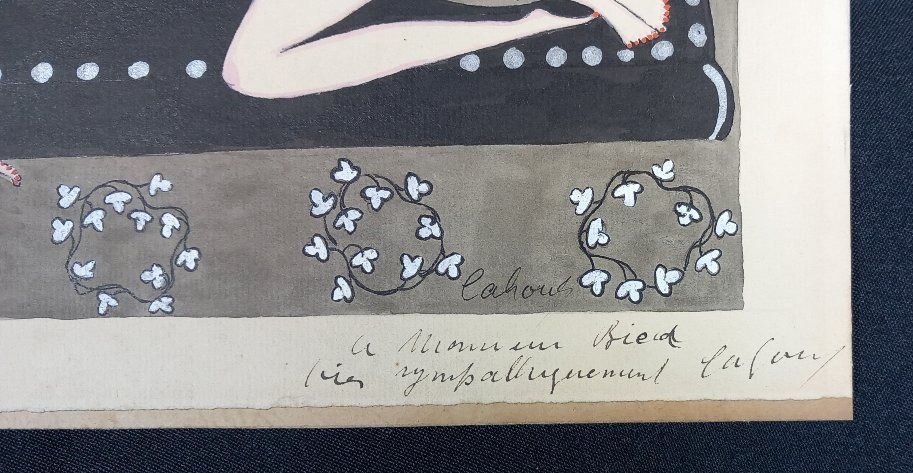
The signature “Cahout” appears in the lower right corner of the drawing. In the lower margin, the artist inscribed the following dedication:“To Mr. Biecot (?) with warm regards, Cahout.”
Dimensions: 31.8 x 25.7 cm
CAHOUT is the pseudonym of Alice Rousseau (1891–1957),wife of Raphaël Drouart Alice Rousseau was born in Vanves in 1891, the daughter of the editor-in-chiefof the newspaper “Le Temps,” described by the journalistHenry-Jacques as “slender, dark-haired, full of mischief and fire”;she adopted the nickname Cahout in reference to the rubber in her boots. Sheattended the Académie Ranson, an art school founded in Paris in 1908 by her unclePaul Ranson. Several Nabi artists taught there, including Maurice Denis. In 1914,she married Raphaël Drouart, whom she had met at the Académie Ranson. The couple, who were very close,exhibited together on several occasions, such as in 1922 at the GalerieE. Druet in Paris. In 1940, she moved with her husband to a town inPortes-en-Ré, where, far from the hustle and bustle of Paris, she devoted herself to her art andher loved ones. Cahout drew inspiration from her surroundings and nature, and also paintedportraits. As both a female artist and the wife of an artist, her work was praised at the timeby the press, which described one of her portraits: “Thesolidity of the composition […] in no way betrays a feminine hand. And allof this is intelligent, personal, and a great pleasure to behold.” Cahout passed away in 1976 at the artists’ retirement homein Nogent-sur-Marne, where she had retired with her husband in 1965.
The drawing depicts three naked women entwined on a rugadorned with geometric patterns and white beaded borders. The three women, with chestnut and brown hair, are depictedengaged in a sexual act, in a swirling motion.
The gray background is richly decorated with floral andstylized plant motifs, including blue flowers or half-flowers with striped petals anddark rosettes and rosaces.
At the bottom of the composition is a frieze of small white stems andleaves. The work employs very precise black outlines and solid areasof color (blue, black, white, gold, gray).
The fluid lines and stylizationof the bodies are reminiscent of erotic illustrations from the 1920s and 1930s.
The signature “Cahout” appears in the lower right corner of the drawing. In the lower margin, the artist inscribed the following dedication:“To Mr. Biecot (?) with warm regards, Cahout.”
Dimensions: 31.8 x 25.7 cm
CAHOUT is the pseudonym of Alice Rousseau (1891–1957),wife of Raphaël Drouart Alice Rousseau was born in Vanves in 1891, the daughter of the editor-in-chiefof the newspaper “Le Temps,” described by the journalistHenry-Jacques as “slender, dark-haired, full of mischief and fire”;she adopted the nickname Cahout in reference to the rubber in her boots. Sheattended the Académie Ranson, an art school founded in Paris in 1908 by her unclePaul Ranson. Several Nabi artists taught there, including Maurice Denis. In 1914,she married Raphaël Drouart, whom she had met at the Académie Ranson. The couple, who were very close,exhibited together on several occasions, such as in 1922 at the GalerieE. Druet in Paris. In 1940, she moved with her husband to a town inPortes-en-Ré, where, far from the hustle and bustle of Paris, she devoted herself to her art andher loved ones. Cahout drew inspiration from her surroundings and nature, and also paintedportraits. As both a female artist and the wife of an artist, her work was praised at the timeby the press, which described one of her portraits: “Thesolidity of the composition […] in no way betrays a feminine hand. And allof this is intelligent, personal, and a great pleasure to behold.” Cahout passed away in 1976 at the artists’ retirement homein Nogent-sur-Marne, where she had retired with her husband in 1965.
800 €
Period: 20th century
Style: Art Deco
Condition: En l'etat
Material: Paper
Reference (ID): 1828893
Availability: In stock
Print