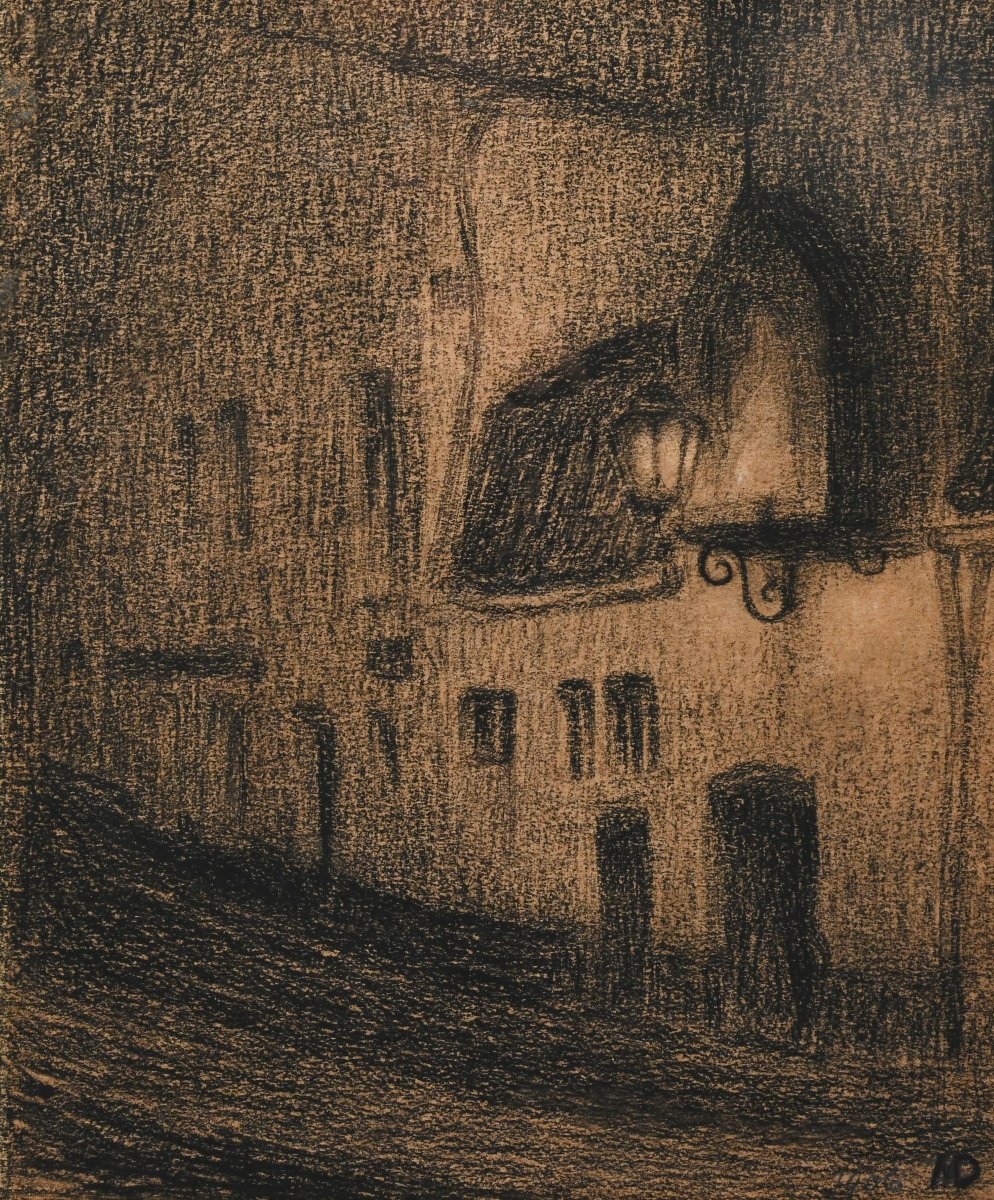
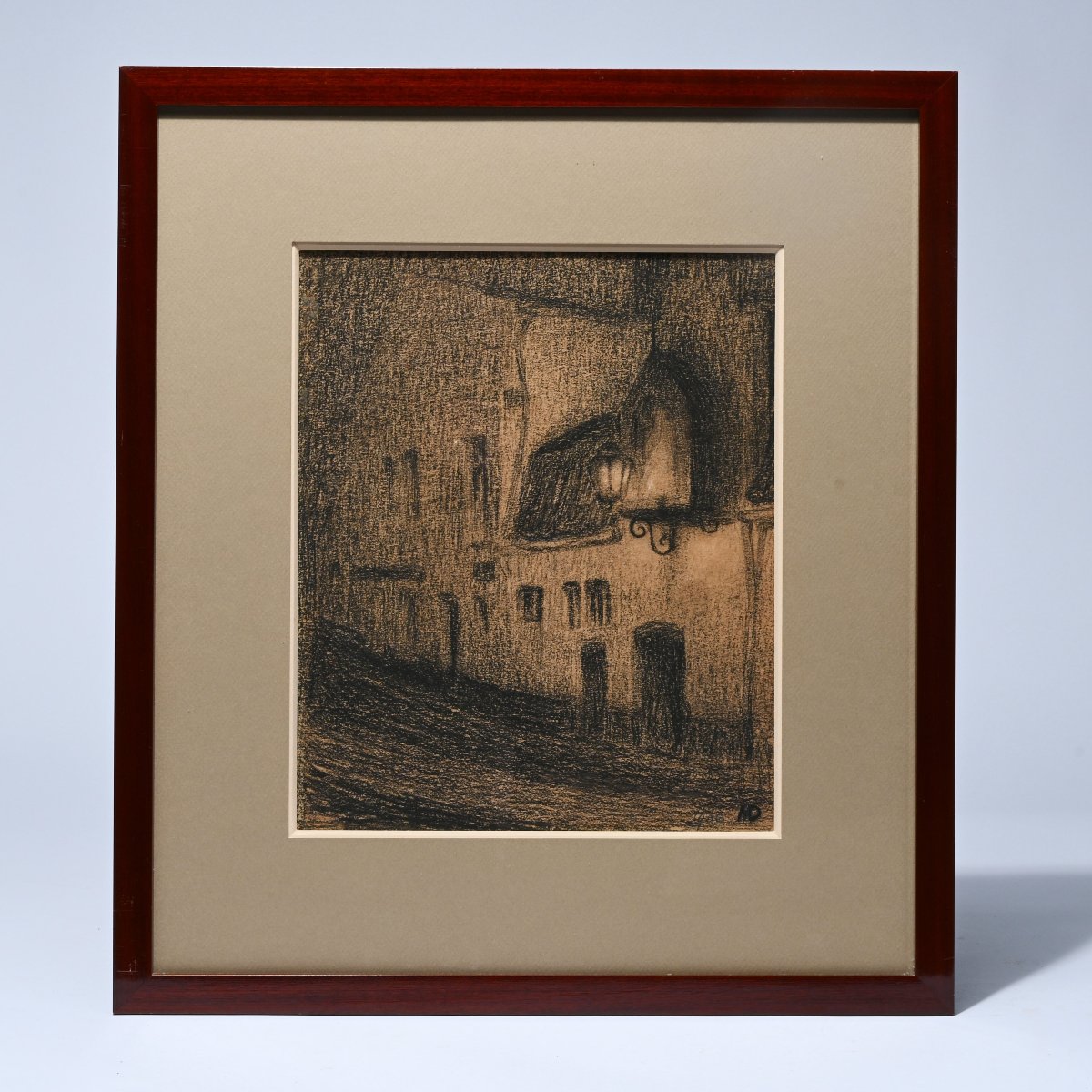
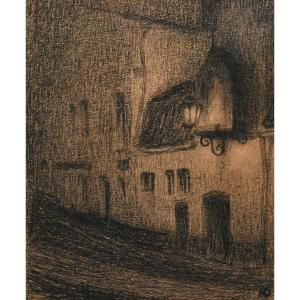


Maurice Dupuis (1882–1959), *old Facades*, 1906, Charcoal Drawing On Display At The Ghent Museum
(Ghent, 1882–1959)
Old Facades (Oude gevels), 1906
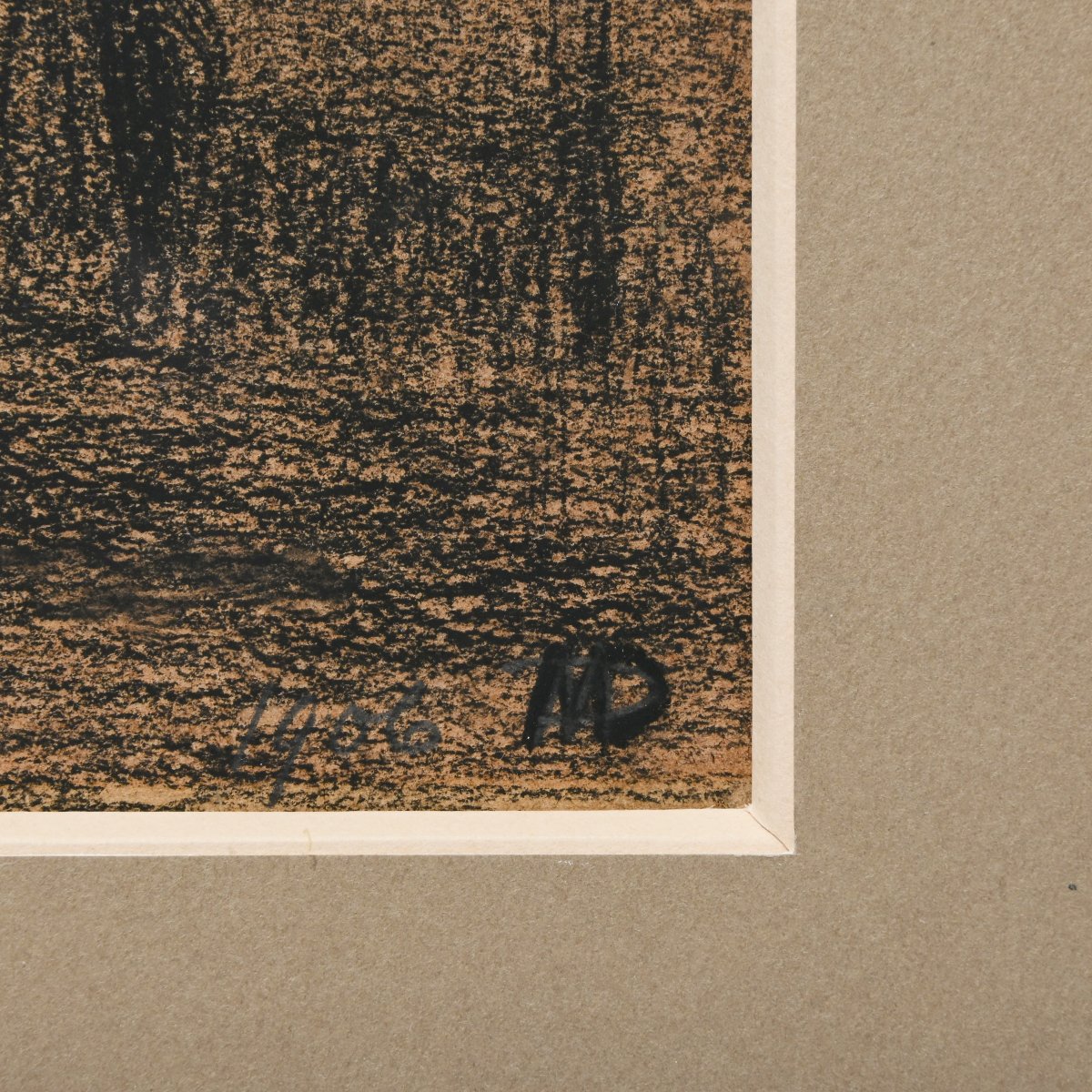
Charcoal on paper, monogrammed “MD” and dated in the lower right corner
29.5 × 24.5 cm
Provenance
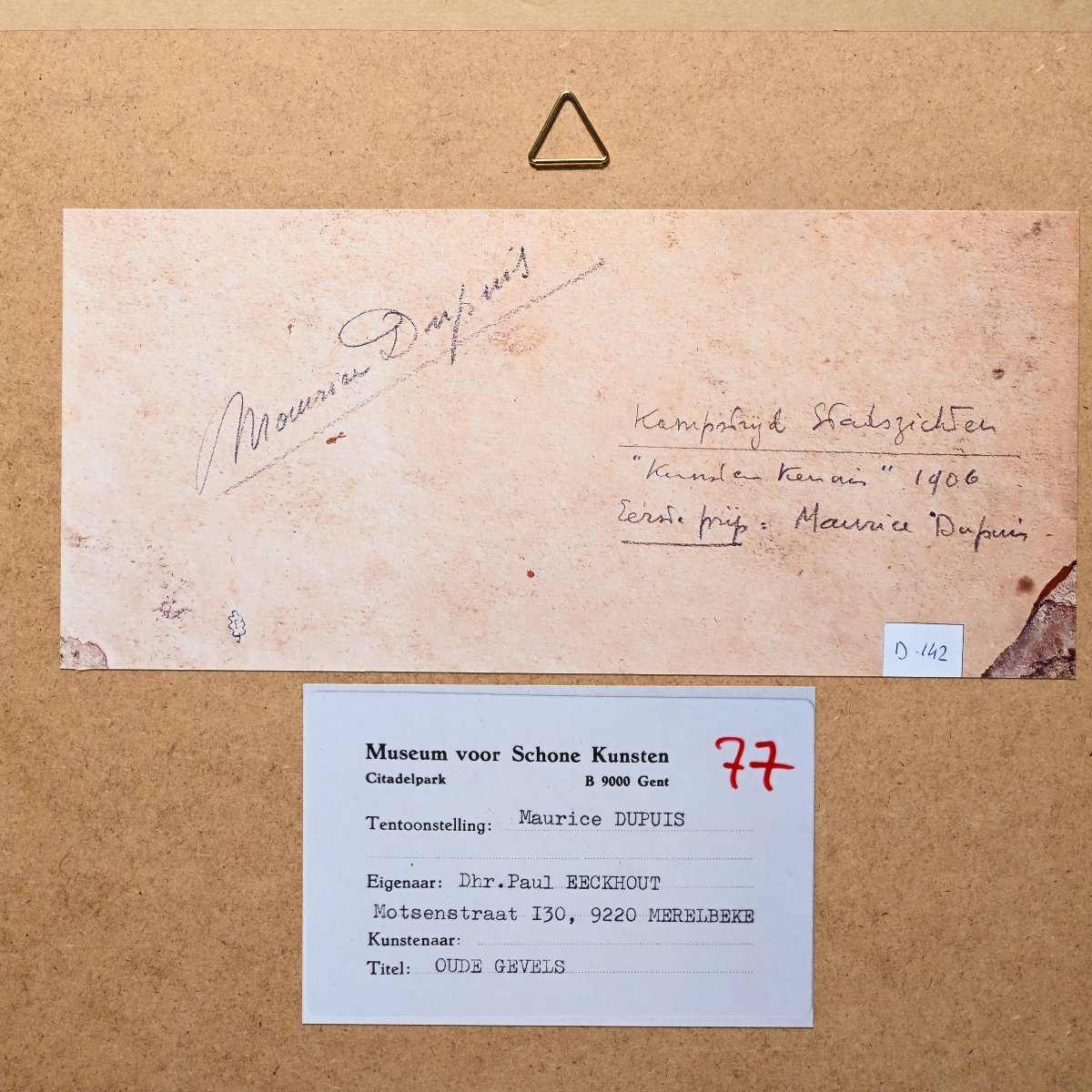
Former collection of Paul Eeckhout, director of the Ghent Museum of Fine Arts from 1948 to 1982, according to the label preserved on the reverse.
Exhibition
Ghent, Museum voor Schone Kunsten, Tribute to Maurice Dupuis 1882–1959, May 1–June 13, 1982, No. 77
A street winds its way between tall facades, while a streetlamp, supported by the scrollwork of an iron railing, stands out against a lighter-colored wall. From this seemingly modest motif, Maurice Dupuis creates a composition of great intensity. The diagonal of the street draws the eye into the distance, the dark openings give rhythm to the architecture, and the rooftops blend into the shadows. More than a mere description of the setting, the drawing evokes an atmosphere: that of a silent city, whose walls seem to hold onto something of the lives that have passed through them.
Here, charcoal fully exploits its unique qualities. At times dense and velvety, at other times light, allowing the warm tone of the paper to show through, it gives the surfaces an almost tactile quality. Details are carefully chosen rather than piled on: an arched doorway, a few windows, the curve of a gallows—these are enough to bring a whole world to life. The architecture retains its concrete presence but also becomes the vehicle for a poetic evocation. While there is no need to formally link the drawing to Symbolism, its contemplative atmosphere and its forms—partially absorbed by shadow—invite us to associate it with that fin-de-siècle sensibility that saw places as an extension of inner life.
Dated 1906, the work belongs to Dupuis’s early period. An old inscription, reproduced on the back of the frame, indicates that it won first prize that year in the “Kunst en Kennis” urban landscape competition. Founded in 1895 for students and alumni of the Ghent Academy, this association organized competitions, exhibitions, and lectures. This award thus situates the drawing within the context of artistic training and emulation where the young artist developed his vision. It also attests to the attention paid, within this context, to an everyday subject treated with genuine artistic ambition.
A painter, draftsman, and engraver, Maurice Dupuis remains closely associated with the artistic life of Ghent. Introduced to the Academy at a very young age as part of Jean Delvin’s circle, he also worked in the Phoenix mechanical engineering workshops, where he learned technical drawing. His career thus combines practical professional experience with a consistently pursued artistic practice. Familiar figures, interiors, still lifes, and street scenes occupy a prominent place in his work. Through these intimate subjects, Dupuis focuses less on anecdotal detail than on the presence of people, the materiality of objects, and the quality of the atmosphere. Several of his paintings are now housed at the Museum of Fine Arts in Ghent, an institution where he himself served as curator.
The history of this drawing is closely linked to that of the museum. It belonged to Paul Eeckhout, who directed the institution from 1948 to 1982 and played a significant role in expanding its collections. This provenance, therefore, goes beyond a mere reference to a private collector: it links the drawing to a connoisseur who was particularly committed to the preservation and study of Ghent’s artistic heritage.
In 1982, the centennial of Dupuis’s birth, the drawing was featured as item number 77 in the museum’s exhibition dedicated to him. Paul Eeckhout was also, along with Rik Clément, the author of the catalog Hulde aan Maurice Dupuis 1882–1959. The owner of the drawing thus participated directly in the work of preserving the artist’s legacy and conducting research on him. Preserved on the back of the frame, the loan label serves as tangible evidence of this stage in the artwork’s history.
Through its masterful use of charcoal, its atmosphere, and its well-documented history, *Vieilles façades* offers a sensitive introduction to the world of Maurice Dupuis. It invites viewers to discover, behind a modest name, an artist capable of imbuing a fragment of a street with the depth of a memory, and to rediscover that attention to ordinary places that constitutes one of the charms of European drawing at the turn of the 20th century.
Period: 20th century
Style: Modern Art
Condition: Good condition
Material: Paper
Width: 24,5
Height: 29,5
Reference (ID): 1828372
Availability: In stock