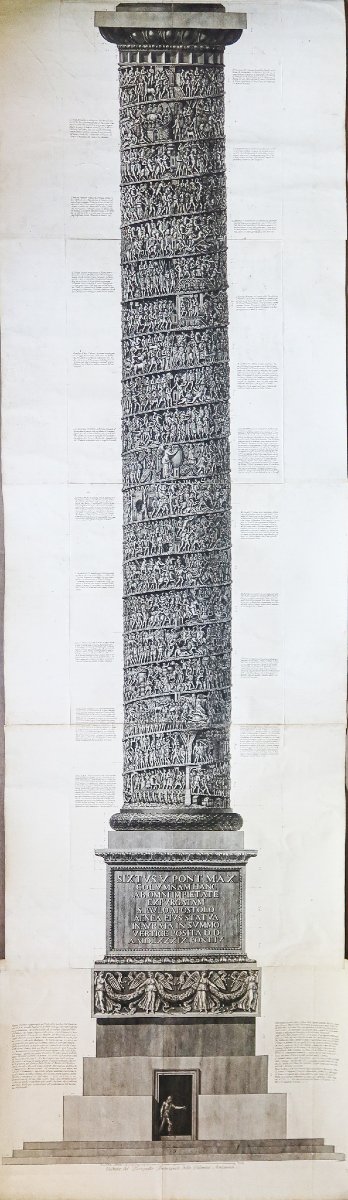
Antonin Column - Piranesi - Rome
5 engravings joined and mounted on Japanese paper.
Dimensions of the Antonine Column: 267 x 76 cm.
You can view allthe maps, books, and engravings available for your region by clicking on thelink to our website specializing in historical archives: https://cartes-livres-anciens.com/categorie-produit/estampes/architecture-design/
Secure payment by creditcard on our website by clicking the link below: https://cartes-livres-anciens.com/produit/estampes/architecture-design/colonne-antonin-gravure-ancienne/
Allour prints and engravings come with a certificate of authenticity.
A finely engraved large-format print faithfully depicting the Antonine Column in Rome. It was produced and distributed by Piranesi at a time when the study of art history and Roman antiquity was flourishing.
The texts engraved in the margins of the column attest to this: Piranesi traces the history of the monument and provides a description of it (at the base of the column), then offers an analysis based on the scenes depicted in the column’s bas-reliefs.
The Antonine Column was erected in the square that today bears its name: Piazza Colonna. It was built between 180 and 193 A.D. at the initiative of the Senate and completed by Emperor Commodus to honor his father, Marcus Aurelius.
Directly inspired by Trajan’s Column, it commemorates Marcus Aurelius’s victories during the Marcomannic Wars against the Germanic and Sarmatian tribes along the Danube.
An exceptional large-scale engraved depiction; actual size 38 meters, document size 2.94, or 1/13 scale.
Giovanni Battista Piranesi (1720–1778) was an Italian engraver, architect, and art theorist, born in Mogliano Veneto near Venice and died in Rome.
He is best known for his etchings depicting the ruins of ancient Rome and for his imaginary compositions known as *Carceri d’invenzione* (“Imaginary Prisons”), which left an indelible mark on art history with their monumental and fantastical atmosphere.
Settling in Rome in the 1740s, Piranesi studied ancient architecture and developed a highly detailed style, playing on the contrasts of light and shadow. His series of engravings, notably *Vedute di Roma*, helped spread the grandiose image of Rome throughout Europe, particularly among travelers on the Grand Tour.
His work blends archaeological precision with dramatic imagination, making him one of the greatest engravers of the 18th century.
He worked with his son Francesco Piranesi, who would continue his work after his death in 1778.
Period: 18th century
Style: Rome and Antic Greece
Condition: Excellent condition
Material: Paper
Reference (ID): 1823487
Availability: In stock