

Pietro Baschenis (bergamo, 1590–1600 – 1630), Pair Of Fantastic Landscapes
Pietro Baschenis (Bergamo, 1590-1600 – 1630)
Pair of fantastic landscapes
Detached fresco applied to canvas, 97 x 143 cm
This pair of detached frescoes on canvas constitutes a testimony of great interest within the profane and decorative production of Pietro Baschenis (ca. 1590 – 1630), among the most fruitful and up-to-date representatives of the famous dynasty of painters originally from Averara, active for generations in the Bergamo area and in the Alpine valleys.
Originally from the hamlet of Colla in Santa Brigida, in the Averara Valley in the province of Bergamo, the Baschenis dynasty constituted for over two centuries —between the mid-fifteenth century and the end of the seventeenth century— one of the most industrious and emblematic workshops of itinerant painters and fresco painters in the Alpine valleys of Lombardy and Trentino. Historically divided into the two main branches of the Lanfranco and Cristoforo families, the family has passed down from father to son a figurative language of immediate popular influence, specialized mainly in fresco mural decoration for churches, oratories and rural sanctuaries. This complex family tree includes Pietro Baschenis (Bergamo, ca. 1590 – 1630), great-grandson of Christopher the Elder and son of Antonio, among the first members of the dynasty to be born directly in the capital of Bergamo rather than in the valley of origin. Trained in the family workshop but attentive to the influences of contemporaries active in Bergamo between the sixteenth and seventeenth centuries —such as Gian Paolo Cavagna, Enea Salmeggia and Francesco Zucco —, Pietro consolidated his economic and professional position also thanks to his successful marriage to Clara Porta, daughter of the famous stucco artist of Lugano origin Lorenzo Porta. This kinship gave him access to important commissions both in sacred art and in secular decorative complexes for the city's nobility, before he died prematurely during the devastating plague epidemic of 1630. Pietro historically represents the last great interpreter of the tradition of the Baschenis family's fresco painters, anticipating the era of Evaristo Baschenis, who would soon link the family name to the famous still life and musical instrument painting.
Freed from the devotional register typical of altar painting and the sacred cycles that the artist widespread throughout the countryside, the two panels belong entirely to the field of interior decoration for noble and bourgeois patrons of the early seventeenth century. These fully reflect the success of inventive landscape painting, conceived as a narrative insert and "figurative escape" within multiple complex wall systems for urban palaces or villa residences.
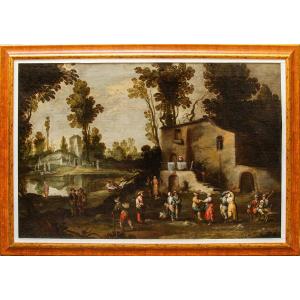
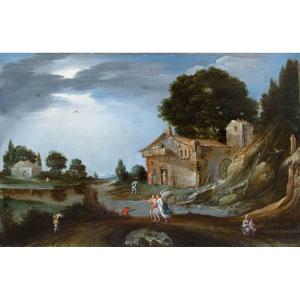
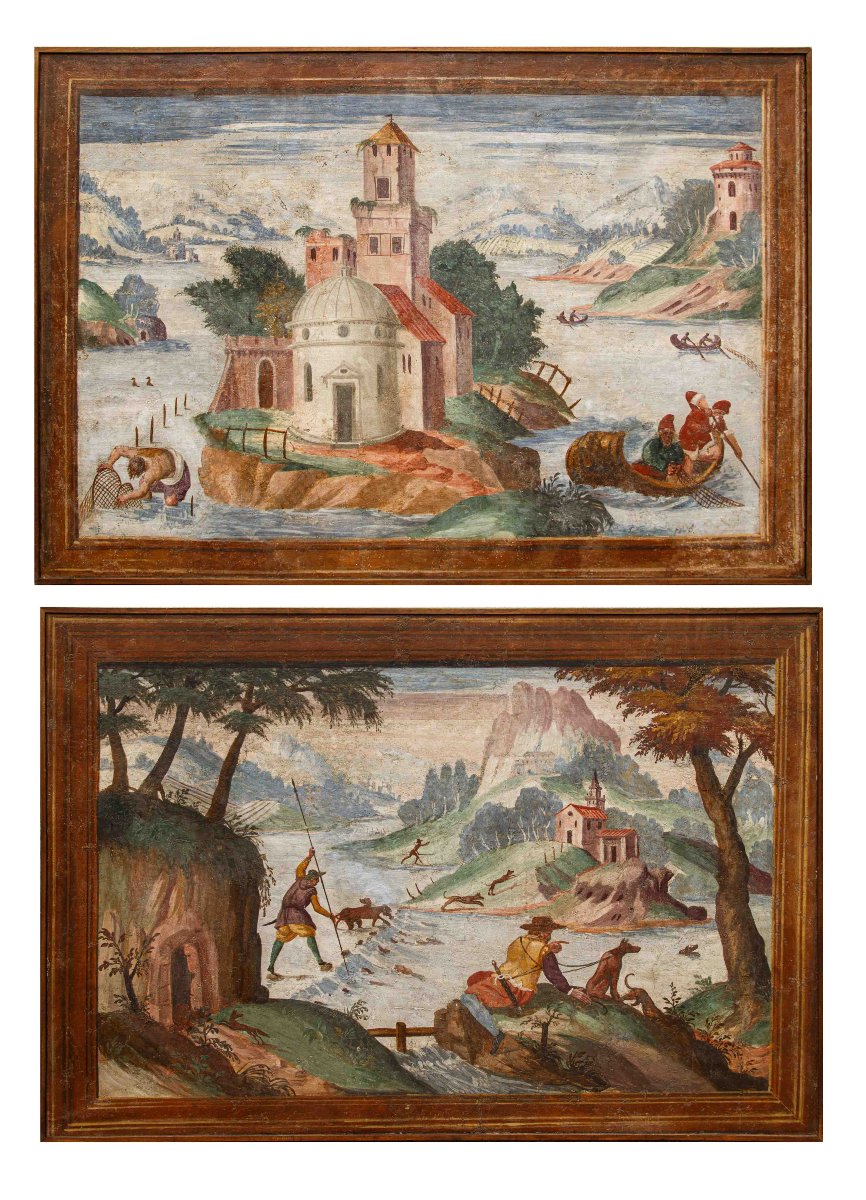
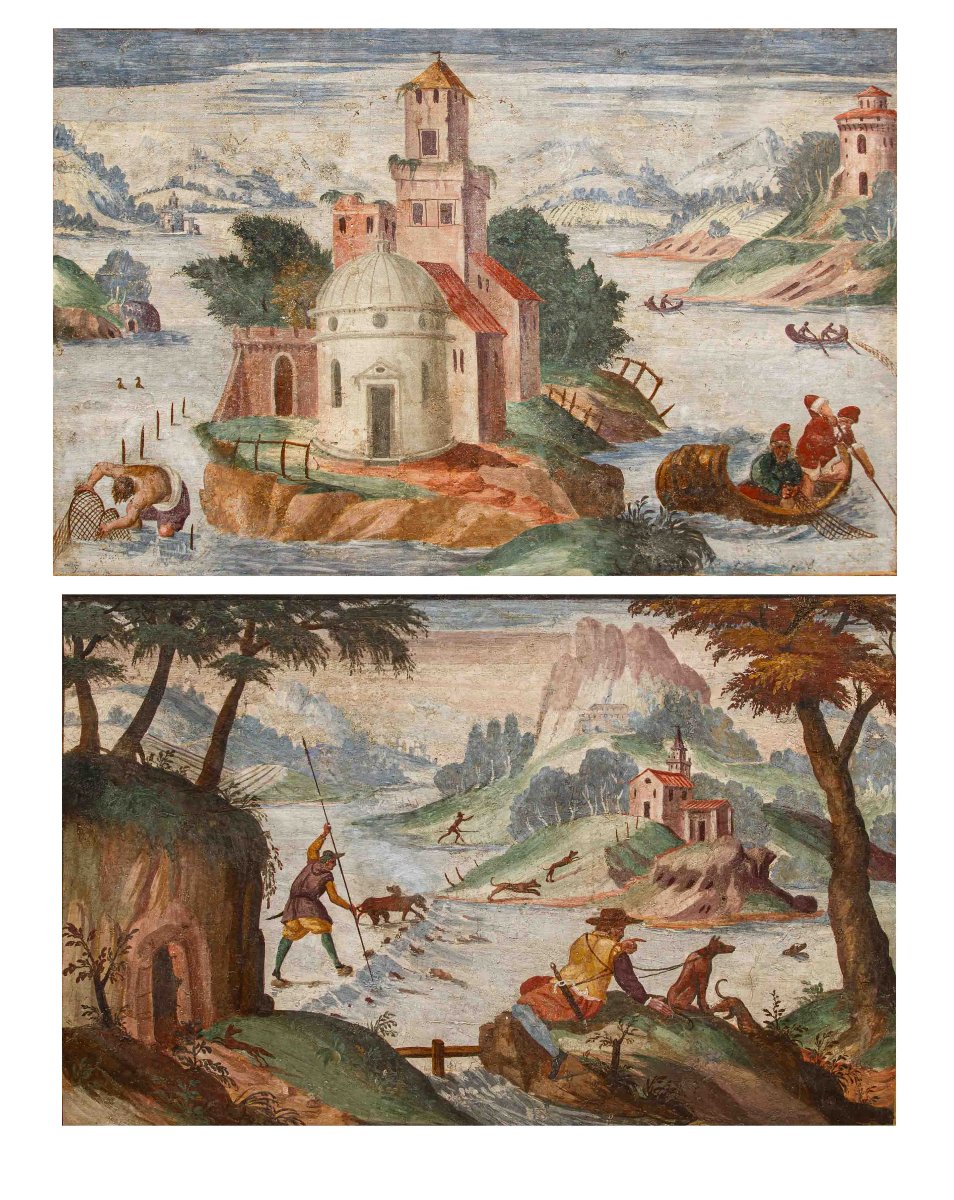
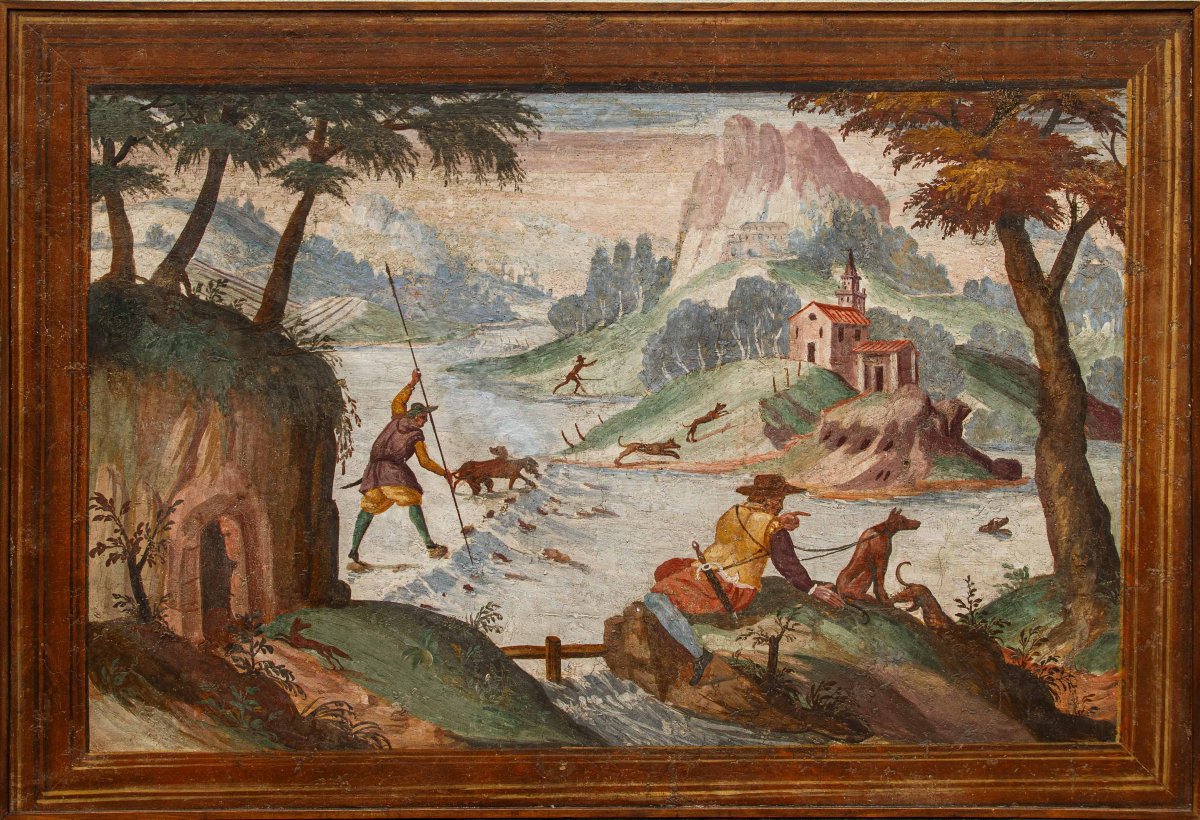
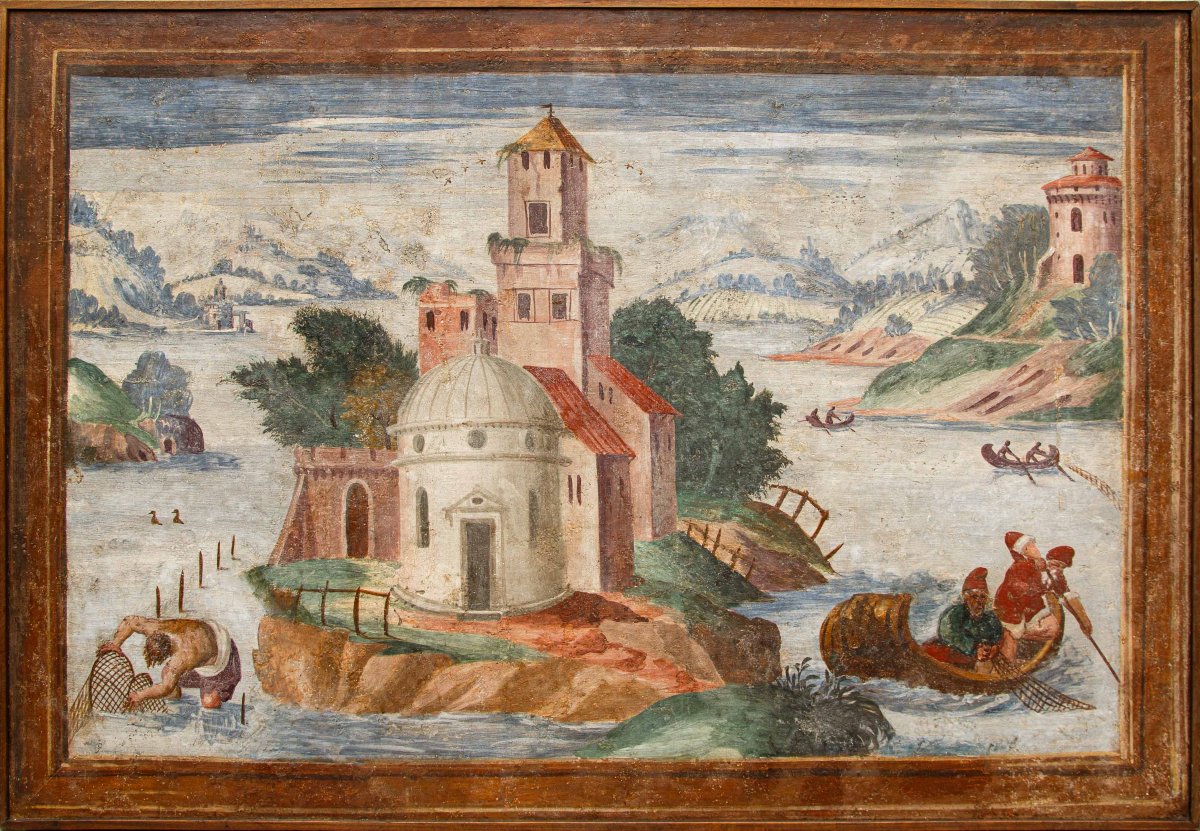
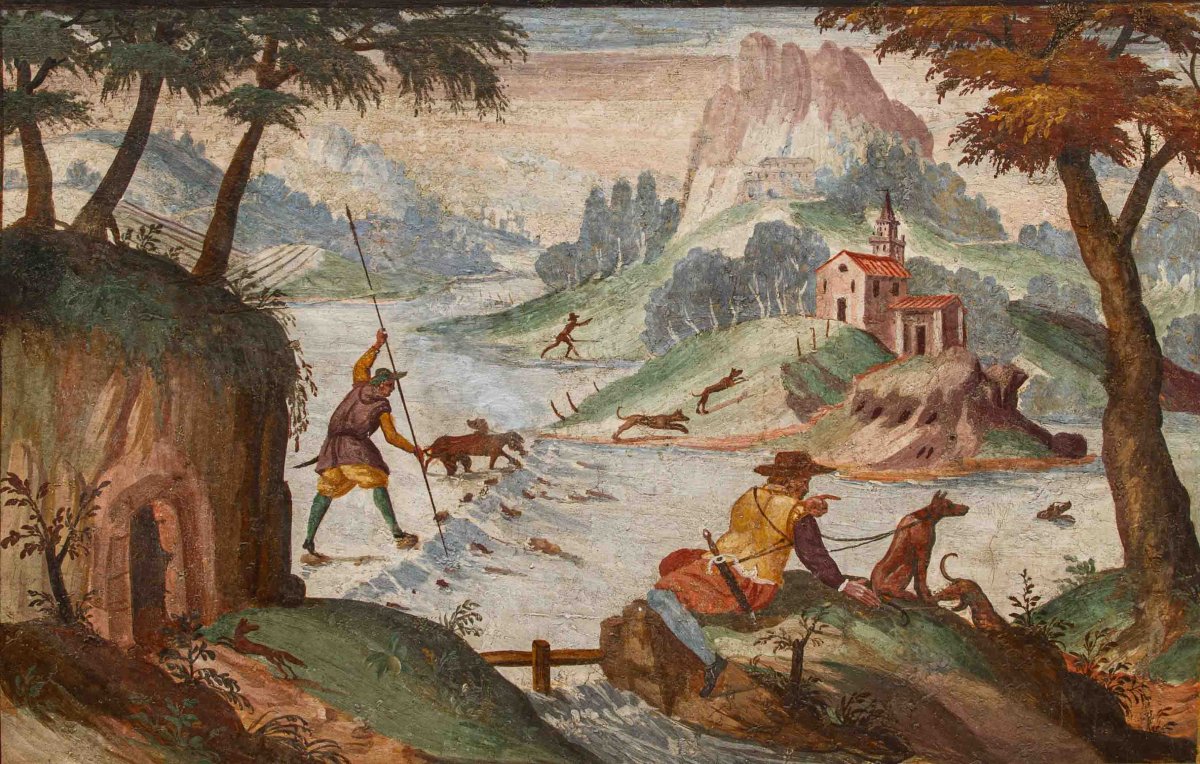
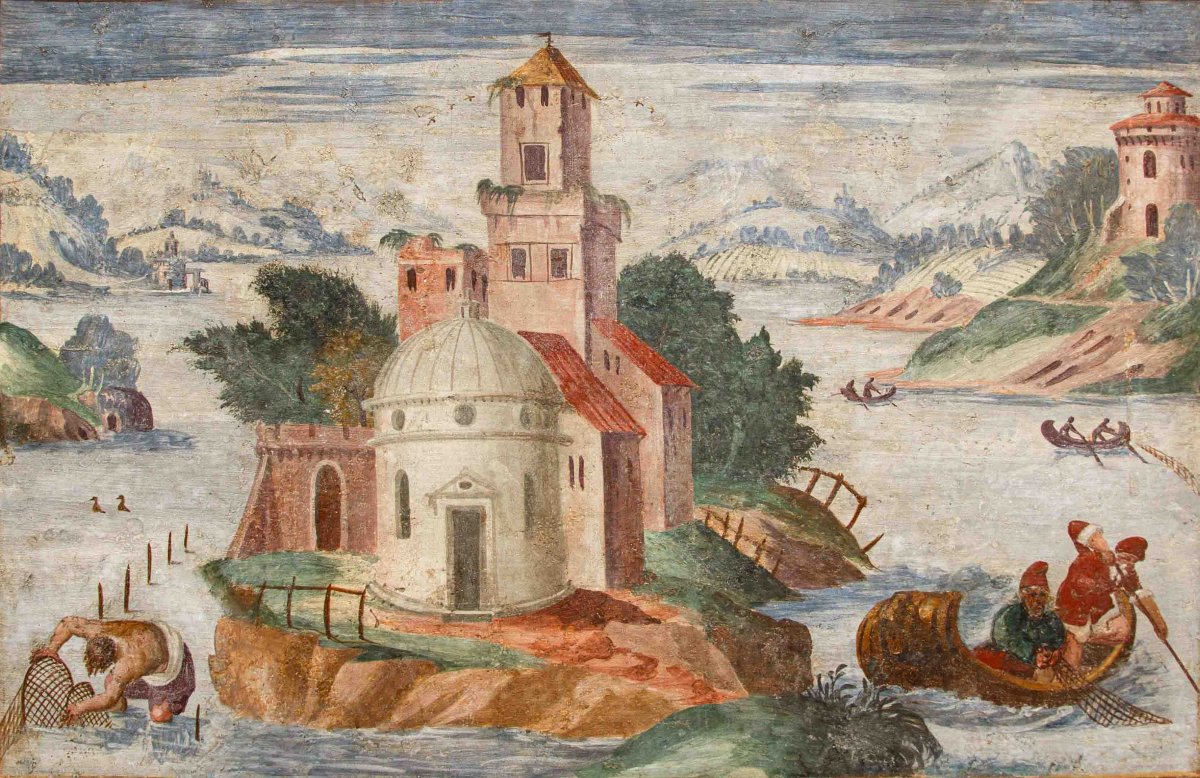
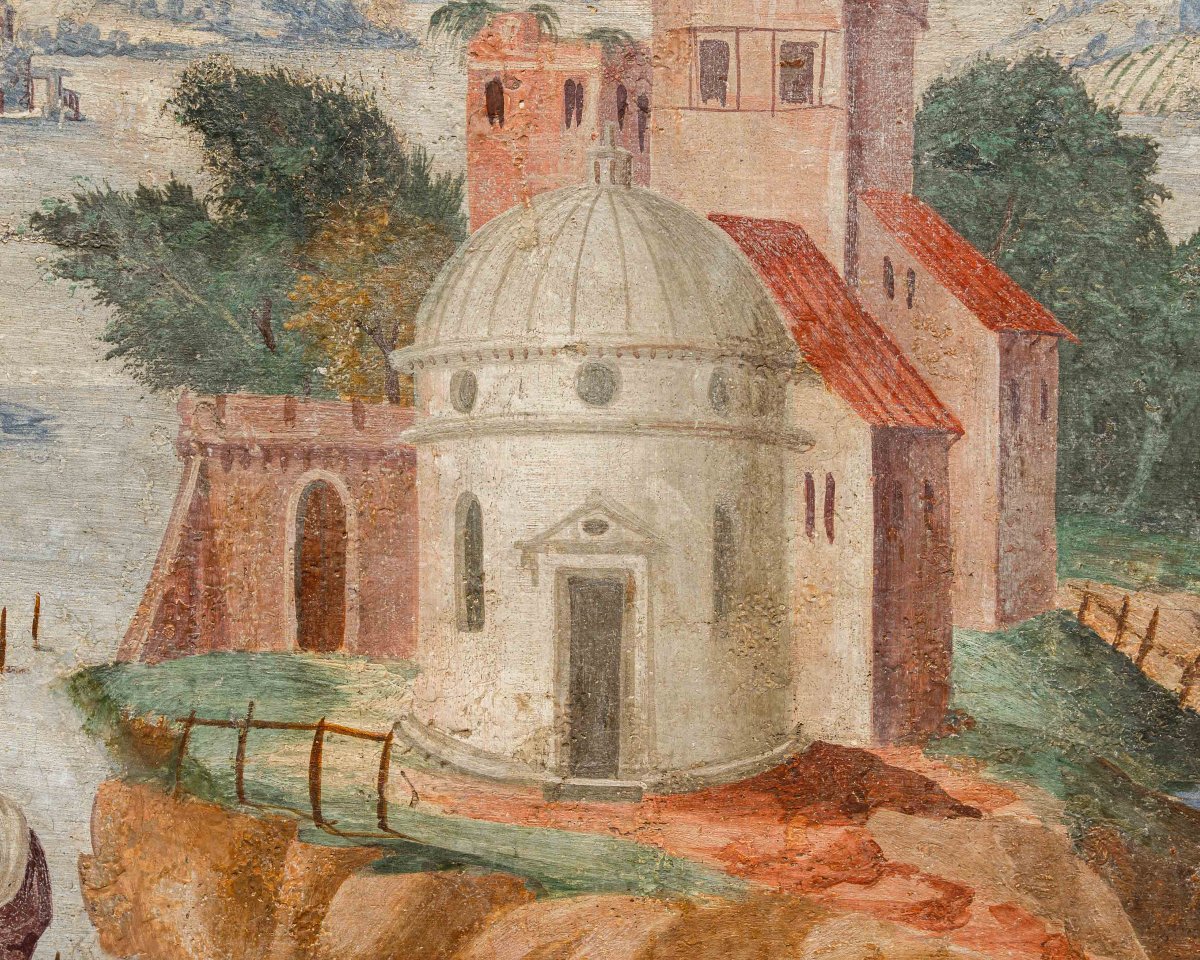
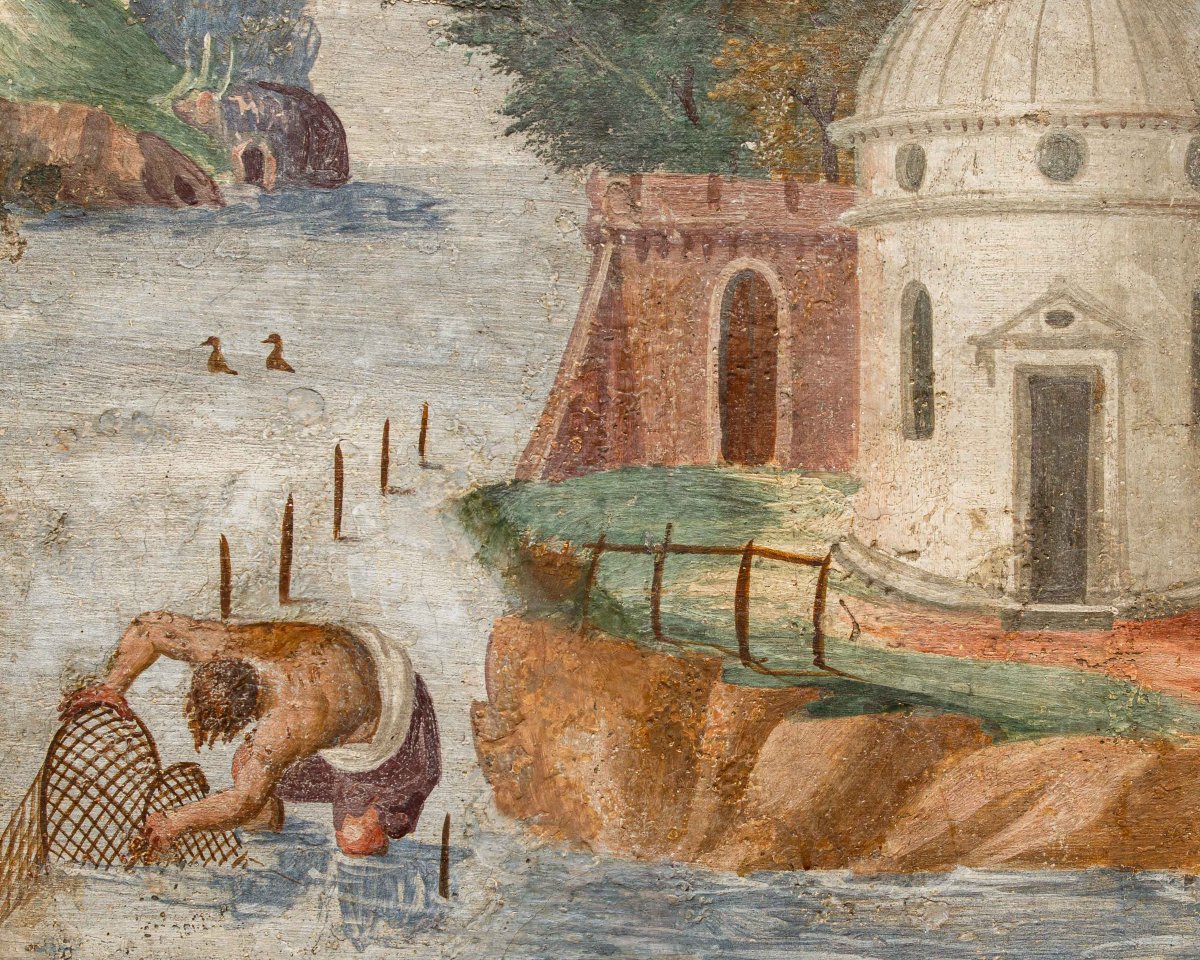
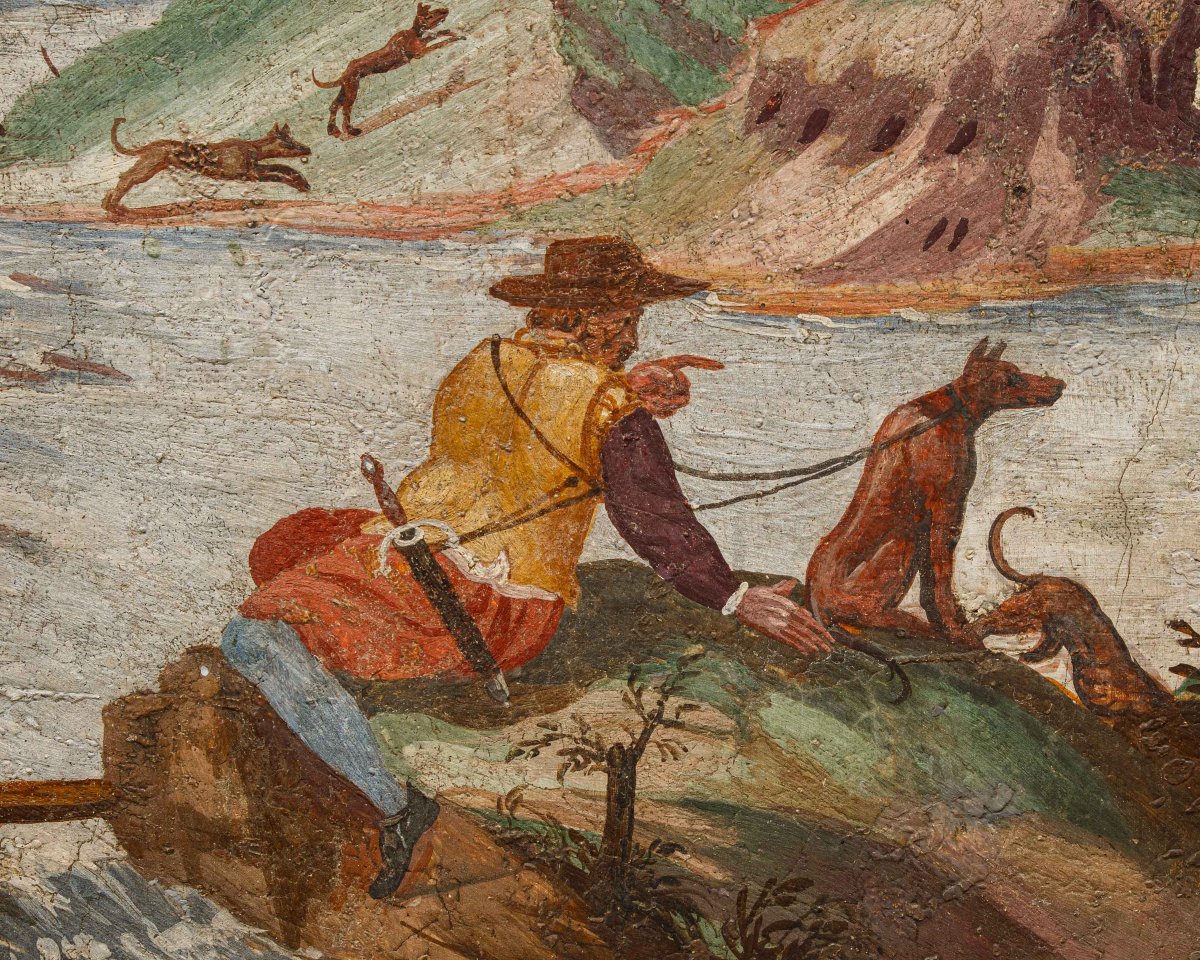
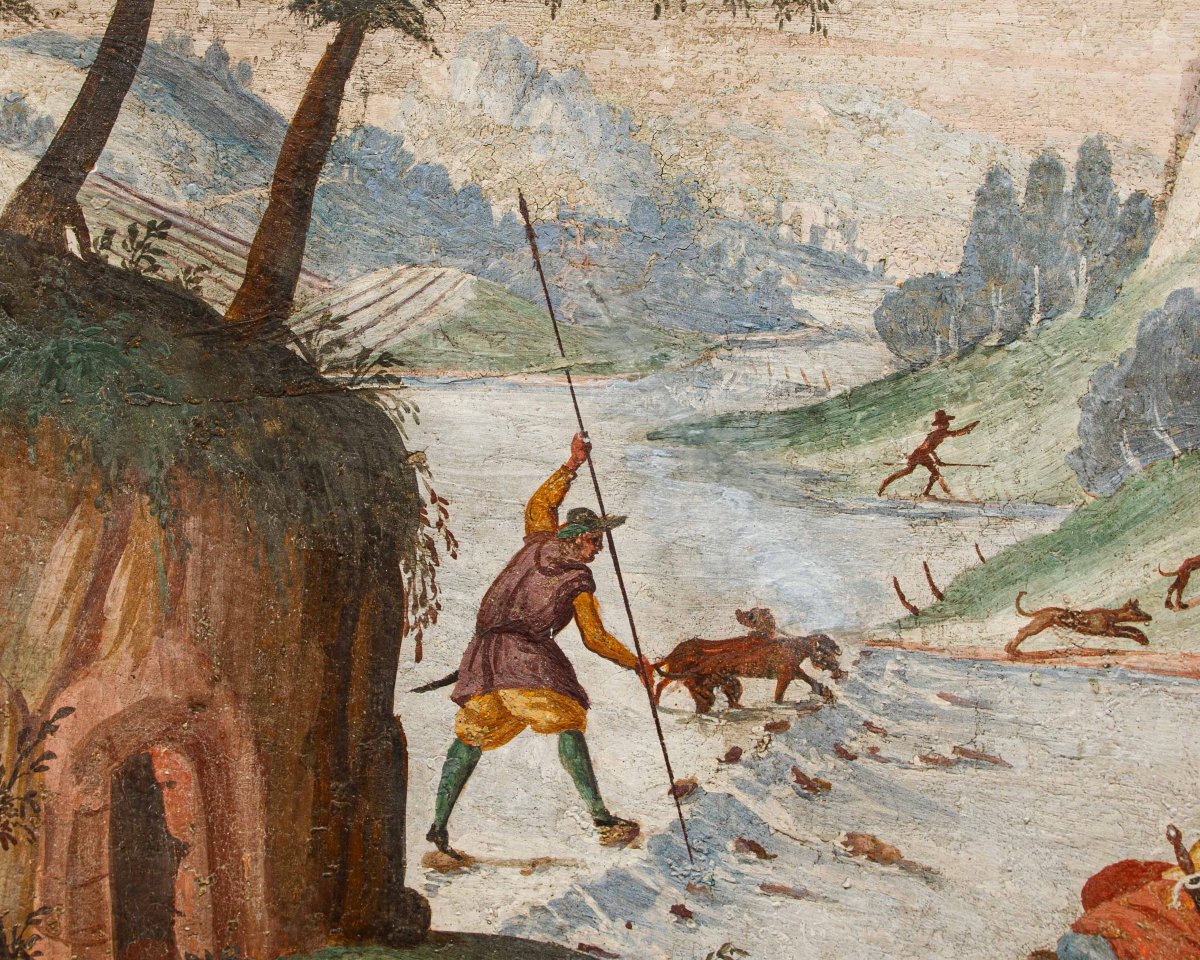
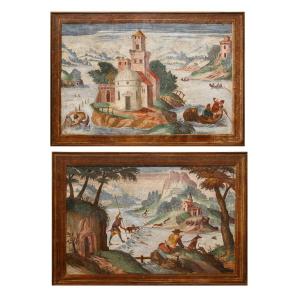
In the first painting the composition is structured around a lake scene dominated in the centre by a capricious architectural emergency, where a small circular temple surmounted by a dome leans against a square tower in late medieval style; all around, on the waters enclosed by hilly reliefs, lively scenes dedicated to fishing take place, between a bare-chested fisherman immersed near a net pot and figures wearing characteristic red headdresses intent on operating a net from a flat-bottomed vessel. The second depiction instead develops the dynamic theme of hunting in a mountain and river landscape, framed by tree-lined wings: here two hunters dressed according to the fashion of the time — one with a vine on the back holding a greyhound on a chain and the other armed with a spear while wading through a watercourse — lead the pack of dogs on the trail of the game, under a sky strewn with bright clouds and dominated at a distance by a small hilltop village. Pietro Baschenis's unmistakable stylistic cipher stands out clearly in his soft, earthy palette, orchestrated on ranges of ochre, browns, desaturated greens, and brick reds, applied with a synthetic, cursive brushstroke typical of quick-execution mural painting. The inventive architectures, which blend classical references and fortified structures from Lombardy's rural tradition, do not respond to a rigid geometric perspective, but rather to a decorative and scenographic sensibility, aimed at evoking a bucolic and ideal atmosphere. Similarly, the rendering of the human speckles —marked by accentuated profiles, immediate gestures and an essential anatomical rendering — shows the painter's typical pronunciation, oriented towards the vivacity of the visual narrative rather than micro-analytical detail.
The inclusion of these two pieces in Pietro Baschenis' catalogue finds specific confirmation in the artist's civil production between the second and third decades of the seventeenth century. Particularly fitting is the comparison with the landscape inserts and grotesques created in 1615 for the Palazzo Nuovo (now the "Angelo Mai" Civic Library in Bergamo), where in the smaller panels a similar taste for the narration of crafts and outdoor work and an identical caricature-like construction appear. Similarly, in the fresco cycles for Casa Bonoremi in Bergamo (1624) and above all in the Villa Bonoremi-Armanni in Levate (1627), where the artist intervenes in close synergy with the stucco workshop of the Porta family, with whom he had become related, the same setting of hilly backgrounds, isolated temples and shaded plant wings is found. Originally intended to serve as overdoors, wall friezes, or paintings set within stucco quadratures in a state room, the frescoes testify to the adherence to the classical topos of hunting and fishing scenes, an allegory of aristocratic pastimes and contemplative life in the villa.
Pair of fantastic landscapes
Detached fresco applied to canvas, 97 x 143 cm
This pair of detached frescoes on canvas constitutes a testimony of great interest within the profane and decorative production of Pietro Baschenis (ca. 1590 – 1630), among the most fruitful and up-to-date representatives of the famous dynasty of painters originally from Averara, active for generations in the Bergamo area and in the Alpine valleys.
Originally from the hamlet of Colla in Santa Brigida, in the Averara Valley in the province of Bergamo, the Baschenis dynasty constituted for over two centuries —between the mid-fifteenth century and the end of the seventeenth century— one of the most industrious and emblematic workshops of itinerant painters and fresco painters in the Alpine valleys of Lombardy and Trentino. Historically divided into the two main branches of the Lanfranco and Cristoforo families, the family has passed down from father to son a figurative language of immediate popular influence, specialized mainly in fresco mural decoration for churches, oratories and rural sanctuaries. This complex family tree includes Pietro Baschenis (Bergamo, ca. 1590 – 1630), great-grandson of Christopher the Elder and son of Antonio, among the first members of the dynasty to be born directly in the capital of Bergamo rather than in the valley of origin. Trained in the family workshop but attentive to the influences of contemporaries active in Bergamo between the sixteenth and seventeenth centuries —such as Gian Paolo Cavagna, Enea Salmeggia and Francesco Zucco —, Pietro consolidated his economic and professional position also thanks to his successful marriage to Clara Porta, daughter of the famous stucco artist of Lugano origin Lorenzo Porta. This kinship gave him access to important commissions both in sacred art and in secular decorative complexes for the city's nobility, before he died prematurely during the devastating plague epidemic of 1630. Pietro historically represents the last great interpreter of the tradition of the Baschenis family's fresco painters, anticipating the era of Evaristo Baschenis, who would soon link the family name to the famous still life and musical instrument painting.
Freed from the devotional register typical of altar painting and the sacred cycles that the artist widespread throughout the countryside, the two panels belong entirely to the field of interior decoration for noble and bourgeois patrons of the early seventeenth century. These fully reflect the success of inventive landscape painting, conceived as a narrative insert and "figurative escape" within multiple complex wall systems for urban palaces or villa residences.
In the first painting the composition is structured around a lake scene dominated in the centre by a capricious architectural emergency, where a small circular temple surmounted by a dome leans against a square tower in late medieval style; all around, on the waters enclosed by hilly reliefs, lively scenes dedicated to fishing take place, between a bare-chested fisherman immersed near a net pot and figures wearing characteristic red headdresses intent on operating a net from a flat-bottomed vessel. The second depiction instead develops the dynamic theme of hunting in a mountain and river landscape, framed by tree-lined wings: here two hunters dressed according to the fashion of the time — one with a vine on the back holding a greyhound on a chain and the other armed with a spear while wading through a watercourse — lead the pack of dogs on the trail of the game, under a sky strewn with bright clouds and dominated at a distance by a small hilltop village. Pietro Baschenis's unmistakable stylistic cipher stands out clearly in his soft, earthy palette, orchestrated on ranges of ochre, browns, desaturated greens, and brick reds, applied with a synthetic, cursive brushstroke typical of quick-execution mural painting. The inventive architectures, which blend classical references and fortified structures from Lombardy's rural tradition, do not respond to a rigid geometric perspective, but rather to a decorative and scenographic sensibility, aimed at evoking a bucolic and ideal atmosphere. Similarly, the rendering of the human speckles —marked by accentuated profiles, immediate gestures and an essential anatomical rendering — shows the painter's typical pronunciation, oriented towards the vivacity of the visual narrative rather than micro-analytical detail.
The inclusion of these two pieces in Pietro Baschenis' catalogue finds specific confirmation in the artist's civil production between the second and third decades of the seventeenth century. Particularly fitting is the comparison with the landscape inserts and grotesques created in 1615 for the Palazzo Nuovo (now the "Angelo Mai" Civic Library in Bergamo), where in the smaller panels a similar taste for the narration of crafts and outdoor work and an identical caricature-like construction appear. Similarly, in the fresco cycles for Casa Bonoremi in Bergamo (1624) and above all in the Villa Bonoremi-Armanni in Levate (1627), where the artist intervenes in close synergy with the stucco workshop of the Porta family, with whom he had become related, the same setting of hilly backgrounds, isolated temples and shaded plant wings is found. Originally intended to serve as overdoors, wall friezes, or paintings set within stucco quadratures in a state room, the frescoes testify to the adherence to the classical topos of hunting and fishing scenes, an allegory of aristocratic pastimes and contemplative life in the villa.
6 000 €
Period: 17th century
Style: Other Style
Condition: Good condition
Material: Oil painting
Width: 143
Height: 97
Reference (ID): 1820590
Availability: In stock
Print