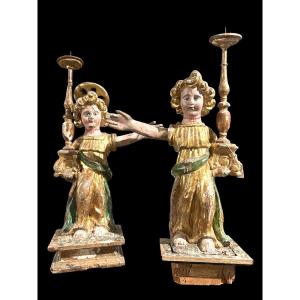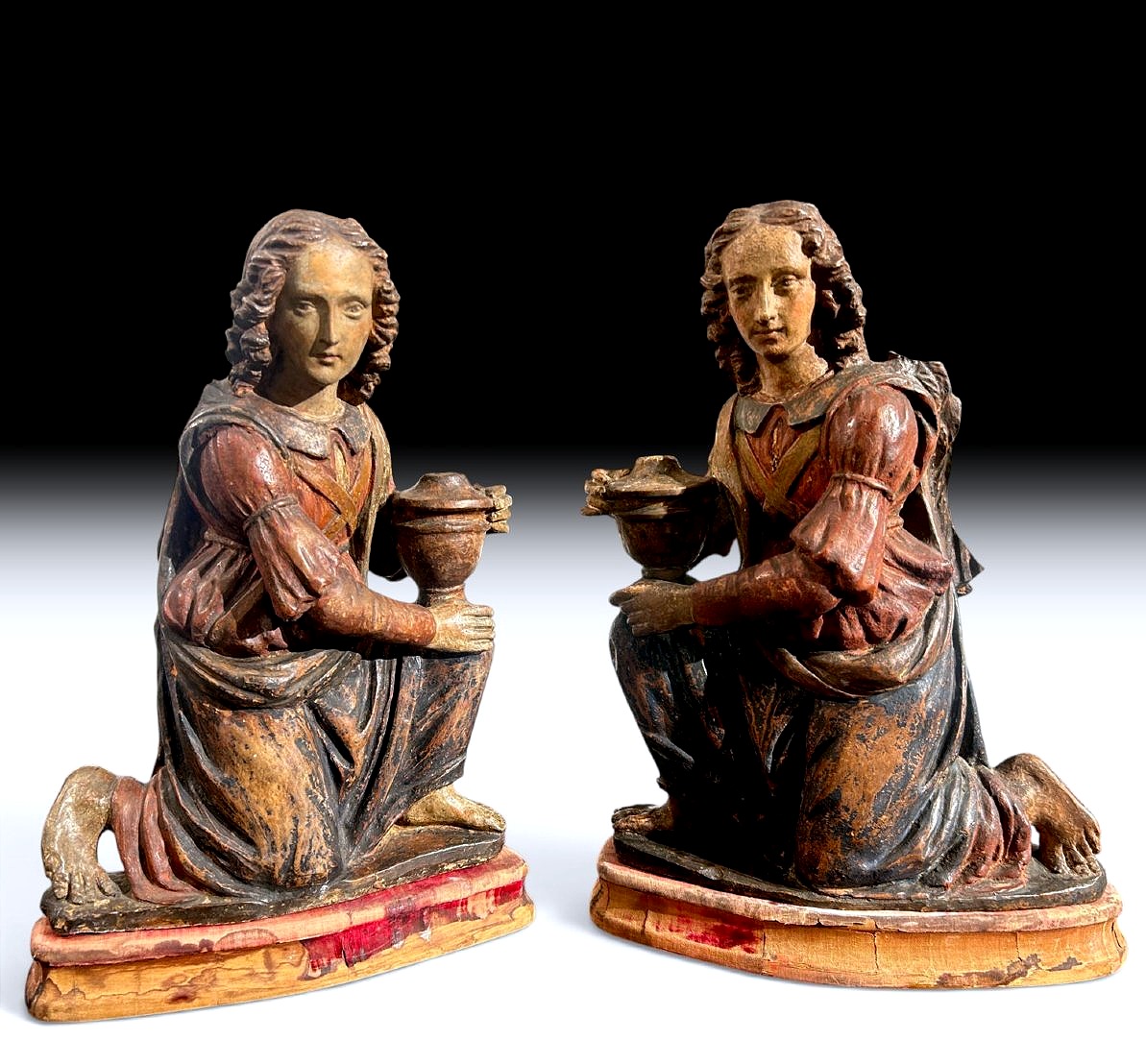
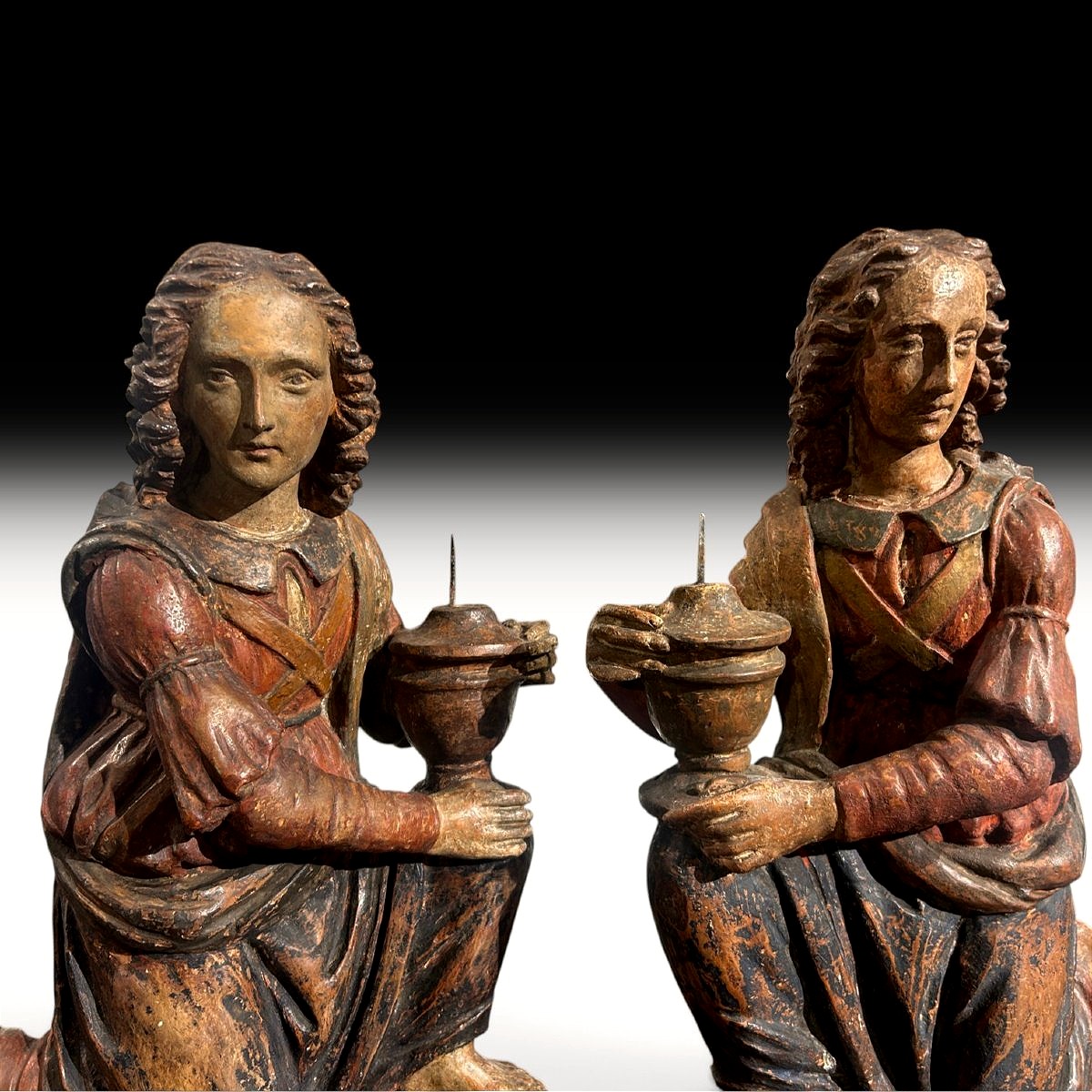
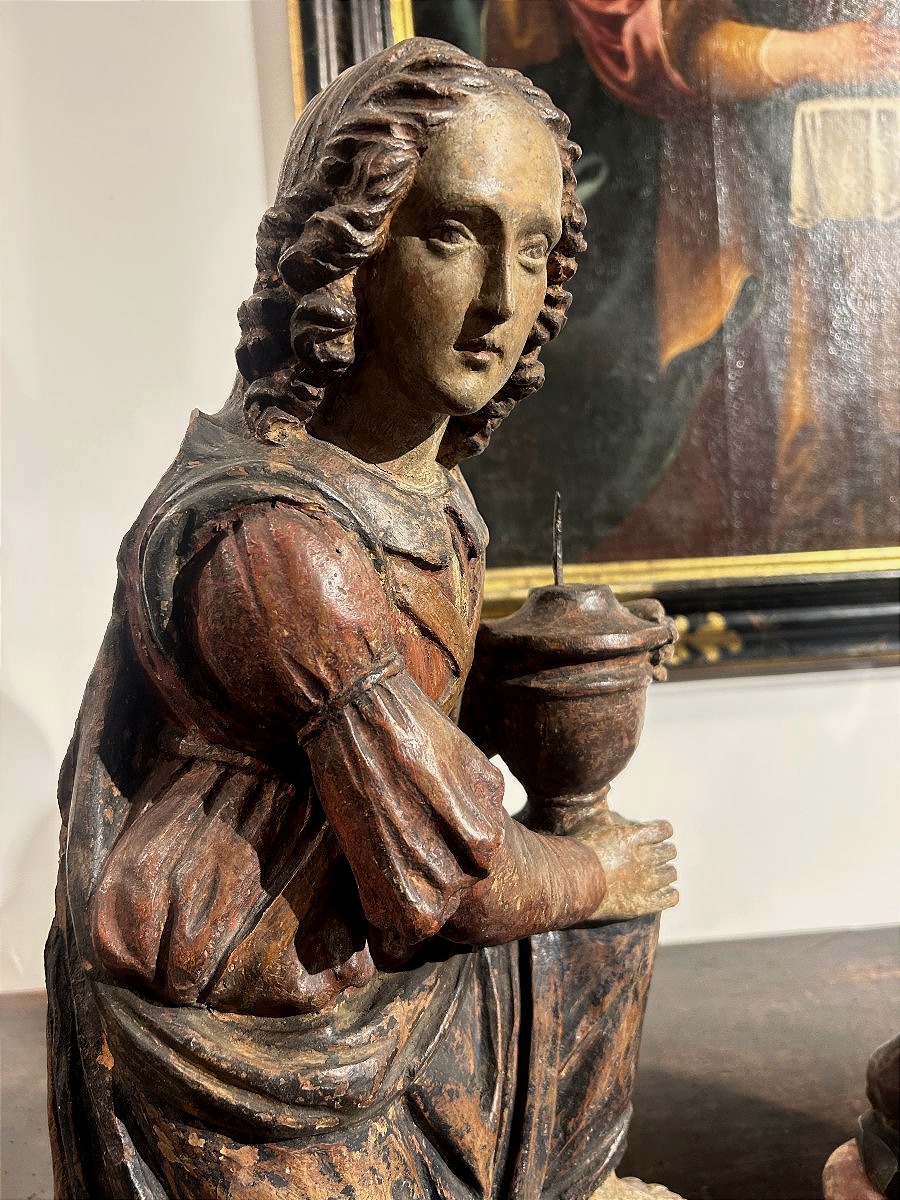
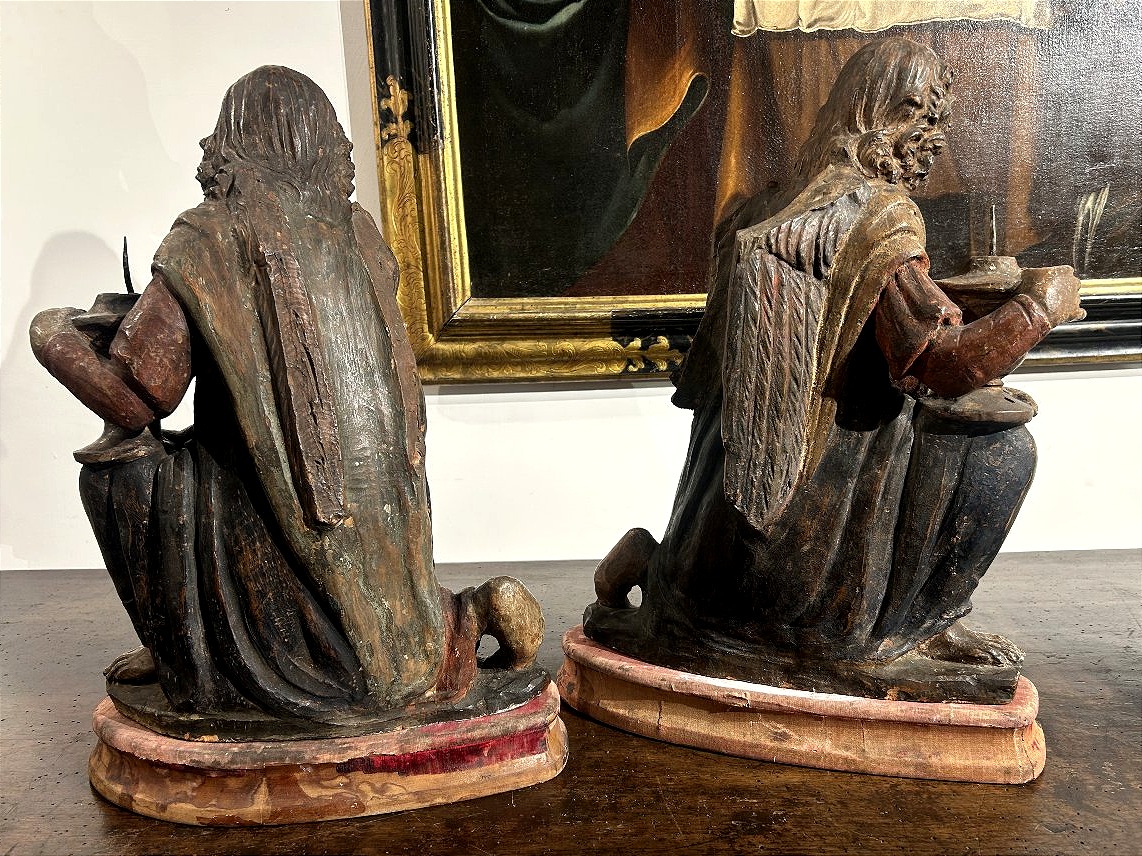
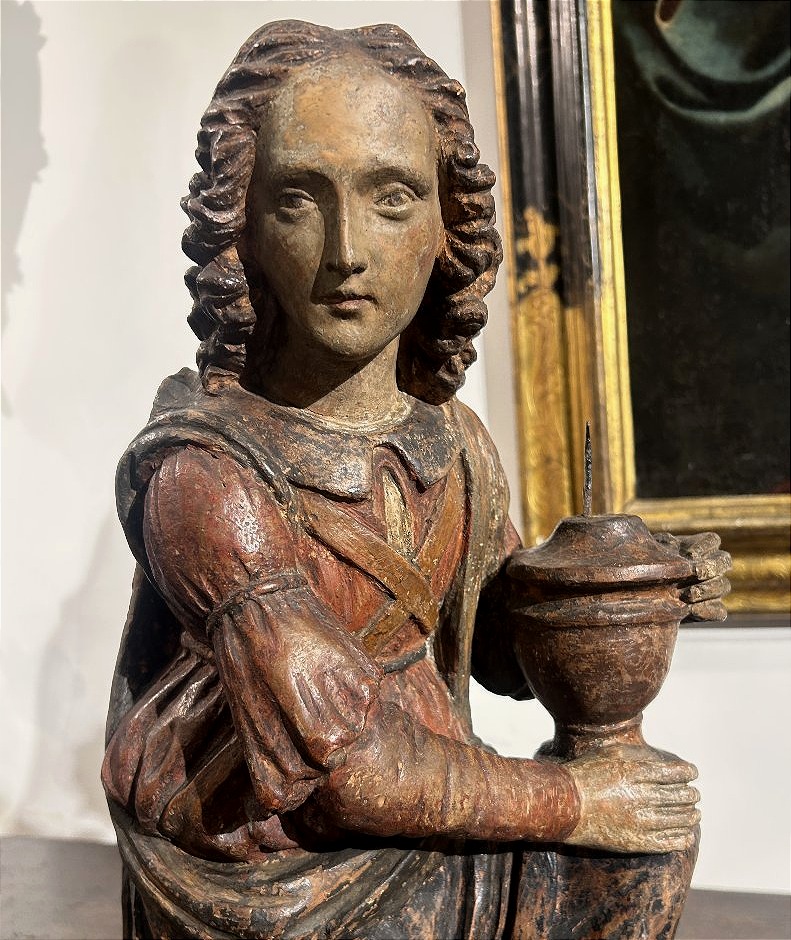

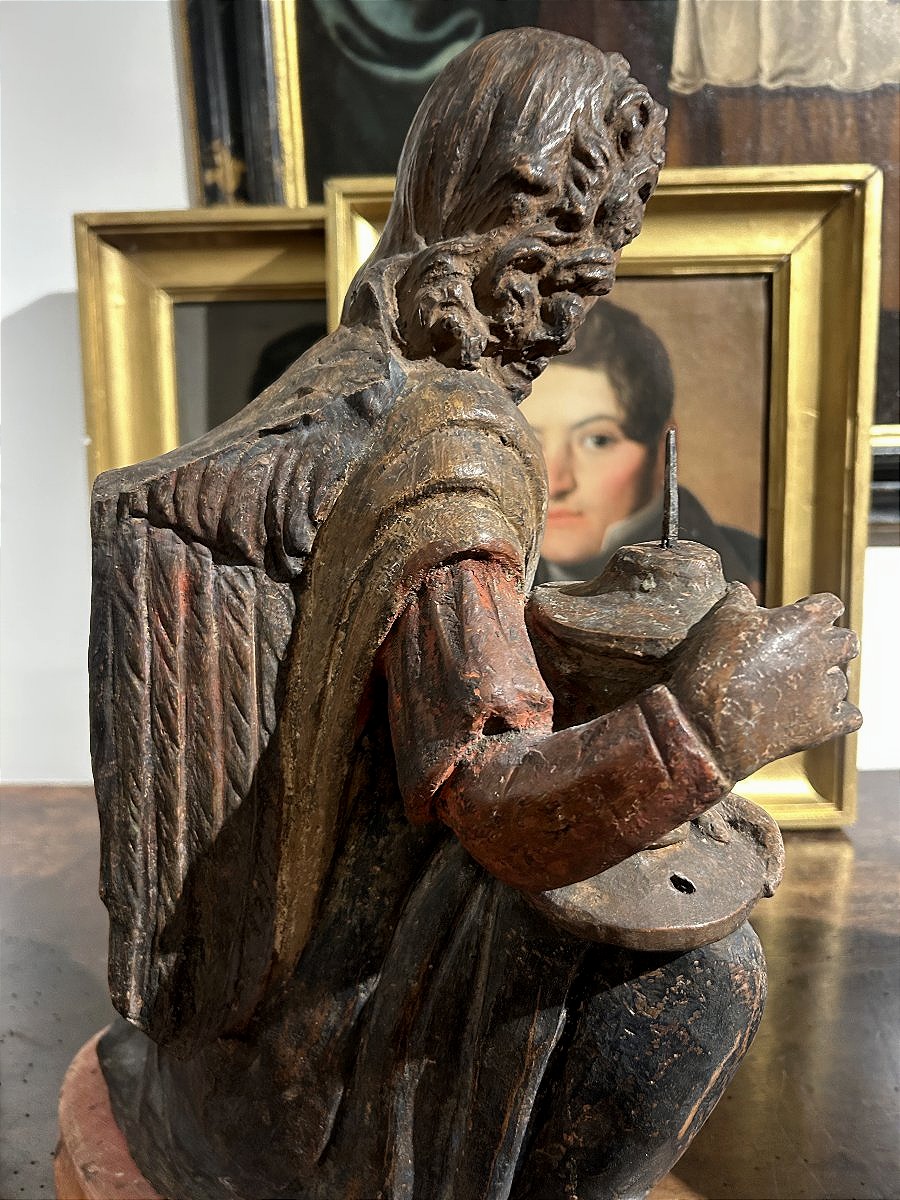
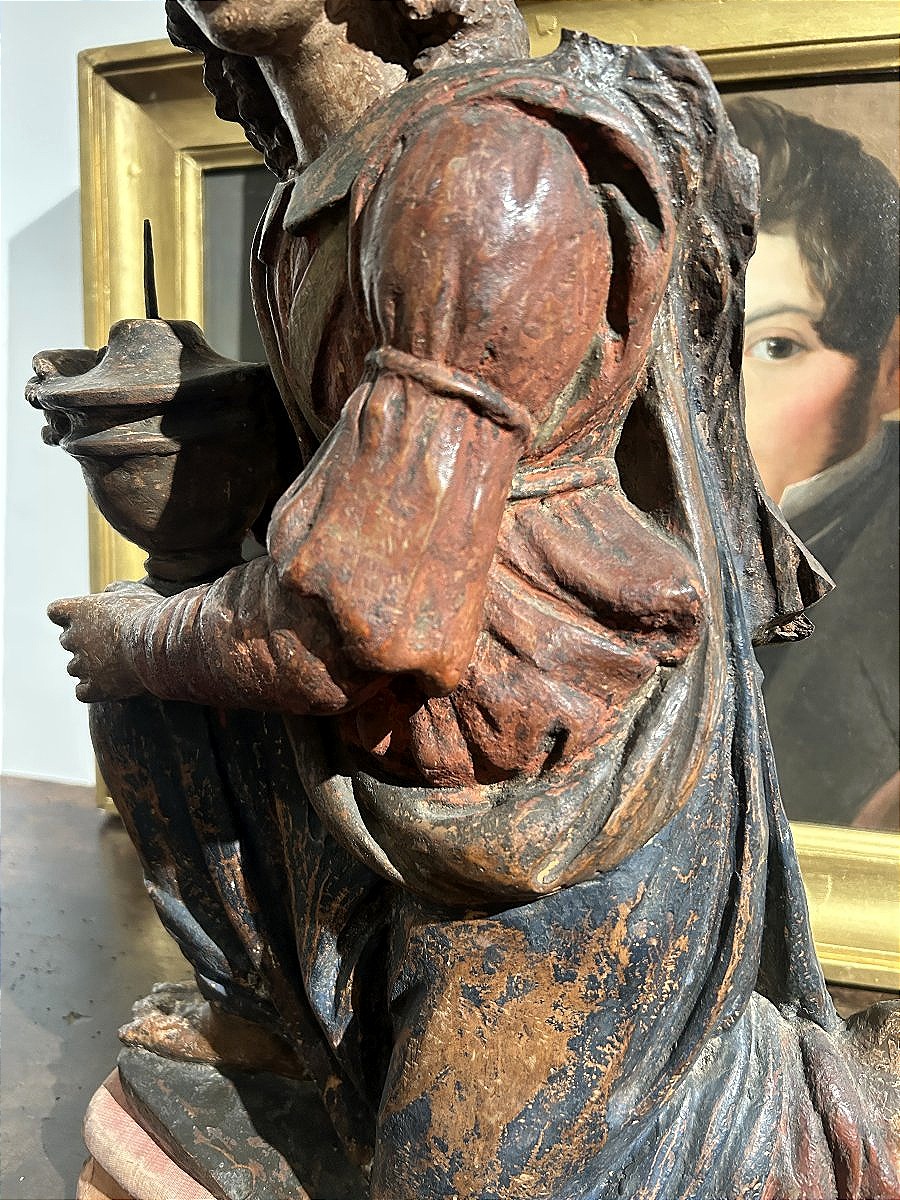
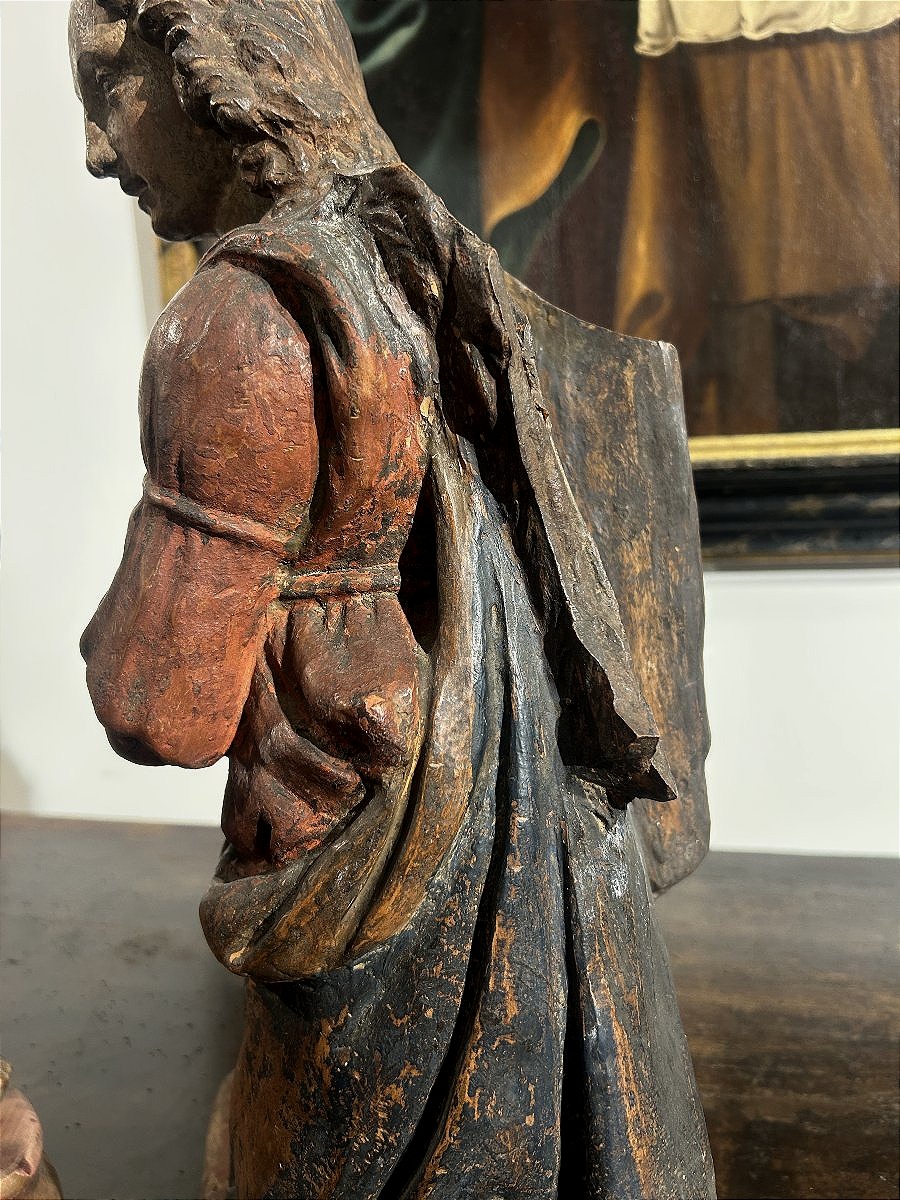
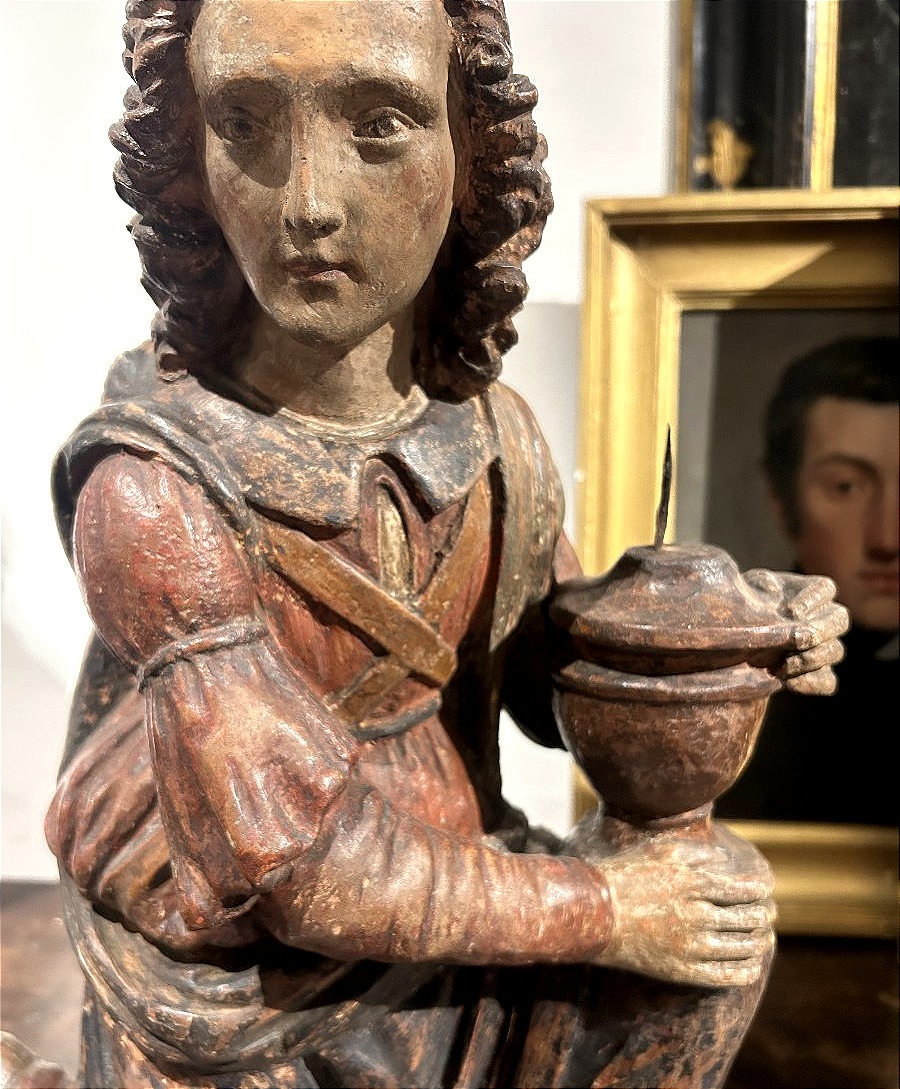
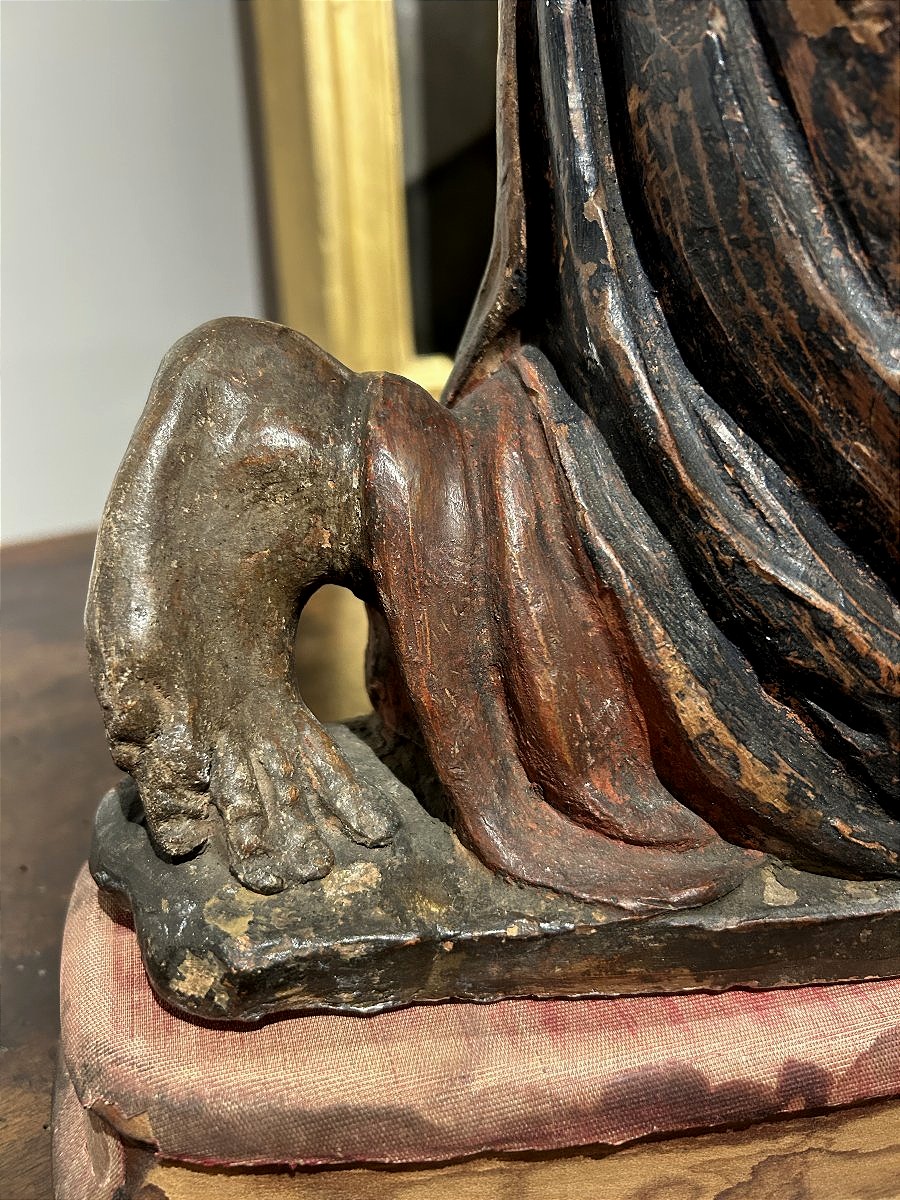
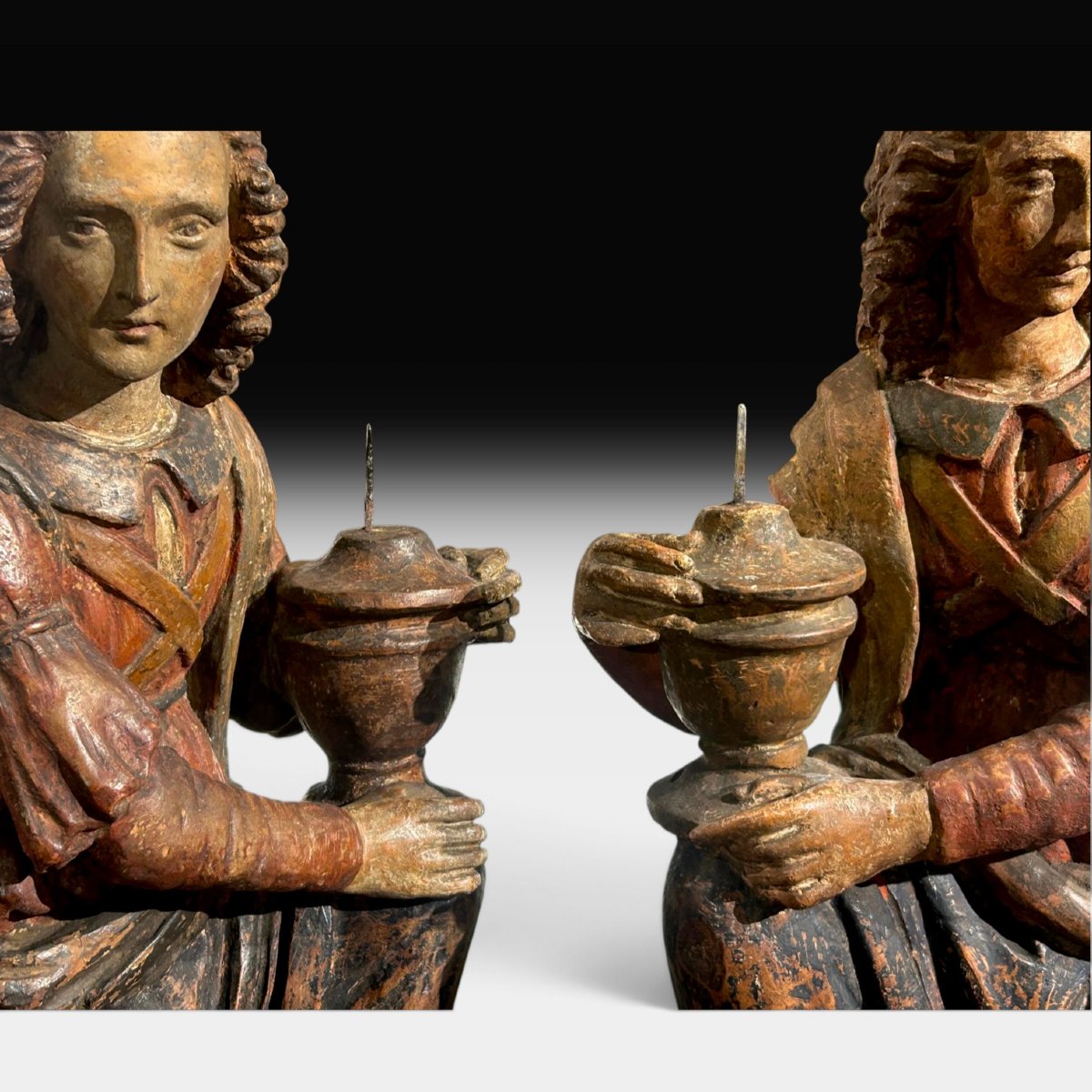
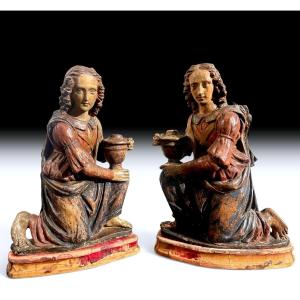


A Pair Of Kneeling Angels In Polychrome Terracotta. Florence, First Quarter Of The 16th Century.
Artist: Attr. à Agnolo Di Polo De' Vetri (firenze, 1470 – Arezzo, 1528)
The Bompadre Gallery is proud to present this spectacular pair of kneeling angels holding torches, with their original cold-painted polychromy almost entirely preserved, which can be attributed with a fair degree of certainty to the devotional work of the renowned Florentine sculptor Agnolo di Polo de’ Vetri.An artist mentioned by Vasari in *The Lives* (1568) alongside Verrocchio’s most illustrious “disciples”—Leonardo himself, Perugino, Francesco di Simone Ferrucci, Lorenzo di Credi—though he was criticized because his talents were sometimes channeled into mass-produced, popular works: “Agnolo di Polo was also his pupil, who worked very practically with clay and has filled the city with works of his own hand; and if he had devoted himself to the art with discernment, he would have created most beautiful works.”
These previously unpublished works that we present here find precise and tangible parallels with Agnolo’s works and best express the sculptural qualities of the master, who was inclined toward anaffable expressive synthesis with smooth, rounded forms, drawing on compositions and models of kneeling angels from the sculptures of his master, Andrea del Verrocchio, as well as works by artists in that circle such as Sandro di Lorenzo, known as the Master of the Turbulent Children (1483–1554)
It is therefore possible that these angels were designed and produced—even in series—by the Florentine artist, who, especially in the last few decades of his life, adopted a similar style to and actively collaborated with Giovanni della Robbia and Benedetto Buglioni, in their ceramic workshops, which produced and distributed sculptural groups and devotional objects in glazed ceramic throughout central Italy—with a few exceptions regarding the polychrome finish; in fact, there are terracotta pieces from their workshops that were painted with cold paint and are unglazed, as in this case. Our sculptures are in excellent condition and show no signs of restoration, retaining almost all of their original polychromy; unfortunately, the wings are largely missing, but the quality of the craftsmanship and painting can be appreciated from the surviving elements. The interiors of the sculptures were filled with plaster by a former collector to make them more stable, but we have verified through a hole that the sculptures possess the hollow structure typical of sculptures from this period and are therefore entirely consistent with original Renaissance prototypes. If desired, restoration work can be carried out to remove the plaster from the bases.
The dimensions of these objects, excluding the velvet bases, are: 33 cm in length x 48 cm.
A certificate of authenticity is included with the sale.
Biography: Agnolo, who “followed in his family’s footsteps”—his father was a mask maker, his brother a gem engraver and medalist, and his grandfather had worked on the cathedral’s stained-glass windows, hence the nickname “de vetri”— —is first documented in Pistoia, where in 1495 he sculpted a statue of Mary Magdalene for the Ospedale della Morte (formerly in New York, Metropolitan Museum, later sold at Sotheby’s in February 2013) and, in 1498, a half-figure of the Redeemer for the Sapienza, now in the local Civic Museum: a genre in which he was particularly skilled, as evidenced by the numerous similar busts attributed to him (Florence, Horne Museum; formerly New York, Piero Corsini Gallery, etc.). He was responsible for various sculptural groups (the Mourners, Pistoia, Holy Spirit; the Entombment of Christ, Florence, San Salvatore al Monte; the Pietà, Terranuova Bracciolini, S. Maria; etc.)—as evidenced by a 1514 commission from Prato for a now-lost painted terracotta Pietà—he created, between 1500 and 1516, several crowded scenes from the Passion of Christ for the Sacro Monte di San Vivaldo in Montaione. The documents—unfortunately mostly referring to lost works (Apostles and other figures for San Lorenzo in Mugello, 1512–14)—confirm his substantial involvement in terracotta sculpture, including small-scale works (seven statuettes for the chef of the Florentine Signoria, 1525), which culminated shortly before his death in the monumental altar of the Spadari Chapel in the Church of the SS. Annunziata in Arezzo (1526–28). Working primarily for patrons attentive to the demands of popular devotion, in years marked by Savonarola’s rigorist spirituality, Agnolo was an effective disseminator of devotional art, expressed through painted terracotta images of remarkable impact due to their simple naturalism, concise naturalism and a style in keeping with traditional values—closely resembling the austere painting of Fra’ Bartolomeo and the “School of San Marco,” as well as the glazed terracotta sculptures of Benedetto Buglioni and Giovanni della Robbia, with whom he is documented as having collaborated in 1517.
These previously unpublished works that we present here find precise and tangible parallels with Agnolo’s works and best express the sculptural qualities of the master, who was inclined toward anaffable expressive synthesis with smooth, rounded forms, drawing on compositions and models of kneeling angels from the sculptures of his master, Andrea del Verrocchio, as well as works by artists in that circle such as Sandro di Lorenzo, known as the Master of the Turbulent Children (1483–1554)
It is therefore possible that these angels were designed and produced—even in series—by the Florentine artist, who, especially in the last few decades of his life, adopted a similar style to and actively collaborated with Giovanni della Robbia and Benedetto Buglioni, in their ceramic workshops, which produced and distributed sculptural groups and devotional objects in glazed ceramic throughout central Italy—with a few exceptions regarding the polychrome finish; in fact, there are terracotta pieces from their workshops that were painted with cold paint and are unglazed, as in this case. Our sculptures are in excellent condition and show no signs of restoration, retaining almost all of their original polychromy; unfortunately, the wings are largely missing, but the quality of the craftsmanship and painting can be appreciated from the surviving elements. The interiors of the sculptures were filled with plaster by a former collector to make them more stable, but we have verified through a hole that the sculptures possess the hollow structure typical of sculptures from this period and are therefore entirely consistent with original Renaissance prototypes. If desired, restoration work can be carried out to remove the plaster from the bases.
The dimensions of these objects, excluding the velvet bases, are: 33 cm in length x 48 cm.
A certificate of authenticity is included with the sale.
Biography: Agnolo, who “followed in his family’s footsteps”—his father was a mask maker, his brother a gem engraver and medalist, and his grandfather had worked on the cathedral’s stained-glass windows, hence the nickname “de vetri”— —is first documented in Pistoia, where in 1495 he sculpted a statue of Mary Magdalene for the Ospedale della Morte (formerly in New York, Metropolitan Museum, later sold at Sotheby’s in February 2013) and, in 1498, a half-figure of the Redeemer for the Sapienza, now in the local Civic Museum: a genre in which he was particularly skilled, as evidenced by the numerous similar busts attributed to him (Florence, Horne Museum; formerly New York, Piero Corsini Gallery, etc.). He was responsible for various sculptural groups (the Mourners, Pistoia, Holy Spirit; the Entombment of Christ, Florence, San Salvatore al Monte; the Pietà, Terranuova Bracciolini, S. Maria; etc.)—as evidenced by a 1514 commission from Prato for a now-lost painted terracotta Pietà—he created, between 1500 and 1516, several crowded scenes from the Passion of Christ for the Sacro Monte di San Vivaldo in Montaione. The documents—unfortunately mostly referring to lost works (Apostles and other figures for San Lorenzo in Mugello, 1512–14)—confirm his substantial involvement in terracotta sculpture, including small-scale works (seven statuettes for the chef of the Florentine Signoria, 1525), which culminated shortly before his death in the monumental altar of the Spadari Chapel in the Church of the SS. Annunziata in Arezzo (1526–28). Working primarily for patrons attentive to the demands of popular devotion, in years marked by Savonarola’s rigorist spirituality, Agnolo was an effective disseminator of devotional art, expressed through painted terracotta images of remarkable impact due to their simple naturalism, concise naturalism and a style in keeping with traditional values—closely resembling the austere painting of Fra’ Bartolomeo and the “School of San Marco,” as well as the glazed terracotta sculptures of Benedetto Buglioni and Giovanni della Robbia, with whom he is documented as having collaborated in 1517.
22 000 €
Period: 16th century
Style: Renaissance, Louis 13th
Condition: Excellent condition
Material: Terracotta
Length: 33
Height: 48
Reference (ID): 1818109
Availability: In stock
Print