


J.b.c. Odiot, Pair Of Silver Cooling Buckets Bearing The Coat Of Arms Of Michel Ney, Duke Of Elchingen
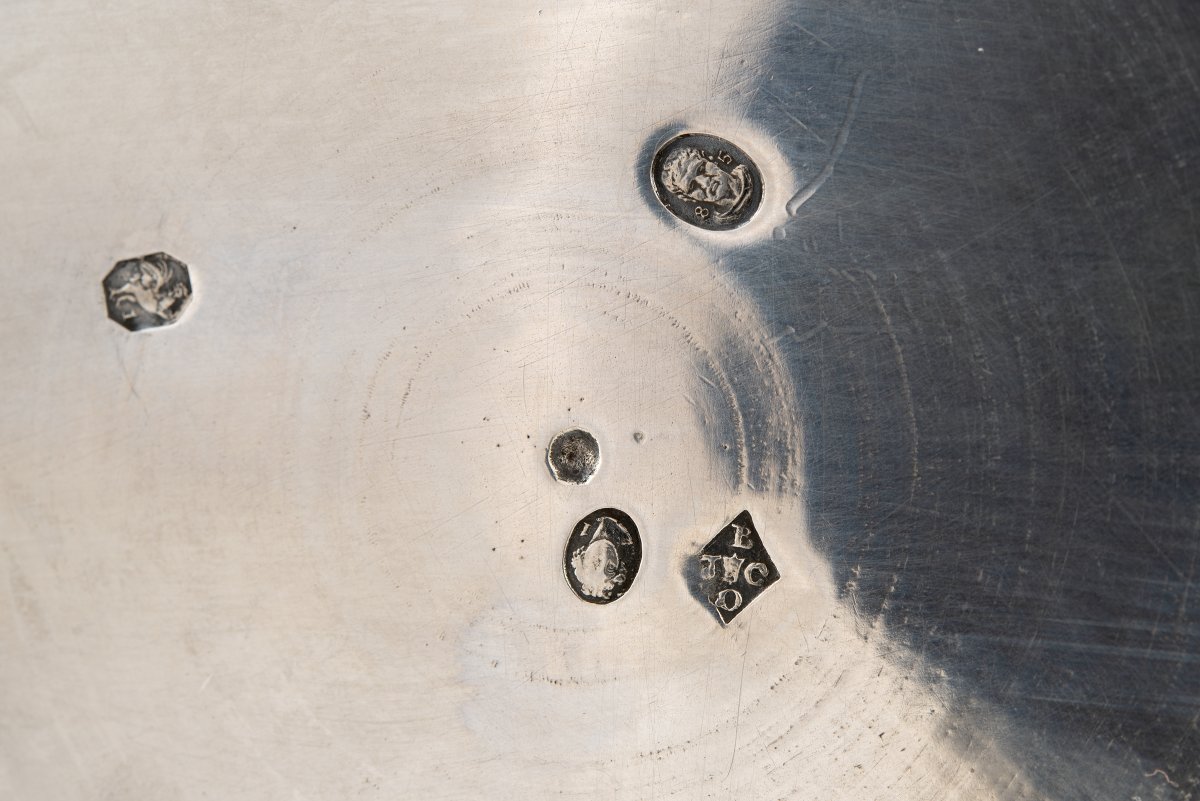
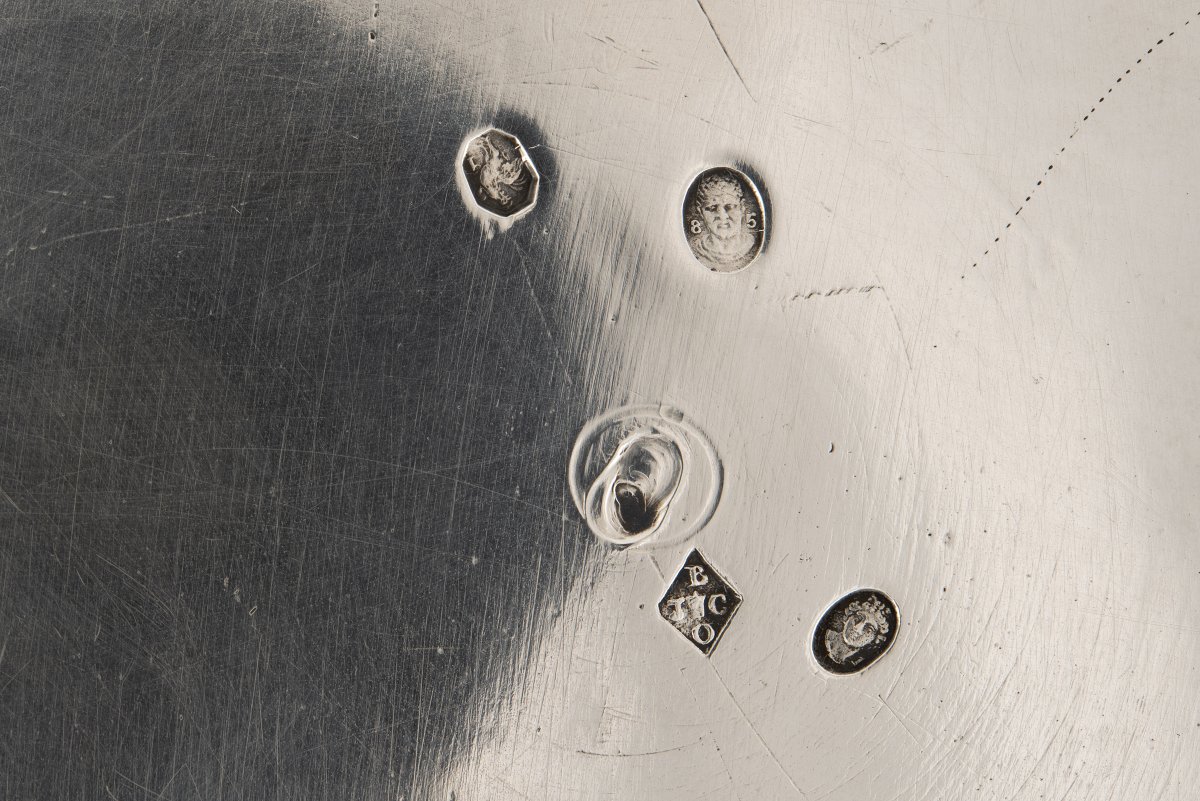
Marked with: - maker’s mark - Jean-Baptiste Claude Odiot (1793-1850) - First standard mark for Paris in use between 1798-1809 - excise mark for Paris in use between 1798-1809 - the mark of Association of Gold and Silver Smiths
Measurements and weight:
1st cooler:
height: 19,8 cm
diameter: 22,2 cm
weight: 1535 g
2nd cooler:
height: 19,2 cm
diameter: 21,7 cm
weight: 1521 g
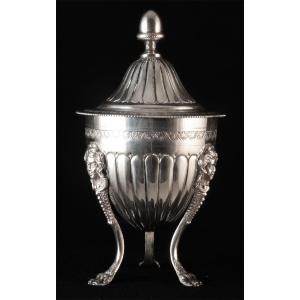
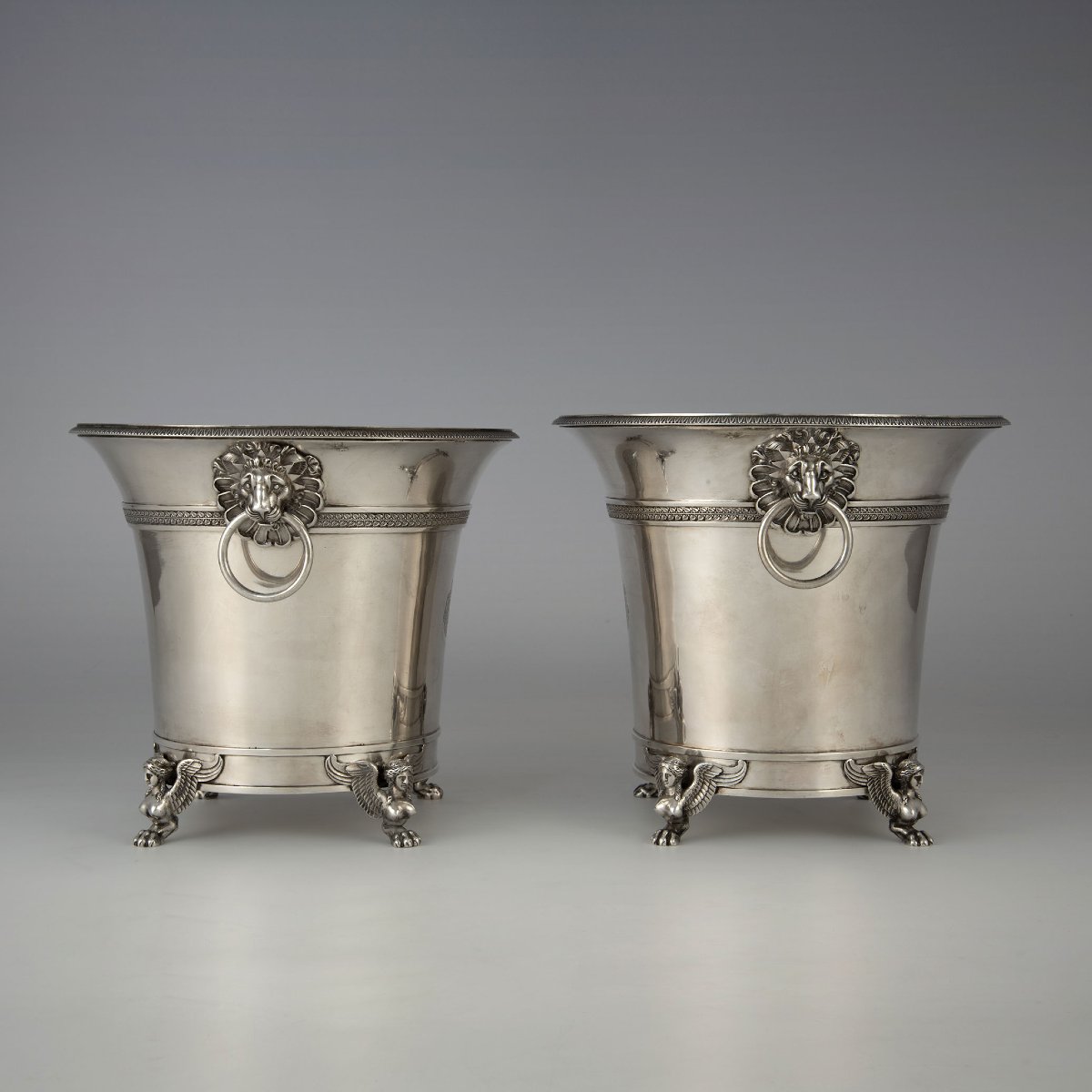
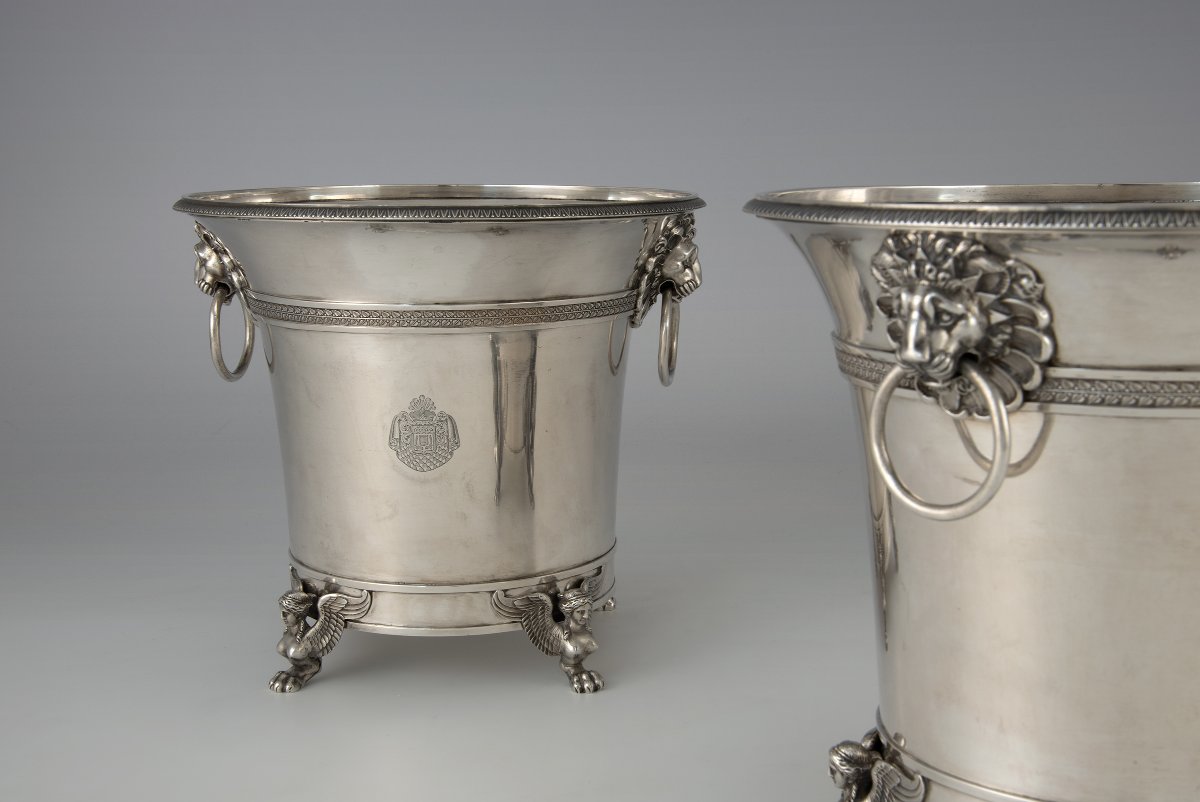
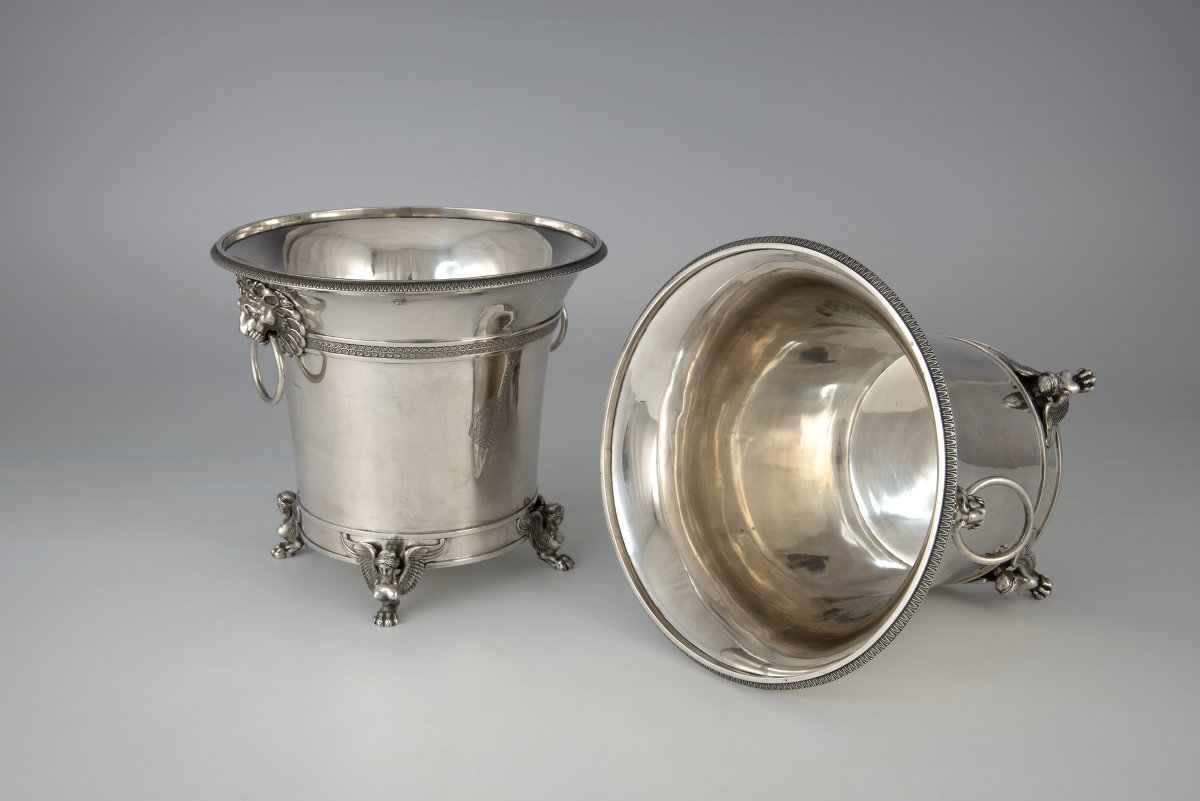
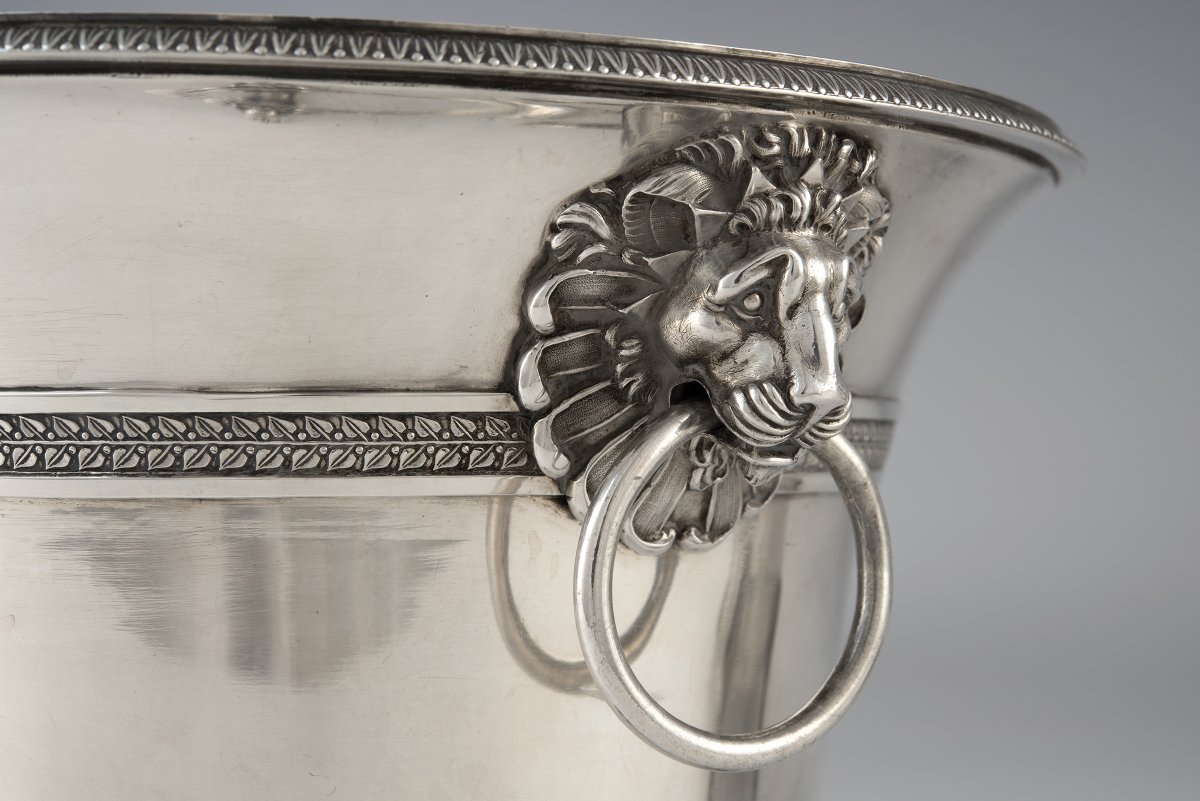
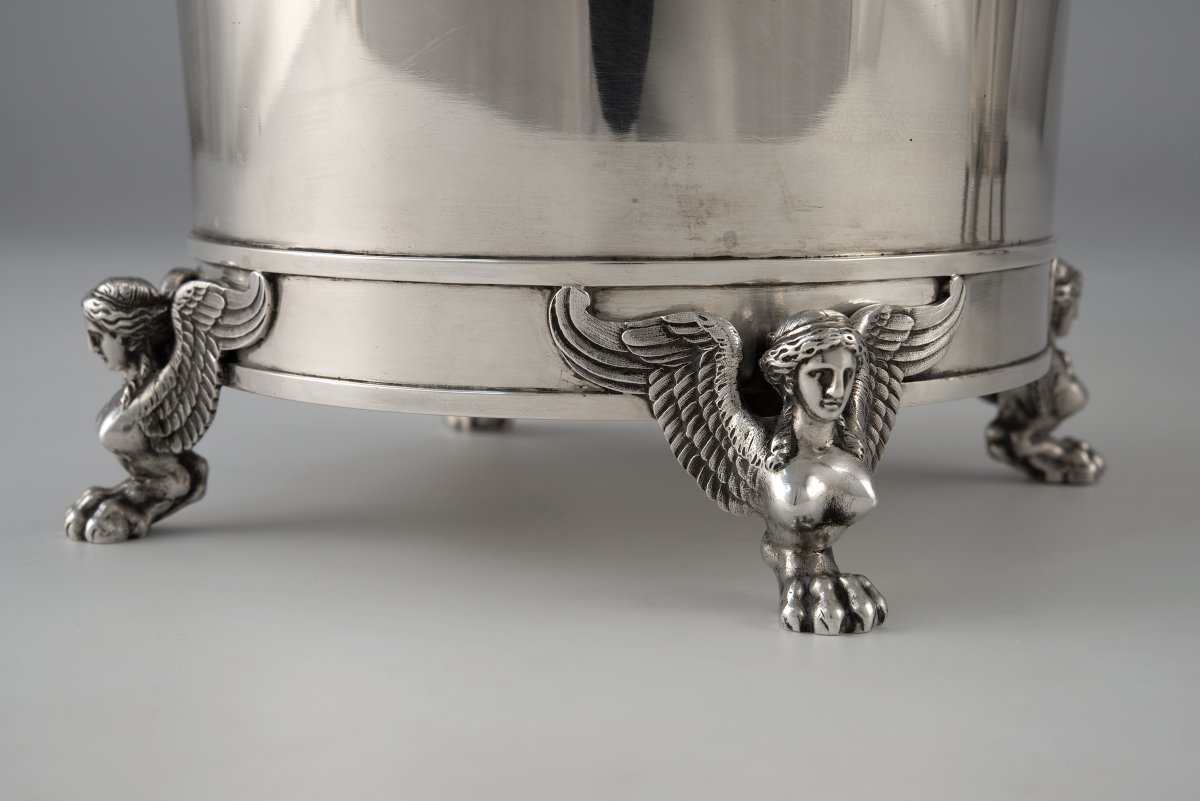
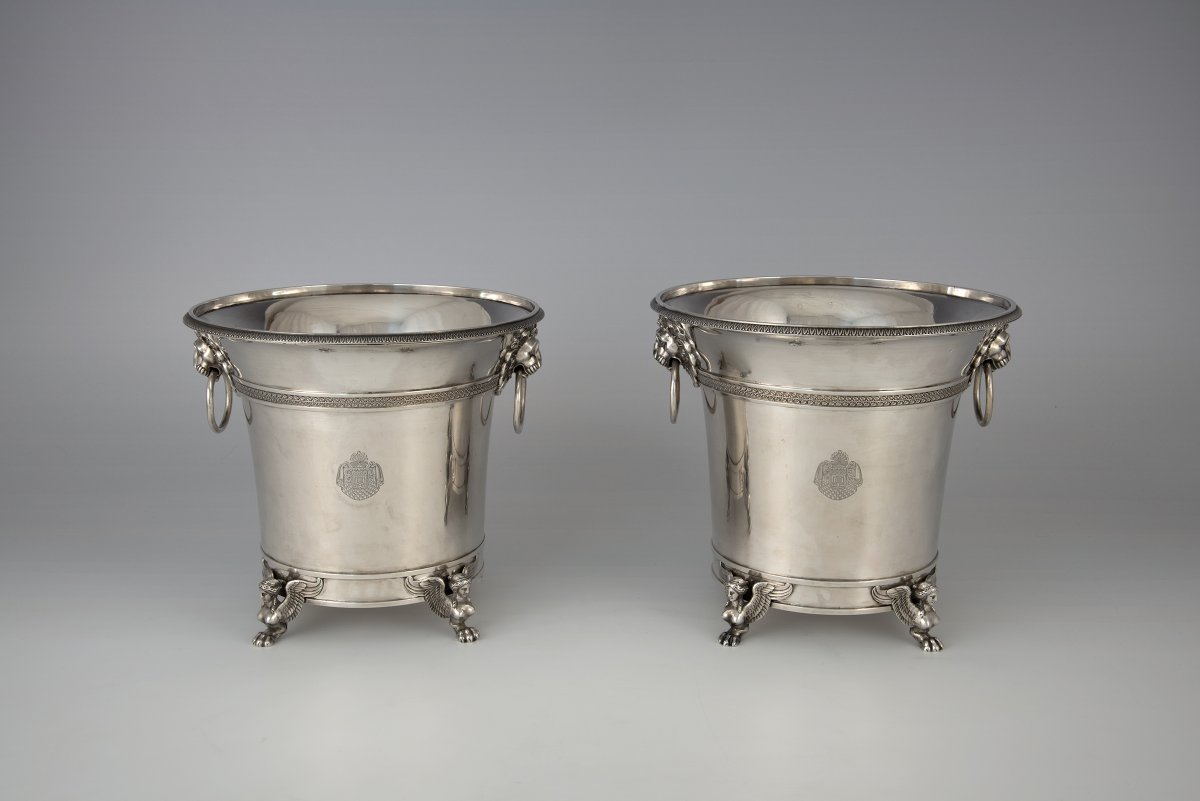
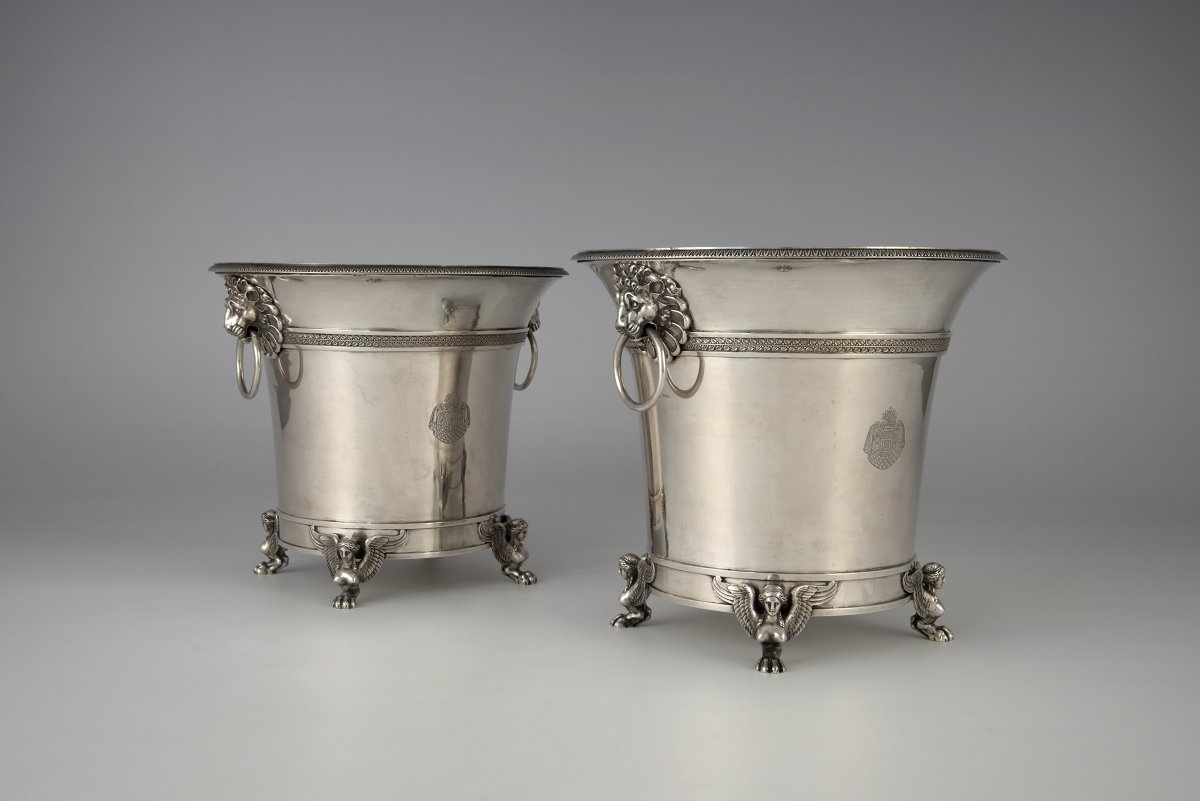
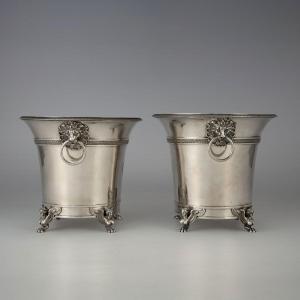
A pair of silver wine coolers with cylindrical bodies, slightly flaring towards the upper rim, supported on four finely modelled winged sphinxes terminating in lion’s paws. To either side are drop handles in the form of movable rings issuing from lion masks. The smooth surfaces of the bodies contrast with the richly worked sculptural elements, giving the vessels a monumental and highly representative character.
The form and decorative vocabulary of the coolers are highly characteristic of the Empire style. The sphinxes, lion masks and paws, strict symmetry, and the combination of simple geometric forms with applied sculptural ornament belong to an artistic language inspired by the art of ancient Rome, Greece and Egypt, which became one of the defining features of the official aesthetic of Napoleon’s Empire. In Odiot’s work, antique motifs, mythological figures and symbols of the Empire formed a carefully developed decorative repertoire. The Musée des Arts Décoratifs has also emphasised that Odiot’s table silver was not merely functional, but often assumed the character of almost independent sculptural works when displayed on the table.
Wine coolers — known in French as seaux à rafraîchir or seaux à bouteille — ranked among the most prestigious elements of an elaborate table service. Filled with ice or cold water, they were used to keep bottles at the appropriate temperature during formal multi-course meals. Silver examples with elaborate sculptural decoration were found above all in the most costly courtly and aristocratic services, the assembly of which required considerable expenditure. The scale of such commissions is well illustrated by the later service made by Odiot for Count Nikolai Demidov, comprising 119 pieces and including four wine coolers.
Their presence in a table service therefore went beyond practical function. Like tureens, large serving dishes, candelabra and surtouts de table, they signalled the status, wealth and ceremonial importance of the service. At a time when formal dining was one of the principal expressions of courtly and diplomatic life, silver tableware also served as a visible demonstration of the owner’s rank and social standing.
The vessels were made by Jean-Baptiste-Claude Odiot (1763–1850), who, alongside Martin-Guillaume Biennais, ranked among the most important Parisian silversmiths of the Napoleonic period. His workshop supplied some of the most powerful clients in France and across Europe. Odiot became especially celebrated for monumental table services combining exceptional quality of execution with rich sculptural decoration and a repertoire of forms derived from antiquity. His clientele included members of the French elite and European courts; even after the fall of the Empire, his reputation remained such that his workshop was visited by figures including Louis XVIII, Tsar Alexander I, Prince Metternich and the Duke of Wellington.
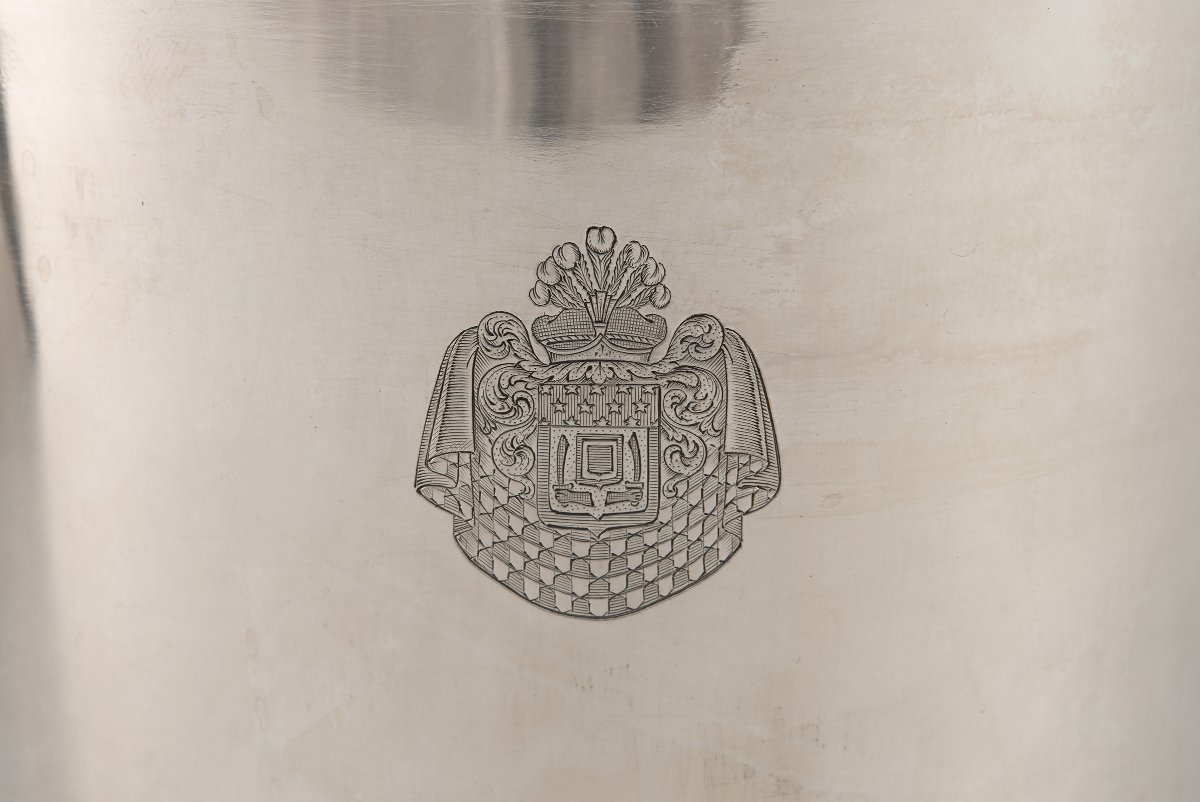
Engraved on the front of each vessel is the elaborate coat of arms of Michel Ney (1769–1815) — Marshal of France, one of Napoleon’s most celebrated commanders, Duke of Elchingen from 1808 and Prince of the Moskowa from 1813. The arms are rendered with considerable precision, using conventional heraldic hatching to represent colours in monochrome engraving. Both versions were engraved by hand according to the same model; slight differences in detail indicate that they are not mechanically reproduced copies, but were most probably engraved together as the decoration of a matching pair.
Very close parallels to this model are preserved in the White House Collection in Washington, D.C., which holds four silver wine coolers by Odiot likewise dating from 1798–1809. They repeat the characteristic construction based on winged sphinx supports and the decorative vocabulary associated with Odiot’s finest works of the Empire period.
The possible provenance of the present pair is particularly compelling. The vessels bear Paris hallmarks for 1798–1809 together with the maker’s mark of Jean-Baptiste-Claude Odiot. Michel Ney received the title of Duke of Elchingen and the associated coat of arms in 1808. At the same time, published sources relating to Odiot’s activity record a delivery of silver to Marshal Ney in 1809.
The convergence of the vessels’ dating, the presence of Ney’s arms, and the documented relationship between the Marshal and Odiot’s workshop supports the hypothesis that the pair may have formed part of a larger service commissioned directly by Michel Ney around 1808–1809.
Michel Ney (1769–1815)was one of the most distinguished and celebrated military commanders of the Napoleonic era. Born into a modest family, he began his military career as an ordinary cavalryman and rose through the ranks to become, in 1804, one of the first Marshals of the Empire appointed by Napoleon. He became renowned for his personal courage, battlefield leadership and ability to inspire troops in the most difficult circumstances.
Ney distinguished himself particularly at Elchingen in 1805, a victory that later earned him the title Duke of Elchingen, and during the Russian campaign of 1812. During the disastrous retreat from Moscow, he commanded the rear guard of the Grande Armée and repeatedly protected the withdrawing French forces under extreme conditions. His conduct earned him the famous epithet “the Bravest of the Brave”, and in 1813 Napoleon granted him the title Prince of the Moskowa.
He took part in many of the most important campaigns and battles of the Napoleonic Wars, including Jena, Eylau, Friedland, Borodino, the Berezina, Leipzig and, finally, Waterloo in 1815. His career ended tragically. After the Bourbon Restoration, Ney was accused of treason for returning to Napoleon’s side during the Hundred Days. He was sentenced to death and executed by firing squad in Paris on 7 December 1815.
In French historical memory, Michel Ney occupies a place among the most legendary military figures of the Napoleonic age. He is remembered not only as one of Napoleon’s most important marshals, but also as a symbol of personal bravery, loyalty to his soldiers and the dramatic fate of the generation shaped by the French Revolution and the Empire.
Period: 19th century
Style: Consulat, Empire
Condition: Good condition
Material: Sterling silver
Reference (ID): 1817908
Availability: In stock