
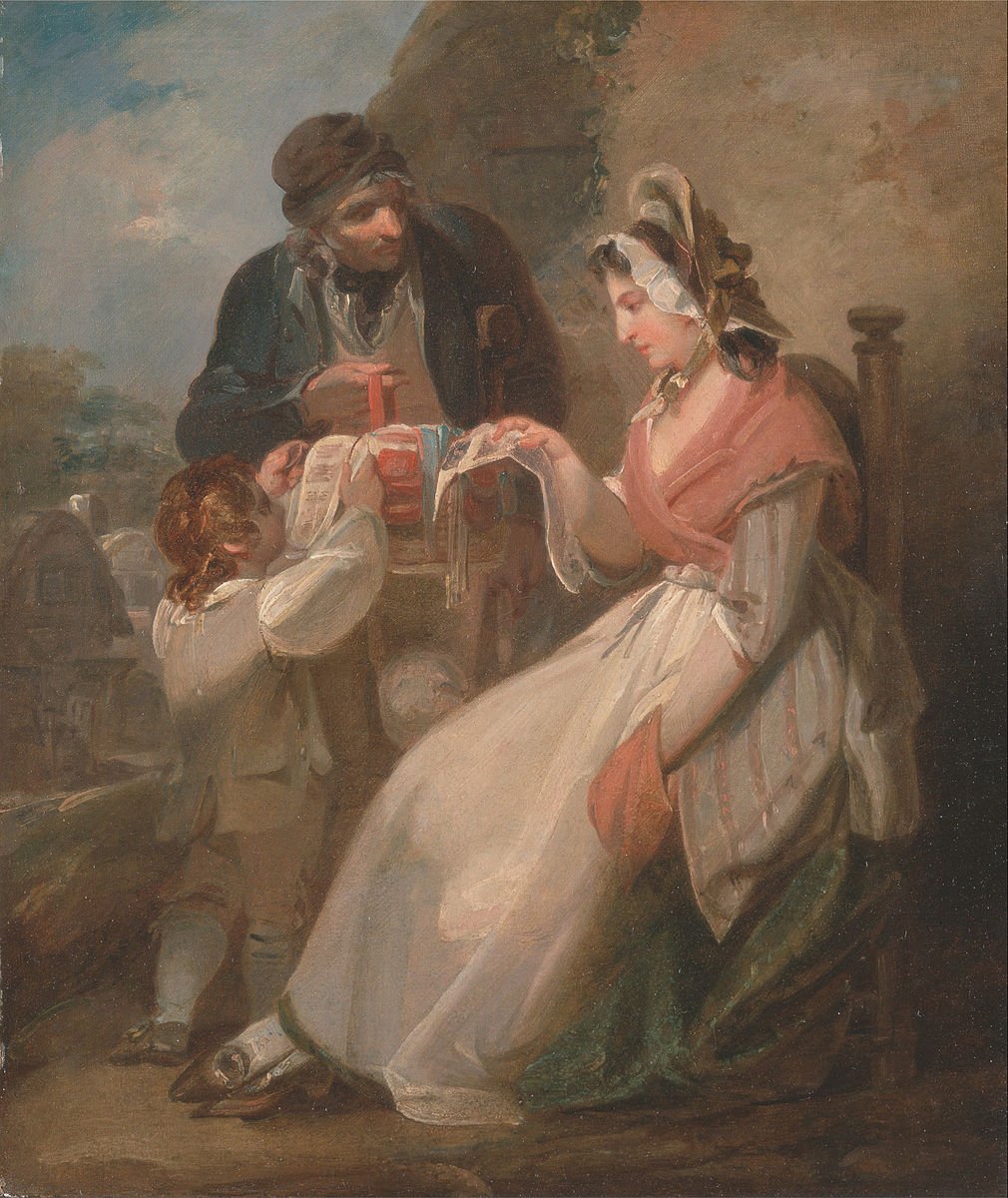


Henry Singleton (1766–1839) The Emergence Of The Elegant British School
Artist: Henry Singleton
Henry SINGLETON
(London 1766 – London 1839)
The Outing of the Elegant
Oil on canvas
H. 35.5 cm; W. 30 cm
Singleton, a quintessentially London painter, devoted his career to painting scenes in which the figures take center stage.
Singleton was born in London in 1766 into a family of artists. He was raised by his uncle, himself a student of Ozias Humphrey, and was already working as a professional artist by the age of 16. He entered the Royal Academy Schools in 1783 and exhibited at the Royal Academy beginning the following year, continuing until his death.
In 1793, Singleton received a major commission to paint a large portrait of the group of Royal Academicians in General Assembly (1795), which depicts all these learned men in the council chamber at Somerset House. Charles Bestland, an engraver and dealer who published an engraving of this image, likely commissioned the work. Despite this major work, Singleton never became an academician himself. His application was rejected twice, in 1807 and 1811.
Singleton first made a name for himself as a history painter. He never fully realized his potential in this genre but remained popular throughout his life, particularly as a portraitist, and devoted his career to painting scenes in which the figures take center stage. He lived comfortably in London and died at a friend’s home in 1839.
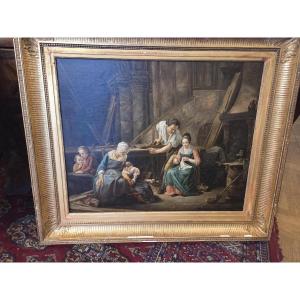
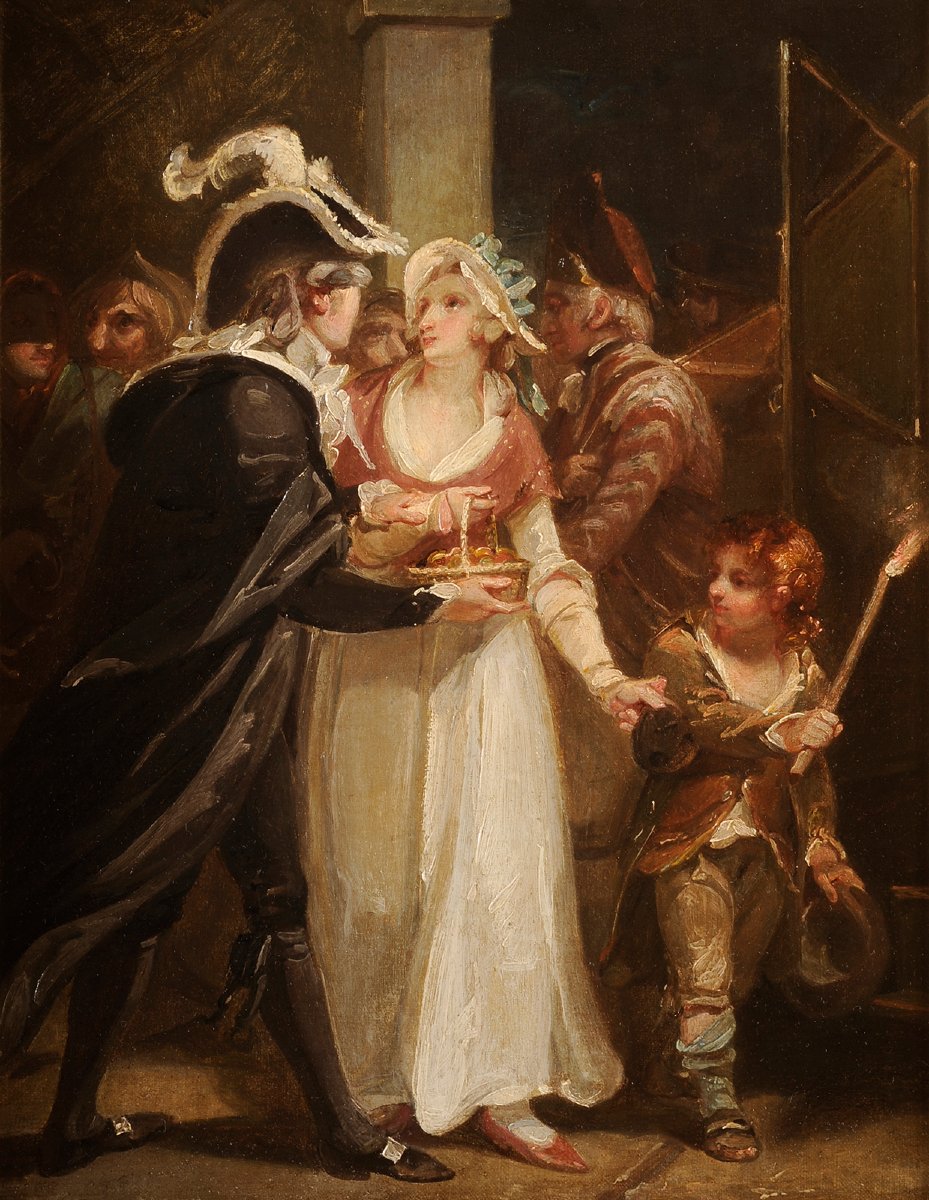
This scene, whose subject is not entirely identified, is part of a series of works of the same format executed at the very end of the 18th century. These works, measuring 35.5 cm high by 30 cm wide, are always small, lively scenes featuring two to three central figures, usually accompanied by a child with rosy cheeks. These scenes range from The Ribbon Seller to The Country Ball, including The Shepherd’s Visit. All of these works bring together different strata of society.
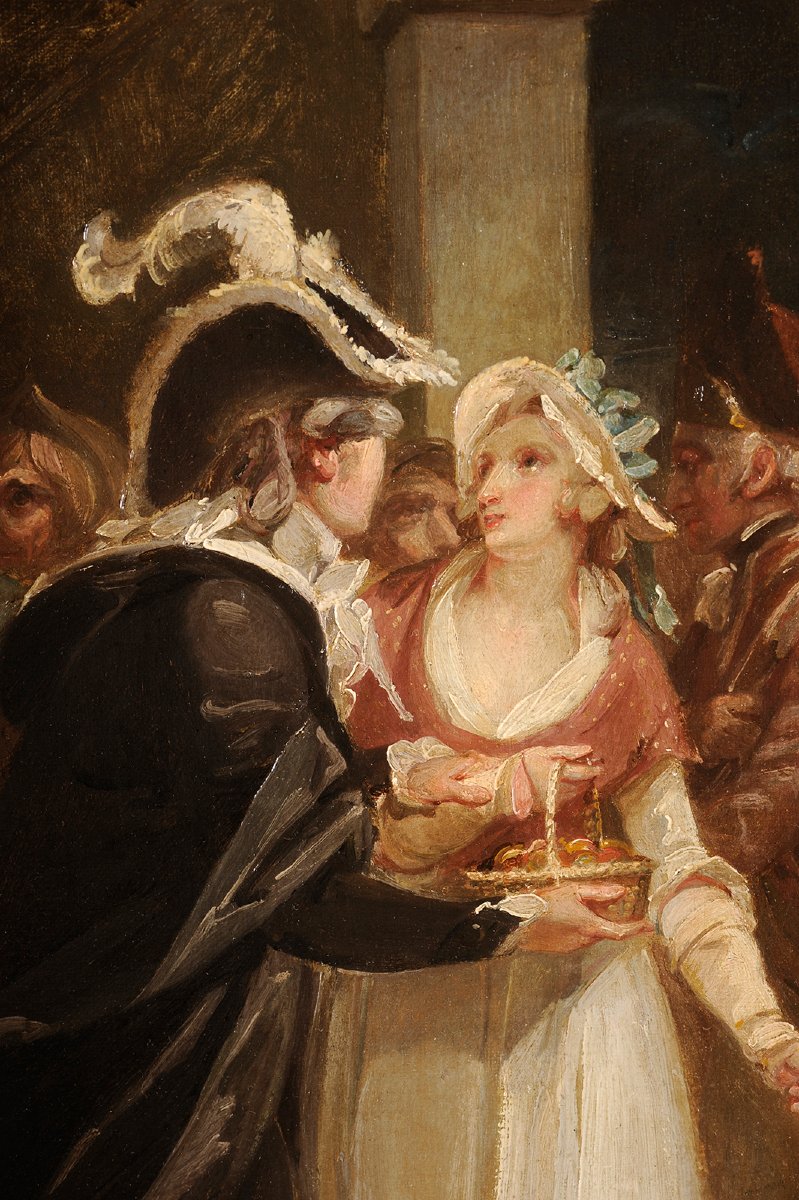
This work depicts an elegant woman being led by a child holding a torch. The child guides her toward a carriage, whose open door on the right is visible. An elegant man seen from behind, wearing a long black coat trimmed with white fur and a hat, appears to be stopping the young woman by holding her basket and her arm. Is he offering to walk her home? No one knows. Nevertheless, it’s safe to assume that this takes place after a theater or opera performance, most likely in London, judging by the characters’ attire. Is this a scene taken from literature?
(London 1766 – London 1839)
The Outing of the Elegant
Oil on canvas
H. 35.5 cm; W. 30 cm
Singleton, a quintessentially London painter, devoted his career to painting scenes in which the figures take center stage.
Singleton was born in London in 1766 into a family of artists. He was raised by his uncle, himself a student of Ozias Humphrey, and was already working as a professional artist by the age of 16. He entered the Royal Academy Schools in 1783 and exhibited at the Royal Academy beginning the following year, continuing until his death.
In 1793, Singleton received a major commission to paint a large portrait of the group of Royal Academicians in General Assembly (1795), which depicts all these learned men in the council chamber at Somerset House. Charles Bestland, an engraver and dealer who published an engraving of this image, likely commissioned the work. Despite this major work, Singleton never became an academician himself. His application was rejected twice, in 1807 and 1811.
Singleton first made a name for himself as a history painter. He never fully realized his potential in this genre but remained popular throughout his life, particularly as a portraitist, and devoted his career to painting scenes in which the figures take center stage. He lived comfortably in London and died at a friend’s home in 1839.
This scene, whose subject is not entirely identified, is part of a series of works of the same format executed at the very end of the 18th century. These works, measuring 35.5 cm high by 30 cm wide, are always small, lively scenes featuring two to three central figures, usually accompanied by a child with rosy cheeks. These scenes range from The Ribbon Seller to The Country Ball, including The Shepherd’s Visit. All of these works bring together different strata of society.
This work depicts an elegant woman being led by a child holding a torch. The child guides her toward a carriage, whose open door on the right is visible. An elegant man seen from behind, wearing a long black coat trimmed with white fur and a hat, appears to be stopping the young woman by holding her basket and her arm. Is he offering to walk her home? No one knows. Nevertheless, it’s safe to assume that this takes place after a theater or opera performance, most likely in London, judging by the characters’ attire. Is this a scene taken from literature?
6 800 €
Period: 19th century
Style: Louis Philippe, Charles 10th
Condition: Perfect condition
Material: Oil painting
Length: 35,5 cm hors cadre
Width: 30 cm hors cadre
Reference (ID): 1817887
Availability: In stock
Print