THIS OBJECT WAS SOLD
Workshop Of Peter Paul Rubens – Mary Magdalene Renouncing Wealth – Oil On Canvas


Workshop of Peter Paul Rubens (Siegen, 1577 – Antwerp, 1640)
Mary Magdalene Renouncing the Vanities of the World, in the Presence of Her Sister Martha
17th century
Oil on canvas, re-stretched in the 19th century (circa 1870)
Neither signed nor monogrammed.
Dimensions: 155 x 120 cm — 185 x 150 cm with frame
Condition: very good. Cleaned in 2018. Numerous small old and more recent retouches, particularly along the upper edge
Frame: blackened wood with wavy moldings, in the 17th-century Dutch style, probably 19th century, with a gilded interior trim. Very good condition
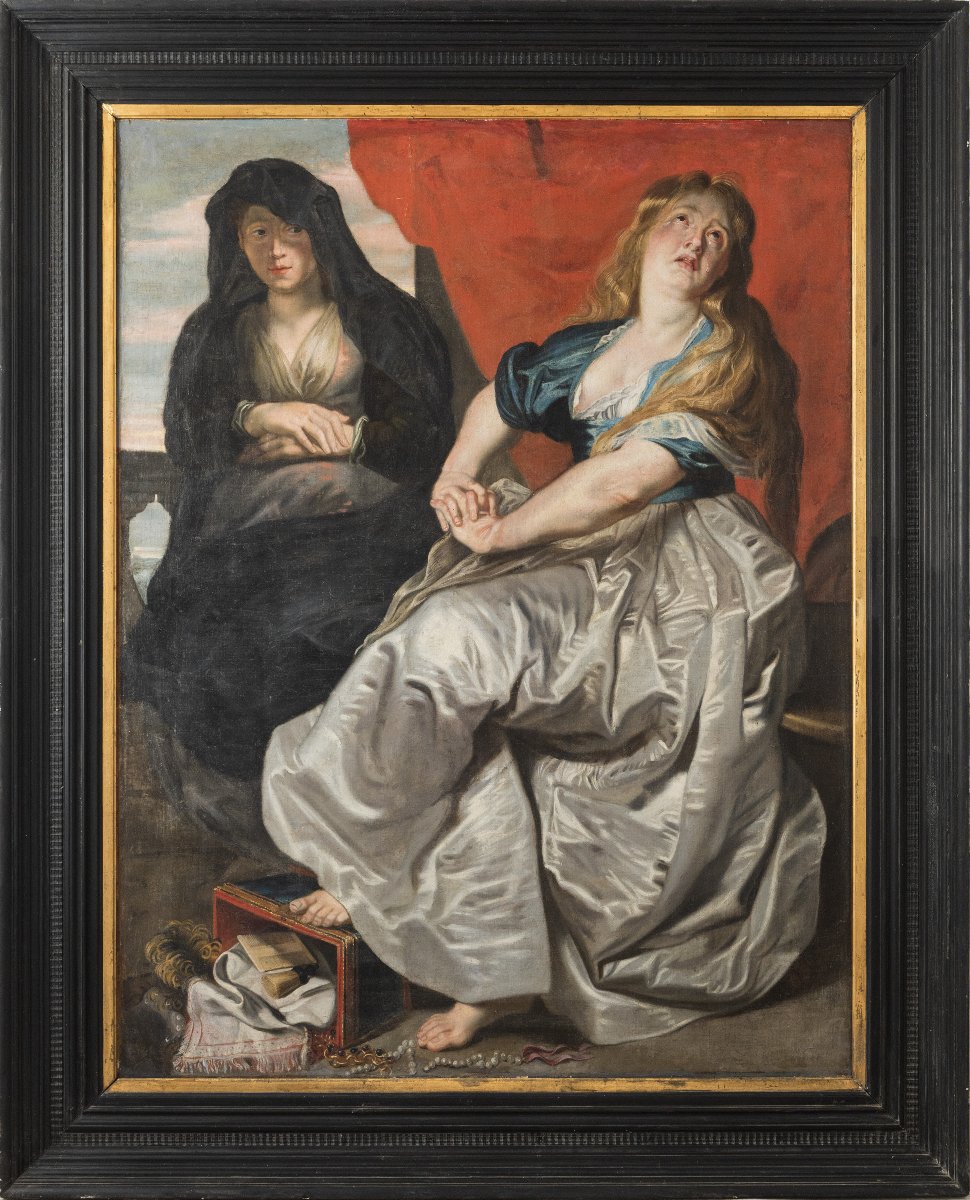
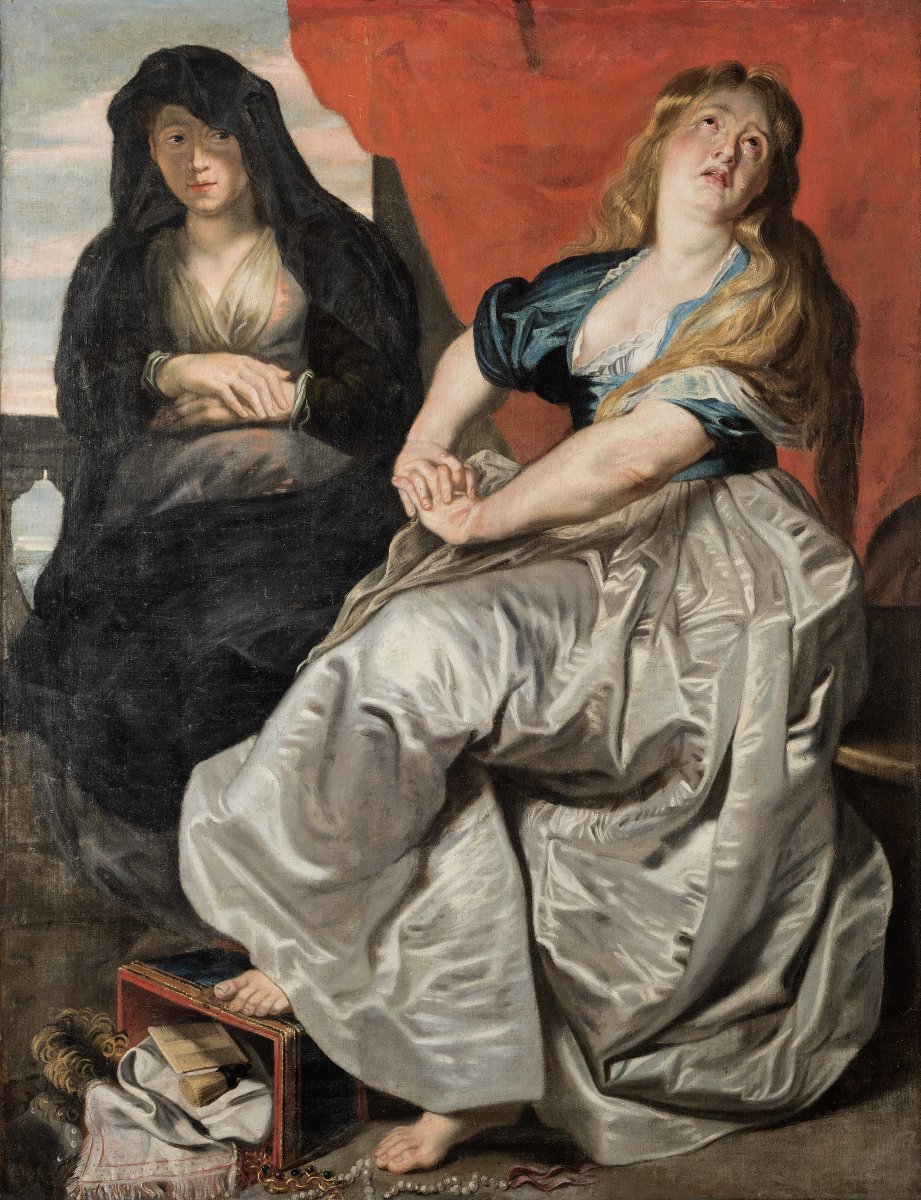
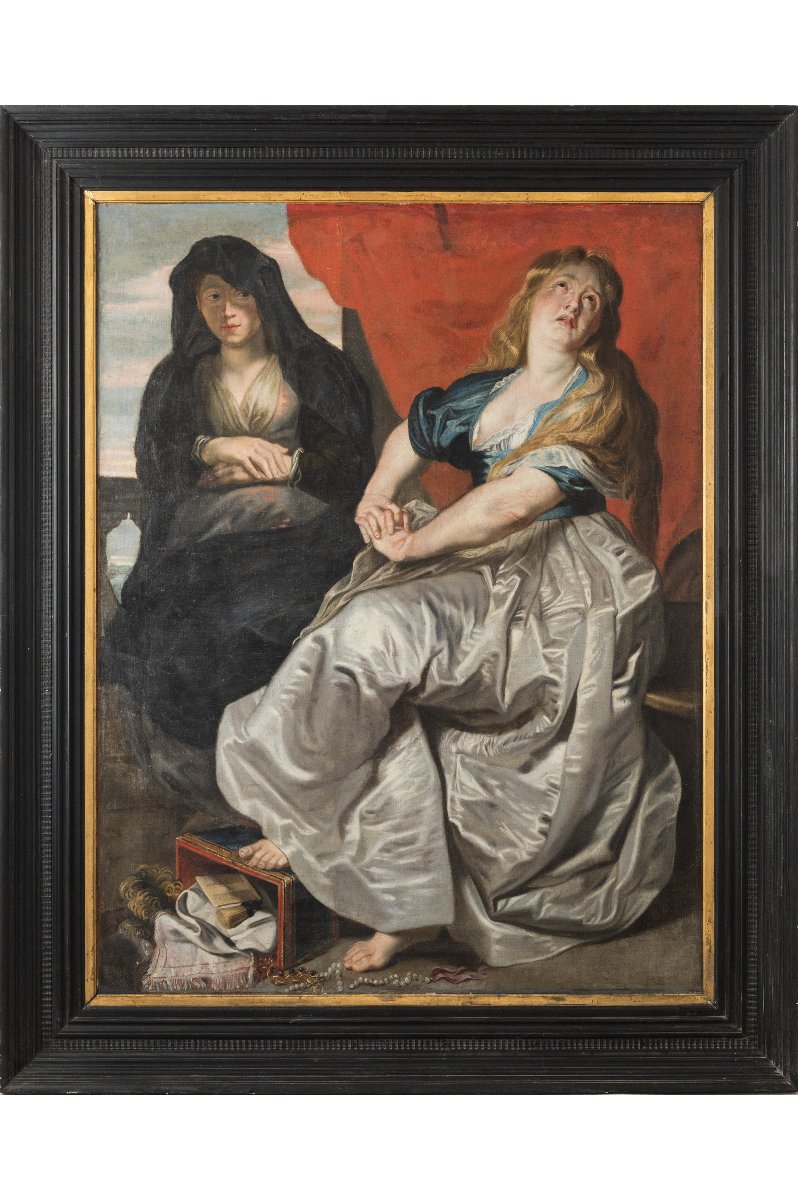
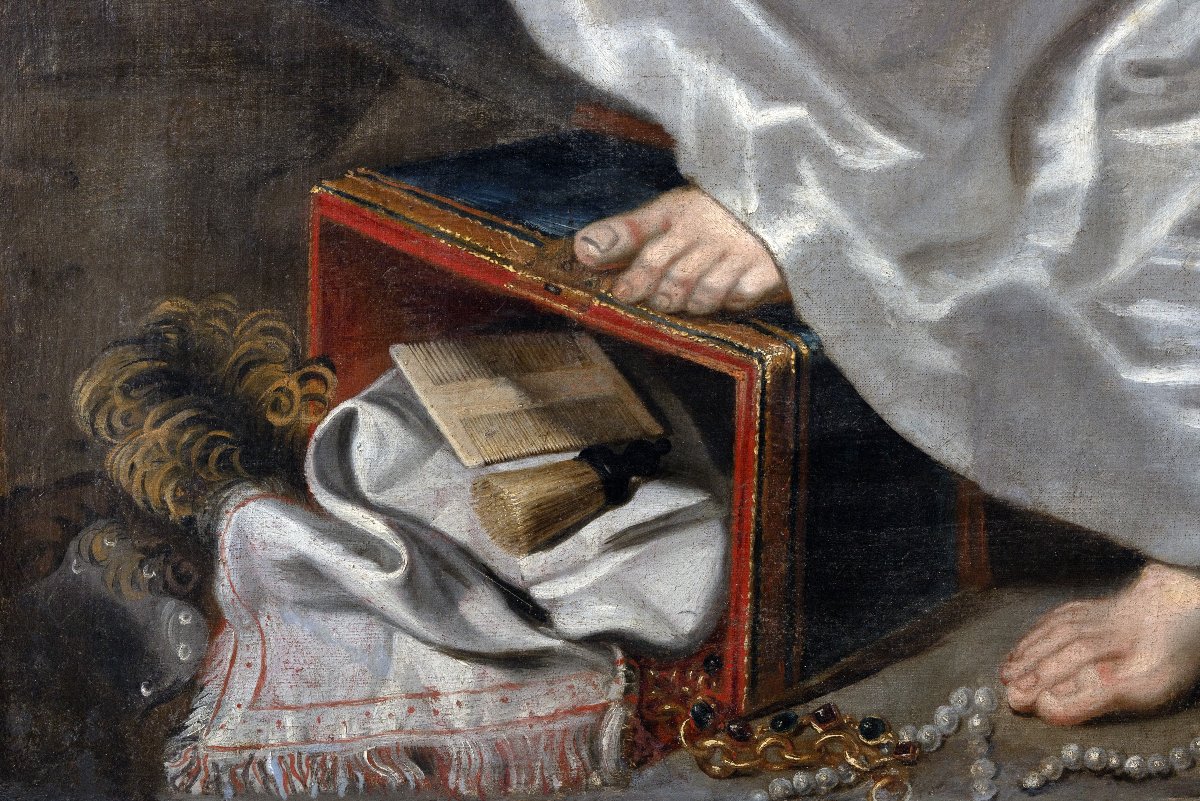
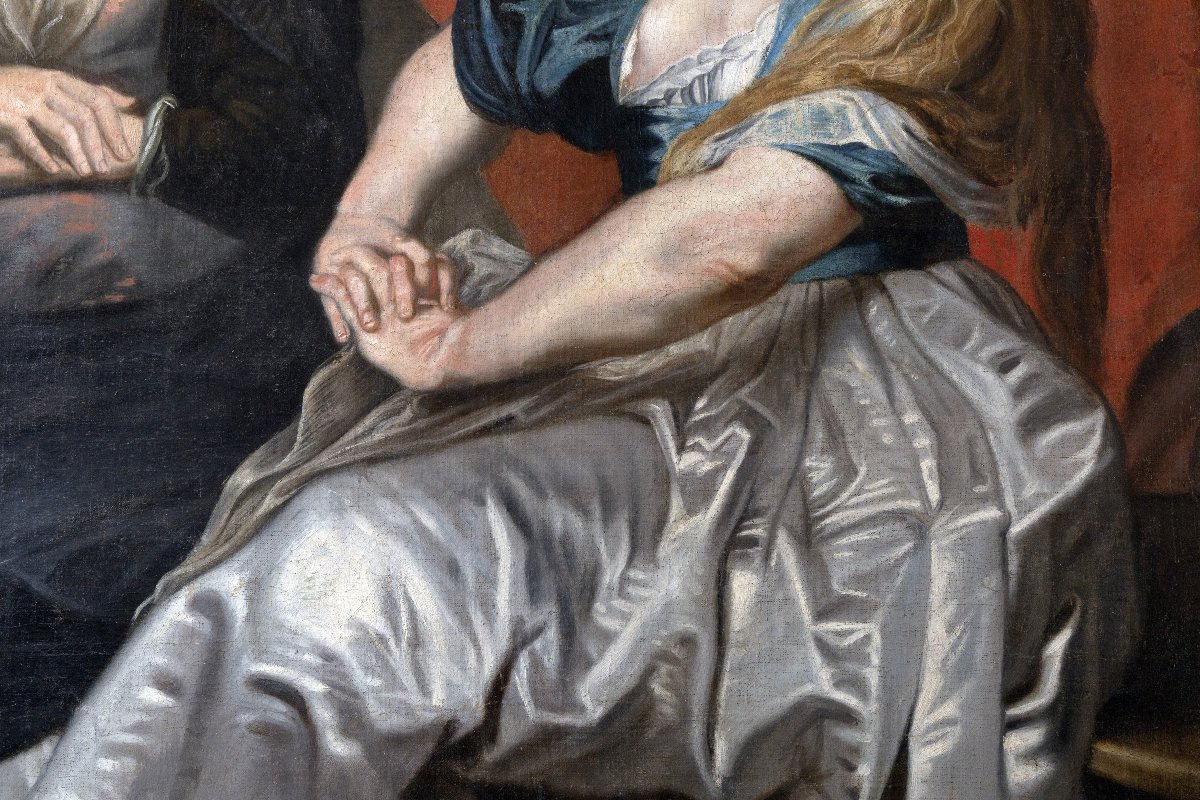
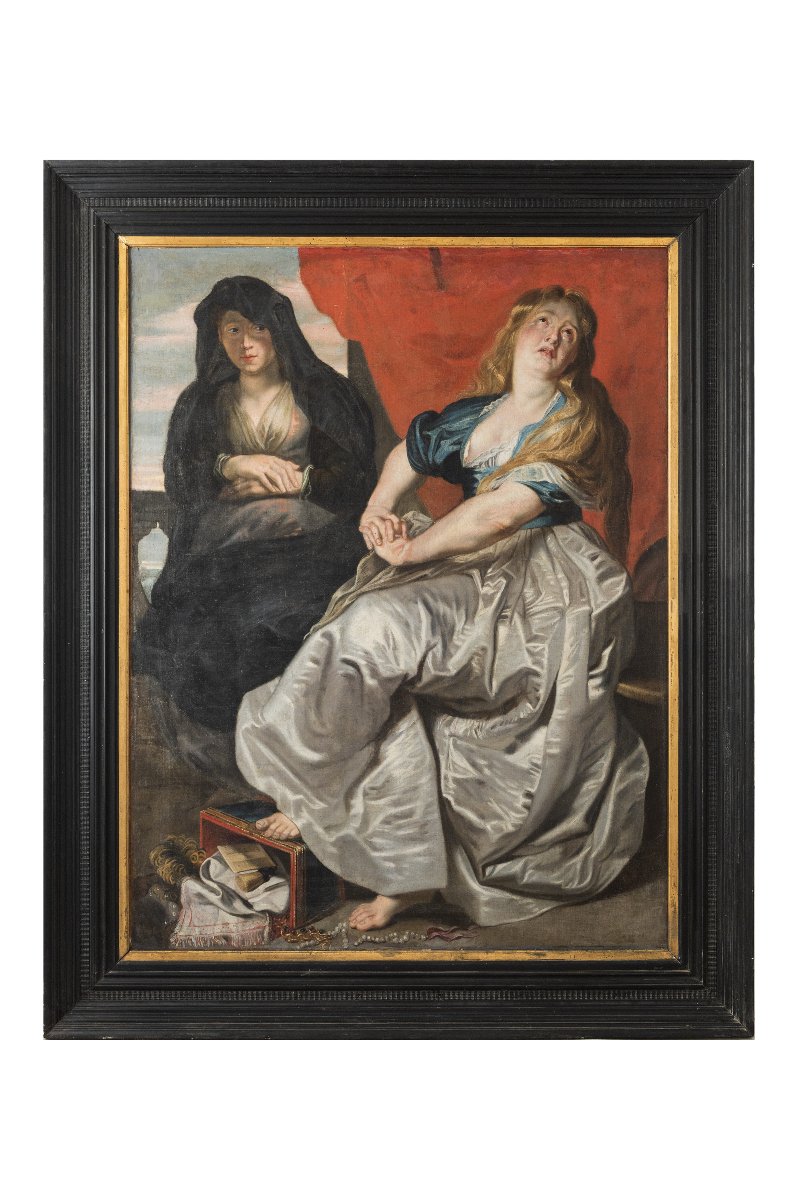
It is a spectacular work, and we must first discuss its impact. Madeleine occupies nearly the entire canvas. She kneels in a white satin dress, the soft folds of which catch the light. She is nearly one meter tall. She has just kicked aside an overturned jewelry box in the foreground, scattering pearls, a gold chain, a book, a red-fringed cloth, and a ribbon across the floor. The red box edged in gold and lined in blue distinguishes this version from all the others.
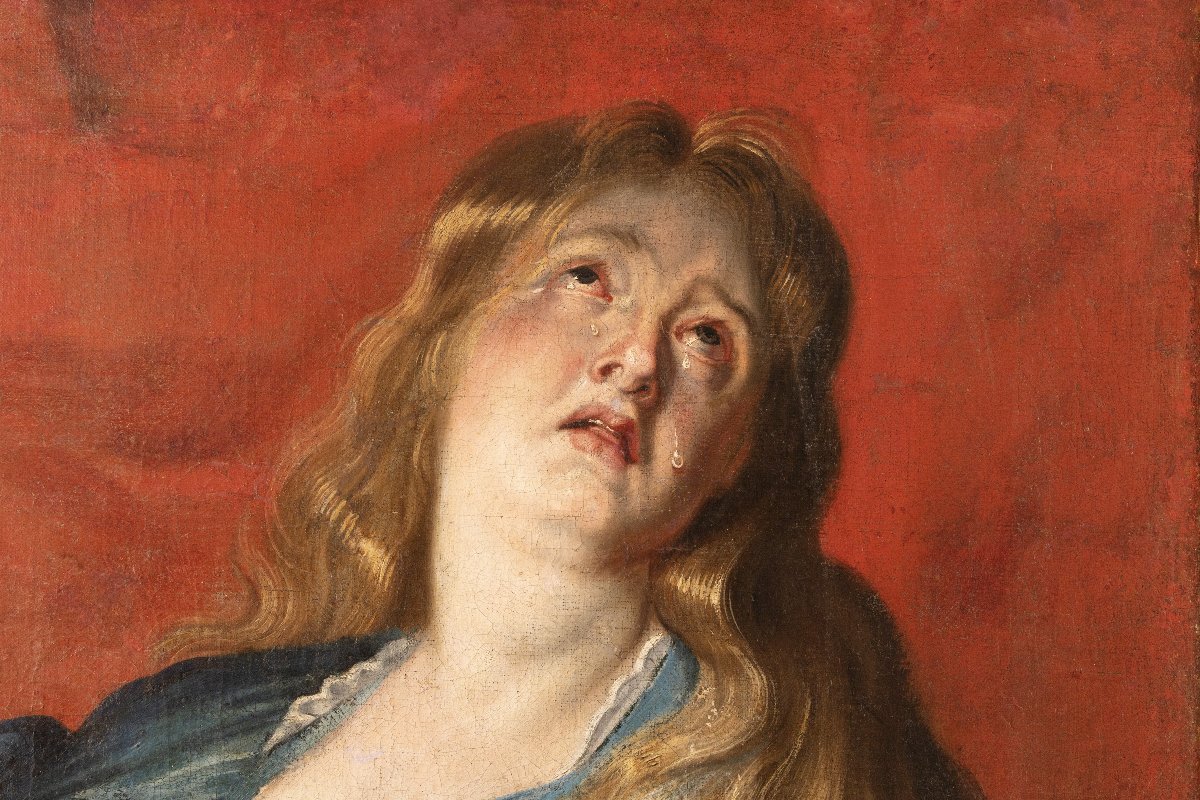
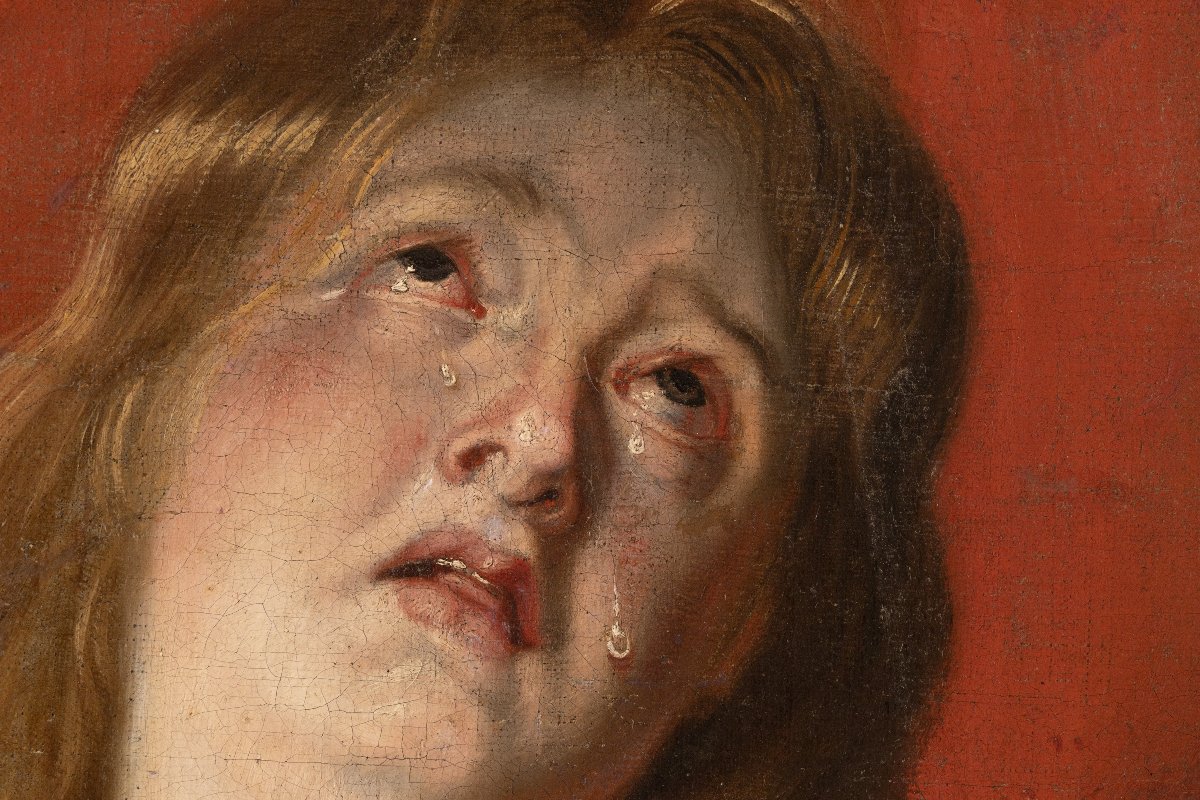
Her face is the most striking feature. Her eyes are raised, her eyelids are reddened, and her mouth is slightly parted. Four tears are painted on her face: two on her right cheek, one at the corner of her lips, and one beneath her left eye. This is not serene devotion; it is a crisis. The painting is bold, with thick layers applied for the highlights, and the network of fine cracks does nothing to detract from the clarity of the expression.
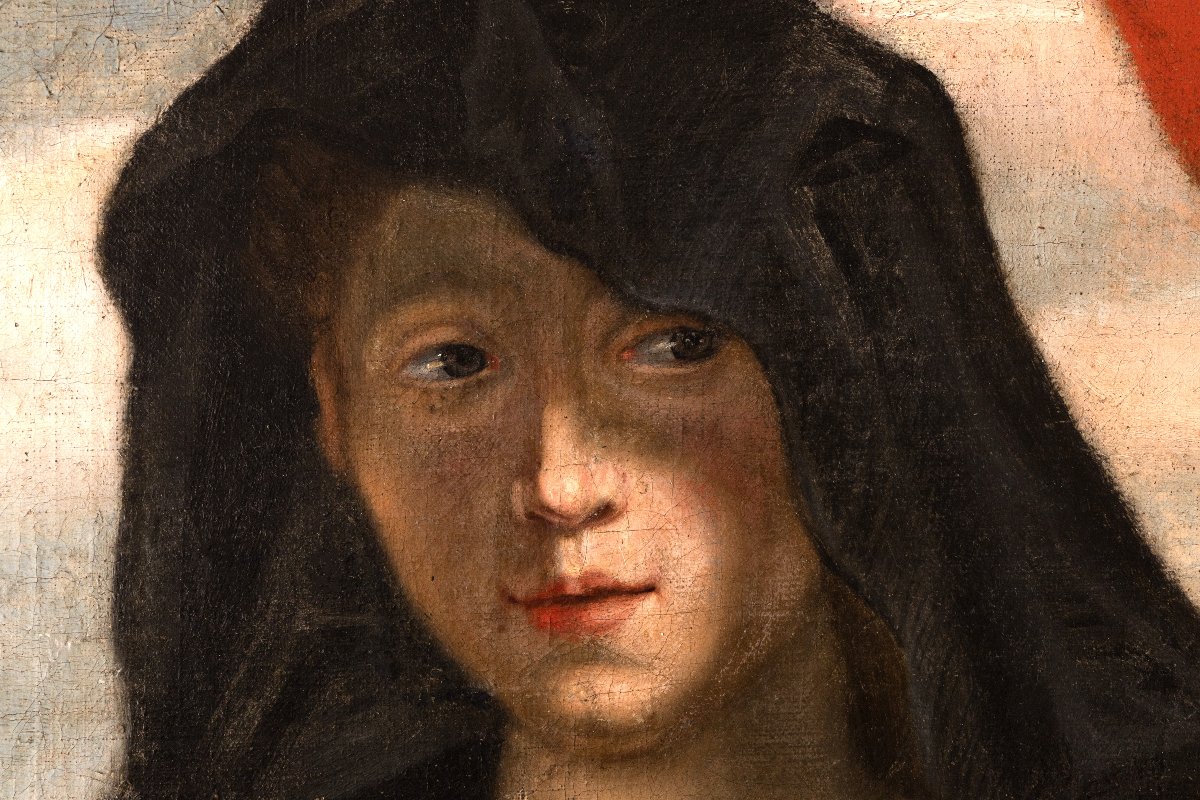
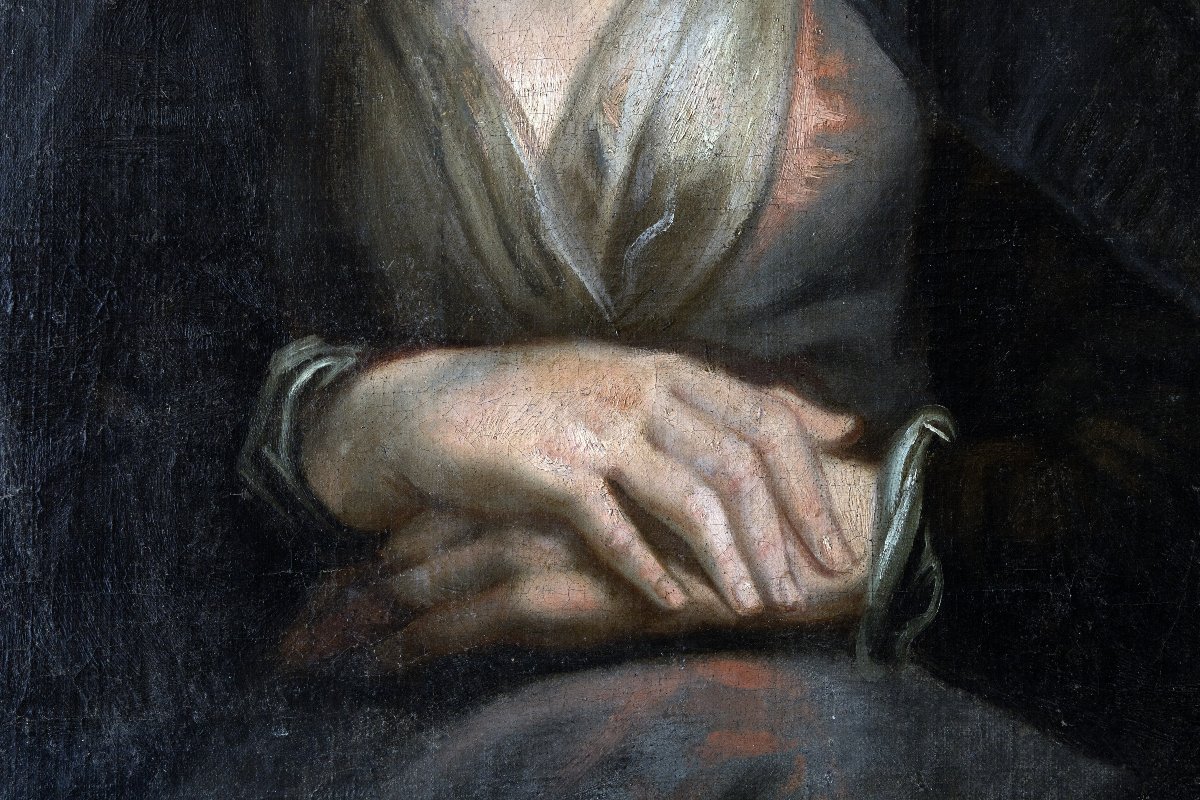
On the left is her sister Martha, who presents the exact opposite contrast. Veiled in black and seated behind a balustrade opening onto the late-afternoon sky, Martha looks off to the side. She appears calm and almost impassive. The large red curtain that frames the composition symbolically separates the two women, representing the world and seclusion.
Following the Western tradition of portraying Mary Magdalene as Martha’s sister, the subject is depicted as a sinner who renounces her finery. This theme of private devotion was highly sought after in Antwerp during the Counter-Reformation.
Condition
Very good overall. The paint adheres well to the canvas with no noticeable lifting.
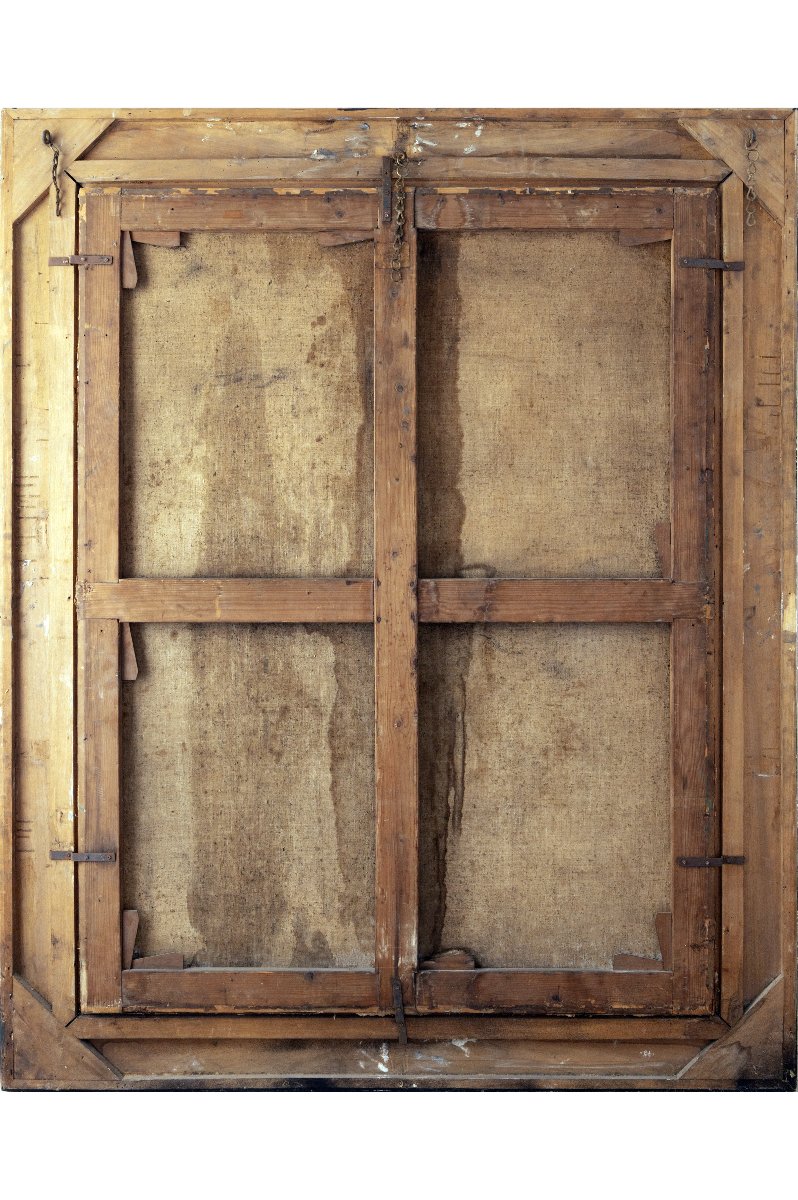
The canvas was re-stretched in the 19th century, probably around 1870. The original canvas does not quite reach the edge of the stretcher, and the upper edge is irregular. This results in touch-ups of varying extent along this border. There are no other extensive areas of repainting. However, there are numerous small and very small retouches, both old and recent, distributed across the entire surface, which is to be expected for a four-century-old painting.
The upper right corner of the relining canvas had become detached and was reattached in 2018 with slightly less tension. This resulted in a very slight lack of flatness in the upper right corner.
The blackened wood frame with wavy moldings is in very good condition.
Provenance
The collection belonged to Henri-Joseph Rega (1690–1754). He was a physician and professor at the University of Leuven, and later became its rector. He was the personal physician to Archduchess Marie-Élisabeth of Austria and Charles of Lorraine, who were the governors of the Austrian Netherlands. Rega founded the University Library and the Botanical Garden of Leuven. His statue stands in front of City Hall. He owned a richly decorated townhouse on Parijsstraat.
It passed down through the family and was then sold as part of his descendants’ estate in Tirlemont (Tienen), Belgium, in 1839 (lot 59, Lugt 15499), where the painting was described as "after Rubens." Tienen is 80 km from Antwerp and 20 km from Leuven.
Then: Hôtel Drouot, Paris, Tessier & Sarrou, January 19, 2018 (un cataloged sale), where the current owner acquired the painting. At that time, a thick layer of grime covered the painting, preventing any examination. It was cleaned within the year.
Rubens’s Studio: How These Paintings Were Produced
After returning from Italy in 1608, Rubens set up a studio in Antwerp that became a full-fledged business within a few years. The demand far exceeded what one man could paint alone. Rubens conceived the composition, often in the form of an oil sketch, and the assistants executed the painting. Rubens then took over the parts he deemed crucial, generally the skin tones and faces.
This organization was by no means informal. Rubens embraced it and took credit for it. In his famous 1618 letter to Sir Dudley Carleton, Rubens lists his available paintings and indicates the extent of his involvement in each one. He categorizes them as "original by my hand," "begun by one of my pupils and retouched by my hand," or "copy after," and assigns a different price to each category. Studio reproductions were therefore standard products, sold as such and not as counterfeits.
Subjects of private devotion recur most frequently. A Repentant Magdalene of this size was intended for a private chapel or large living room. The 1626 inventory of Rubens's possessions (published by Denucé) mentions a copy of the Magdalene, attesting that several versions of this composition existed during the artist's lifetime.
Dissemination through engraving
Before anyone else, Rubens understood what printmaking could do for him. He hired engravers, including Lucas Vorsterman from 1617 to 1621, Paulus Pontius, and the Bolswert brothers. He also obtained privileges in Brabant, the United Provinces, and France to protect the reproduction of his works. Vorsterman executed a reverse engraving of our composition (Hymans no. 80). Interestingly, the box and its contents in this engraving do not correspond to any known painted versions, suggesting the existence of a now-lost prototype. These prints were widely circulated throughout Europe and subsequently inspired generations of copyists outside the workshop.
The Family of Versions
This is one of the most frequently copied compositions in Rubens’s oeuvre. The Corpus Rubenianum by Ludwig Burchard, Part VIII, Saints II, no. 129 (Hans Vlieghe) lists four complete and four partial versions. A survey of this work has identified approximately a dozen complete and fifteen partial versions. The most notable ones are in the Kunsthistorisches Museum in Vienna (205 x 157 cm), the Museumslandschaft Hessen Kassel (192 x 148 cm), the Danish Royal Collection (panel), and Irbit, Russia (180 x 152 cm). There have also been two appearances at Sotheby's, one in New York in 2000 and one in London in 2007, as well as a sale in Florence in 2021.
Two factors support the attribution adopted here.
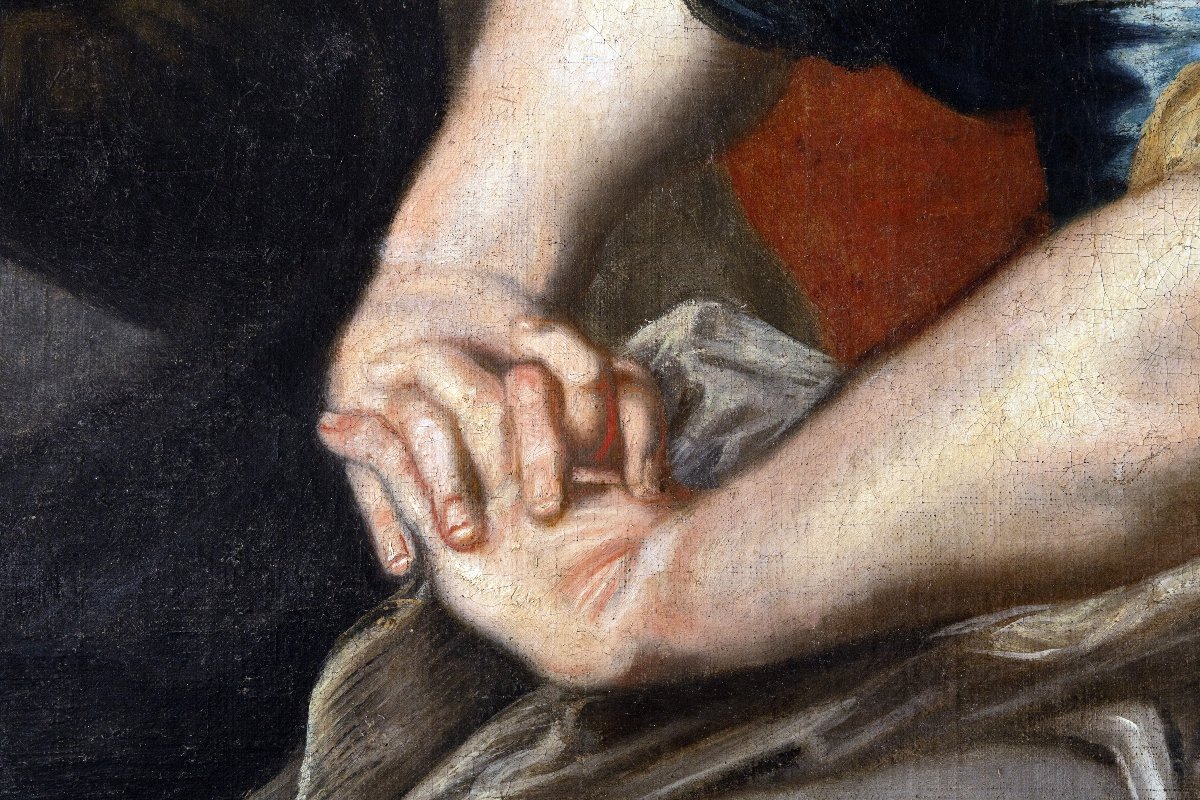
The first is based on direct comparison. In six of these versions—Vienna, Kassel, Copenhagen, Sotheby's (2000), Irbit, and our own—the two figures are perfectly superimposable: every fold of the satin, every lock of hair, and every finger. Only the casket and its contents vary from one painting to another: red, blue, black, brass, with or without a lid. This is the hallmark of serial production originating from the same location, where the casket most likely served to identify each copy. An external copy made from a print does not reproduce the folds down to the millimeter and adds a different accessory.
The second version came from Russia. The Irbit version has been held at the Hermitage since 1931, first as a copy, and then transferred in 1976. In 2012, it was restored and reexamined by Viktor Korobov, the head of painting restoration at the Hermitage. He deemed it authentic, concluding that it was executed with the participation of students. It is now displayed in a secure glass case. However, it belongs to the group with long, straight hair, like ours, and not to the curly-haired type of the Viennese version. This finding necessitates reconsidering the hypothesis of a single original followed by later copies.
In December 2018, the owner brought this painting to the Rubenianum in Antwerp, where Arnout Balis, the institution's president at the time, and Hans Vlieghe, the author of the Corpus volume devoted to the saints, examined it. The visit was the subject of an article in Het Laatste Nieuws on December 12, 2018, accompanied by photographs.
A complete documentary dossier, including a detailed inventory of versions, archival sources, and press clippings, is available upon request.
The artwork is on display and available for pickup at the gallery (07240).
For delivery within mainland France, please contact us for rates, which vary by destination.
Mary Magdalene Renouncing the Vanities of the World, in the Presence of Her Sister Martha
17th century
Oil on canvas, re-stretched in the 19th century (circa 1870)
Neither signed nor monogrammed.
Dimensions: 155 x 120 cm — 185 x 150 cm with frame
Condition: very good. Cleaned in 2018. Numerous small old and more recent retouches, particularly along the upper edge
Frame: blackened wood with wavy moldings, in the 17th-century Dutch style, probably 19th century, with a gilded interior trim. Very good condition
It is a spectacular work, and we must first discuss its impact. Madeleine occupies nearly the entire canvas. She kneels in a white satin dress, the soft folds of which catch the light. She is nearly one meter tall. She has just kicked aside an overturned jewelry box in the foreground, scattering pearls, a gold chain, a book, a red-fringed cloth, and a ribbon across the floor. The red box edged in gold and lined in blue distinguishes this version from all the others.
Her face is the most striking feature. Her eyes are raised, her eyelids are reddened, and her mouth is slightly parted. Four tears are painted on her face: two on her right cheek, one at the corner of her lips, and one beneath her left eye. This is not serene devotion; it is a crisis. The painting is bold, with thick layers applied for the highlights, and the network of fine cracks does nothing to detract from the clarity of the expression.
On the left is her sister Martha, who presents the exact opposite contrast. Veiled in black and seated behind a balustrade opening onto the late-afternoon sky, Martha looks off to the side. She appears calm and almost impassive. The large red curtain that frames the composition symbolically separates the two women, representing the world and seclusion.
Following the Western tradition of portraying Mary Magdalene as Martha’s sister, the subject is depicted as a sinner who renounces her finery. This theme of private devotion was highly sought after in Antwerp during the Counter-Reformation.
Condition
Very good overall. The paint adheres well to the canvas with no noticeable lifting.
The canvas was re-stretched in the 19th century, probably around 1870. The original canvas does not quite reach the edge of the stretcher, and the upper edge is irregular. This results in touch-ups of varying extent along this border. There are no other extensive areas of repainting. However, there are numerous small and very small retouches, both old and recent, distributed across the entire surface, which is to be expected for a four-century-old painting.
The upper right corner of the relining canvas had become detached and was reattached in 2018 with slightly less tension. This resulted in a very slight lack of flatness in the upper right corner.
The blackened wood frame with wavy moldings is in very good condition.
Provenance
The collection belonged to Henri-Joseph Rega (1690–1754). He was a physician and professor at the University of Leuven, and later became its rector. He was the personal physician to Archduchess Marie-Élisabeth of Austria and Charles of Lorraine, who were the governors of the Austrian Netherlands. Rega founded the University Library and the Botanical Garden of Leuven. His statue stands in front of City Hall. He owned a richly decorated townhouse on Parijsstraat.
It passed down through the family and was then sold as part of his descendants’ estate in Tirlemont (Tienen), Belgium, in 1839 (lot 59, Lugt 15499), where the painting was described as "after Rubens." Tienen is 80 km from Antwerp and 20 km from Leuven.
Then: Hôtel Drouot, Paris, Tessier & Sarrou, January 19, 2018 (un cataloged sale), where the current owner acquired the painting. At that time, a thick layer of grime covered the painting, preventing any examination. It was cleaned within the year.
Rubens’s Studio: How These Paintings Were Produced
After returning from Italy in 1608, Rubens set up a studio in Antwerp that became a full-fledged business within a few years. The demand far exceeded what one man could paint alone. Rubens conceived the composition, often in the form of an oil sketch, and the assistants executed the painting. Rubens then took over the parts he deemed crucial, generally the skin tones and faces.
This organization was by no means informal. Rubens embraced it and took credit for it. In his famous 1618 letter to Sir Dudley Carleton, Rubens lists his available paintings and indicates the extent of his involvement in each one. He categorizes them as "original by my hand," "begun by one of my pupils and retouched by my hand," or "copy after," and assigns a different price to each category. Studio reproductions were therefore standard products, sold as such and not as counterfeits.
Subjects of private devotion recur most frequently. A Repentant Magdalene of this size was intended for a private chapel or large living room. The 1626 inventory of Rubens's possessions (published by Denucé) mentions a copy of the Magdalene, attesting that several versions of this composition existed during the artist's lifetime.
Dissemination through engraving
Before anyone else, Rubens understood what printmaking could do for him. He hired engravers, including Lucas Vorsterman from 1617 to 1621, Paulus Pontius, and the Bolswert brothers. He also obtained privileges in Brabant, the United Provinces, and France to protect the reproduction of his works. Vorsterman executed a reverse engraving of our composition (Hymans no. 80). Interestingly, the box and its contents in this engraving do not correspond to any known painted versions, suggesting the existence of a now-lost prototype. These prints were widely circulated throughout Europe and subsequently inspired generations of copyists outside the workshop.
The Family of Versions
This is one of the most frequently copied compositions in Rubens’s oeuvre. The Corpus Rubenianum by Ludwig Burchard, Part VIII, Saints II, no. 129 (Hans Vlieghe) lists four complete and four partial versions. A survey of this work has identified approximately a dozen complete and fifteen partial versions. The most notable ones are in the Kunsthistorisches Museum in Vienna (205 x 157 cm), the Museumslandschaft Hessen Kassel (192 x 148 cm), the Danish Royal Collection (panel), and Irbit, Russia (180 x 152 cm). There have also been two appearances at Sotheby's, one in New York in 2000 and one in London in 2007, as well as a sale in Florence in 2021.
Two factors support the attribution adopted here.
The first is based on direct comparison. In six of these versions—Vienna, Kassel, Copenhagen, Sotheby's (2000), Irbit, and our own—the two figures are perfectly superimposable: every fold of the satin, every lock of hair, and every finger. Only the casket and its contents vary from one painting to another: red, blue, black, brass, with or without a lid. This is the hallmark of serial production originating from the same location, where the casket most likely served to identify each copy. An external copy made from a print does not reproduce the folds down to the millimeter and adds a different accessory.
The second version came from Russia. The Irbit version has been held at the Hermitage since 1931, first as a copy, and then transferred in 1976. In 2012, it was restored and reexamined by Viktor Korobov, the head of painting restoration at the Hermitage. He deemed it authentic, concluding that it was executed with the participation of students. It is now displayed in a secure glass case. However, it belongs to the group with long, straight hair, like ours, and not to the curly-haired type of the Viennese version. This finding necessitates reconsidering the hypothesis of a single original followed by later copies.
In December 2018, the owner brought this painting to the Rubenianum in Antwerp, where Arnout Balis, the institution's president at the time, and Hans Vlieghe, the author of the Corpus volume devoted to the saints, examined it. The visit was the subject of an article in Het Laatste Nieuws on December 12, 2018, accompanied by photographs.
A complete documentary dossier, including a detailed inventory of versions, archival sources, and press clippings, is available upon request.
The artwork is on display and available for pickup at the gallery (07240).
For delivery within mainland France, please contact us for rates, which vary by destination.
Explore similar pieces and discover your ideal find:
religious paintings