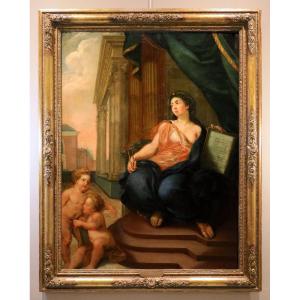


Allegory Of Architecture, Attributed To Theodoor Van Thulden (1606–1669)
Artist: Theodoor Van Thulden (bois-le-duc, 1606 - 1669), Attribué
Theodoor van Thulden (Bois-Le-Duc, 1606 – 1669) attributed
Allegory of Architecture
Oil on canvas
127 x 97 cm
Framed: 148 x 118 cm
Provenance: Hampel Munich, 2 April 2020, Lot 514, Estimate: €12,000 – €15,000 (link)
FULL DETAILS OF THE WORK (CLICK HERE)
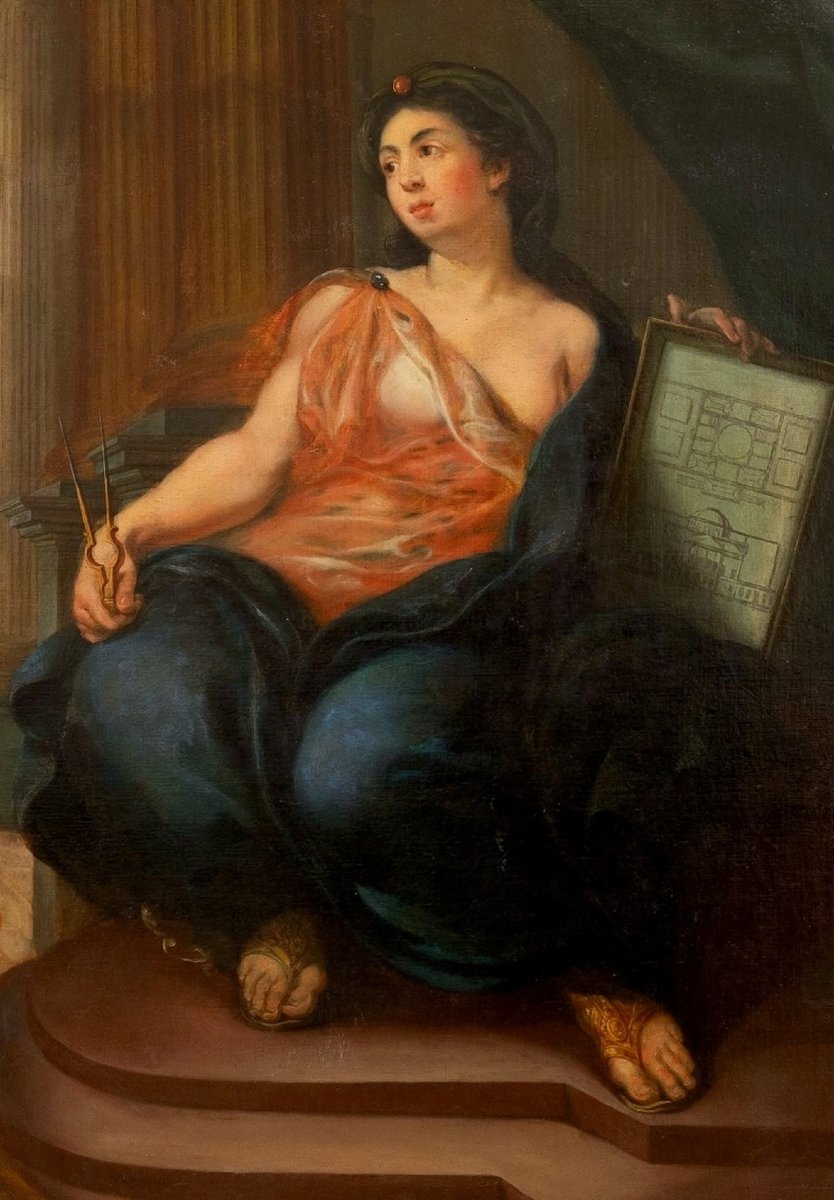
The painting belongs to the tradition of so-called ‘cultured allegories’, a pictorial genre that was very widespread during the Renaissance and Baroque periods, in which abstract concepts are personified by human figures – often beautiful young women – accompanied by specific iconographic attributes.
In this case, the meaning of the composition centres on the celebration of the Liberal Arts and, in particular, takes the form of an Allegory of Architecture, one of the art forms that has accompanied humanity since the earliest times.
It is a painting by the Flemish master Theodoor van Thulden (1606–1669), a specialist in depicting grand allegorical compositions, a genre in which he masterfully applied the sense of grandeur and expressiveness he had learnt whilst working alongside Peter Paul Rubens.
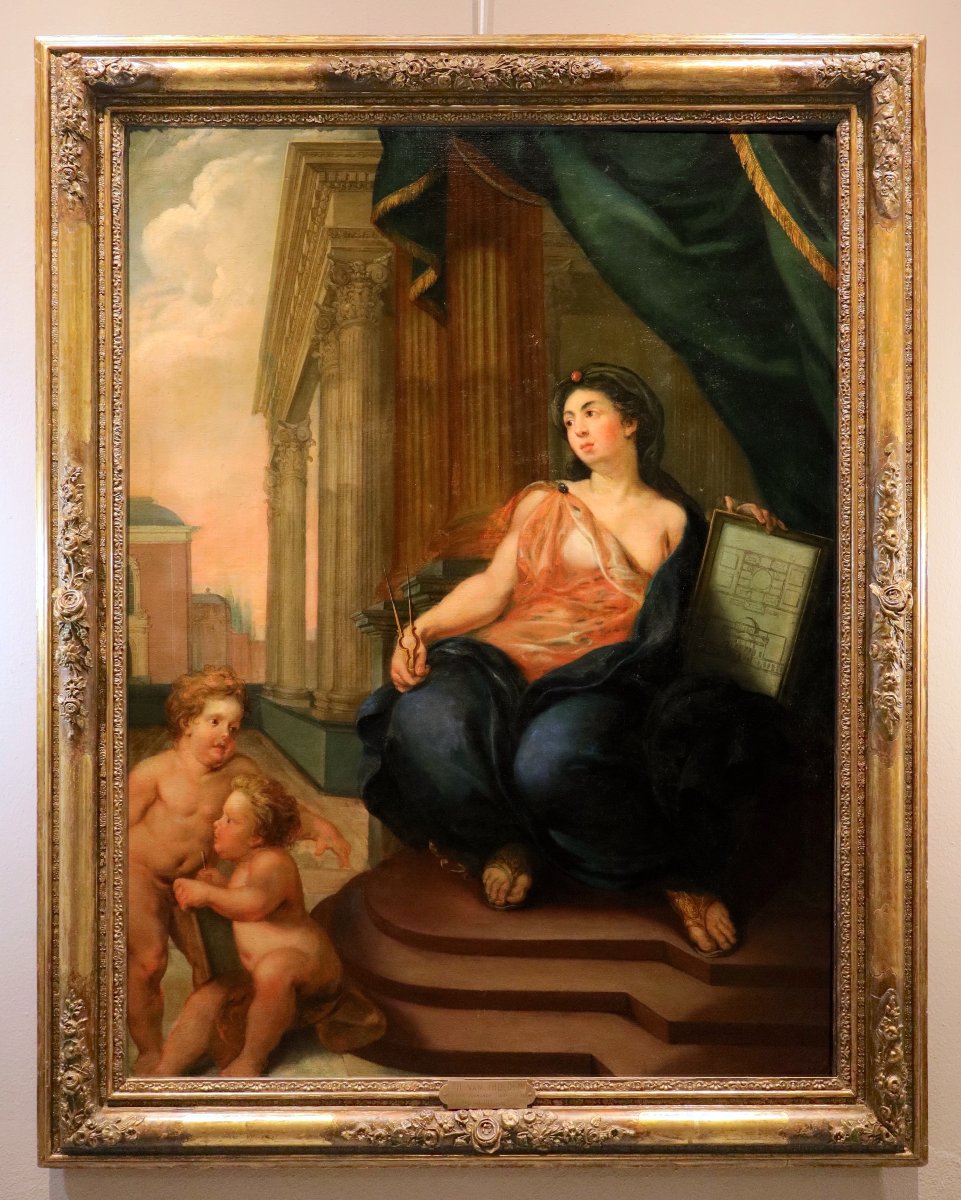
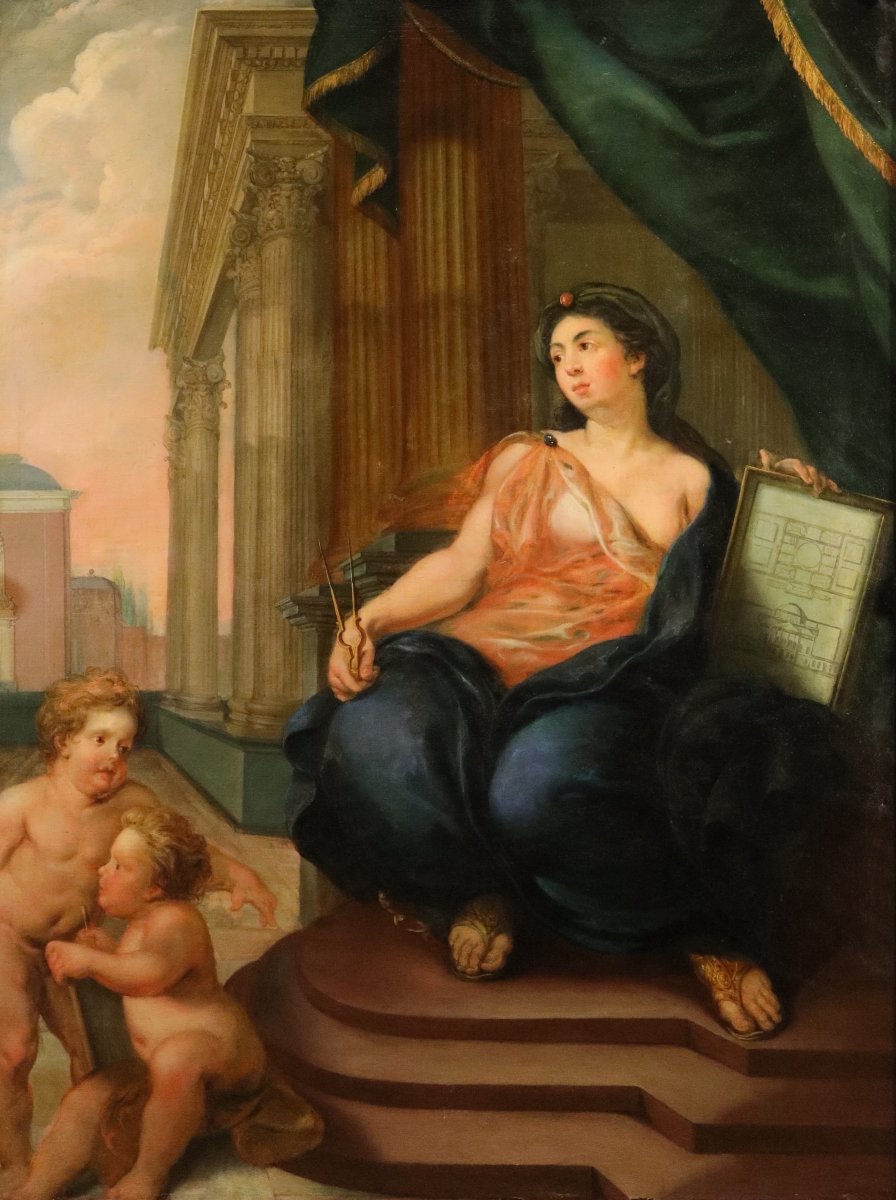
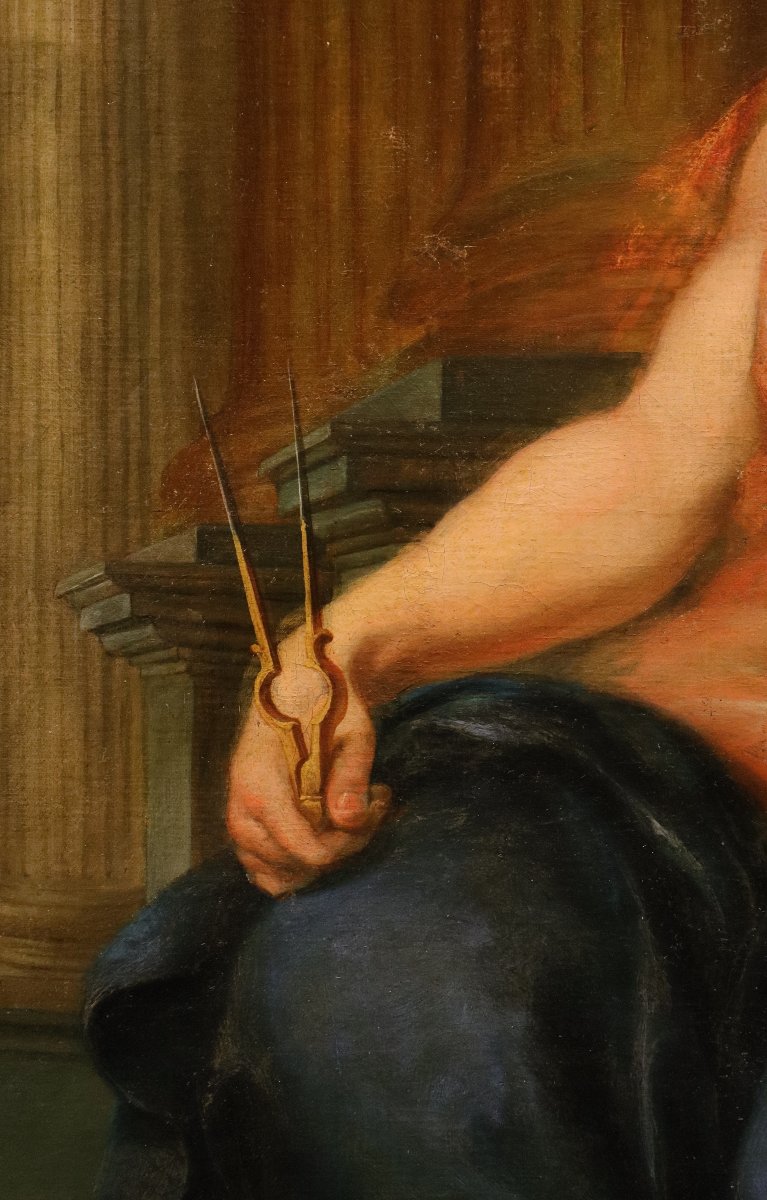
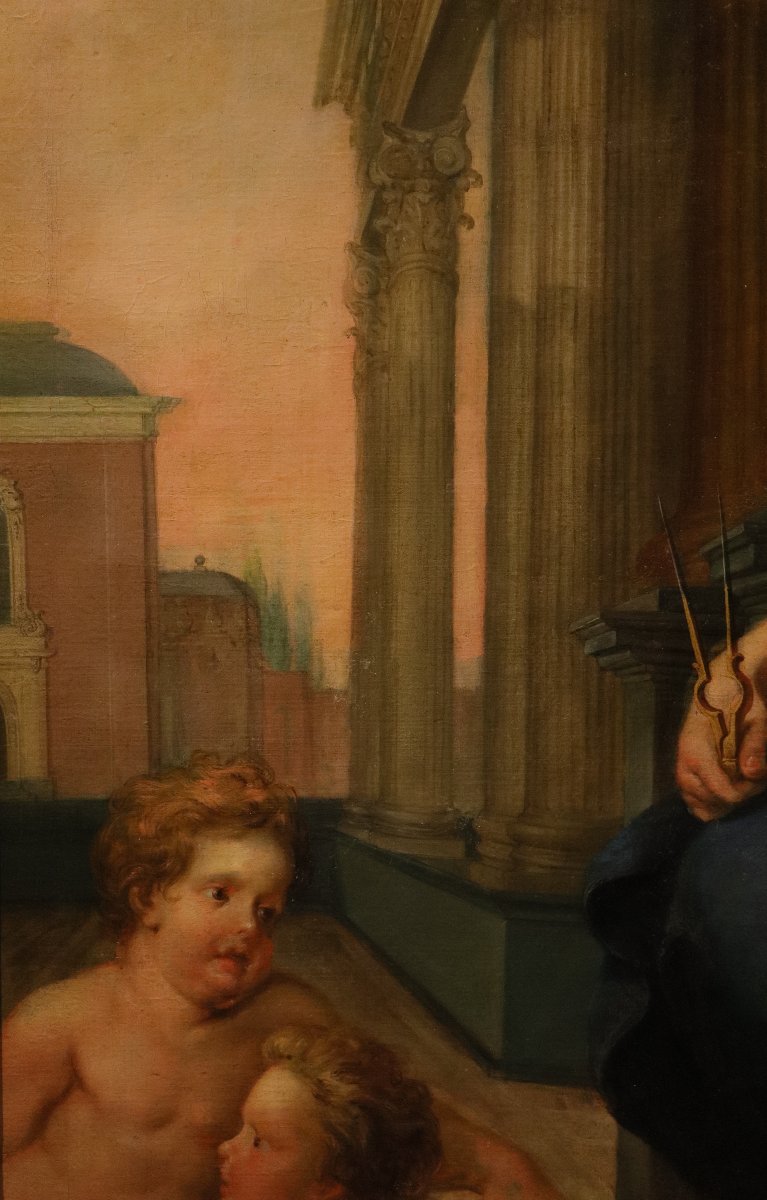
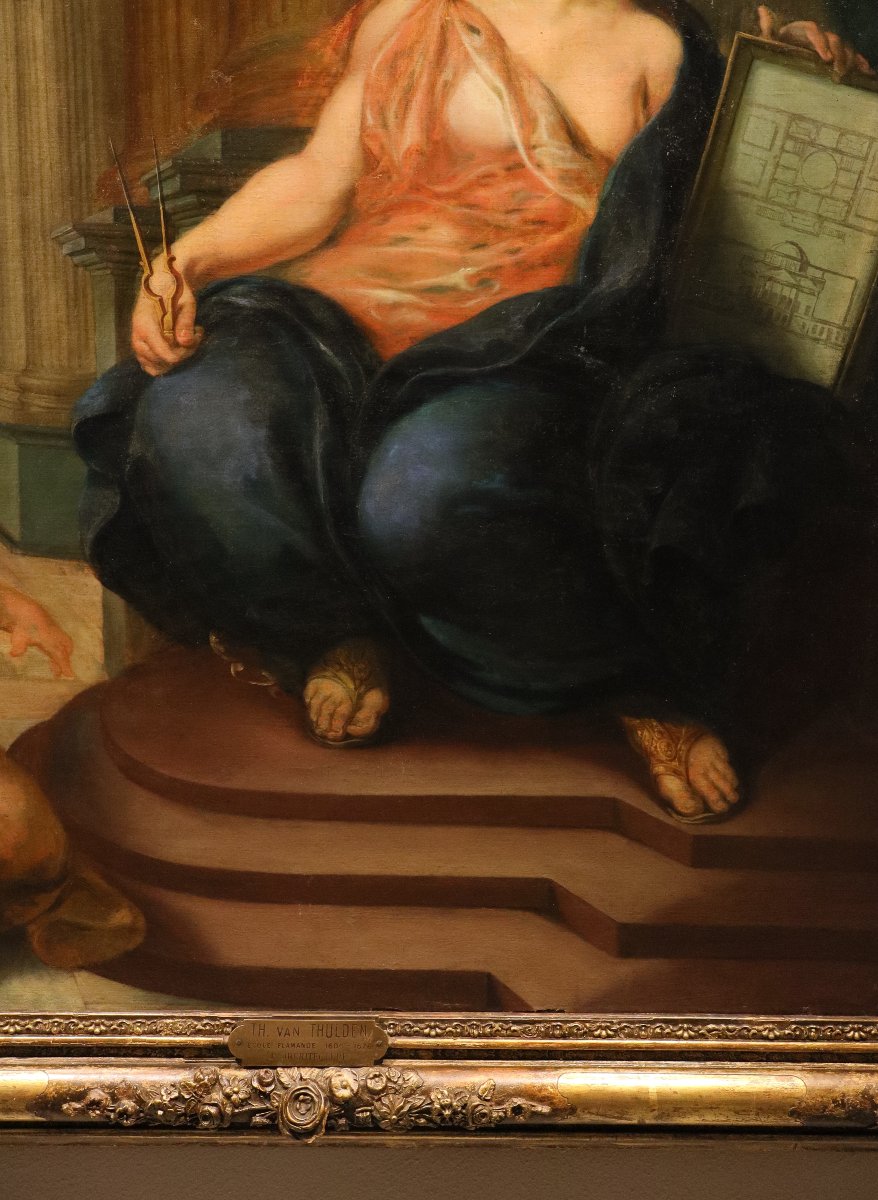
The artist has masterfully rendered the subject, giving Architecture the appearance of a seductive maiden, classical and elegant, richly dressed in draped garments reminiscent of a classical deity. She is seated on classical steps beneath an imposing colonnade and a green drape, whilst holding measuring instruments and displaying a framed design.
Every visual detail is designed to celebrate architecture’s value, not only as a practical craft but as a supreme intellectual discipline.
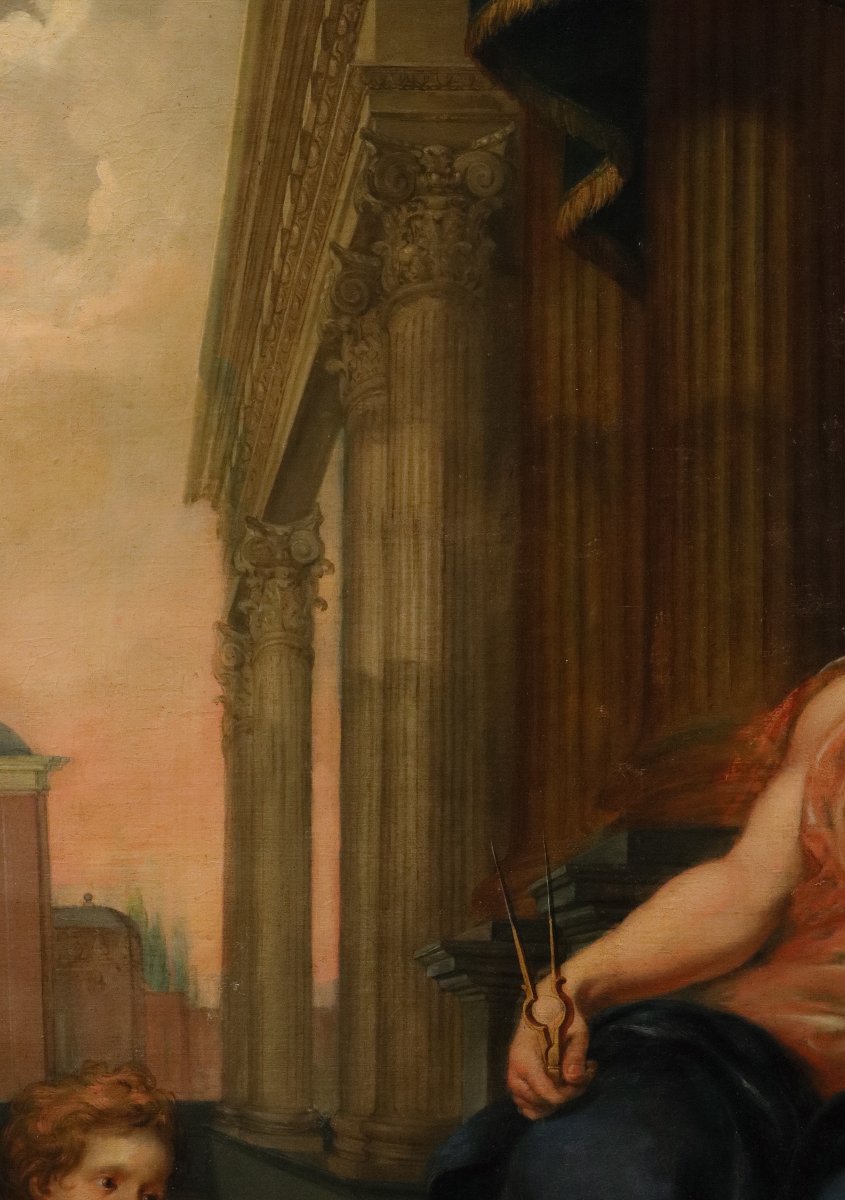
The architectural structures surrounding her, in particular the columns (inspired by the monuments of Roman and Greek antiquity), evoke Solidity and Endurance over time, whilst the massive plinth represents Practice and the foundations of knowledge – the solid bedrock upon which human ingenuity rests.
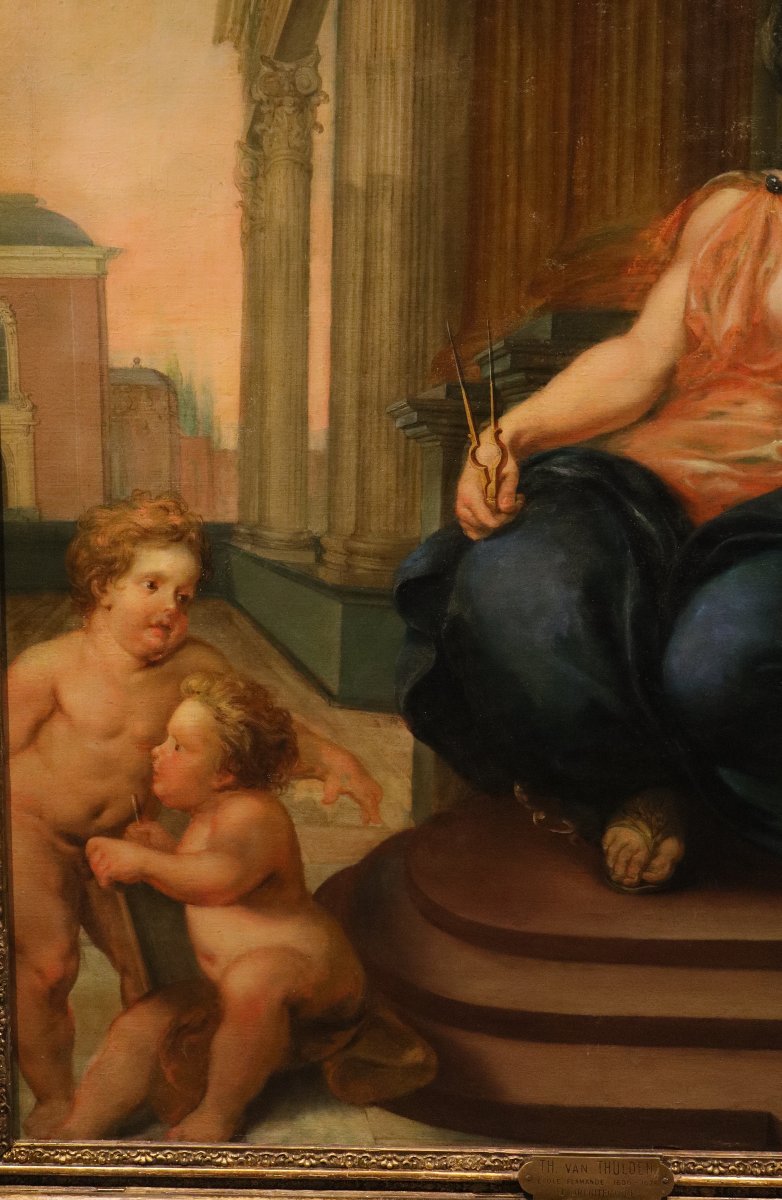
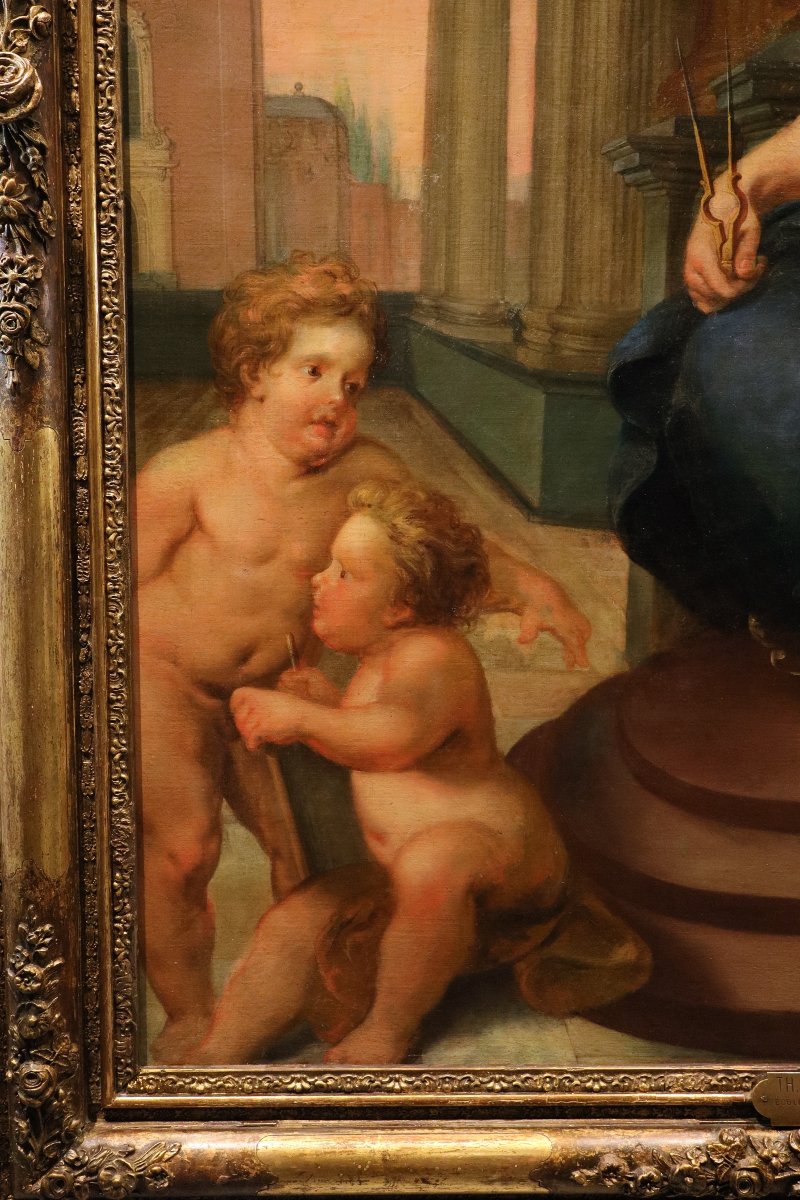
At her feet stand two cherubs observing curiously, holding measuring instruments (a compass and a set square); their presence completes the allegory by embodying Geometry and Proportion, indicating that architecture is founded on precise mathematical rules, rational planning and the pursuit of ideal symmetry.
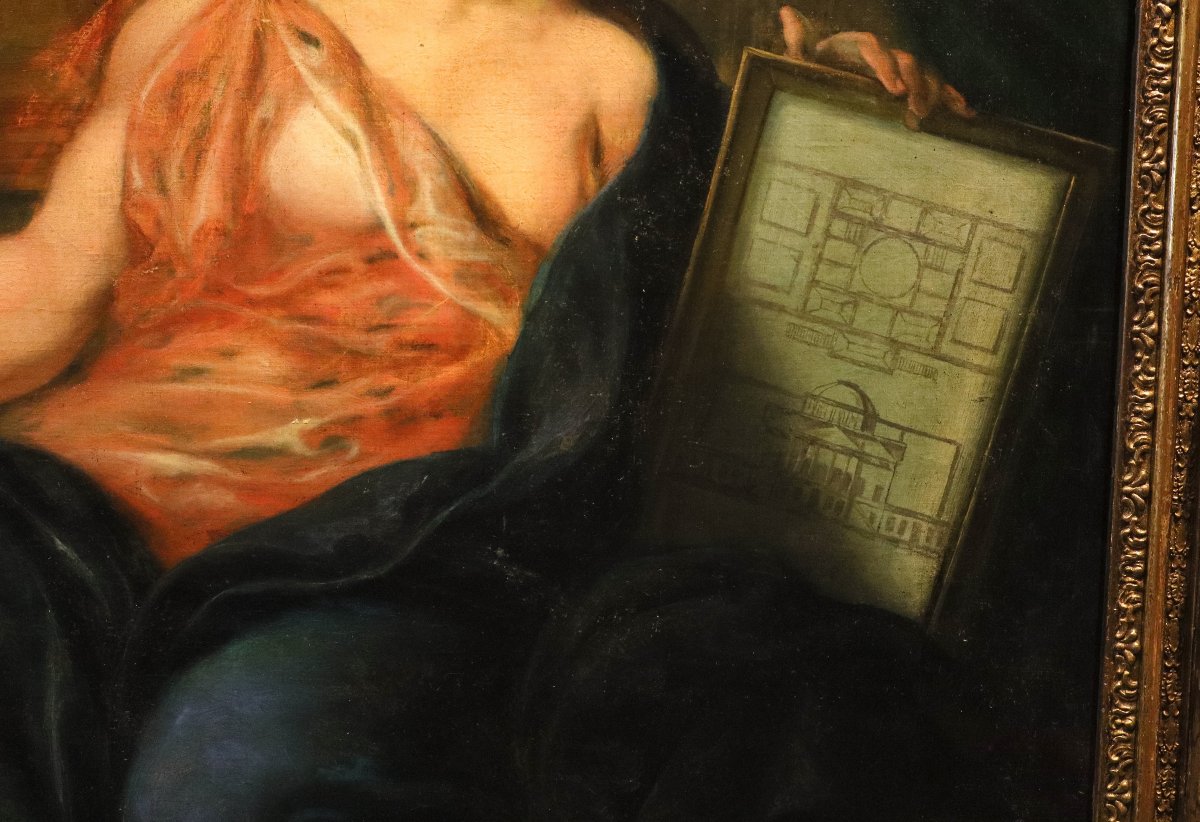
A symbolically very interesting element is the architectural plan, featuring the elevation and floor plan of a Palladian villa, which the woman displays with elegance.
During his stay in Italy, Rubens did indeed study Venetian palaces and villas at close quarters, developing in particular a deep admiration for the architecture of Andrea Palladio – an interest he passed on directly to his circle of collaborators and pupils, amongst whom Theodoor van Thulden stands out.
The architectural order, which also embodies the broader concept of universal harmony, is thus perfectly illustrated: the perfect symmetry of the ground plan—a square with a circle at its centre—represents the harmony of the cosmos reflected in human proportions.
From his master, Van Thulden also inherited the use of light, a visual device that directly illuminates the allegory and symbolises the Intellect and knowledge that guide humanity out of the darkness of ignorance through the liberal arts.
We may now mention, by way of comparison, within the painter’s allegorical oeuvre, a number of works structurally similar to the one before us. Among these is the Allegory of the Return of Peace (Fig. 1 – 1657 – Noordbrabants Museum), which depicts two female personifications in sculptural poses, accompanied by cherubs, and which shares with our work the rich colour palette and strong contrasts of light derived from Rubens. Similarly, in the ‘Allegory of Justice and Peace’ (Fig. 2 – Museum für Kunst und Kultur, Münster), we see a solemn composition in which the abstract concepts of good governance and the law are humanised through classical poses and monumental elements in the background, much like the columns in our ‘Allegory of Architecture’. Finally, the Allegory of the City of Antwerp (Fig. 3 – National Museum of Fine Arts, Valletta), featuring a richly dressed female figure seated on a throne to personify the city, presents the same pyramidal composition with the central figure surrounded by iconographic elements.
On observing these three works, we can also note van Thulden’s evolution in relation to the models of his master Rubens: these works are all united by an elegant classicism, where the exuberance of the Flemish Baroque is tempered by more orderly, geometric and profoundly intellectual compositions.
ADDITIONAL INFORMATION:
The work comes with an attractive frame and is accompanied by a certificate of authenticity and a descriptive iconographic sheet.
We arrange and organise the transport of purchased works, both within Italy and abroad, using professional and insured carriers.
It is also possible to view the painting at our gallery in Riva del Garda; we would be delighted to welcome you and show you our collection of works.
Please feel free to contact us, with no obligation, for any further information.
Follow us on:
https://www.instagram.com/galleriacastelbarco/?hl=it
https://www.facebook.com/galleriacastelbarco/
Allegory of Architecture
Oil on canvas
127 x 97 cm
Framed: 148 x 118 cm
Provenance: Hampel Munich, 2 April 2020, Lot 514, Estimate: €12,000 – €15,000 (link)
FULL DETAILS OF THE WORK (CLICK HERE)
The painting belongs to the tradition of so-called ‘cultured allegories’, a pictorial genre that was very widespread during the Renaissance and Baroque periods, in which abstract concepts are personified by human figures – often beautiful young women – accompanied by specific iconographic attributes.
In this case, the meaning of the composition centres on the celebration of the Liberal Arts and, in particular, takes the form of an Allegory of Architecture, one of the art forms that has accompanied humanity since the earliest times.
It is a painting by the Flemish master Theodoor van Thulden (1606–1669), a specialist in depicting grand allegorical compositions, a genre in which he masterfully applied the sense of grandeur and expressiveness he had learnt whilst working alongside Peter Paul Rubens.
The artist has masterfully rendered the subject, giving Architecture the appearance of a seductive maiden, classical and elegant, richly dressed in draped garments reminiscent of a classical deity. She is seated on classical steps beneath an imposing colonnade and a green drape, whilst holding measuring instruments and displaying a framed design.
Every visual detail is designed to celebrate architecture’s value, not only as a practical craft but as a supreme intellectual discipline.
The architectural structures surrounding her, in particular the columns (inspired by the monuments of Roman and Greek antiquity), evoke Solidity and Endurance over time, whilst the massive plinth represents Practice and the foundations of knowledge – the solid bedrock upon which human ingenuity rests.
At her feet stand two cherubs observing curiously, holding measuring instruments (a compass and a set square); their presence completes the allegory by embodying Geometry and Proportion, indicating that architecture is founded on precise mathematical rules, rational planning and the pursuit of ideal symmetry.
A symbolically very interesting element is the architectural plan, featuring the elevation and floor plan of a Palladian villa, which the woman displays with elegance.
During his stay in Italy, Rubens did indeed study Venetian palaces and villas at close quarters, developing in particular a deep admiration for the architecture of Andrea Palladio – an interest he passed on directly to his circle of collaborators and pupils, amongst whom Theodoor van Thulden stands out.
The architectural order, which also embodies the broader concept of universal harmony, is thus perfectly illustrated: the perfect symmetry of the ground plan—a square with a circle at its centre—represents the harmony of the cosmos reflected in human proportions.
From his master, Van Thulden also inherited the use of light, a visual device that directly illuminates the allegory and symbolises the Intellect and knowledge that guide humanity out of the darkness of ignorance through the liberal arts.
We may now mention, by way of comparison, within the painter’s allegorical oeuvre, a number of works structurally similar to the one before us. Among these is the Allegory of the Return of Peace (Fig. 1 – 1657 – Noordbrabants Museum), which depicts two female personifications in sculptural poses, accompanied by cherubs, and which shares with our work the rich colour palette and strong contrasts of light derived from Rubens. Similarly, in the ‘Allegory of Justice and Peace’ (Fig. 2 – Museum für Kunst und Kultur, Münster), we see a solemn composition in which the abstract concepts of good governance and the law are humanised through classical poses and monumental elements in the background, much like the columns in our ‘Allegory of Architecture’. Finally, the Allegory of the City of Antwerp (Fig. 3 – National Museum of Fine Arts, Valletta), featuring a richly dressed female figure seated on a throne to personify the city, presents the same pyramidal composition with the central figure surrounded by iconographic elements.
On observing these three works, we can also note van Thulden’s evolution in relation to the models of his master Rubens: these works are all united by an elegant classicism, where the exuberance of the Flemish Baroque is tempered by more orderly, geometric and profoundly intellectual compositions.
ADDITIONAL INFORMATION:
The work comes with an attractive frame and is accompanied by a certificate of authenticity and a descriptive iconographic sheet.
We arrange and organise the transport of purchased works, both within Italy and abroad, using professional and insured carriers.
It is also possible to view the painting at our gallery in Riva del Garda; we would be delighted to welcome you and show you our collection of works.
Please feel free to contact us, with no obligation, for any further information.
Follow us on:
https://www.instagram.com/galleriacastelbarco/?hl=it
https://www.facebook.com/galleriacastelbarco/
13 500 €
Period: 17th century
Style: Louis 15th - Transition
Condition: Excellent condition
Material: Oil painting
Width: encadré 118 cm.
Height: encadré 148 cm.
Reference (ID): 1813668
Availability: In stock
Print