THIS OBJECT WAS SOLD
Cartel Clock Louis XV Painter: Hipólito Bach, 19th Century


ORDERING AND ADDITIONAL INFORMATION FROM OUR WEBSITE
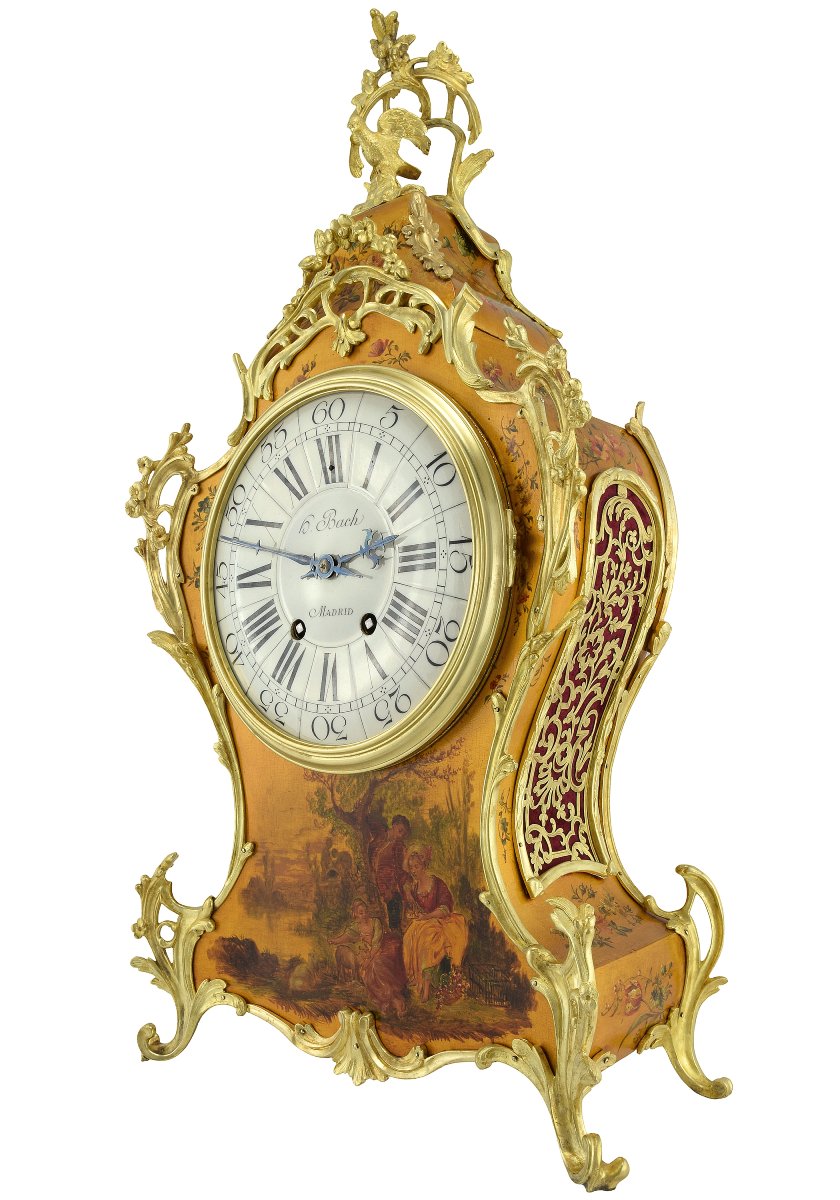
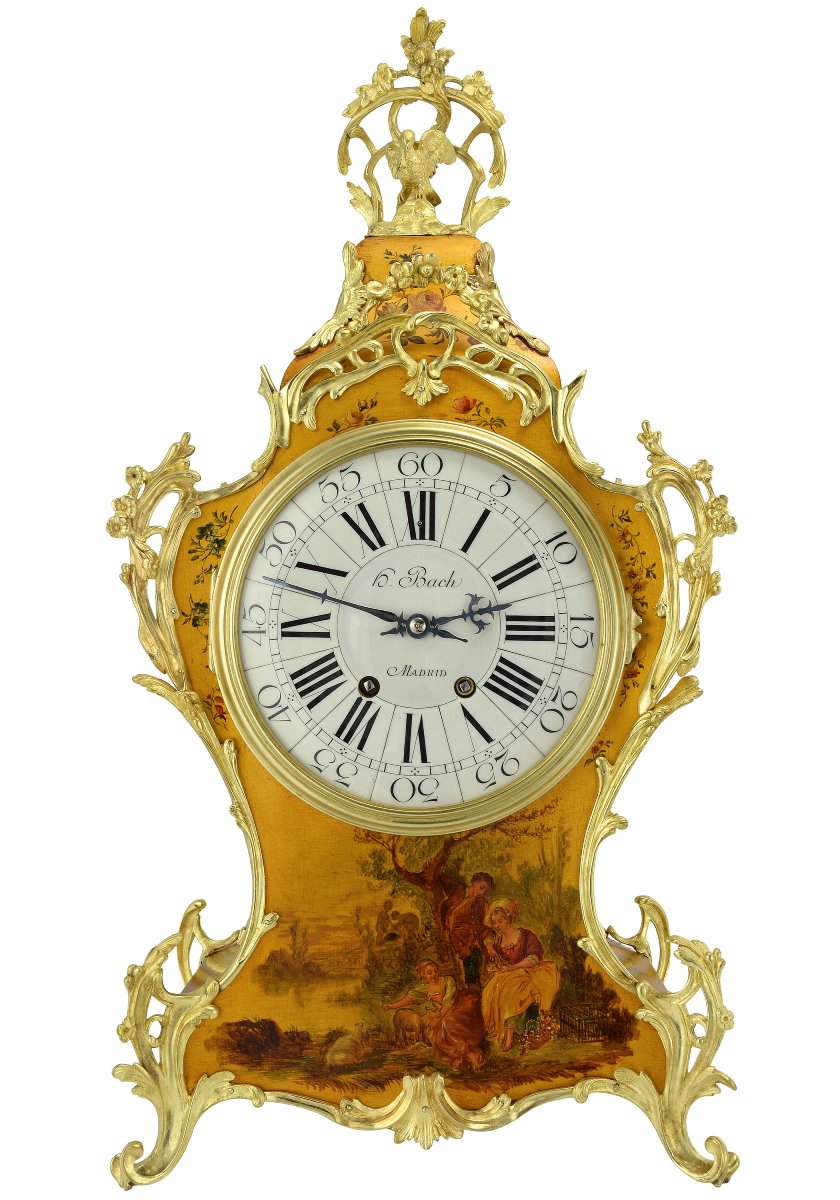
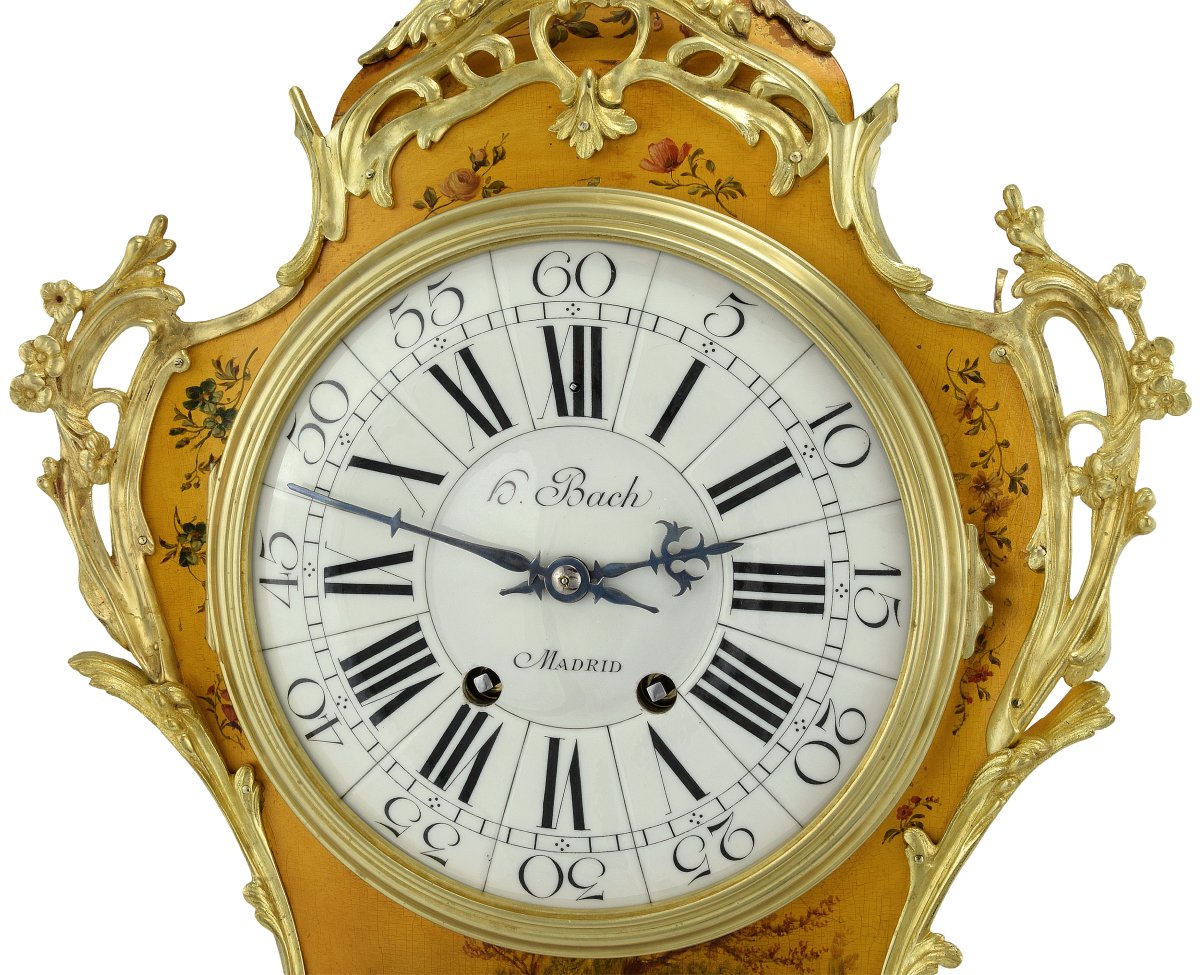
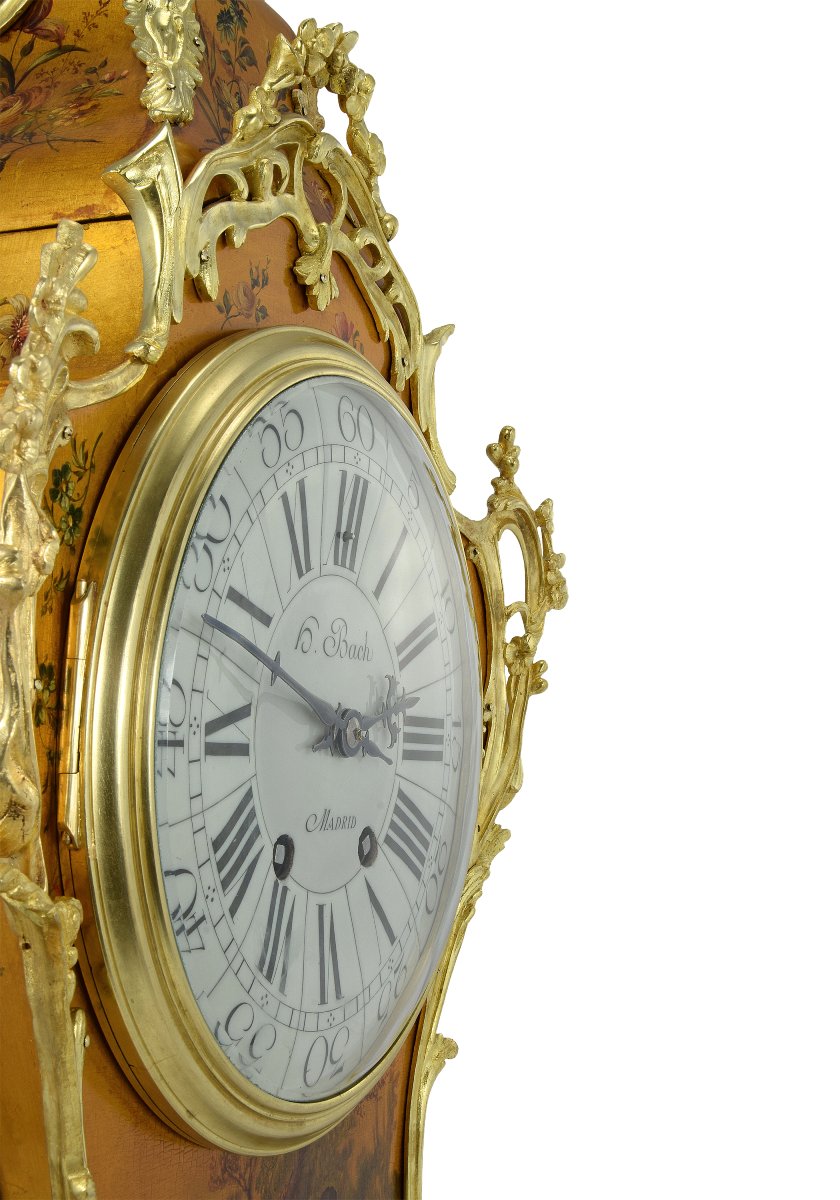
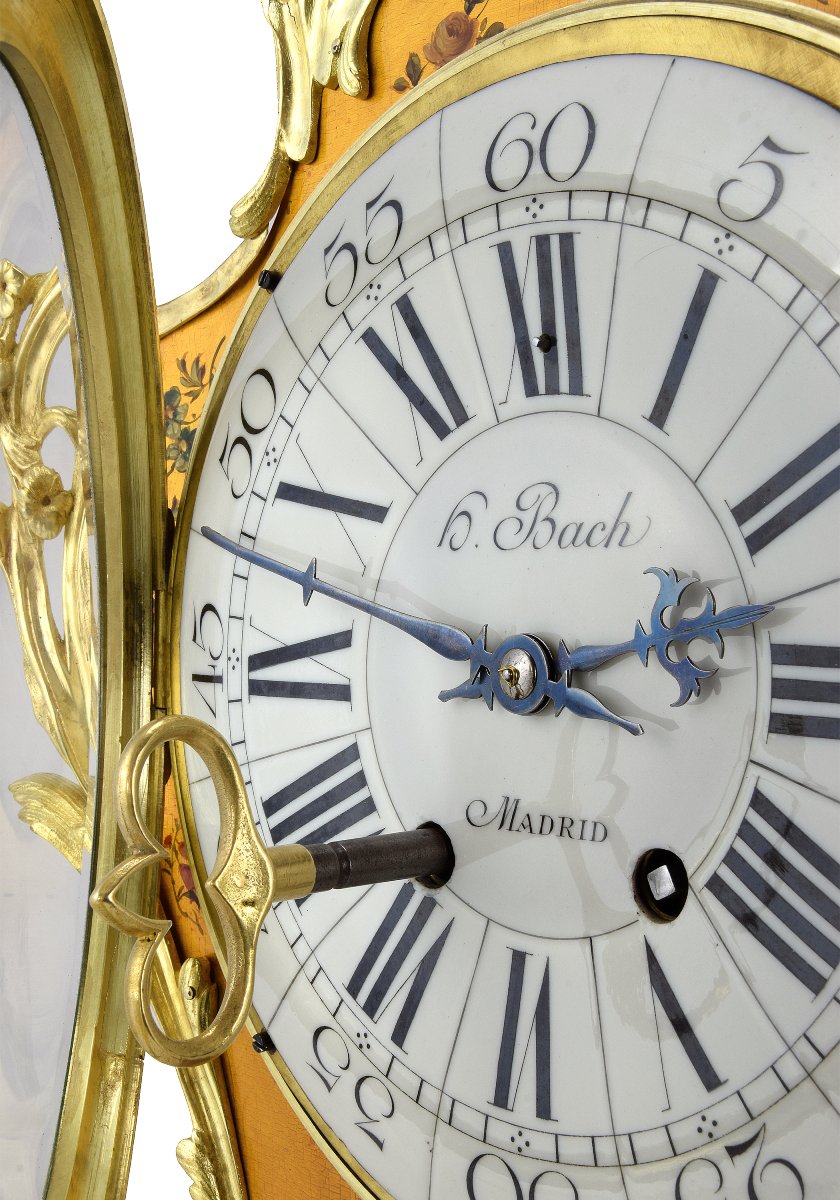
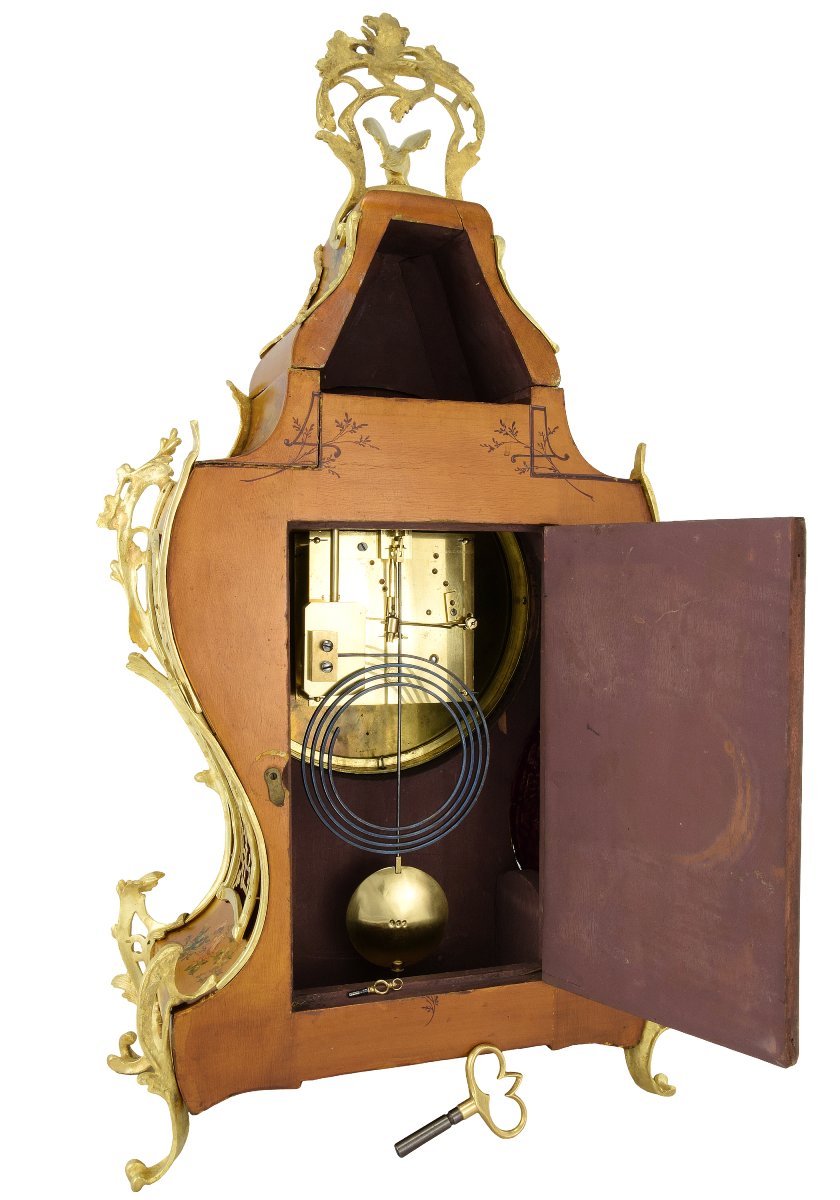
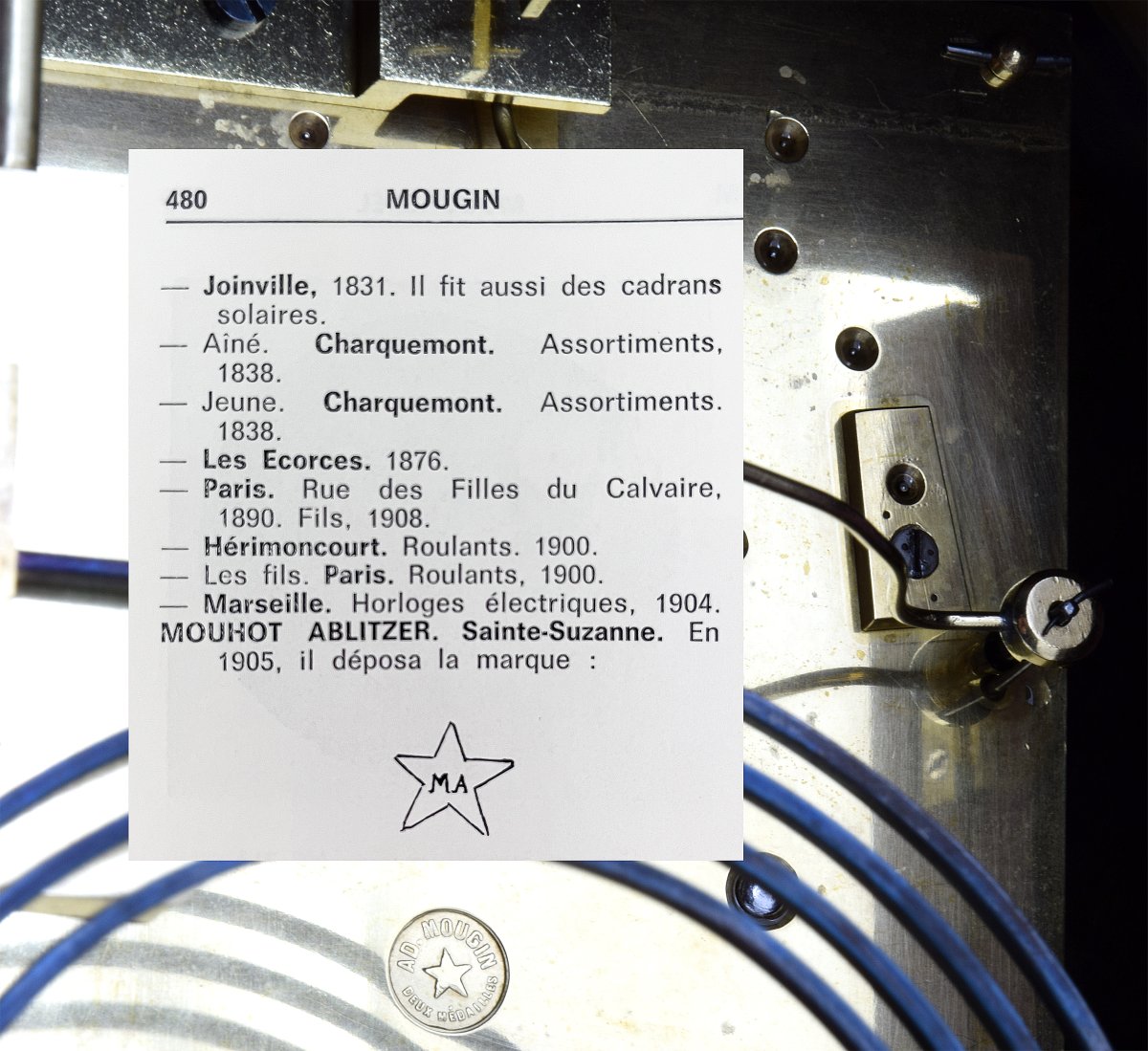
Exceptional large cartel clock in Martin varnish and gilt bronze, in the Louis XV style, made circa 1880, of rare scale with its impressive height of 70 cm, displaying an exceptionally remarkable decorative quality. The movement bears the stamp “Mongin”, a clockmaker listed in Tardy’s famous Dictionnaire des horlogers français, adding further horological and documentary interest to this remarkable work. The dial, a true focal point of the composition owing to its extraordinary dimensions and elegance, bears at its centre the signature “H. Bach” and the mention “Madrid”, identifying the painter Hipólito Bach, to whom the remarkable painted compositions covering the case are attributed. H. Bach, active in Madrid during the 19th century, was notably known as an artist and specialist in decorative painting on fans; his signature “H. Bach Madrid” is documented on painted works from this period. Here, his contribution takes on an entirely exceptional dimension owing to the scale of the support and the richness of the decorative programme, combining bouquets of flowers, foliage, landscapes and a pastoral scene. The case is executed using the refined technique of Martin varnish, a particularly sought-after decorative process in the arts of the 18th century and later brilliantly revived during the 19th century. This technique relies upon meticulous preparation of the support, the successive application of coloured layers and varnishes, followed by the execution of painted decoration before the final finishing and polishing operations. The result offers a deep, luminous surface in a warm yellow-orange tone, admirably enhanced by the brilliance of the gilt bronze. This particularly sophisticated combination of painted varnish, figurative painting and gilt bronze reveals a clear desire to create a sumptuous object of display, closer in character to a work of decorative art than to a simple clock.
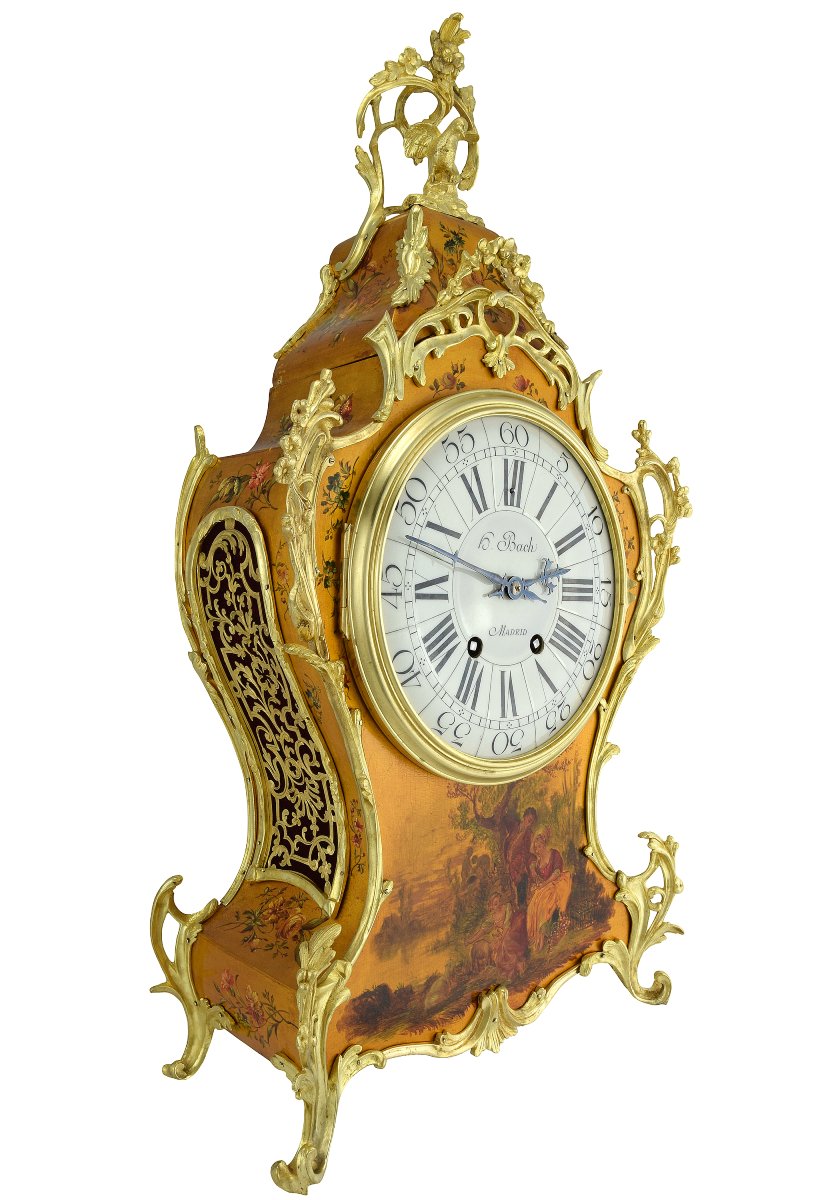
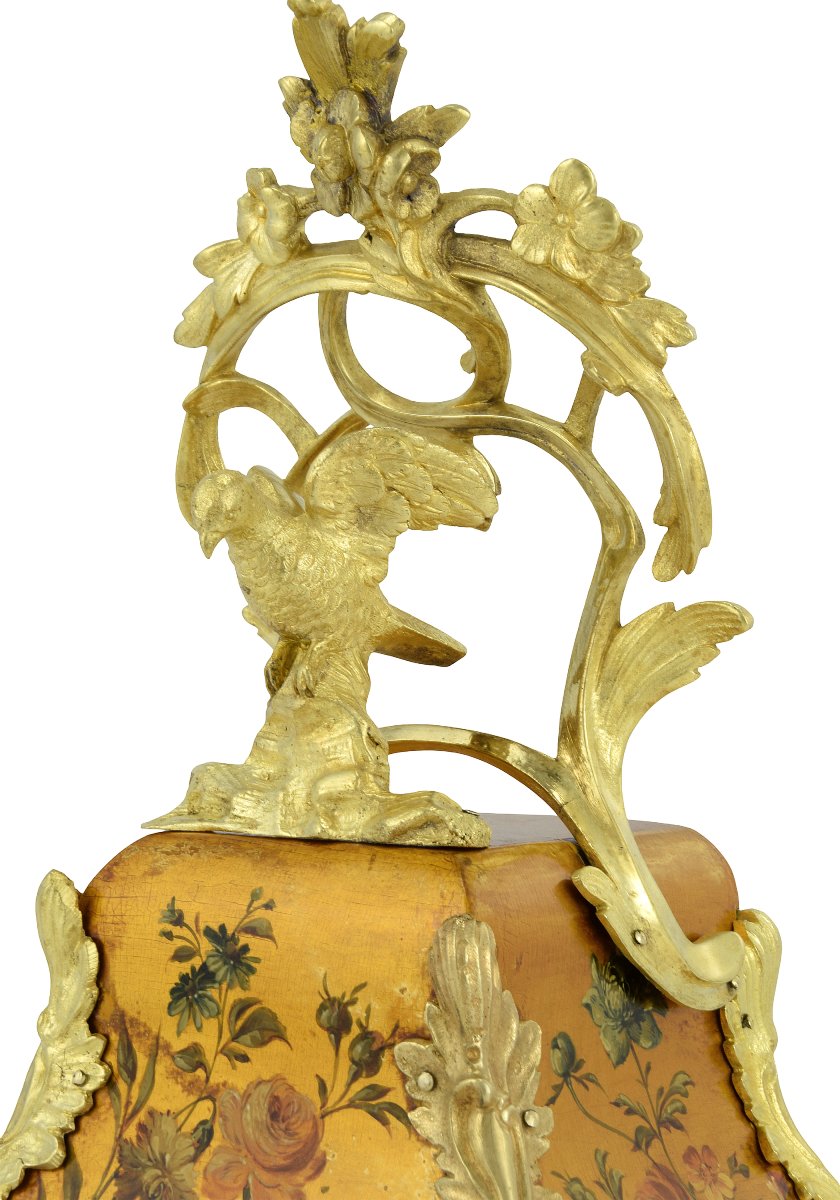
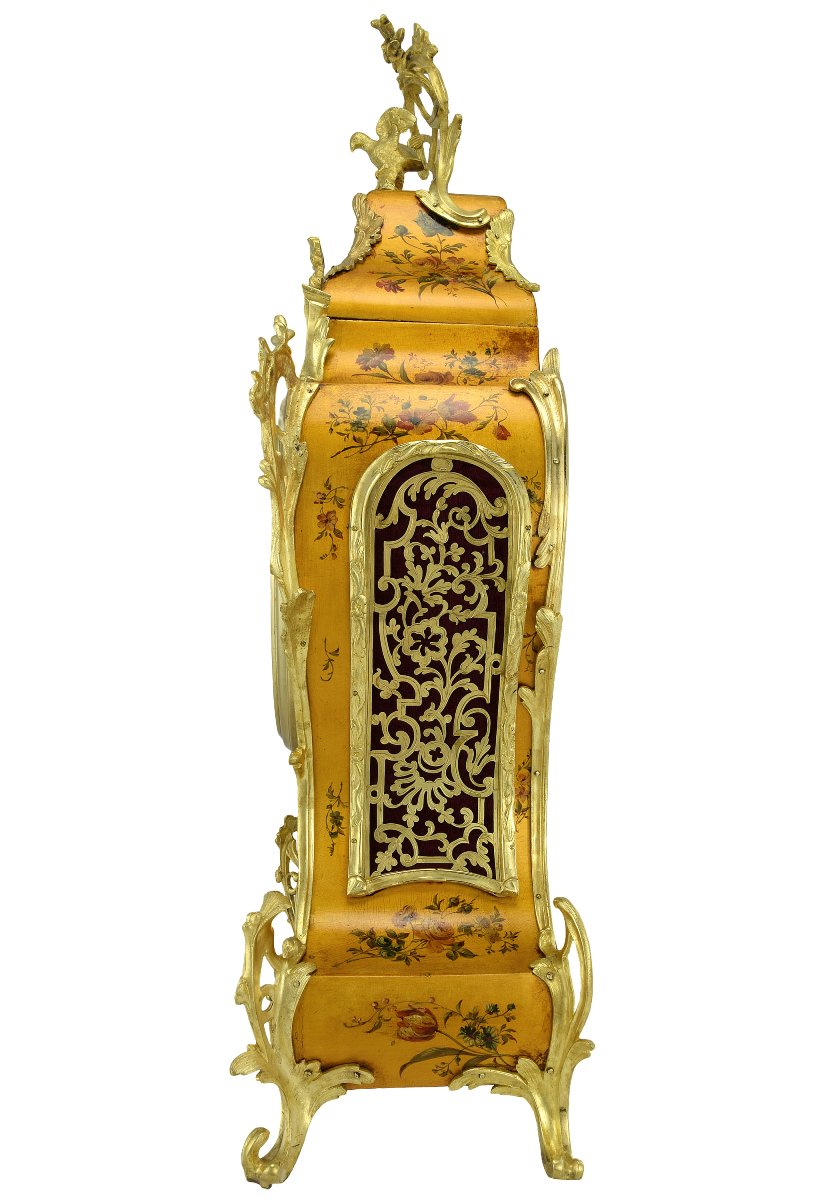
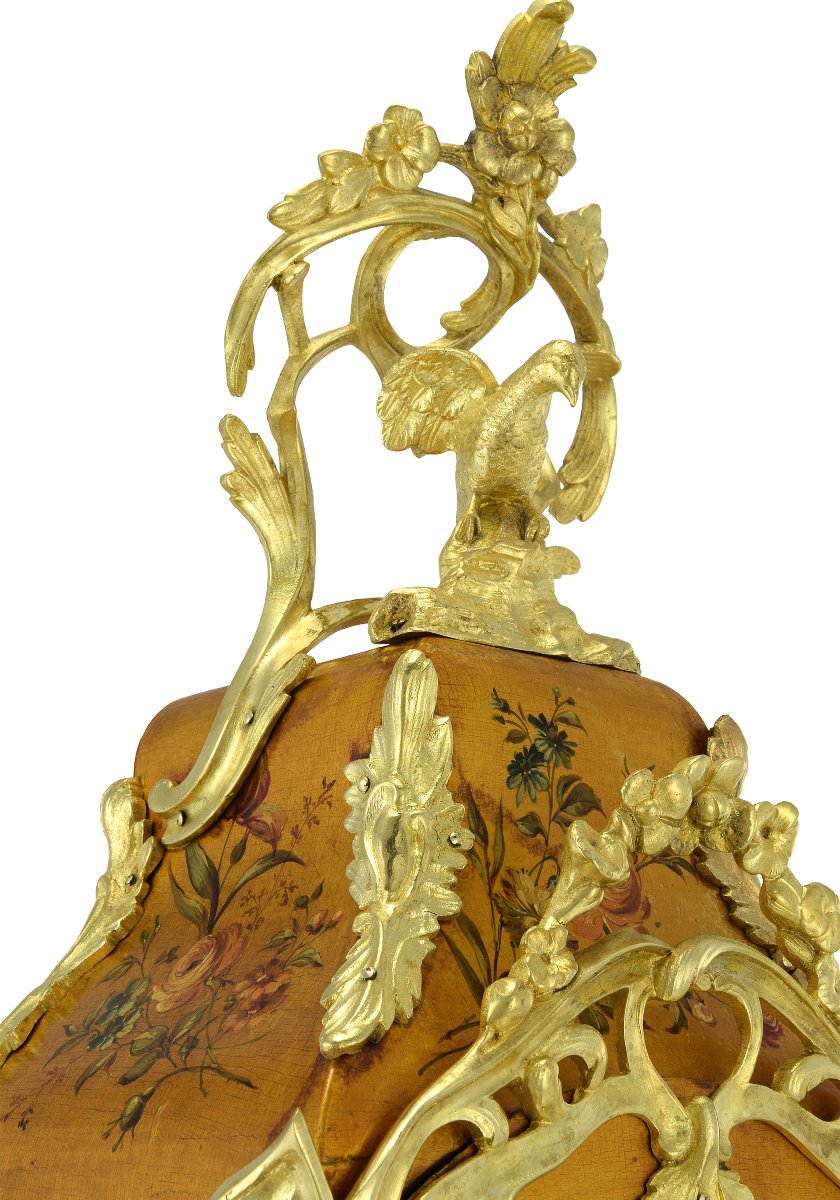
From top to bottom, the composition unfolds an exceptionally exuberant Louis XV architecture, entirely based upon curved lines, controlled asymmetry, rocaille ornament and vegetal motifs. The crowning element is dominated by a spectacular openwork gilt-bronze decoration depicting an eagle with outspread wings, perched at the summit of the case and surrounded by an elegant network of scrolls, foliage, flowers and rocaille motifs. This summit figure gives the clock a truly sculptural dimension and constitutes an especially original crowning feature. Beneath it, the strongly curved upper section of the case is enriched with flowering bouquets, garlands and finely chased rocaille ornaments. The gilt bronzes then develop into long, sinuous compositions that perfectly follow the contours of the case, alternating acanthus leaves, shells, rocaille motifs, volutes, foliate scrolls, bouquets and fully opened flowers. On either side, the magnificent cut and openwork gilt-bronze grilles form one of the most spectacular elements of the decoration. Their design, composed of arabesques, volutes and vegetal scrolls, reveals in depth a dark red velvet backing, whose deep tone powerfully enhances the brilliance of the gilding and gives the grilles an exceptional sense of relief and depth. At the centre unfolds the extraordinary oversized dial, remarkable in its presence, enclosed within a broad moulded gilt-bronze bezel. Its immaculate white ground bears large black Roman numerals, accompanied by an outer minute track, while the centre elegantly carries the signatures “H. Bach” and “Madrid”. The finely pierced blued-steel hands, animated with delicate scrollwork, provide a superb contrast against the whiteness of the dial. Beneath the dial, the case continues into a large curved panel housing the principal painted scene. The lower section then expands into a deeply shaped construction bordered with gilt bronze and terminating in four cabriole feet with scrolling ends, giving the whole a light, animated silhouette perfectly characteristic of the Louis XV rocaille vocabulary.
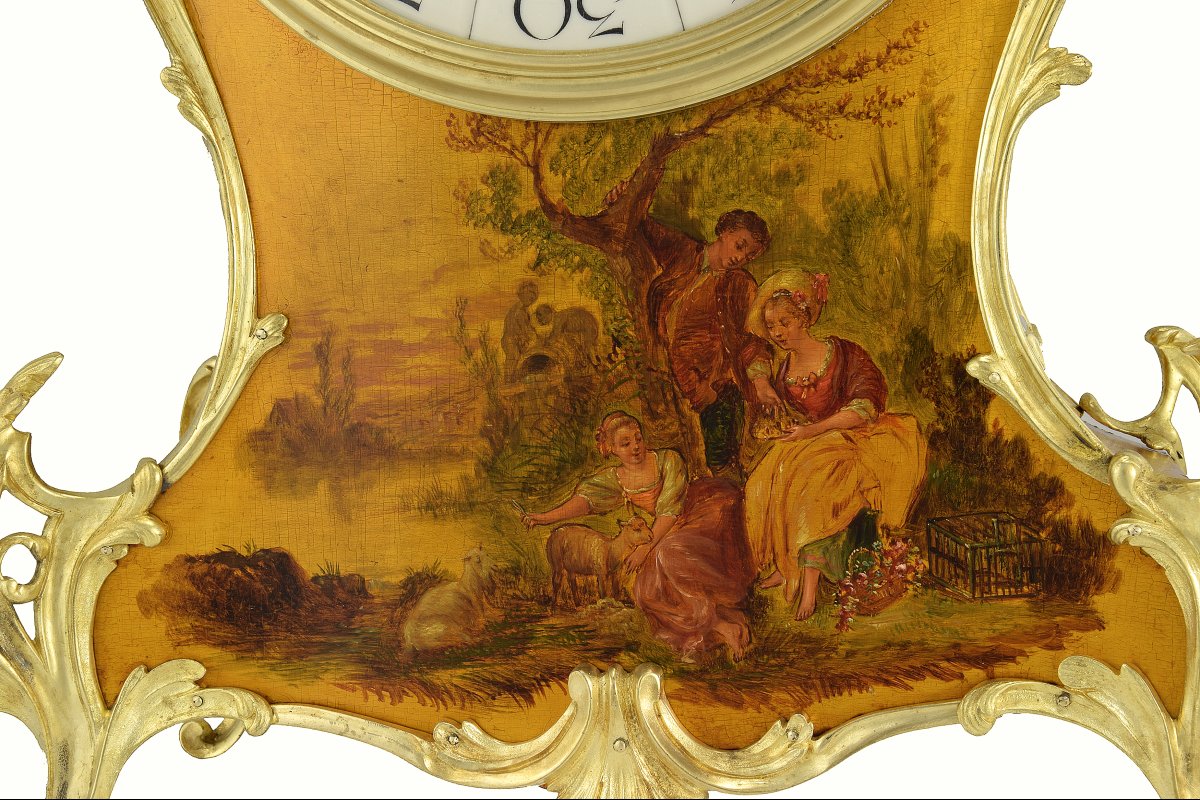
The pictorial programme executed by H. Bach constitutes one of the most precious and captivating elements of this clock. Each panel of the case is decorated with remarkably varied floral compositions: roses, wild flowers, bouquets, foliage and flowering branches are arranged naturally against the warm background of the Martin varnish. These compositions accompany and emphasise the architecture of the case, creating a constant dialogue between painting and sculpture. The large lower panel presents a superb and particularly refined galant pastoral scene. Beneath a majestic tree, several figures are placed within a rural landscape: a young woman dressed in a warm-toned gown sits beside a male figure, while a child and a small animal complete the scene. A flower-filled basket, vegetation, trees and distant landscapes give the composition genuine pictorial depth. The palette, dominated by ochres, reds, greens and brown tones, harmonises beautifully with the golden background of the varnish. The painter skilfully integrated the scene into the animated contours of the case, intelligently exploiting the available surface to create a true miniature landscape composition. The various bouquets punctuating the other panels naturally extend this principal scene and lend the whole an exceptional decorative unity. H. Bach’s work thus gives this clock an extraordinary pictorial dimension: it is not merely richly ornamented, but presents a genuine painted decorative programme in which landscapes, figures and flowers fully contribute to its artistic identity.
With its exceptional height of 70 cm, monumental yet elegant silhouette, richness of gilt bronze, rarity of its painted Martin varnish, importance of its extraordinary dial signed H. Bach Madrid, quality of its pictorial decoration and exuberance of its rocaille vocabulary, this cartel clock constitutes a particularly spectacular example of late 19th-century decorative arts. The presence of the “Mongin” stamp on the movement, combined with the H. Bach Madrid signature and such an abundant decorative programme, brings together within a single work horological, artistic and decorative significance. Its Louis XV architecture, admirably articulated by sculpted gilt bronzes, contrasts with the warmth of the varnish and the depth of the dark red velvet backing of the grilles, while the remarkable painted decoration lends the whole a truly unique dimension. The clock immediately impresses through its grandeur, but it is through close examination of its details that its full richness is revealed: the delicacy of the flowers, quality of the landscapes, refinement of the figures, openwork grilles, movement of the rocaille ornament, variety of foliage and sophistication of the gilt bronze. Authentic, monumental, rare and possessing an exceptional decorative presence, it has that particular quality of works of art destined to become the focal point of an interior. Its extraordinary combination of H. Bach’s painting, Martin varnish, gilt bronze and a Mongin-signed movement makes it a distinguished piece, particularly appealing to connoisseurs of antique clocks and collectors of decorative arts. A truly remarkable work, whose grandeur, originality of design, profusion of decoration and beautiful state of preservation make it an exceptional cartel clock, as spectacular in its presence as it is precious in the quality of its execution.
Original, unmodified movement, striking the hours and half-hours on an antique bell.
Exceptional large cartel clock in Martin varnish and gilt bronze, in the Louis XV style, made circa 1880, of rare scale with its impressive height of 70 cm, displaying an exceptionally remarkable decorative quality. The movement bears the stamp “Mongin”, a clockmaker listed in Tardy’s famous Dictionnaire des horlogers français, adding further horological and documentary interest to this remarkable work. The dial, a true focal point of the composition owing to its extraordinary dimensions and elegance, bears at its centre the signature “H. Bach” and the mention “Madrid”, identifying the painter Hipólito Bach, to whom the remarkable painted compositions covering the case are attributed. H. Bach, active in Madrid during the 19th century, was notably known as an artist and specialist in decorative painting on fans; his signature “H. Bach Madrid” is documented on painted works from this period. Here, his contribution takes on an entirely exceptional dimension owing to the scale of the support and the richness of the decorative programme, combining bouquets of flowers, foliage, landscapes and a pastoral scene. The case is executed using the refined technique of Martin varnish, a particularly sought-after decorative process in the arts of the 18th century and later brilliantly revived during the 19th century. This technique relies upon meticulous preparation of the support, the successive application of coloured layers and varnishes, followed by the execution of painted decoration before the final finishing and polishing operations. The result offers a deep, luminous surface in a warm yellow-orange tone, admirably enhanced by the brilliance of the gilt bronze. This particularly sophisticated combination of painted varnish, figurative painting and gilt bronze reveals a clear desire to create a sumptuous object of display, closer in character to a work of decorative art than to a simple clock.
From top to bottom, the composition unfolds an exceptionally exuberant Louis XV architecture, entirely based upon curved lines, controlled asymmetry, rocaille ornament and vegetal motifs. The crowning element is dominated by a spectacular openwork gilt-bronze decoration depicting an eagle with outspread wings, perched at the summit of the case and surrounded by an elegant network of scrolls, foliage, flowers and rocaille motifs. This summit figure gives the clock a truly sculptural dimension and constitutes an especially original crowning feature. Beneath it, the strongly curved upper section of the case is enriched with flowering bouquets, garlands and finely chased rocaille ornaments. The gilt bronzes then develop into long, sinuous compositions that perfectly follow the contours of the case, alternating acanthus leaves, shells, rocaille motifs, volutes, foliate scrolls, bouquets and fully opened flowers. On either side, the magnificent cut and openwork gilt-bronze grilles form one of the most spectacular elements of the decoration. Their design, composed of arabesques, volutes and vegetal scrolls, reveals in depth a dark red velvet backing, whose deep tone powerfully enhances the brilliance of the gilding and gives the grilles an exceptional sense of relief and depth. At the centre unfolds the extraordinary oversized dial, remarkable in its presence, enclosed within a broad moulded gilt-bronze bezel. Its immaculate white ground bears large black Roman numerals, accompanied by an outer minute track, while the centre elegantly carries the signatures “H. Bach” and “Madrid”. The finely pierced blued-steel hands, animated with delicate scrollwork, provide a superb contrast against the whiteness of the dial. Beneath the dial, the case continues into a large curved panel housing the principal painted scene. The lower section then expands into a deeply shaped construction bordered with gilt bronze and terminating in four cabriole feet with scrolling ends, giving the whole a light, animated silhouette perfectly characteristic of the Louis XV rocaille vocabulary.
The pictorial programme executed by H. Bach constitutes one of the most precious and captivating elements of this clock. Each panel of the case is decorated with remarkably varied floral compositions: roses, wild flowers, bouquets, foliage and flowering branches are arranged naturally against the warm background of the Martin varnish. These compositions accompany and emphasise the architecture of the case, creating a constant dialogue between painting and sculpture. The large lower panel presents a superb and particularly refined galant pastoral scene. Beneath a majestic tree, several figures are placed within a rural landscape: a young woman dressed in a warm-toned gown sits beside a male figure, while a child and a small animal complete the scene. A flower-filled basket, vegetation, trees and distant landscapes give the composition genuine pictorial depth. The palette, dominated by ochres, reds, greens and brown tones, harmonises beautifully with the golden background of the varnish. The painter skilfully integrated the scene into the animated contours of the case, intelligently exploiting the available surface to create a true miniature landscape composition. The various bouquets punctuating the other panels naturally extend this principal scene and lend the whole an exceptional decorative unity. H. Bach’s work thus gives this clock an extraordinary pictorial dimension: it is not merely richly ornamented, but presents a genuine painted decorative programme in which landscapes, figures and flowers fully contribute to its artistic identity.
With its exceptional height of 70 cm, monumental yet elegant silhouette, richness of gilt bronze, rarity of its painted Martin varnish, importance of its extraordinary dial signed H. Bach Madrid, quality of its pictorial decoration and exuberance of its rocaille vocabulary, this cartel clock constitutes a particularly spectacular example of late 19th-century decorative arts. The presence of the “Mongin” stamp on the movement, combined with the H. Bach Madrid signature and such an abundant decorative programme, brings together within a single work horological, artistic and decorative significance. Its Louis XV architecture, admirably articulated by sculpted gilt bronzes, contrasts with the warmth of the varnish and the depth of the dark red velvet backing of the grilles, while the remarkable painted decoration lends the whole a truly unique dimension. The clock immediately impresses through its grandeur, but it is through close examination of its details that its full richness is revealed: the delicacy of the flowers, quality of the landscapes, refinement of the figures, openwork grilles, movement of the rocaille ornament, variety of foliage and sophistication of the gilt bronze. Authentic, monumental, rare and possessing an exceptional decorative presence, it has that particular quality of works of art destined to become the focal point of an interior. Its extraordinary combination of H. Bach’s painting, Martin varnish, gilt bronze and a Mongin-signed movement makes it a distinguished piece, particularly appealing to connoisseurs of antique clocks and collectors of decorative arts. A truly remarkable work, whose grandeur, originality of design, profusion of decoration and beautiful state of preservation make it an exceptional cartel clock, as spectacular in its presence as it is precious in the quality of its execution.
Original, unmodified movement, striking the hours and half-hours on an antique bell.
Explore similar pieces and discover your ideal find:
Wall Clocks