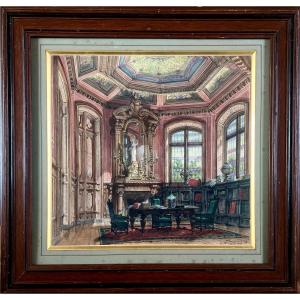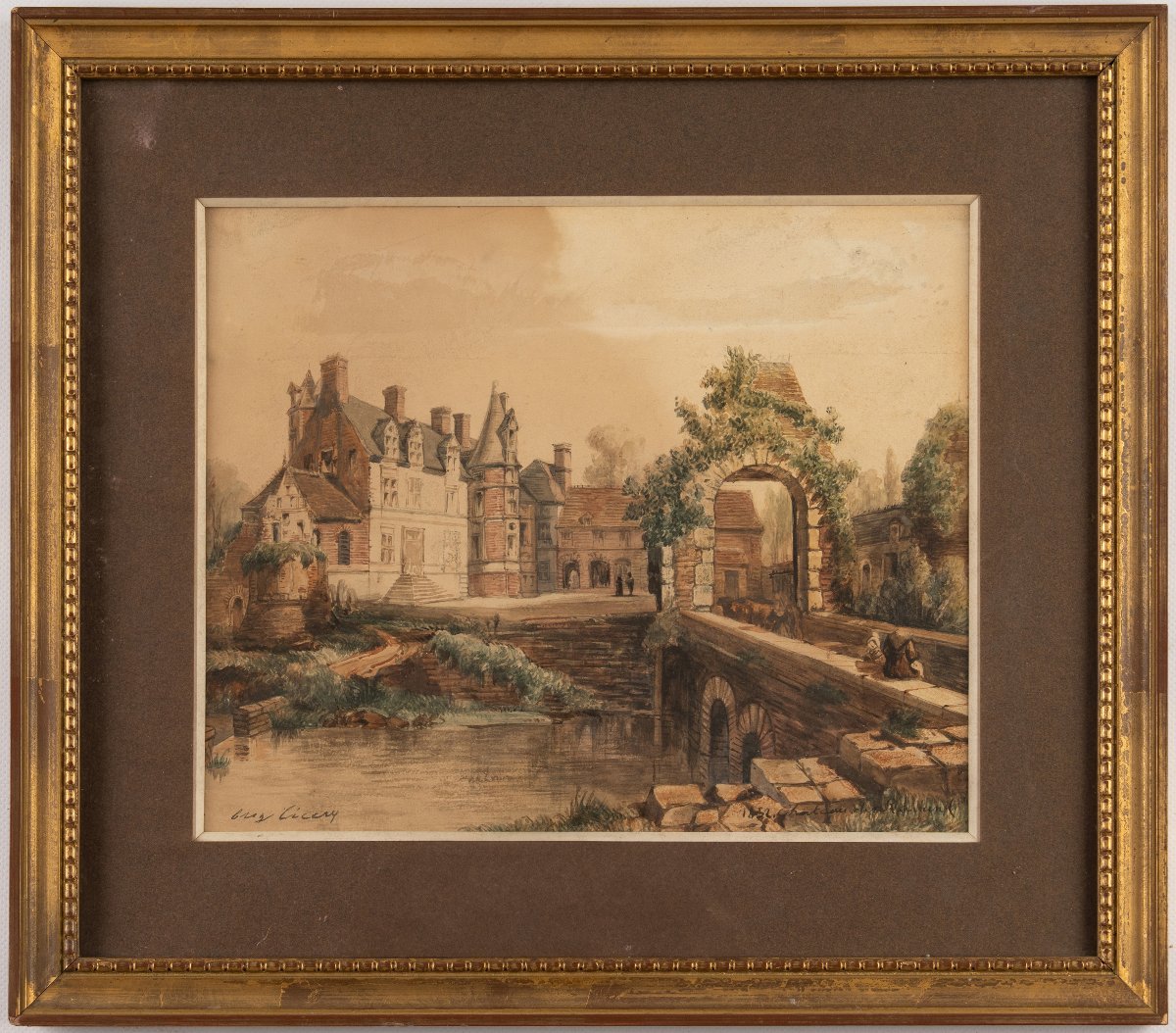
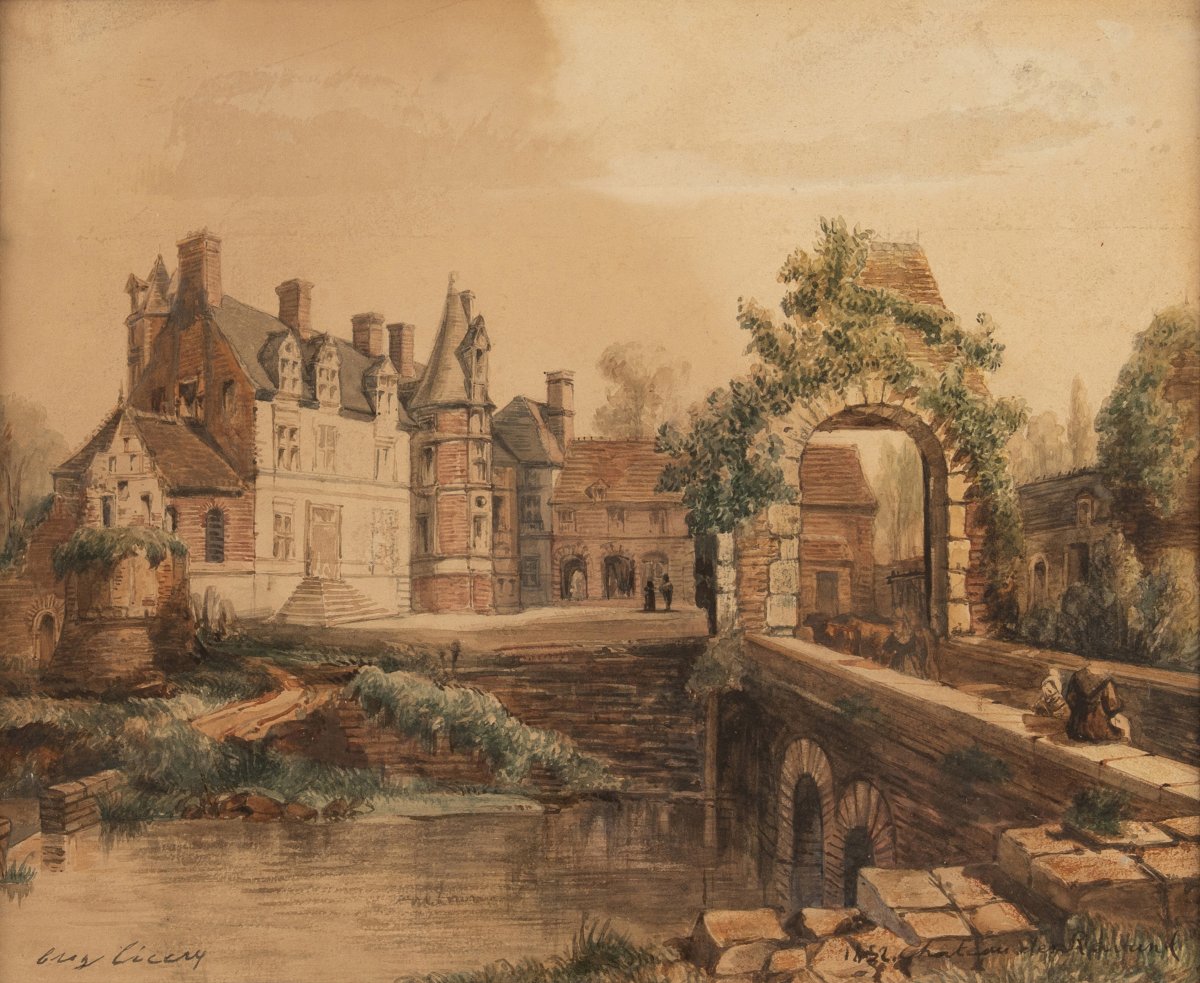


Eugène Cicéri. View Of The Château Des Ravalet In Tourlaville (cherbourg, Cotentin, Manche). 1852.
Original drawing. Watercolor and pastels. 25 x 30.5 cm (image size), in a frame measuring 40.2 x 45.7 cm. Browned paper.
Signed lower left: “Eug Cicery”; date and title in the lower right: “1852. Château des Ravanl [sic].”
The Château de Tourlaville was built in 1562 by the Ravalet family in the Cotentin Renaissance style. It was modified, along with its grounds, in the second half of the 19th century, beginning in 1859, by the de Tocqueville family. This drawing, dated 1852, shows the château as it appeared before the renovations. Now owned by the city of Cherbourg, it was designated a Historic Monument in 1996.
This view was reproduced in the book La Normandie illustrée by Félix Benoist and Hippolyte Lalaisse (Nantes, Charpentier, 1852–1854), in which it is attributed to Félix Benoist and not to Cicéri, under the title “Château de Tourlaville, near Cherbourg (Manche)” with the notes “Lith. Charpentier, Ed. Nantes / Fx Benoist del. / Eug. Ciceri & Ph. Benoist lith. fig. by Bayot.”
“The memories associated with the Château de Tourlaville are less glorious; on the contrary, its name evokes appalling crimes, the likes of which are rarely found in the annals of human history.
Julien Ravallet de Tourlaville, after having long and honorably borne arms in defense of Henry IV, had married and had two children, a son and a daughter, both endowed with such ravishing beauty that they were nicknamed in the region “the handsome young man” and “the beautiful young lady.” As they grew older, the mutual friendship they shared degenerated into a criminal passion; the young Ravallet abducted his sister, who had recently married an elderly gentleman, and disappeared with her, without the men sent in pursuit being able to discover the route they had taken. The two culprits, hiding under false names, wandered for over a year through various cities and were finally arrested in Paris, where the Parliament sentenced them to death. No pleas, not even those of a desperate father, could secure a pardon for them from the king. The sentence was carried out, to the great sorrow of the onlookers, who were moved by the sight of such youth, nobility, and beauty. The two bodies were buried in one of the convents of Paris, and this epitaph was engraved on their tomb: “Here lie the brother and sister. Passersby, do not inquire into the cause of their death: pass on, and pray to God for their souls.” This sad tale, which one might mistake for a novel, took place in 1603. History and other chroniclers attest to this.” (Excerpt from the chapter on Cherbourg from La Normandie illustrée).
Ref. A14-63
Period: 19th century
Style: Napoleon 3rd
Condition: Condition of use
Reference (ID): 1812534
Availability: In stock