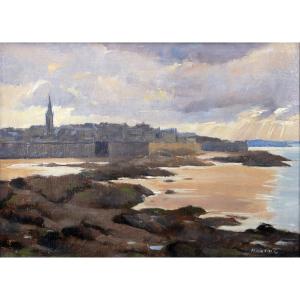


Maxime Voyet – Saint-malo, The Walled City At Low Tide – Oil On Cardboard – Signed
Artist: Maxime, Pseudonyme De Maxime Voyet (1896-1985)
MAXIME, pseudonym of Maxime VOYET (1896–1985)
Saint-Malo, the walled city at low tide
Before 1944
Oil on cardboard
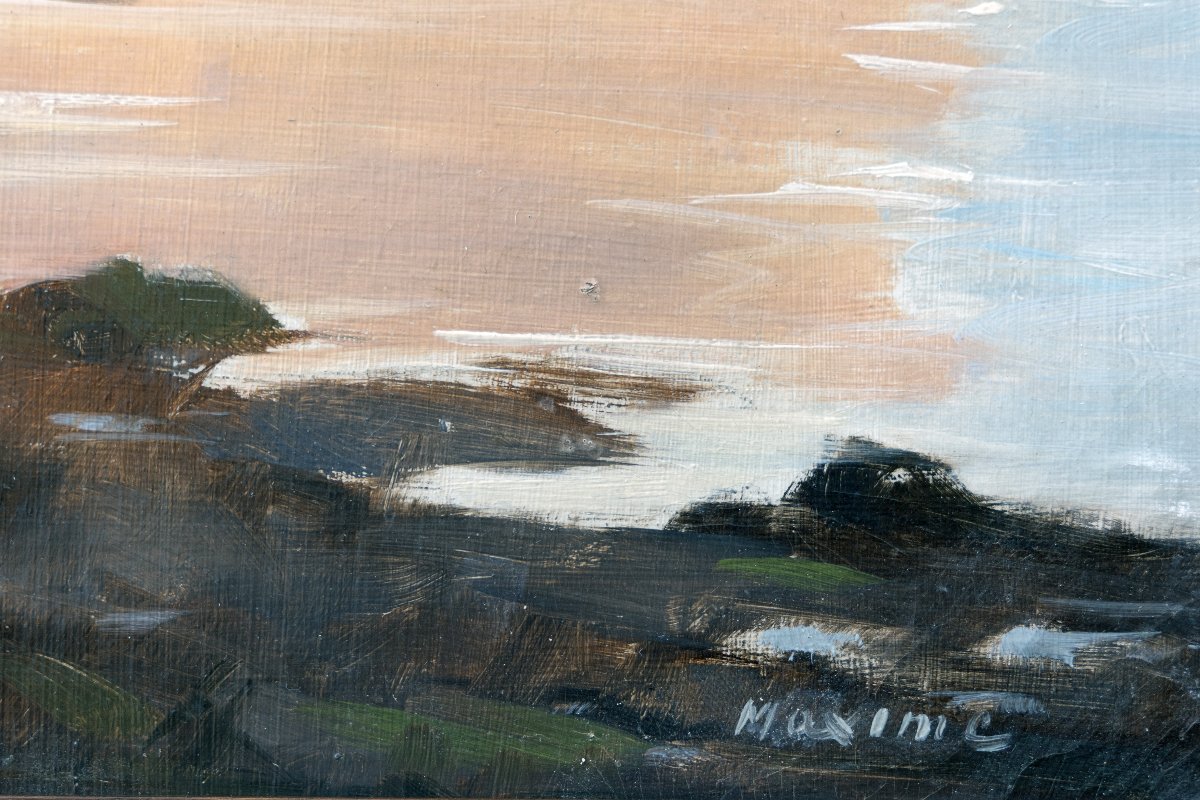
Signed in white in the lower right corner: “Maxime”
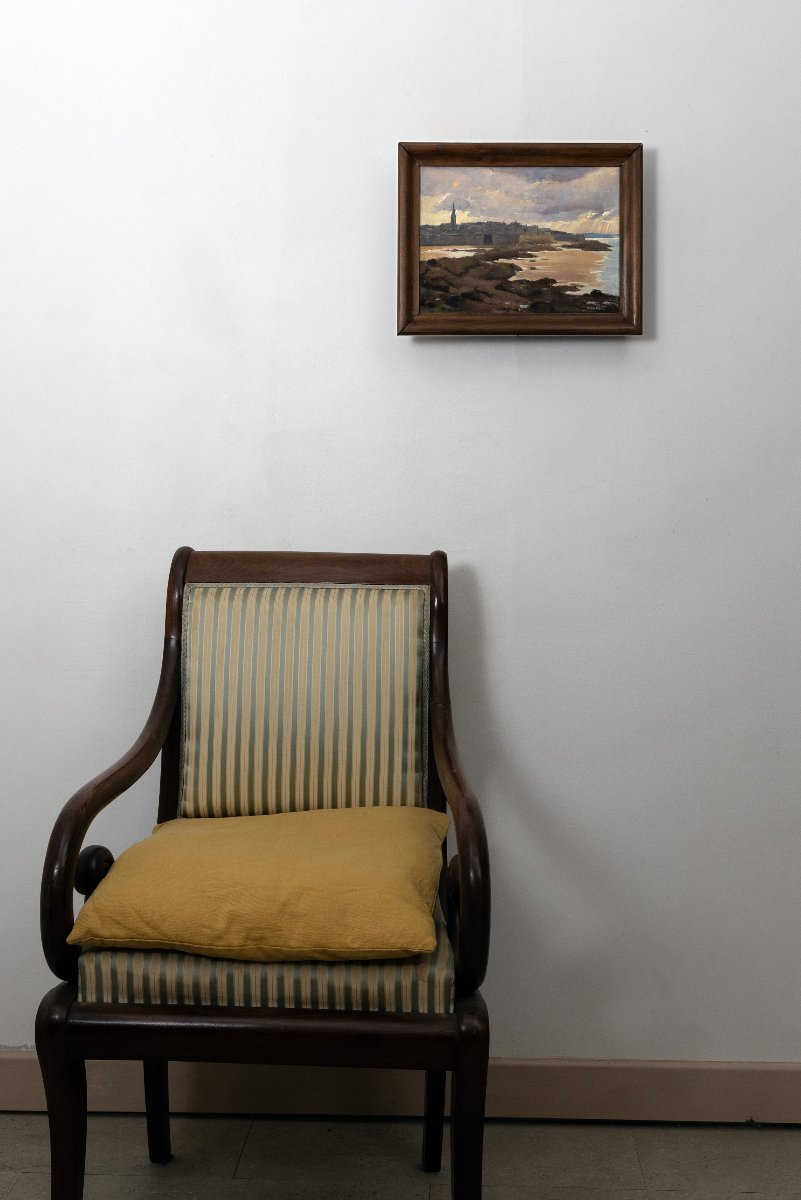
Dimensions: 32 x 23.5 cm — with frame: 38 x 29.5 cm
Condition: very good
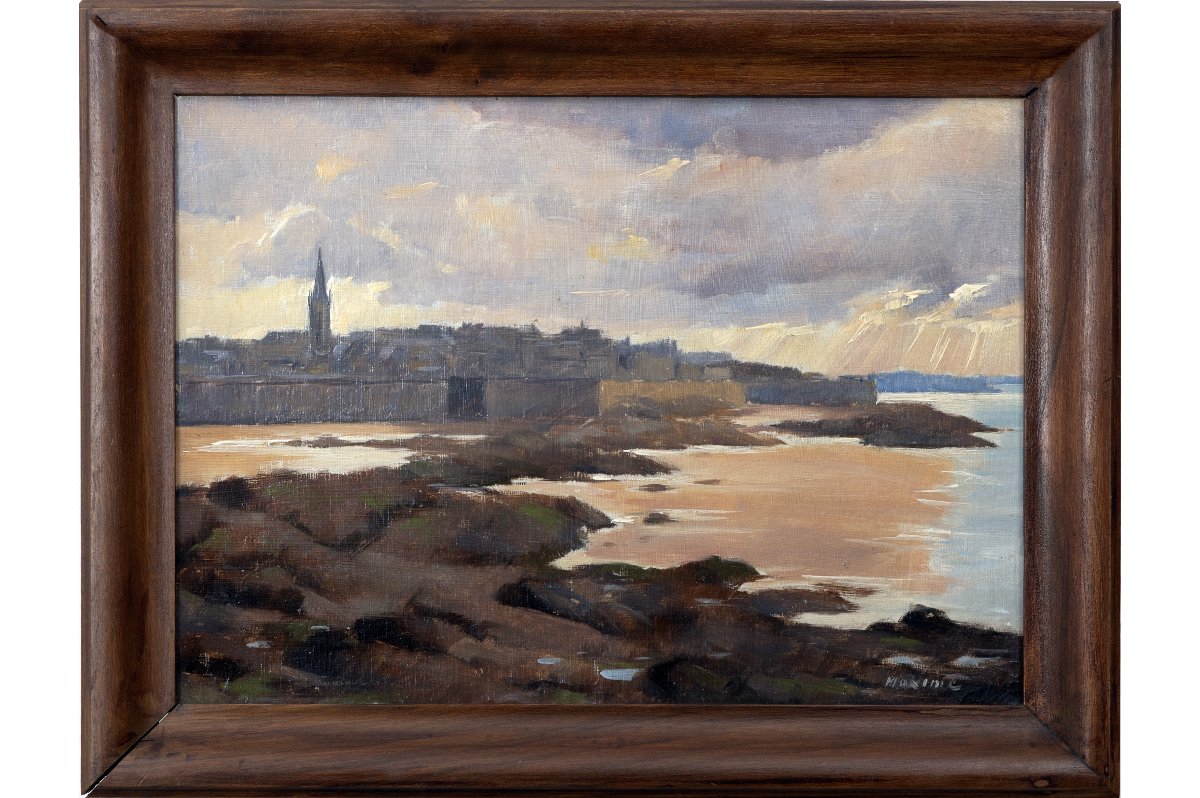
Stained and waxed wooden frame, in good condition
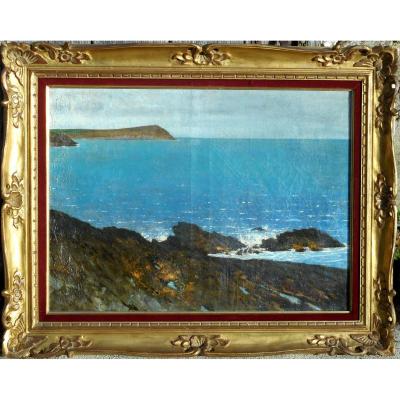
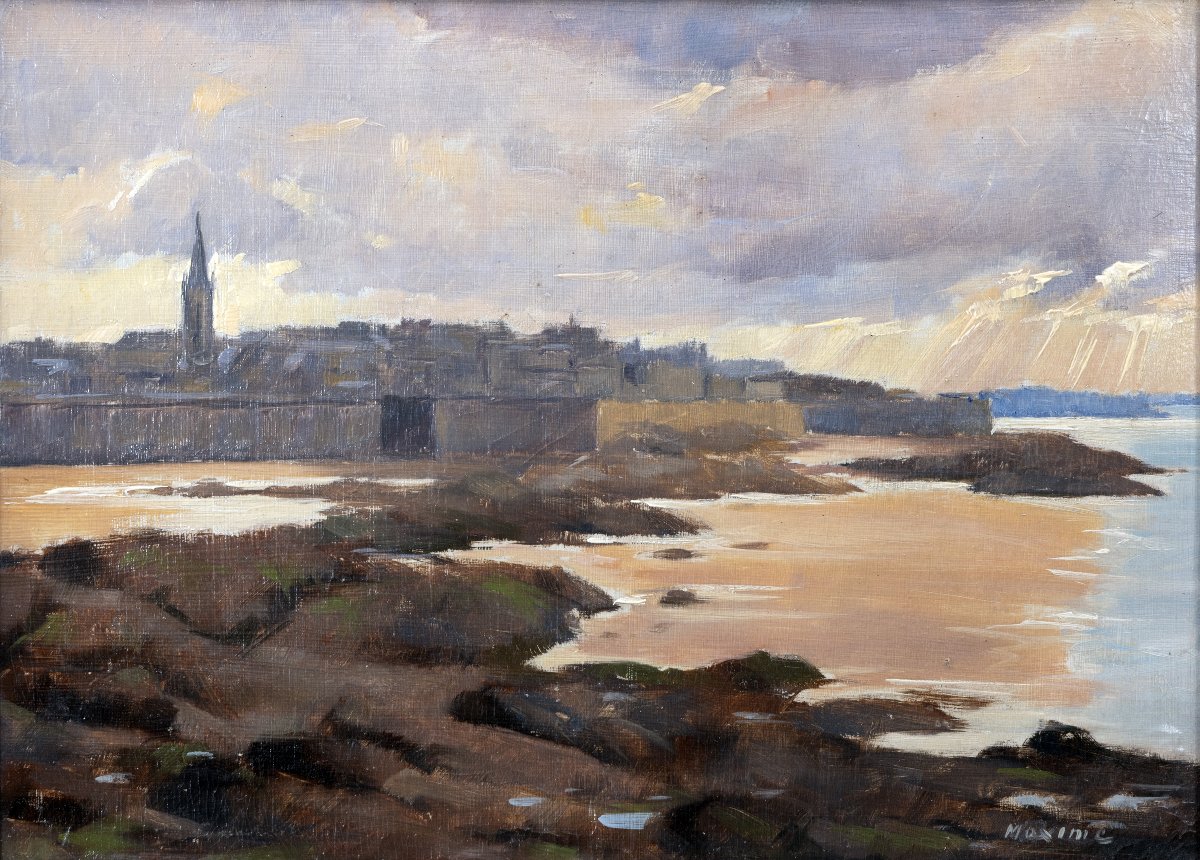
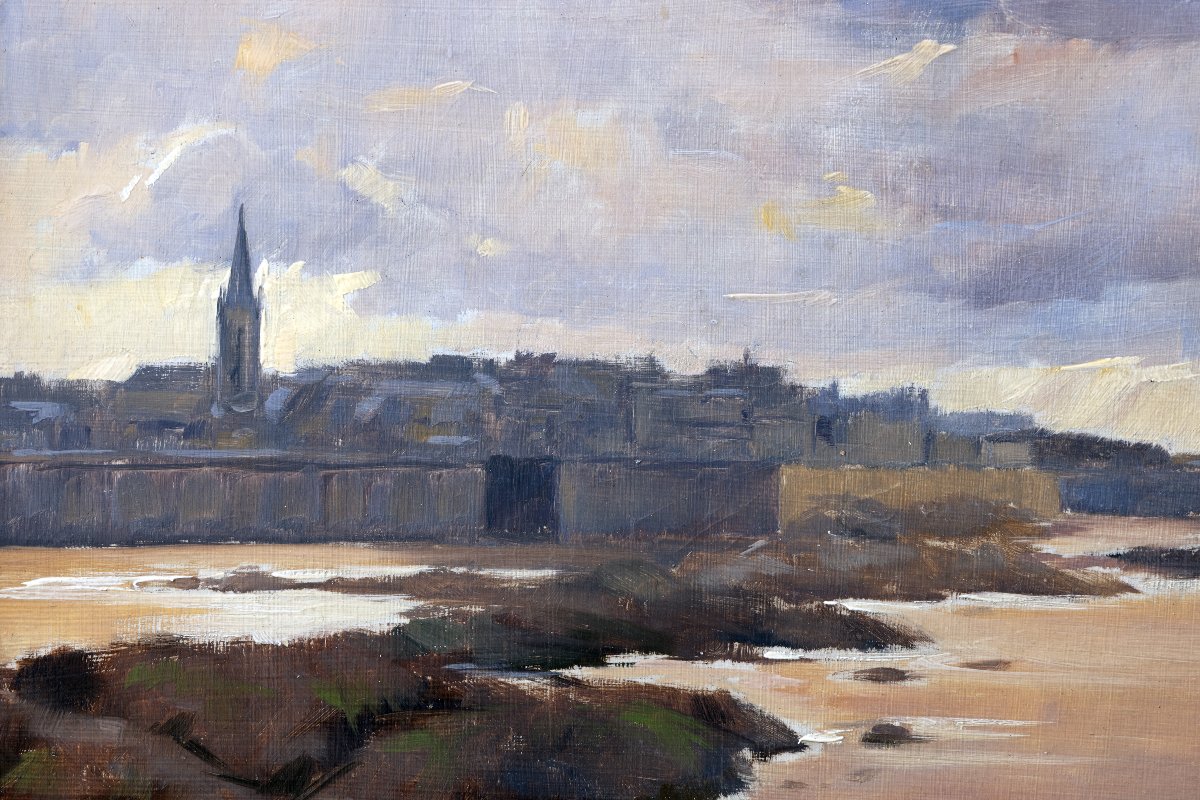
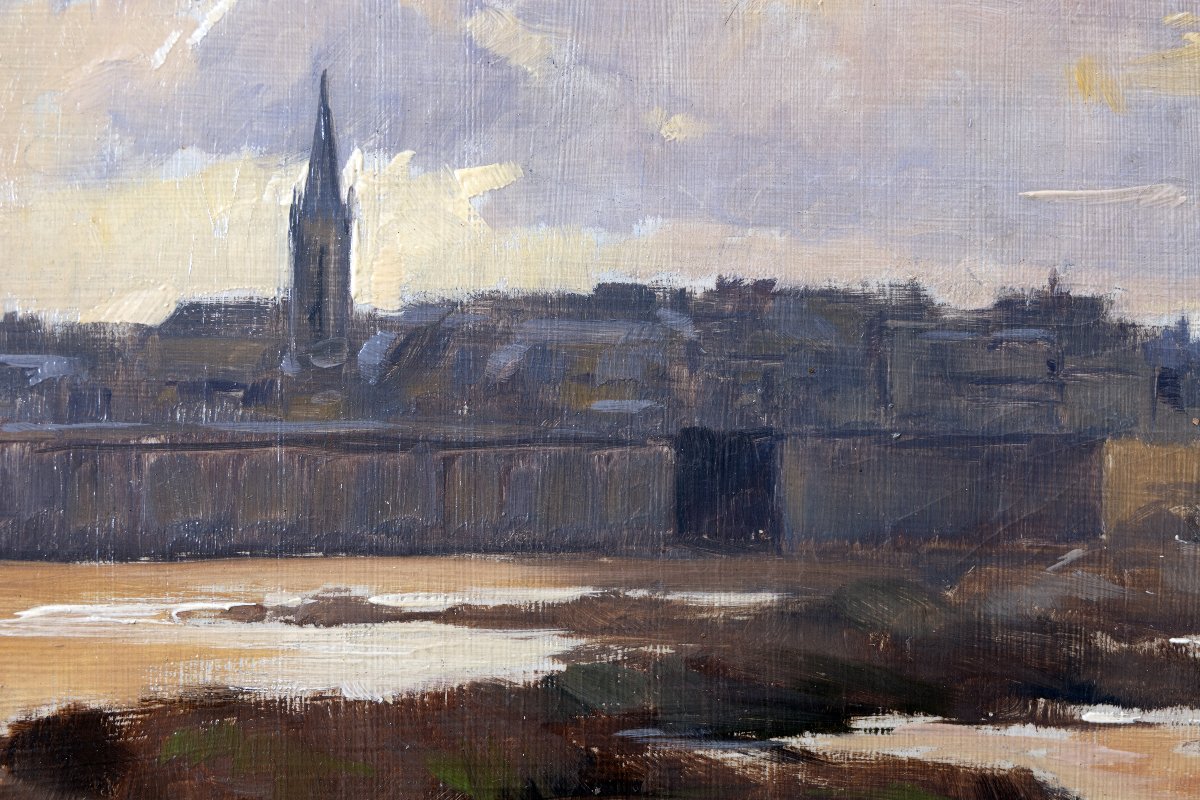
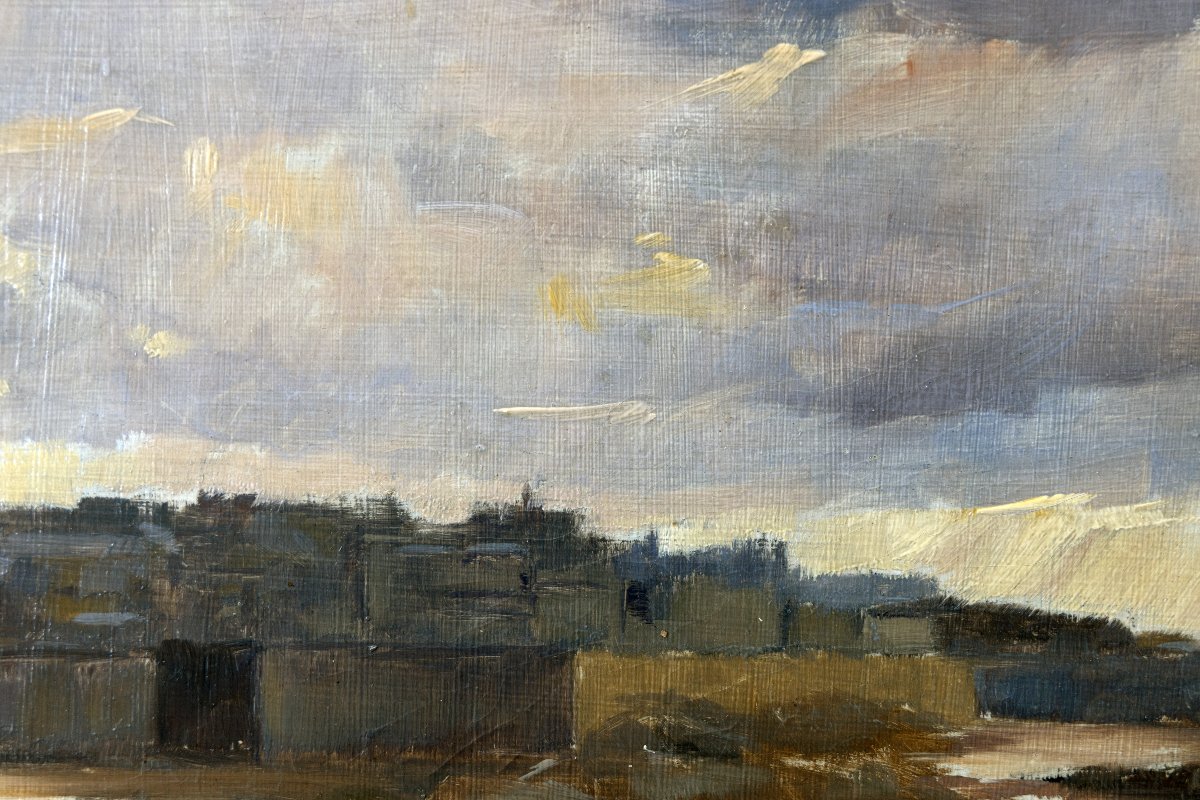
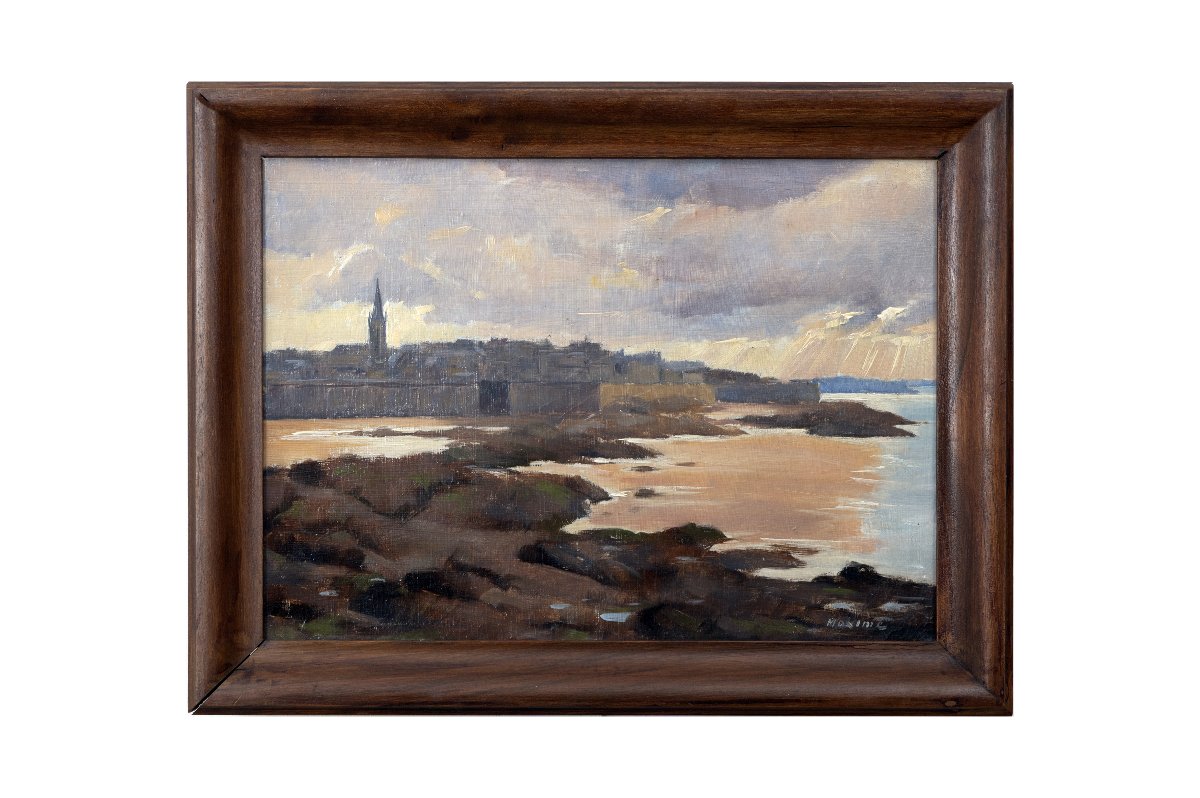
A late afternoon on the coast at low tide. The walled city stands out in the distance as a gray and brown mass, dominated by the cathedral’s spire. In front of it, the line of the ramparts runs horizontally, pierced by a dark opening. The exposed sand takes on an orange-pink hue and reflects the light of the sky.
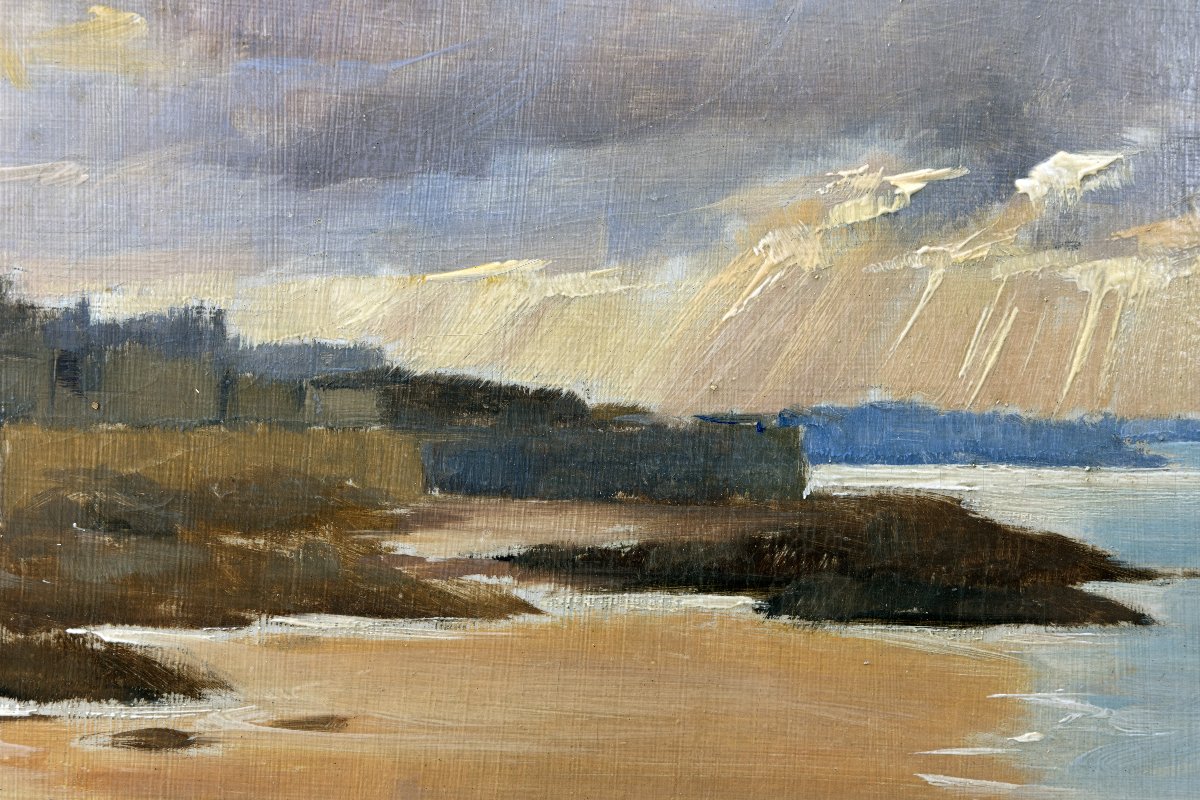
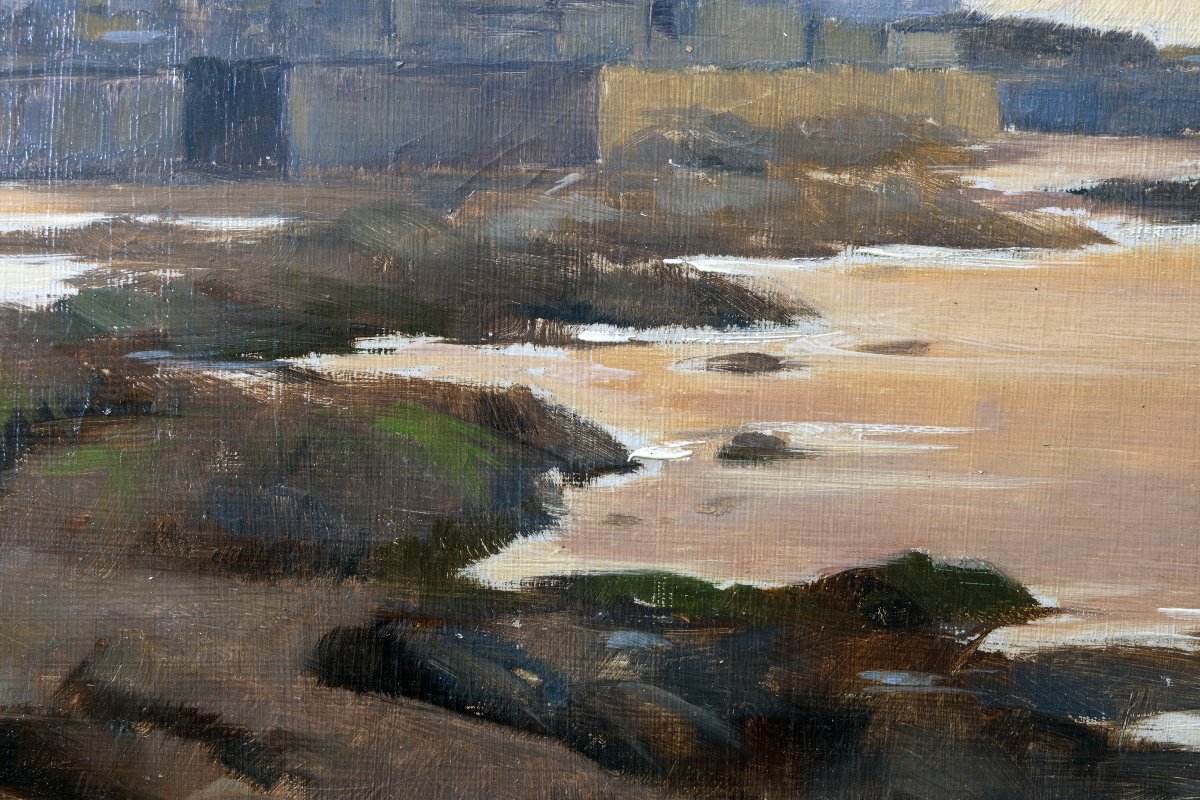
The sky occupies half the painting. It is heavy, purplish-gray, with pale yellow patches and long cream-colored streaks toward the horizon. On the right, the sea remains blue and calm; a distant coastline blocks the view. In the foreground, the rocks are covered with seaweed, appearing almost black, with a few clear pools of water scattered among them.
The brushwork is quick, applied flat, without any touch-ups. One senses the work was done en plein air: the painter captured a precise moment of light, when the low sun passes beneath the clouds and illuminates the shore. A sober painting, without artifice, held together by the accuracy of the grays and pinks.
The painting bears its own date. The cathedral’s spire is still crowned with its small pinnacles: it is the openwork spire made of Caen stone, erected in 1858 under Napoleon III, destroyed on August 6, 1944, by German artillery fire, and replaced in 1972 with a more understated finial. The work therefore predates the fighting of the summer of 1944, which destroyed eighty percent of the walled city. It depicts Saint-Malo as it was before.
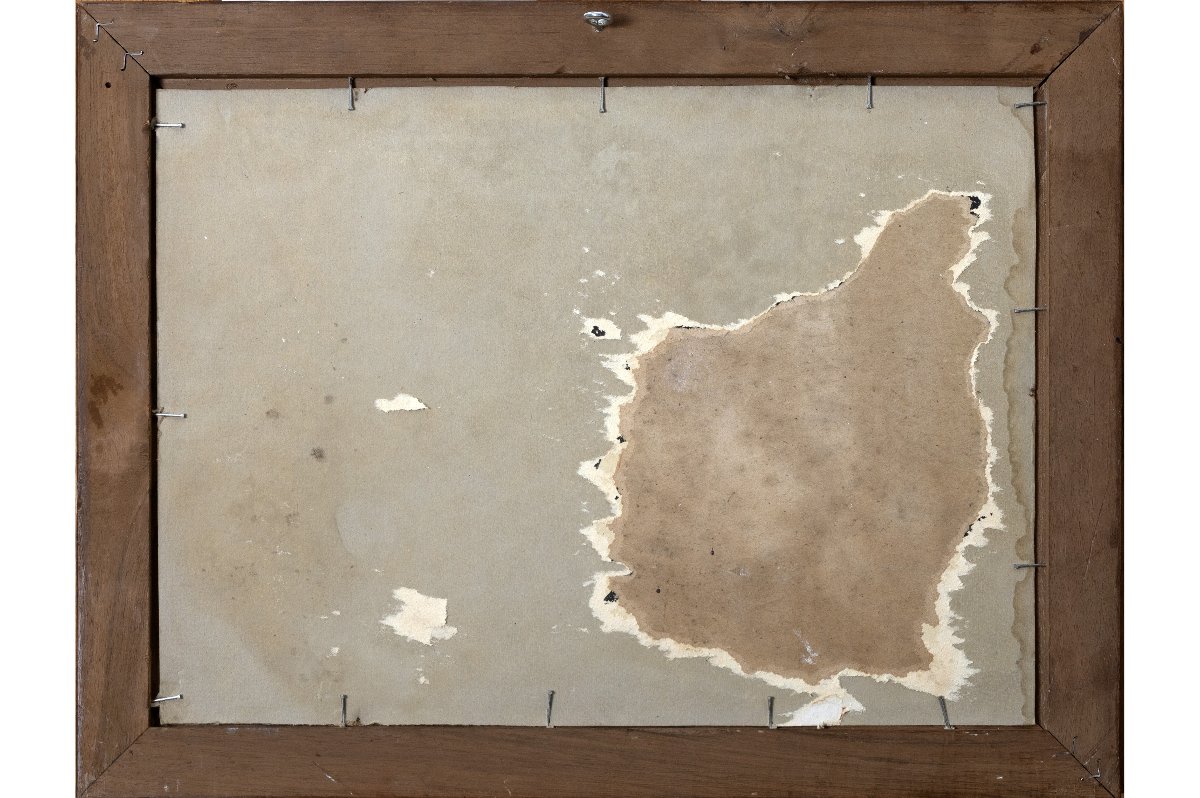
Condition: The painting is in very good condition, and the material is well preserved. There are a few tiny spots of dirt on the surface. The frame is in good condition, with slight looseness at two corners. On the back, it is evident that a piece of paper, now largely missing, was once glued to the cardboard.
THE ARTIST
Maxime Voyet was born in La Jaudonnière, in the Vendée region, on October 30, 1896, and died in Tours on November 17, 1985. He signed his works with only his first name, “Maxime.”
His life did not begin with painting. He first trained as a mason, then joined the railroad after the war and became a steam locomotive engineer. He painted in his spare time, and it was not until his retirement, around 1950, that he devoted himself fully to it.
His early style, to which this painting belongs, is that of a realist landscape painter. He worked from life, in small formats, on cardboard or hardboard: countryside scenes, city streets, and seashores. His brushwork was swift, his palette understated, and his focus was primarily on light and the moment.
Starting in 1960, his work took a new direction: he adopted a decidedly naïve style and turned to railway subjects—stations and locomotives—with which his career had made him familiar. It is this second period that established his reputation and earned him a place in the catalog of the “Maîtres populaires de la réalité” and in the exhibition of Naïve Painters at the Laval Museum. He is also the father of the painter Jacques Voyet.
Work on view at the gallery (07240)
Shipping: please contact us for shipping costs within France and internationally.
Saint-Malo, the walled city at low tide
Before 1944
Oil on cardboard
Signed in white in the lower right corner: “Maxime”
Dimensions: 32 x 23.5 cm — with frame: 38 x 29.5 cm
Condition: very good
Stained and waxed wooden frame, in good condition
A late afternoon on the coast at low tide. The walled city stands out in the distance as a gray and brown mass, dominated by the cathedral’s spire. In front of it, the line of the ramparts runs horizontally, pierced by a dark opening. The exposed sand takes on an orange-pink hue and reflects the light of the sky.
The sky occupies half the painting. It is heavy, purplish-gray, with pale yellow patches and long cream-colored streaks toward the horizon. On the right, the sea remains blue and calm; a distant coastline blocks the view. In the foreground, the rocks are covered with seaweed, appearing almost black, with a few clear pools of water scattered among them.
The brushwork is quick, applied flat, without any touch-ups. One senses the work was done en plein air: the painter captured a precise moment of light, when the low sun passes beneath the clouds and illuminates the shore. A sober painting, without artifice, held together by the accuracy of the grays and pinks.
The painting bears its own date. The cathedral’s spire is still crowned with its small pinnacles: it is the openwork spire made of Caen stone, erected in 1858 under Napoleon III, destroyed on August 6, 1944, by German artillery fire, and replaced in 1972 with a more understated finial. The work therefore predates the fighting of the summer of 1944, which destroyed eighty percent of the walled city. It depicts Saint-Malo as it was before.
Condition: The painting is in very good condition, and the material is well preserved. There are a few tiny spots of dirt on the surface. The frame is in good condition, with slight looseness at two corners. On the back, it is evident that a piece of paper, now largely missing, was once glued to the cardboard.
THE ARTIST
Maxime Voyet was born in La Jaudonnière, in the Vendée region, on October 30, 1896, and died in Tours on November 17, 1985. He signed his works with only his first name, “Maxime.”
His life did not begin with painting. He first trained as a mason, then joined the railroad after the war and became a steam locomotive engineer. He painted in his spare time, and it was not until his retirement, around 1950, that he devoted himself fully to it.
His early style, to which this painting belongs, is that of a realist landscape painter. He worked from life, in small formats, on cardboard or hardboard: countryside scenes, city streets, and seashores. His brushwork was swift, his palette understated, and his focus was primarily on light and the moment.
Starting in 1960, his work took a new direction: he adopted a decidedly naïve style and turned to railway subjects—stations and locomotives—with which his career had made him familiar. It is this second period that established his reputation and earned him a place in the catalog of the “Maîtres populaires de la réalité” and in the exhibition of Naïve Painters at the Laval Museum. He is also the father of the painter Jacques Voyet.
Work on view at the gallery (07240)
Shipping: please contact us for shipping costs within France and internationally.
180 €
Period: 20th century
Style: Other Style
Condition: Excellent condition
Material: Oil painting on cardboard
Width: 32 cm / 38 cm encadré
Height: 23,5 cm / 29,5 cm encadré
Reference (ID): 1809893
Availability: In stock
Print