

Mauro Picenardi (1735–1809), Attributed: Christ Among His Disciples
Mauro Picenardi (Crema, 1735 – Bergamo, 1809), attributed to
Christ Among the Disciples
Oil on canvas, 62 x 37 cm – with frame, 73 x 46 cm
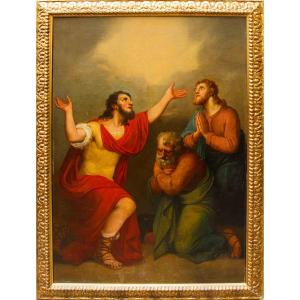
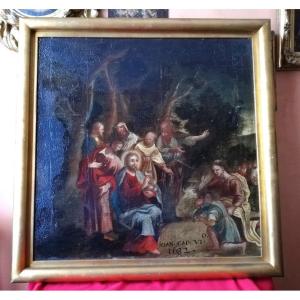
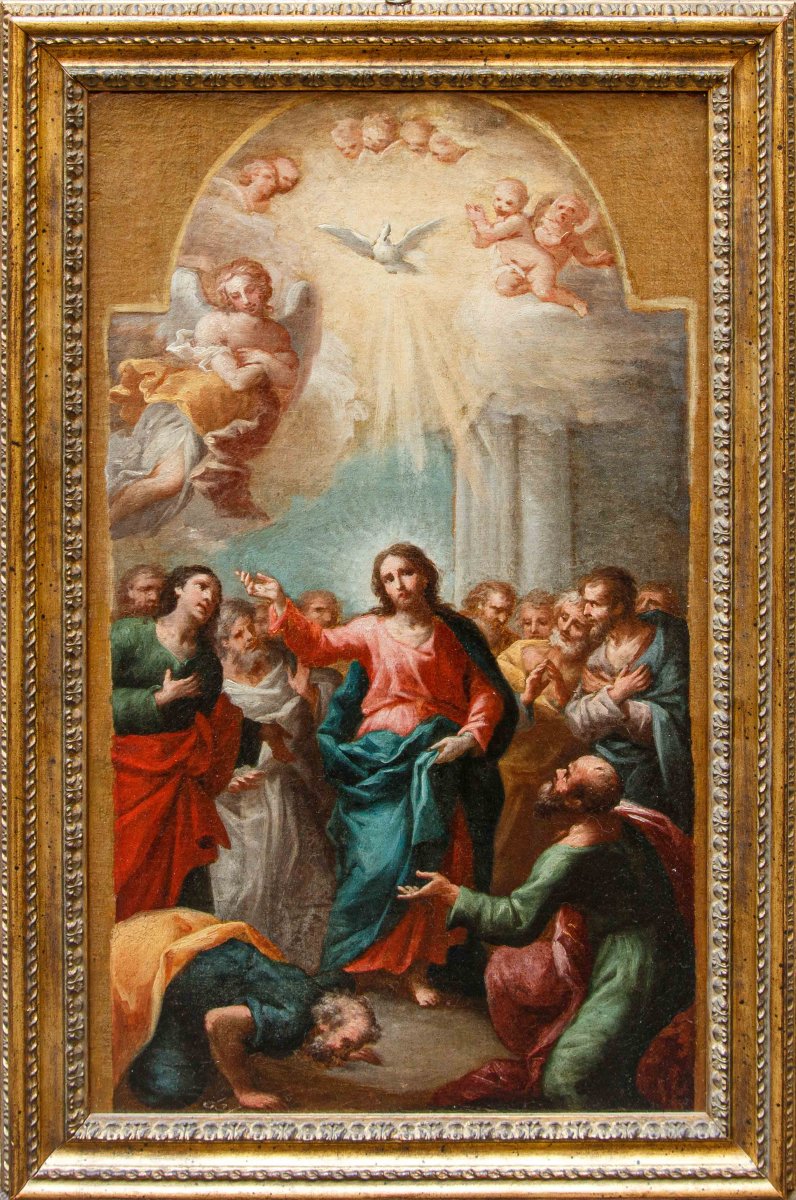
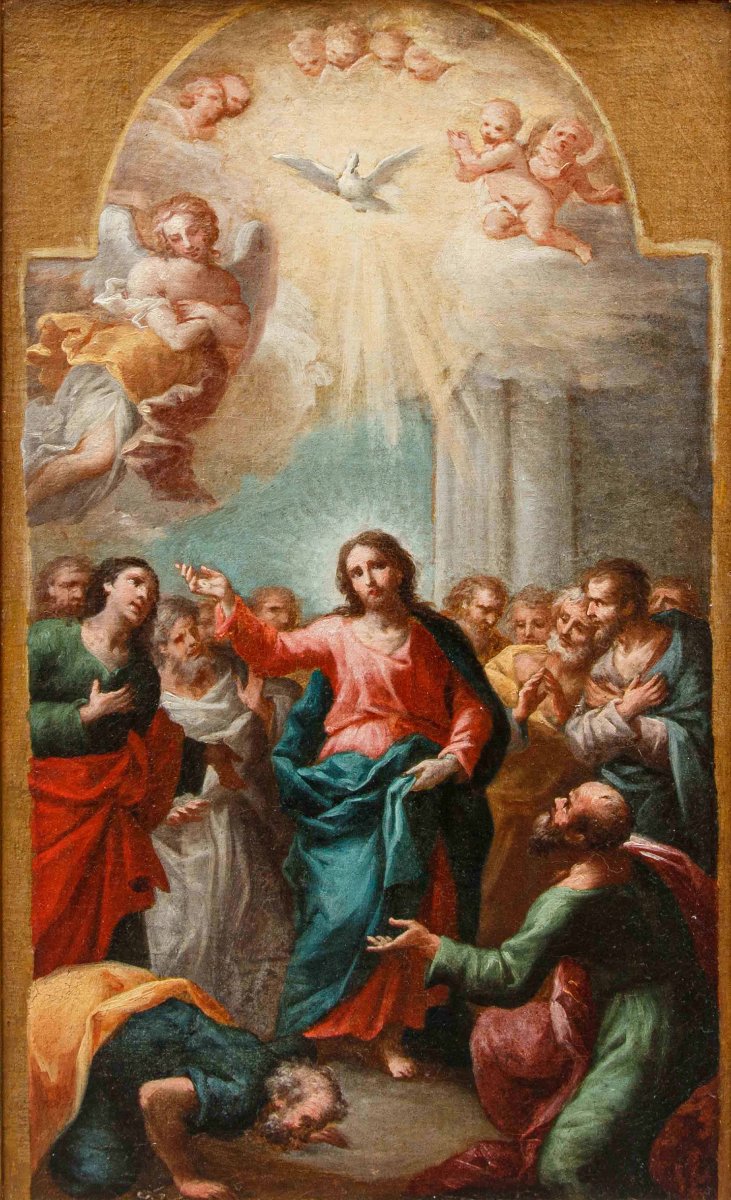
The painting depicts Christ at the center of a lively gathering of apostles, captured in the act of blessing and taking his leave of them at a moment that iconographic tradition attributes to the Ascension. Dressed in a pink tunic and a wide green-and-blue cloak, the Savior raises his right hand in a solemn gesture while holding the hem of his robe with his left, a movement that lends the figure a certain dynamism. Around him, the apostles react with various theatrical gestures: some bring their hands to their chests in astonishment, others throw themselves to the ground, kissing the earth, and still others lift their gaze upward, creating a chorus of emotions that animates the entire lower portion of the canvas. In the upper section, within a halo of golden clouds, the celestial vision unfolds: the dove of the Holy Spirit radiates beams of light, while the heads of cherubs, a group of putti, and two angels complete the supernatural scene with warm, ethereal colors.
The work fits naturally into the oeuvre of Mauro Picenardi, a painter from Crema whose life and artistic career unfolded on the geographical periphery of the Venetian Republic yet in constant dialogue with it. Born in Crema on January 15, 1735, the son of the Cremonese painter Tomaso Picenardi, Mauro received his early, traditional training in his father’s workshop but soon left it, unable to tolerate the cultural constraints of his hometown. It was precisely his experience in Verona—gained at the Academy of Painting under the influence of Giambettino Cignaroli and Balestra—that decisively shaped his style: not the revolutionary teachings of Giambattista Tiepolo, but the more moderate—yet still stimulating—approach of the Veronese art scene, which nonetheless opened him up to the spirit of Venetian painting.
In this painting, the hallmarks of his artistic maturity are clearly evident: the figures are not defined by sharp contours but are constructed directly through color, applied with free and loose brushstrokes that dissolve the outlines into a vaporous, almost luminous rendering, particularly evident in the celestial glory at the top. At the same time, a solid compositional framework—a legacy of Veronese discipline—remains, organizing the agitation of the earthly figures into a clear and legible pyramidal structure, reminiscent of his altarpieces created for churches in Verona, Bergamo, and the Crema area. This balance between formal rigor and painterly freedom, between drawing and color, is the hallmark that makes Picenardi’s entire sacred oeuvre recognizable, from the Veronese commissions of his early years to the works of his full artistic maturity in Bergamo, created under the patronage of Giacomo Carrara and Paolina Secco Suardi Gismondi, who secured him numerous commissions in the city’s and province’s churches until his death in Bergamo in 1809.
Period: 18th century
Style: Other Style
Condition: Good condition
Material: Oil painting
Length: 37
Height: 62
Reference (ID): 1804749
Availability: In stock