

Placido Costanzi (1702–1759), The Rape Of The Sabine Women
Placido Costanzi (Rome, 1702 – 1759)
The Rape of the Sabine Women
Oil on canvas, 49.5 x 66.5 cm – with frame, 65.5 x 82
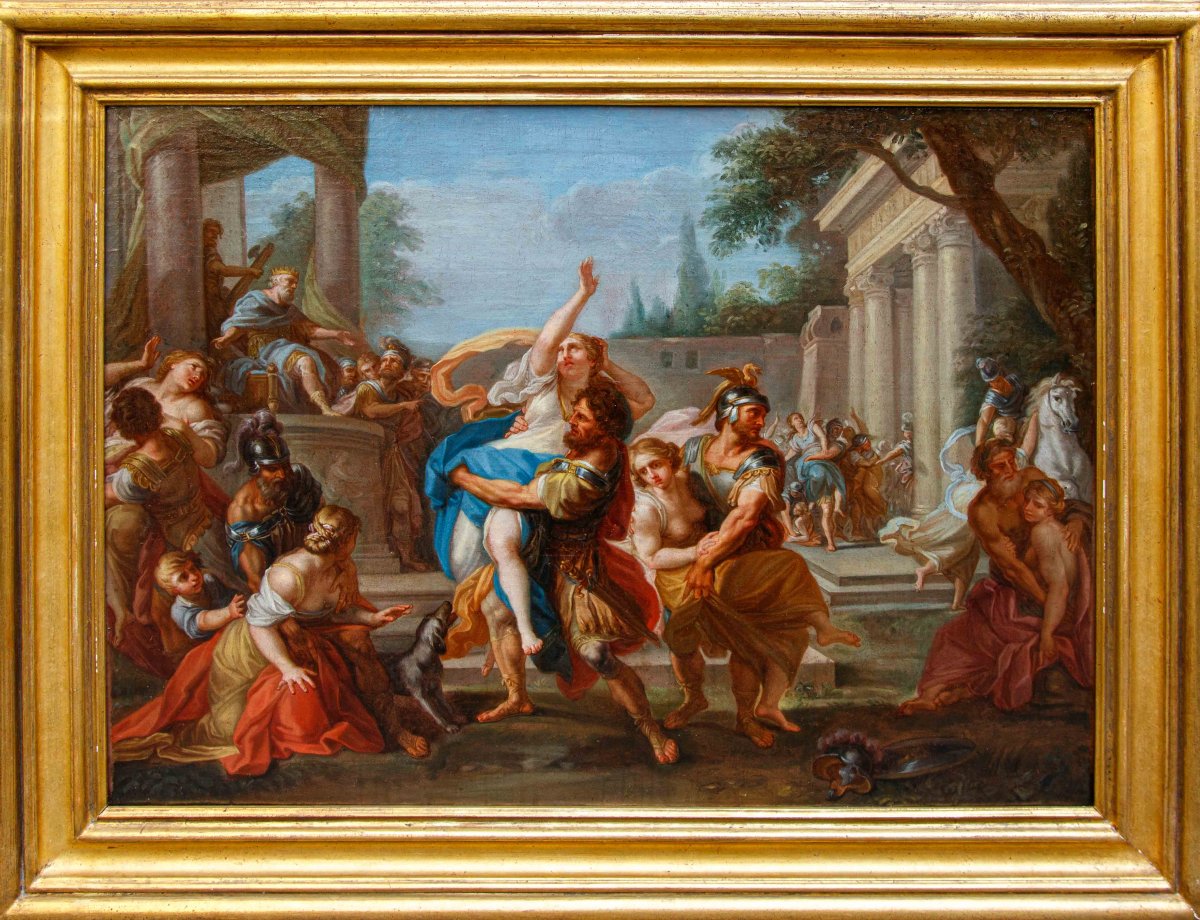
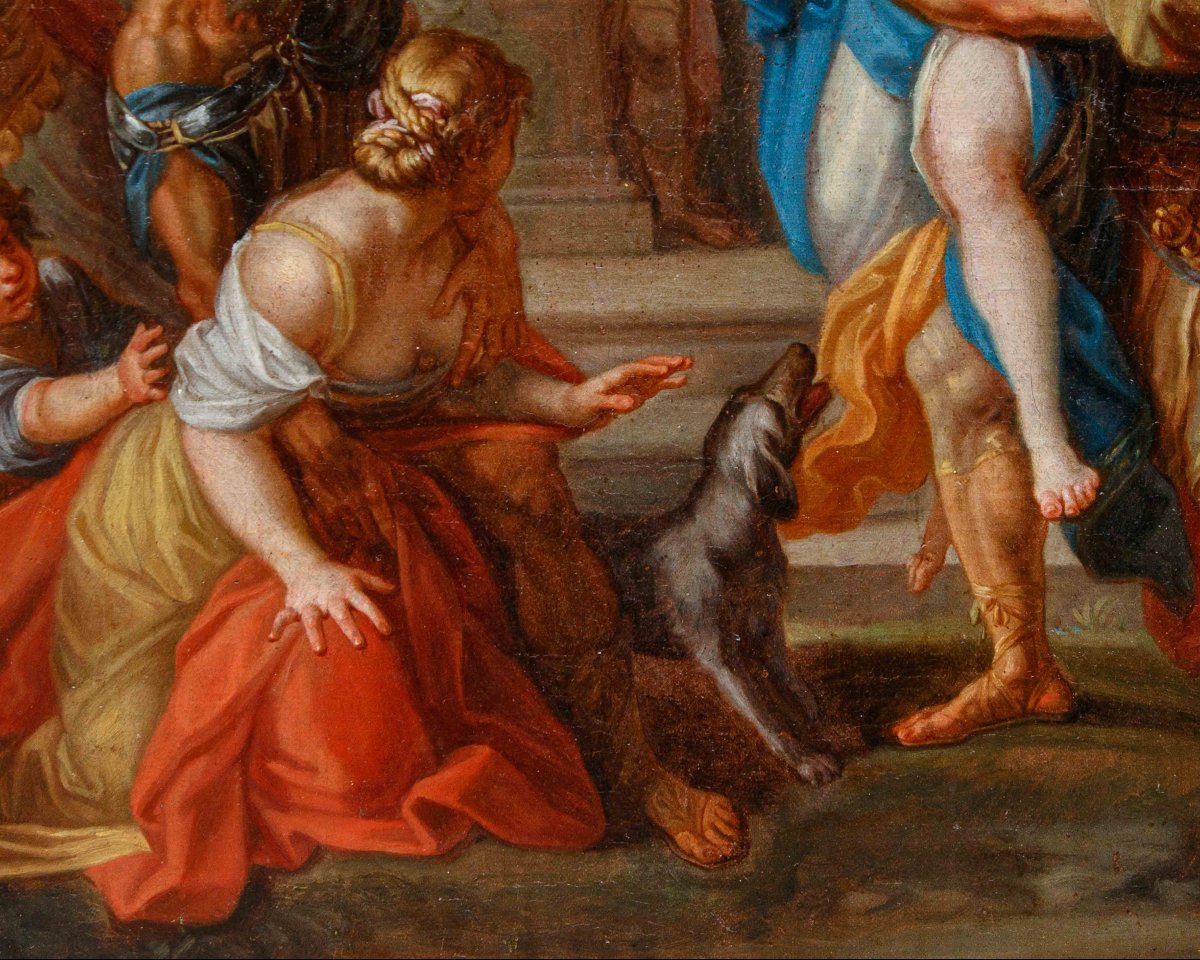
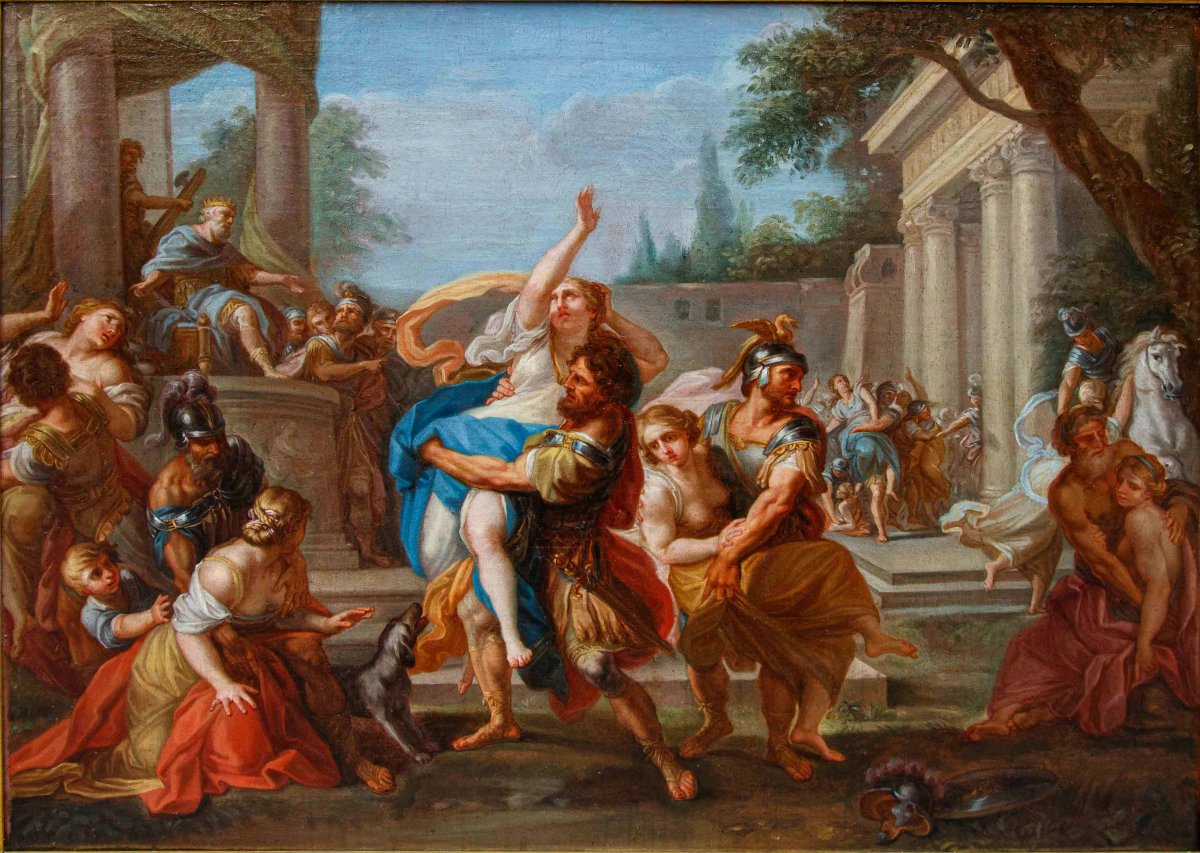
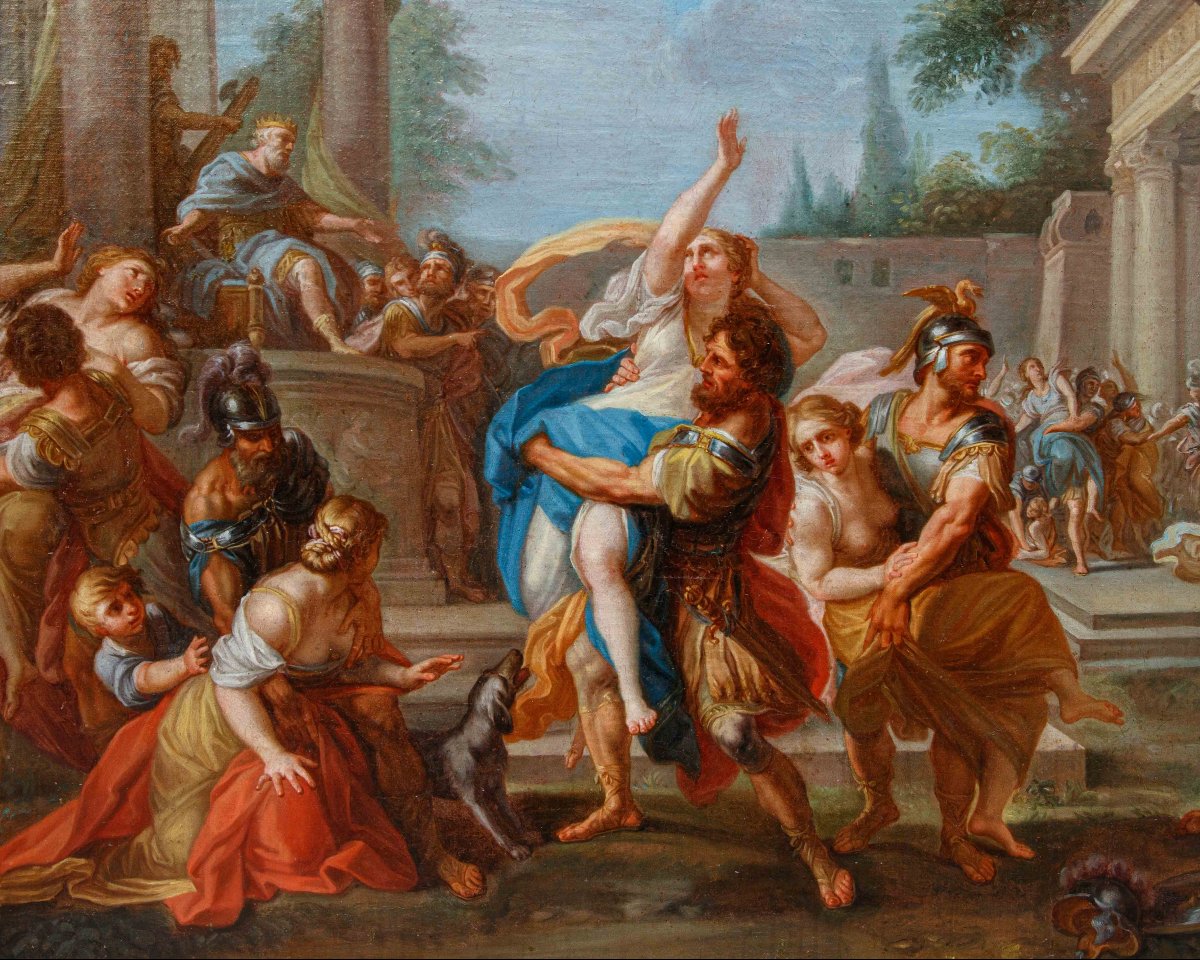
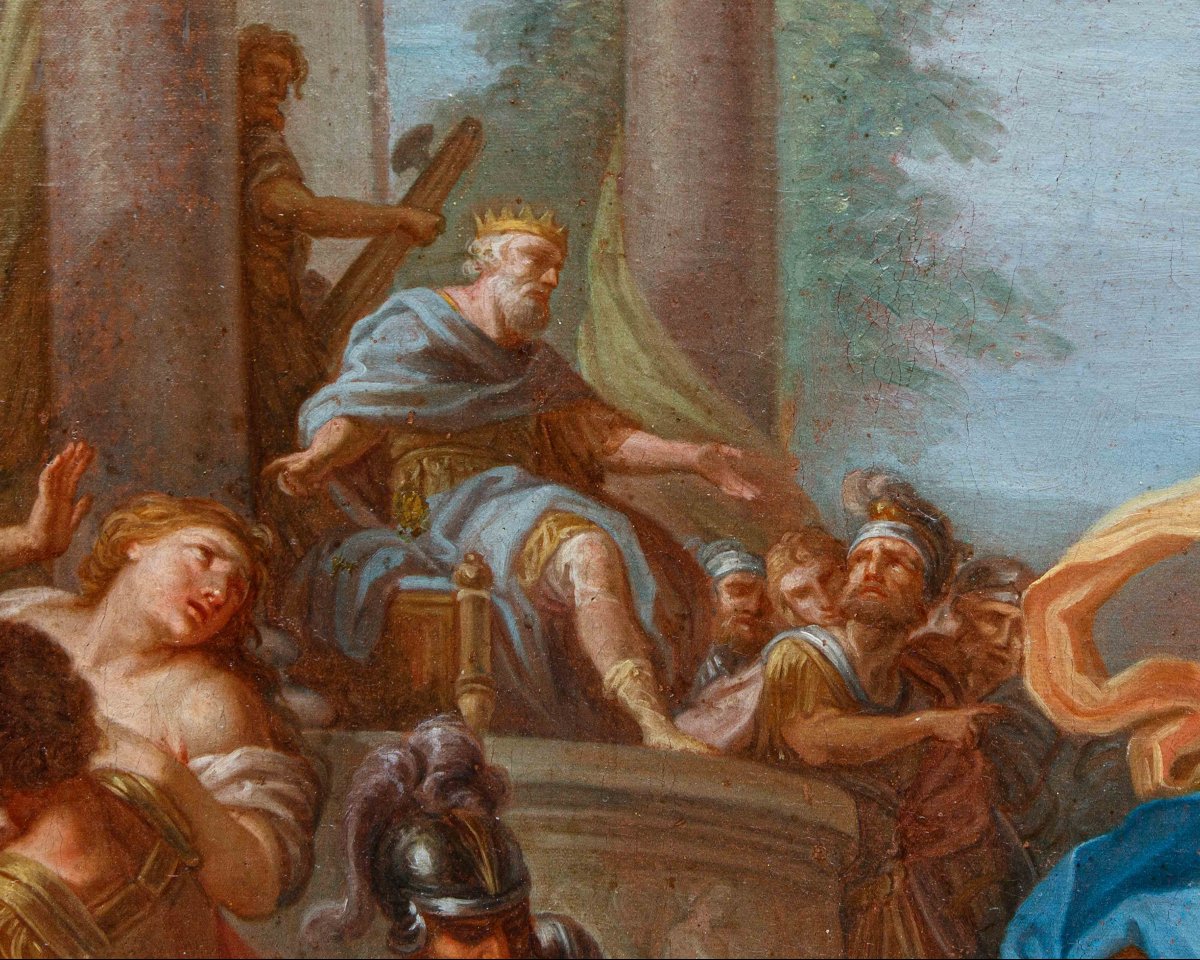
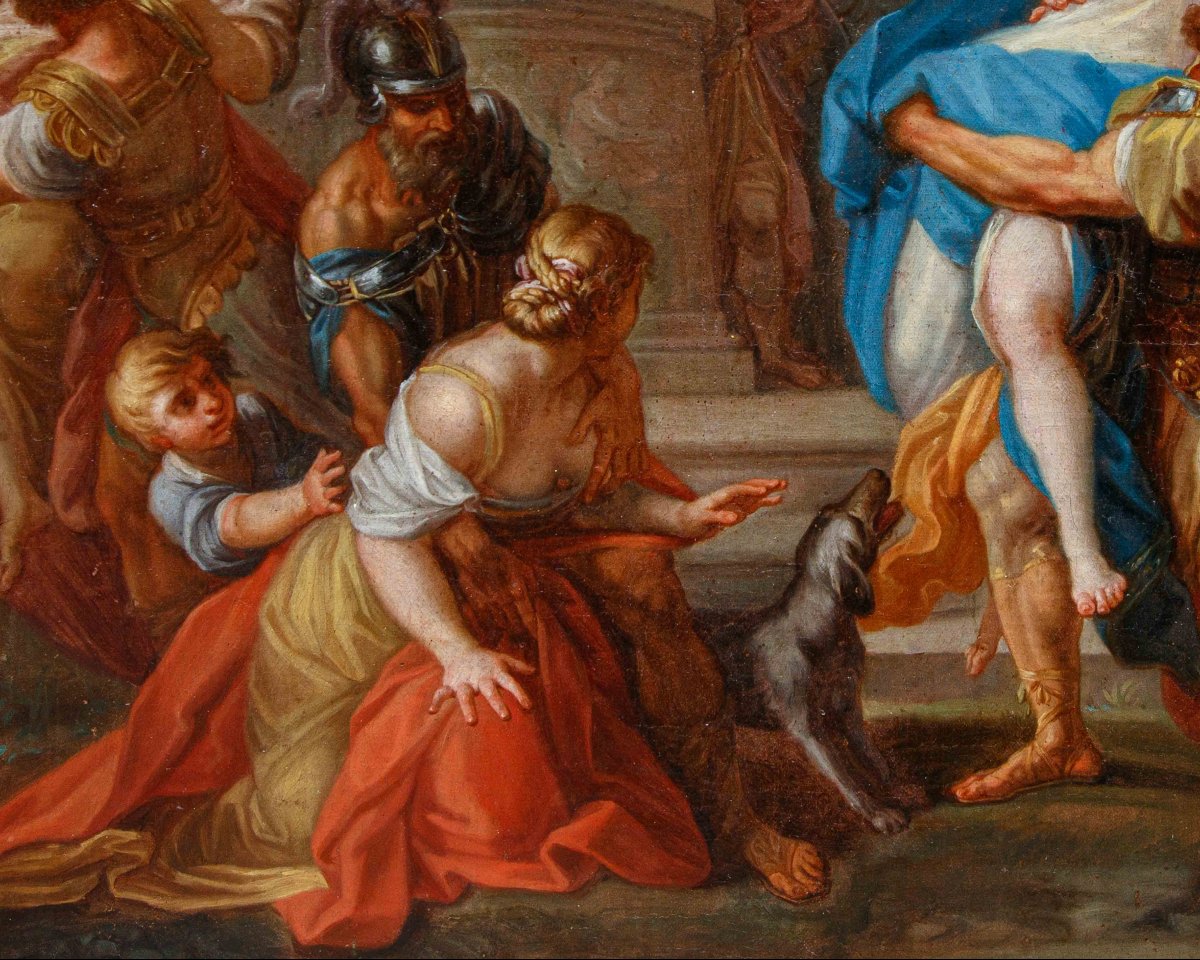
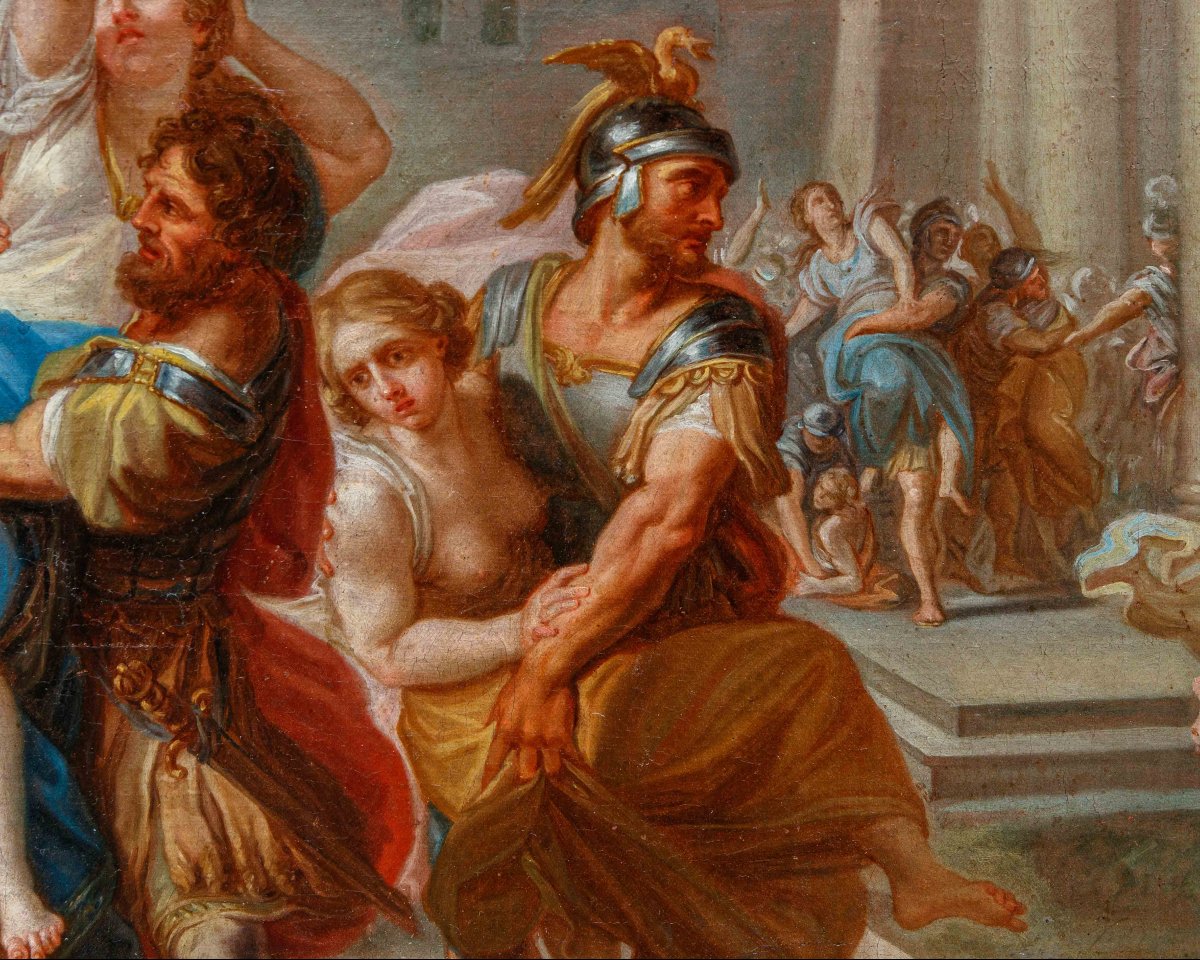
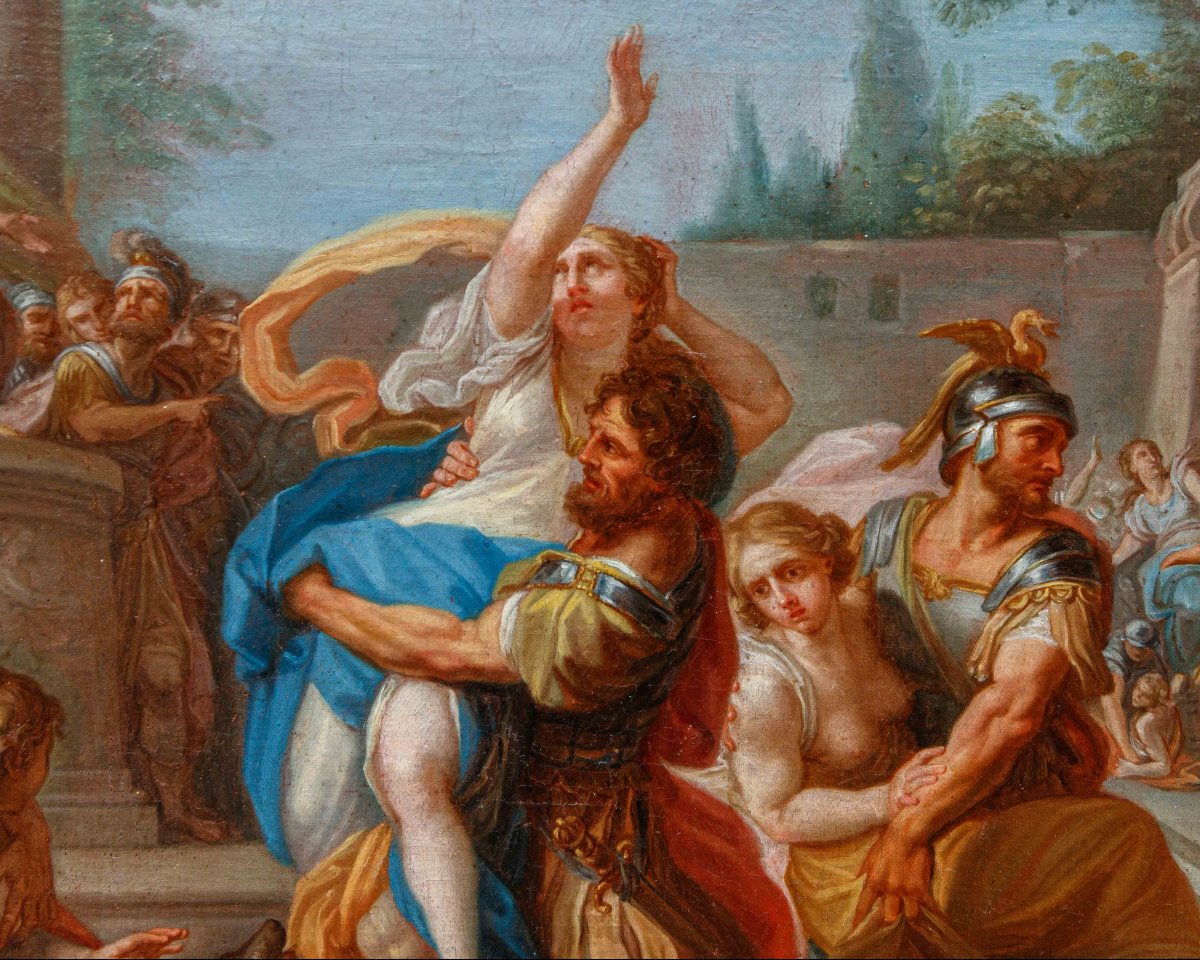
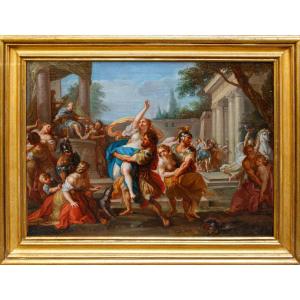
The painting depicts, with great intensity, the famous episode of the Rape of the Sabine Women, the culminating moment of the Roman legend in which Romulus’s soldiers abduct the young Sabine women during a celebration to ensure the continuity of the nascent people. At the center of the scene, a soldier lifts a young woman in his arms; her face is turned toward the sky and her right arm is raised in a desperate gesture of supplication, while other figures in the background and on either side struggle between flight and resignation, in a whirlwind of bodies and drapery. On the left, seated on a pedestal, is King Romulus, observing the scene with a regal and detached air, while the abduction unfolds around him. This version bears a direct resemblance to another signed canvas by Placido Costanzi, featuring the same subject and composition, which was auctioned at Christie’s in 2008: the two works share the same dimensions, scenic layout, arrangement of the main figures, and the dramatic intensity of the narrative, confirming the existence of a recurring treatment of the theme in the artist’s oeuvre, likely replicated to fulfill different commissions.
The composition appears to draw inspiration from Pietro da Cortona’s famous *Rape of the Sabine Women*, now housed in the Capitoline Picture Gallery in Rome: from this work, Costanzi specifically borrows the figure of the Sabine woman with her arm raised at the center of the scene, an iconographic element that becomes the emotional and visual fulcrum of the entire composition, evoking the solemn Baroque theatricality of the 17th-century master, albeit filtered through a more fluid, 18th-century pictorial sensibility.
Placido Costanzi was born in Rome to Giovanni and Costanza Anguilla, into a family of gem cutters—a trade also pursued by his brothers Tommaso and Carlo. He trained under the Trevisani and later under Benedetto Luti, developing an elegant and luminous style akin to that of his contemporary Sebastiano Conca. By 1724, he had already created decorations—now lost—for Cardinals Alberoni and Acquaviva d’Aragona, and he was active early on in Tuscany as well, even sending works to Lima and France. He painted numerous works for Roman churches, including the Resurrection of Tabitha for Santa Maria degli Angeli e dei Martiri, and frescoes for San Gregorio al Celio, Santa Maria in Campo Marzio, and the church of San Pietro Apostolo in Castel San Pietro. Beginning in 1725, he collaborated with Jan Frans van Bloemen, known as “l’Orizzonte,” incorporating figures into his landscapes. He joined the Congregation of the Virtuosi at the Pantheon and, in 1741, the Academy of San Luca, of which he became Prince in 1758. He was also highly regarded abroad, working for clients in Spain, England, France, and Germany.
Costanzi was an artist capable of moving with remarkable skill between various genres of painting, ranging from works of religious inspiration to those dedicated to historical and mythological themes. He carved out a niche for himself within Roman Arcadian classicism with a personal style and an engaging touch, developing over time a balanced, elegant, and at the same time rigorous style. Among his works on mythological subjects are *The Founding of the City of Alexandria*, now at the Walters Art Museum in Baltimore, and The Triumph of Bacchus and Ariadne, housed at Palazzo Labia in Venice—testaments to his ability to blend historical narrative, mythological invention, and compositional refinement, qualities that are fully evident in this painting as well.
Period: 18th century
Style: Other Style
Condition: Good condition
Material: Oil painting
Length: 65
Height: 49
Reference (ID): 1804739
Availability: In stock