

Tuscany, 18th Century, Dolphin Putto
Tuscany, 18th century
Dolphin Putto
Marble, cm alt. 55
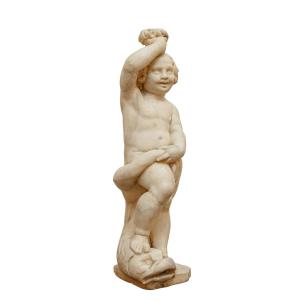
The sculpture in question, made of fine marble, depicts a cherub, or more precisely, a water sprite (perhaps a young Eros or a cupid), completely naked and plump. The marble, despite its coldness, is crafted to suggest the softness and fleshyness of the childlike figure, typical of the ideal of Renaissance and late Renaissance beauty. The putto is immortalized in a dynamic and seemingly unstable pose, placing its right foot on a dolphin, often associated with Poseidon, which serves as its base here. This search for dynamism and a pose that was not perfectly frontal constituted a distinctive feature of plastic art starting from the sixteenth century, anticipating that typically eighteenth-century predilection for the serpentine figure: the subject, in fact, presents a slight contrast and a torsion of the torso, elements that accentuate the sense of movement of the whole. With his right hand he holds a sort of vessel above his head, suggesting its original function as a decorative fountain, while his left hand appears to hold or embrace the dolphin's tail. The face is smiling and playful, with thick curls and an expression of lively and childish innocence. Due to its shape, this type of sculpture could, in fact, have been intended to embellish Medici villas and gardens, places where water and festive sculpture were fundamental elements (as in the famous fountains of the Boboli Gardens). This joyful naturalism represented a typical feature of the 18th-century Tuscan school, which drew inspiration from the timeless Florentine tradition of sculptors such as Andrea del Verrocchio and Giambologna. The sixteenth century, in Tuscany, was in fact a period of intense sculptural creativity, dominated first by the Renaissance peak and then by Mannerism. Andrea del Verrocchio's bronze Putto with Dolphin, dating back to around 1470 and preserved in Palazzo Vecchio, serves as an archetypal model for our sculpture, characterized by extraordinary mobility conceived for an unstable fountain pose, initially intended for Villa Careggi. During the 16th century, sculptors such as Tribolo and Ammannati also populated the grand ducal fountains with countless cherubs and marine figures, often conceived not as individual masterpieces, but elements of a complex hydraulic and allegorical machine.
Dolphin Putto
Marble, cm alt. 55
The sculpture in question, made of fine marble, depicts a cherub, or more precisely, a water sprite (perhaps a young Eros or a cupid), completely naked and plump. The marble, despite its coldness, is crafted to suggest the softness and fleshyness of the childlike figure, typical of the ideal of Renaissance and late Renaissance beauty. The putto is immortalized in a dynamic and seemingly unstable pose, placing its right foot on a dolphin, often associated with Poseidon, which serves as its base here. This search for dynamism and a pose that was not perfectly frontal constituted a distinctive feature of plastic art starting from the sixteenth century, anticipating that typically eighteenth-century predilection for the serpentine figure: the subject, in fact, presents a slight contrast and a torsion of the torso, elements that accentuate the sense of movement of the whole. With his right hand he holds a sort of vessel above his head, suggesting its original function as a decorative fountain, while his left hand appears to hold or embrace the dolphin's tail. The face is smiling and playful, with thick curls and an expression of lively and childish innocence. Due to its shape, this type of sculpture could, in fact, have been intended to embellish Medici villas and gardens, places where water and festive sculpture were fundamental elements (as in the famous fountains of the Boboli Gardens). This joyful naturalism represented a typical feature of the 18th-century Tuscan school, which drew inspiration from the timeless Florentine tradition of sculptors such as Andrea del Verrocchio and Giambologna. The sixteenth century, in Tuscany, was in fact a period of intense sculptural creativity, dominated first by the Renaissance peak and then by Mannerism. Andrea del Verrocchio's bronze Putto with Dolphin, dating back to around 1470 and preserved in Palazzo Vecchio, serves as an archetypal model for our sculpture, characterized by extraordinary mobility conceived for an unstable fountain pose, initially intended for Villa Careggi. During the 16th century, sculptors such as Tribolo and Ammannati also populated the grand ducal fountains with countless cherubs and marine figures, often conceived not as individual masterpieces, but elements of a complex hydraulic and allegorical machine.
3 800 €
Period: 18th century
Style: Other Style
Condition: Good condition
Material: Marble
Height: cm 55
Reference (ID): 1668381
Availability: In stock
Print