THIS OBJECT WAS SOLD
Pair Of Lifelike Porcelain Parakeets On Rocaille Wall Consoles, Germany, 20th Century
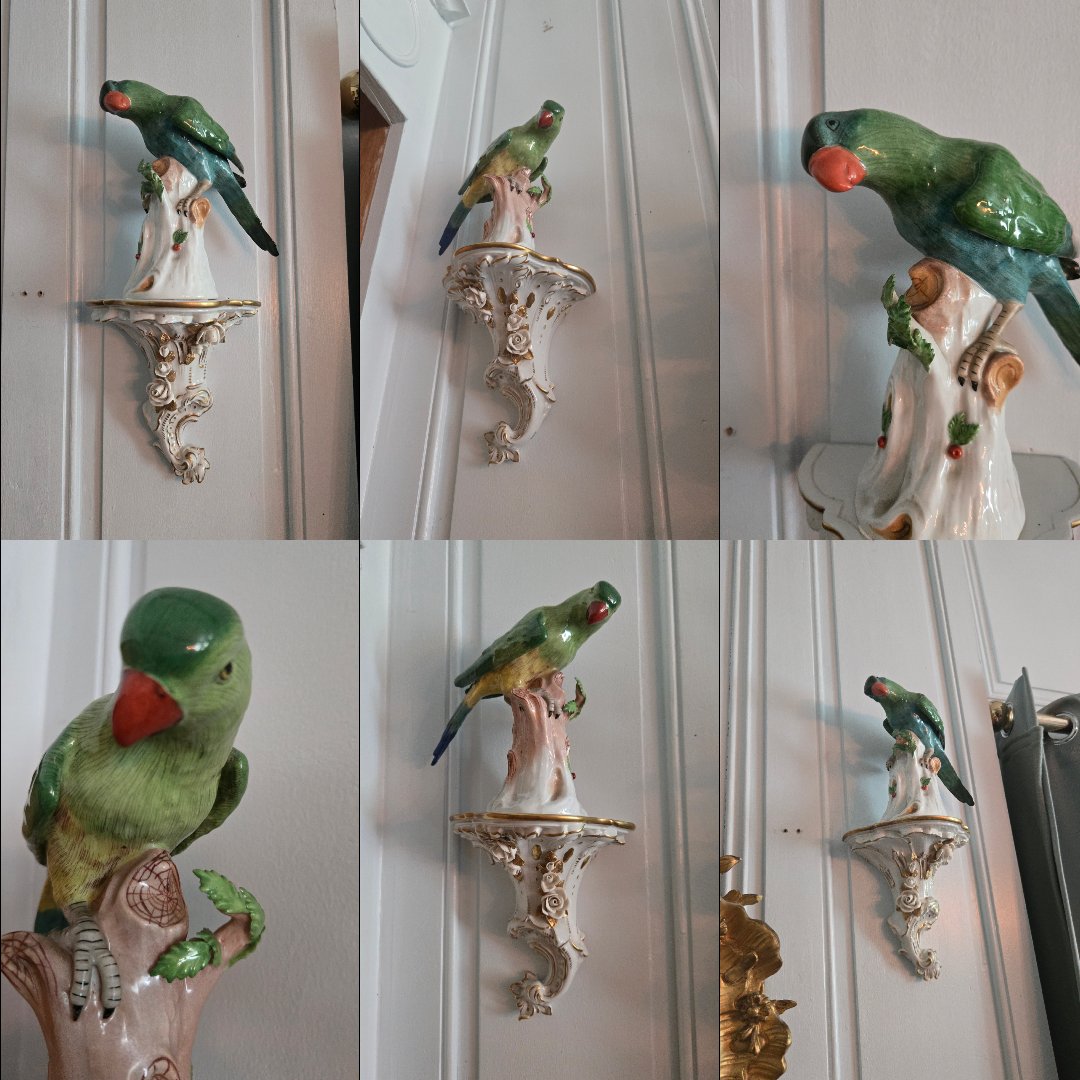
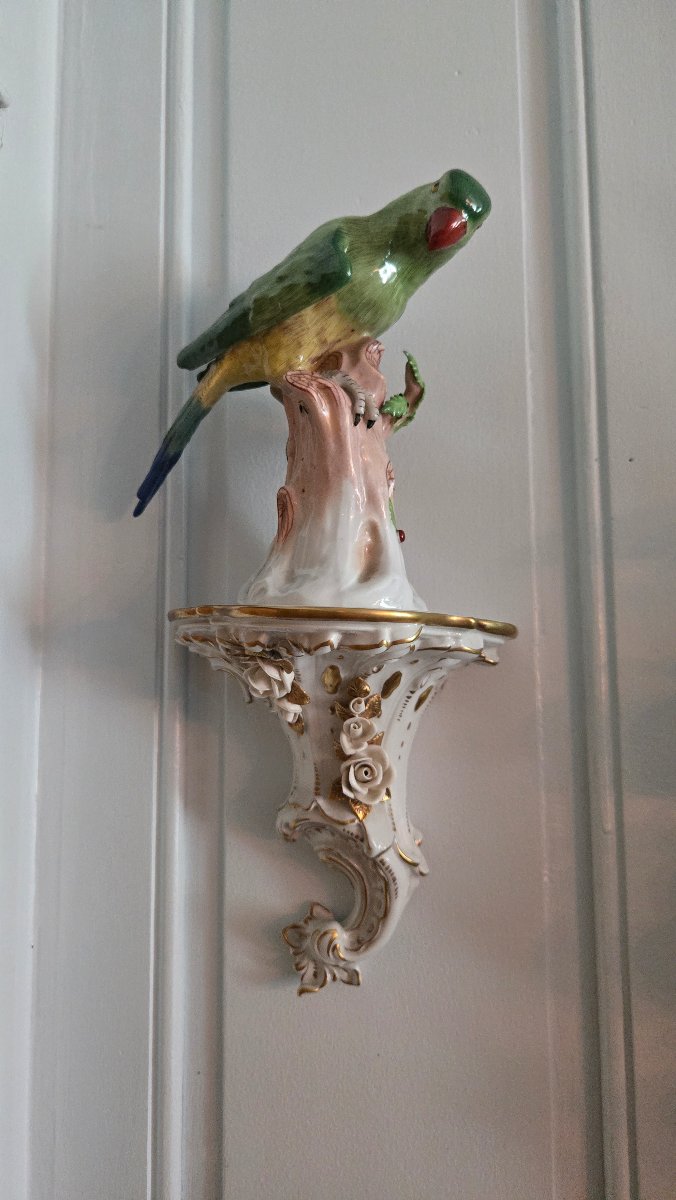
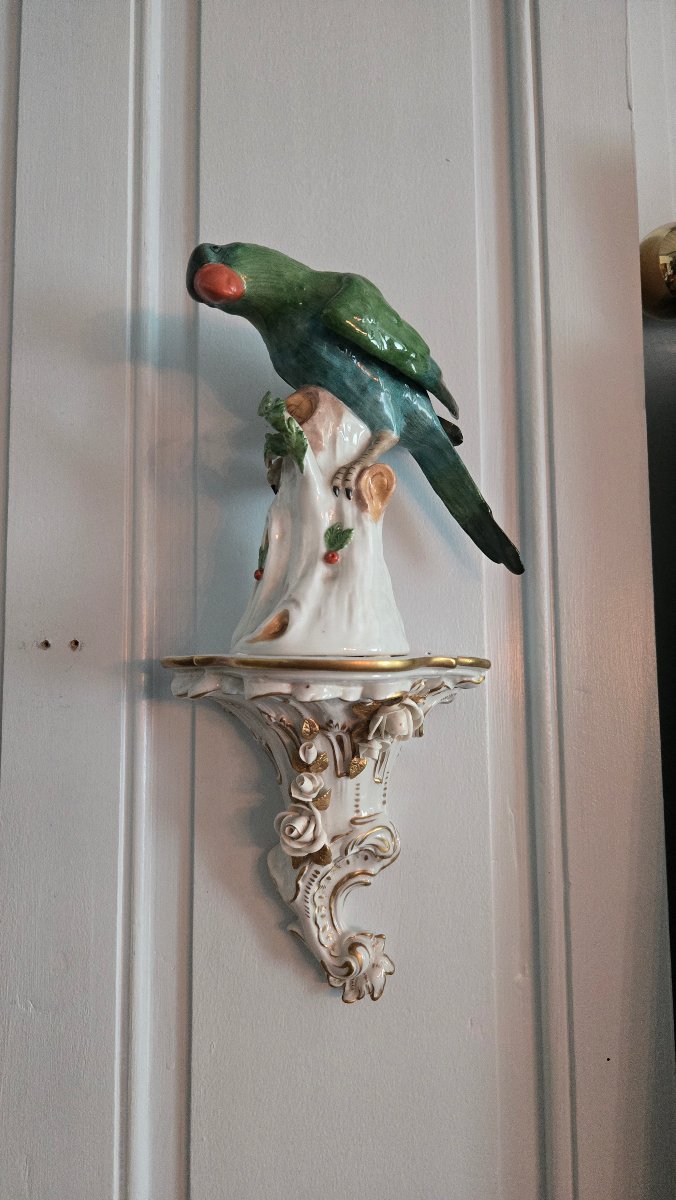
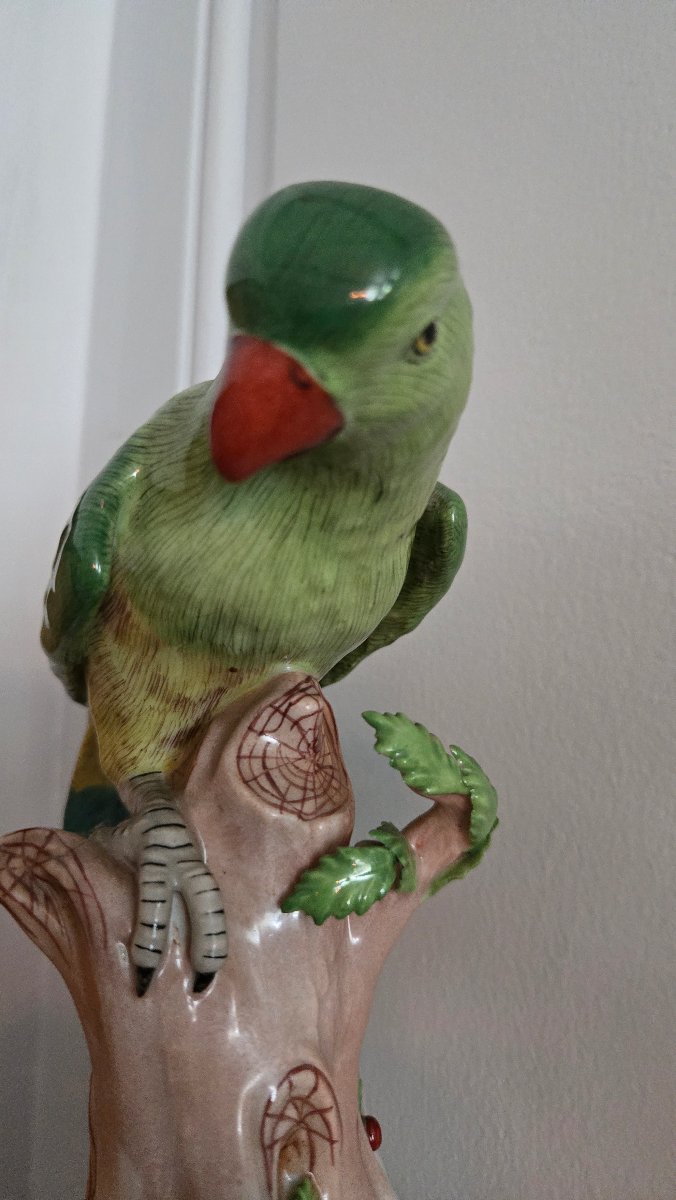
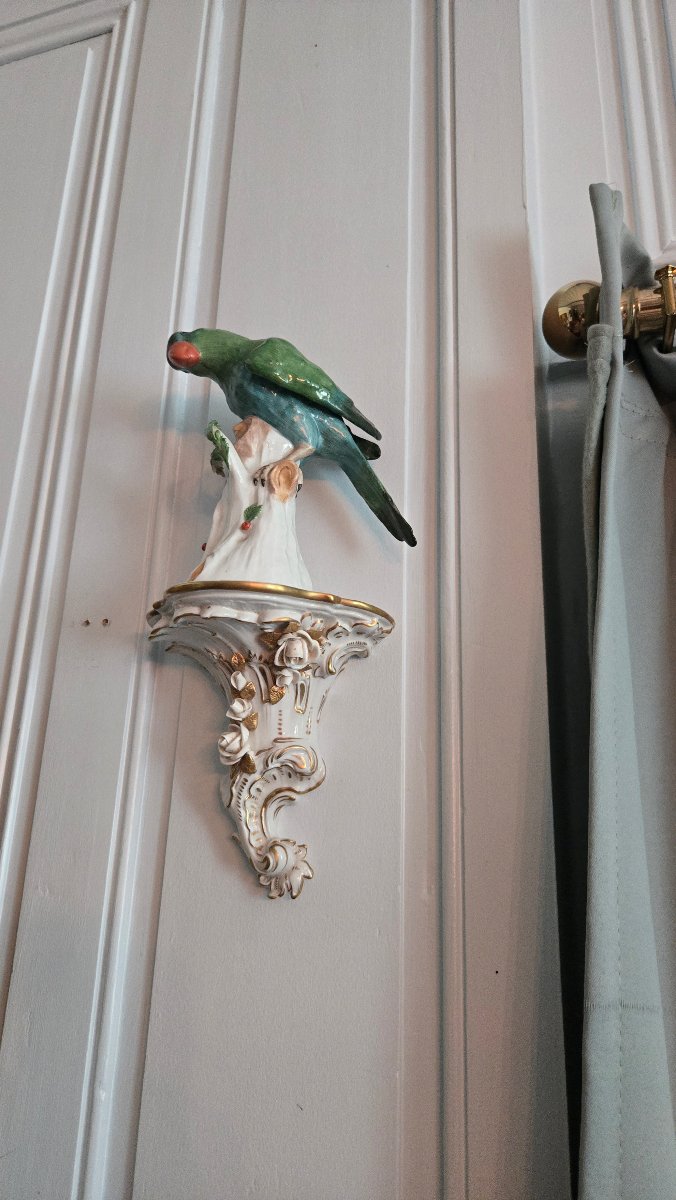

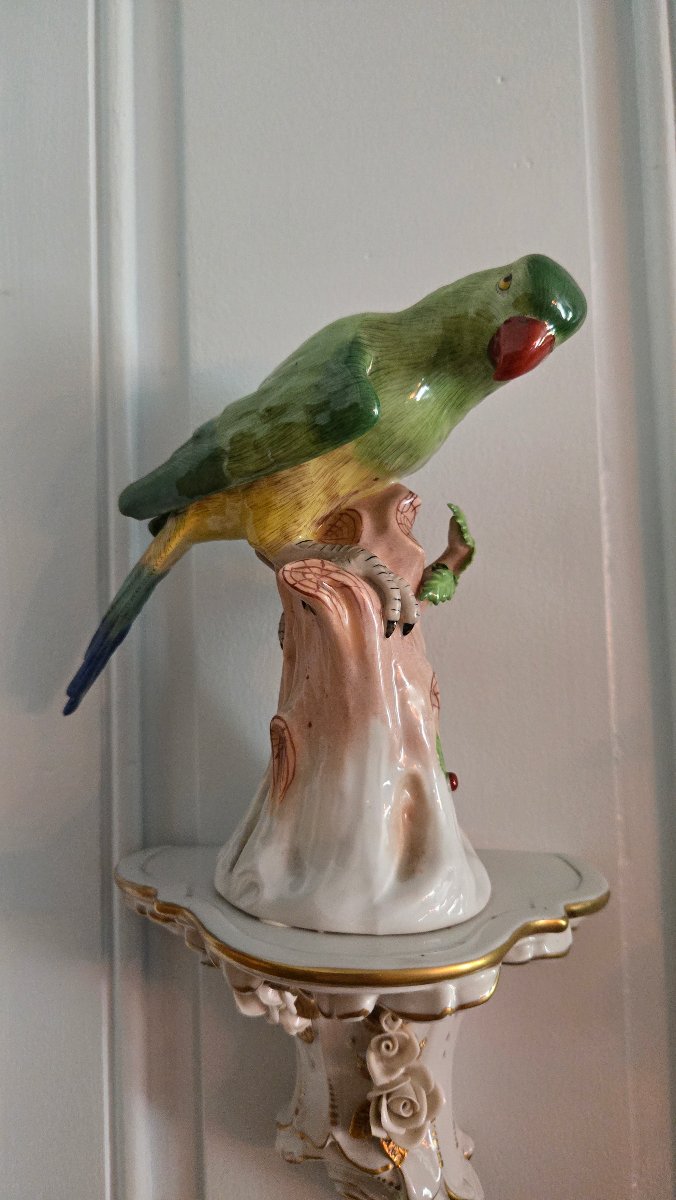

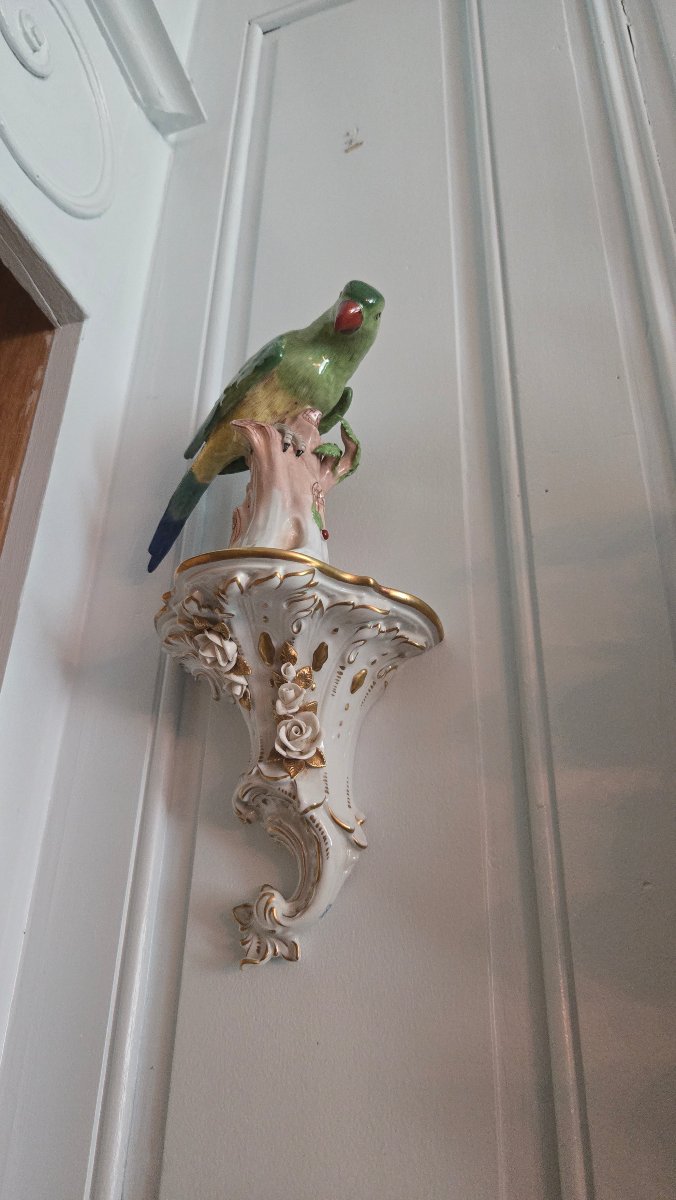
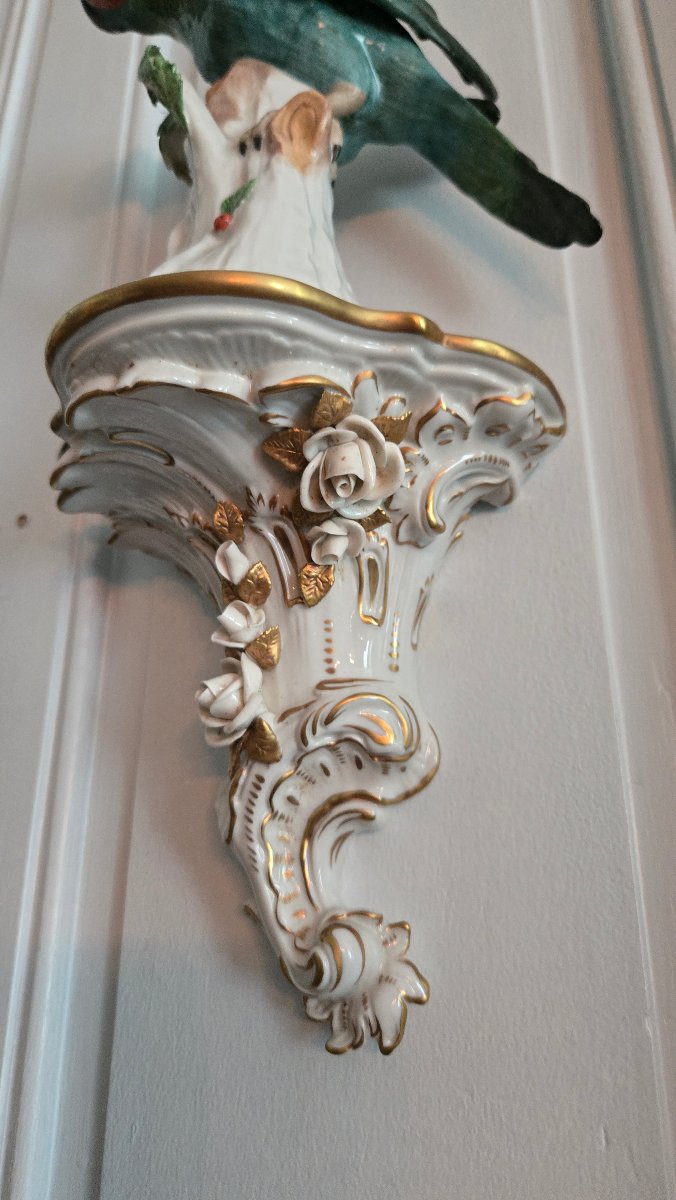
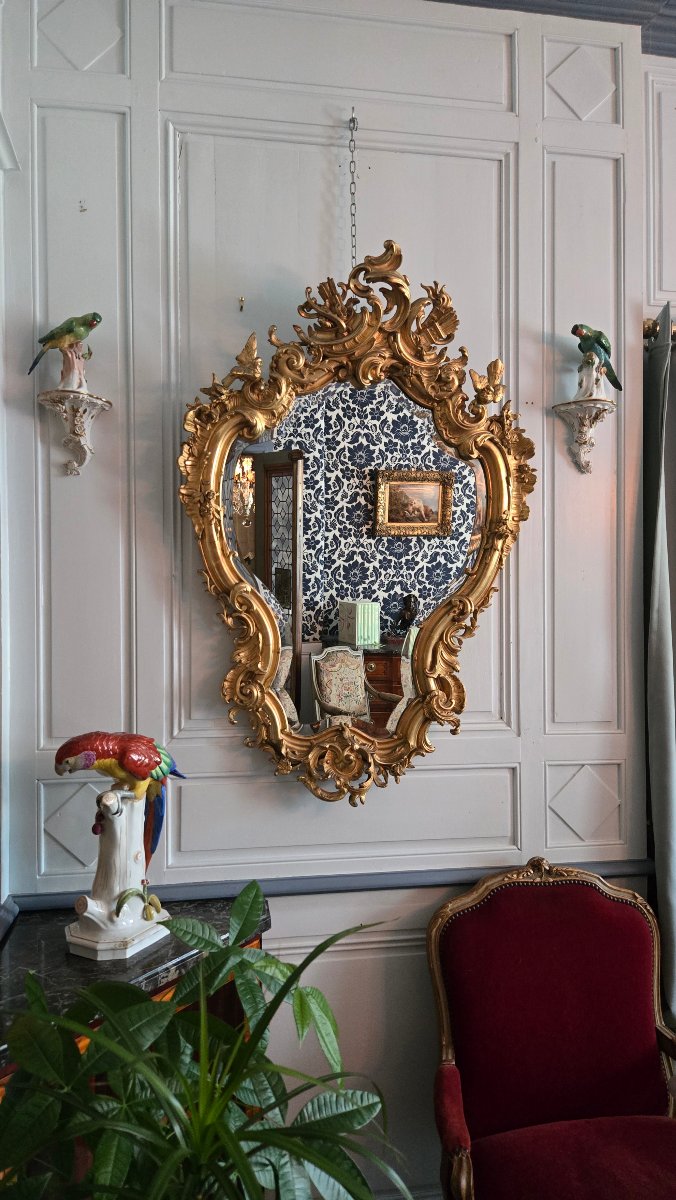
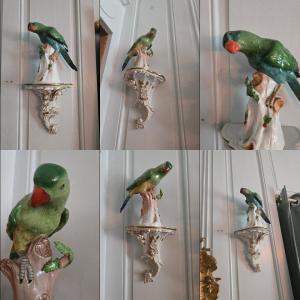


This elegant pair of decorative wall pieces consists of two lifelike parakeets crafted from polychrome porcelain, each resting on a white porcelain wall console accented with gold. The birds are arranged as a pair and face each other, a composition designed to be installed on either side of a mirror, a fireplace, a door, or a wall panel, creating a particularly harmonious decorative balance.
The consoles feature an ornamental style directly inspired by the 18th-century Rocaille style. Their dynamic silhouette combines curves and counter-curves, scrollwork, stylized shells, and bouquets of roses rendered in relief, delicately highlighted by gilded accents. This preference for Rococo forms remained very much in evidence in German porcelain factories throughout the 20th century, particularly in Thuringia, where porcelain makers carried on the decorative legacy of the 18th century by adapting it to the production of decorative objects intended for the interiors of their own era.
The reverse of both consoles bears a blue monogram underglaze from the Rudolf Kämmer factory, located in Rudolstadt-Volkstedt, Thuringia. Founded in 1886, this manufactory is part of the rich porcelain-making tradition of this region of Germany, where numerous workshops specializing in the creation of figurines, floral arrangements, and decorative porcelain objects have flourished. The raised roses, combined with gold highlights, are among the motifs frequently found in this manufacturer’s work.
The true stars of this set are the two parakeets. They depict ring-necked parakeets (Psittacula krameri), recognizable by their nuanced green plumage, their orange-red beaks, and their long, tapered tails. Each is perched on a naturalistic tree stump adorned with twigs, foliage, and small berries, with the branches rendered with meticulous attention to detail.
The sculpting and painting are meticulous. The plumage is brought to life by fine brushstrokes that suggest the different layers of feathers. The gradations of greens, yellows, and blues add depth and nuance to the overall composition, while the eyes, claws, and anatomical details showcase the craftsmanship of German porcelain makers who specialized in decorative animal sculpture throughout the 20th century.
Since the 18th century, parrots and parakeets have held a special place in European decorative arts. Their exotic nature, vibrant colors, and elegant silhouette quickly captivated the major porcelain manufacturers. Inspired by birds imported from Africa and Asia, they became sought-after subjects in compositions designed to adorn aristocratic and, later, bourgeois residences. This tradition continued throughout the 19th and 20th centuries, particularly in the manufactories of Saxony and Thuringia, which developed a significant production of naturalistic birds. The two parakeets are clearly a pair made from the same mold. Their sculptural form, pictorial treatment, and decorative style resemble the works of 20th-century manufacturers in Saxony and Thuringia. However, they bear no visible markings, as the bases are now attached to the consoles. In the absence of an accessible signature, an attribution to a specific manufacturer cannot be made with certainty.
A close examination of the ensemble reveals that the birds and the brackets were likely not produced by the same manufacturer. The brackets are clearly identified by their Rudolf Kämmer mark, while the parakeets appear to come from another German manufacturer. They were likely paired with the brackets at a later date to create this wall arrangement. This carefully crafted, antique arrangement offers a particularly balanced ensemble and allows the birds to be displayed in a stable and secure manner.
Through their symmetrical composition, the two parakeets seem to engage in a dialogue with one another, creating a lively and elegant decoration. Placed on either side of a mirror, a fireplace, or an architectural feature, they fully fulfill their ornamental purpose and form a decorative ensemble with a striking presence.
Condition: excellent overall condition. The brackets are intact. The birds are securely fastened to their mounts. No visible damage or restoration.
Dimensions:
Total height: 35 cm
The consoles feature an ornamental style directly inspired by the 18th-century Rocaille style. Their dynamic silhouette combines curves and counter-curves, scrollwork, stylized shells, and bouquets of roses rendered in relief, delicately highlighted by gilded accents. This preference for Rococo forms remained very much in evidence in German porcelain factories throughout the 20th century, particularly in Thuringia, where porcelain makers carried on the decorative legacy of the 18th century by adapting it to the production of decorative objects intended for the interiors of their own era.
The reverse of both consoles bears a blue monogram underglaze from the Rudolf Kämmer factory, located in Rudolstadt-Volkstedt, Thuringia. Founded in 1886, this manufactory is part of the rich porcelain-making tradition of this region of Germany, where numerous workshops specializing in the creation of figurines, floral arrangements, and decorative porcelain objects have flourished. The raised roses, combined with gold highlights, are among the motifs frequently found in this manufacturer’s work.
The true stars of this set are the two parakeets. They depict ring-necked parakeets (Psittacula krameri), recognizable by their nuanced green plumage, their orange-red beaks, and their long, tapered tails. Each is perched on a naturalistic tree stump adorned with twigs, foliage, and small berries, with the branches rendered with meticulous attention to detail.
The sculpting and painting are meticulous. The plumage is brought to life by fine brushstrokes that suggest the different layers of feathers. The gradations of greens, yellows, and blues add depth and nuance to the overall composition, while the eyes, claws, and anatomical details showcase the craftsmanship of German porcelain makers who specialized in decorative animal sculpture throughout the 20th century.
Since the 18th century, parrots and parakeets have held a special place in European decorative arts. Their exotic nature, vibrant colors, and elegant silhouette quickly captivated the major porcelain manufacturers. Inspired by birds imported from Africa and Asia, they became sought-after subjects in compositions designed to adorn aristocratic and, later, bourgeois residences. This tradition continued throughout the 19th and 20th centuries, particularly in the manufactories of Saxony and Thuringia, which developed a significant production of naturalistic birds. The two parakeets are clearly a pair made from the same mold. Their sculptural form, pictorial treatment, and decorative style resemble the works of 20th-century manufacturers in Saxony and Thuringia. However, they bear no visible markings, as the bases are now attached to the consoles. In the absence of an accessible signature, an attribution to a specific manufacturer cannot be made with certainty.
A close examination of the ensemble reveals that the birds and the brackets were likely not produced by the same manufacturer. The brackets are clearly identified by their Rudolf Kämmer mark, while the parakeets appear to come from another German manufacturer. They were likely paired with the brackets at a later date to create this wall arrangement. This carefully crafted, antique arrangement offers a particularly balanced ensemble and allows the birds to be displayed in a stable and secure manner.
Through their symmetrical composition, the two parakeets seem to engage in a dialogue with one another, creating a lively and elegant decoration. Placed on either side of a mirror, a fireplace, or an architectural feature, they fully fulfill their ornamental purpose and form a decorative ensemble with a striking presence.
Condition: excellent overall condition. The brackets are intact. The birds are securely fastened to their mounts. No visible damage or restoration.
Dimensions:
Total height: 35 cm
Explore similar pieces and discover your ideal find:
Porcelain Figurines, Biscuit Porcelain