

Men's Beaded Shirt From The Great Plains
Probably Cheyenne (Tsitsistas/Suhtai), with Lakota (Teton Sioux) influences
Great Plains of North America
Circa 1880–1900
Finely tanned deer hide, glass beads, pigments, leather.
Dimensions:
Length: 80 cm
Wingspan: 110 cm
Provenance: Former Bernard Souteyrand Collection.
Description
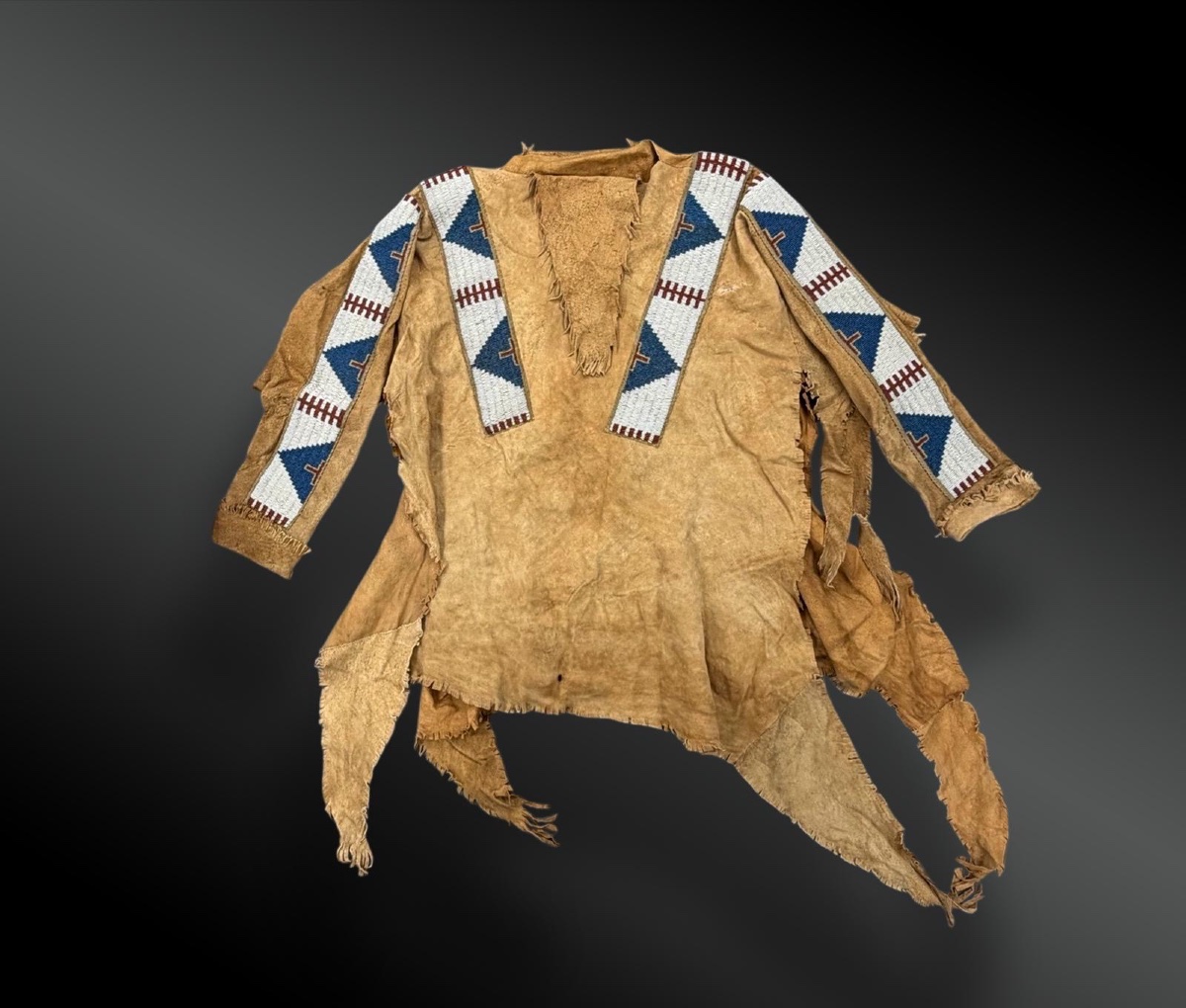
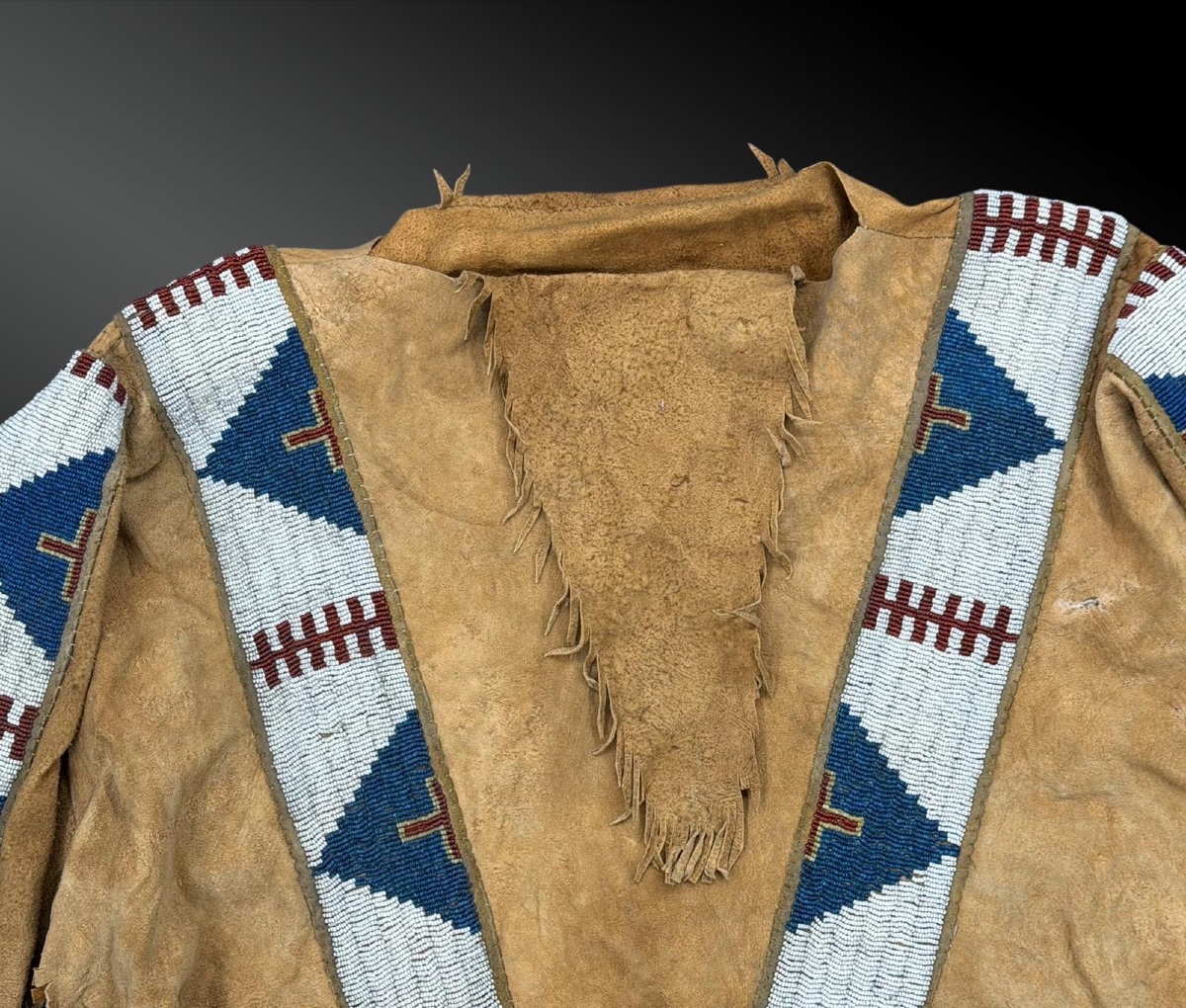
This remarkable men’s shirt from the Great Plains is a beautiful example of late 19th-century Native American clothing art. Made from carefully prepared deer hide, it features a traditional cut adorned with long fringes and an elegant, fringed triangular breastplate.
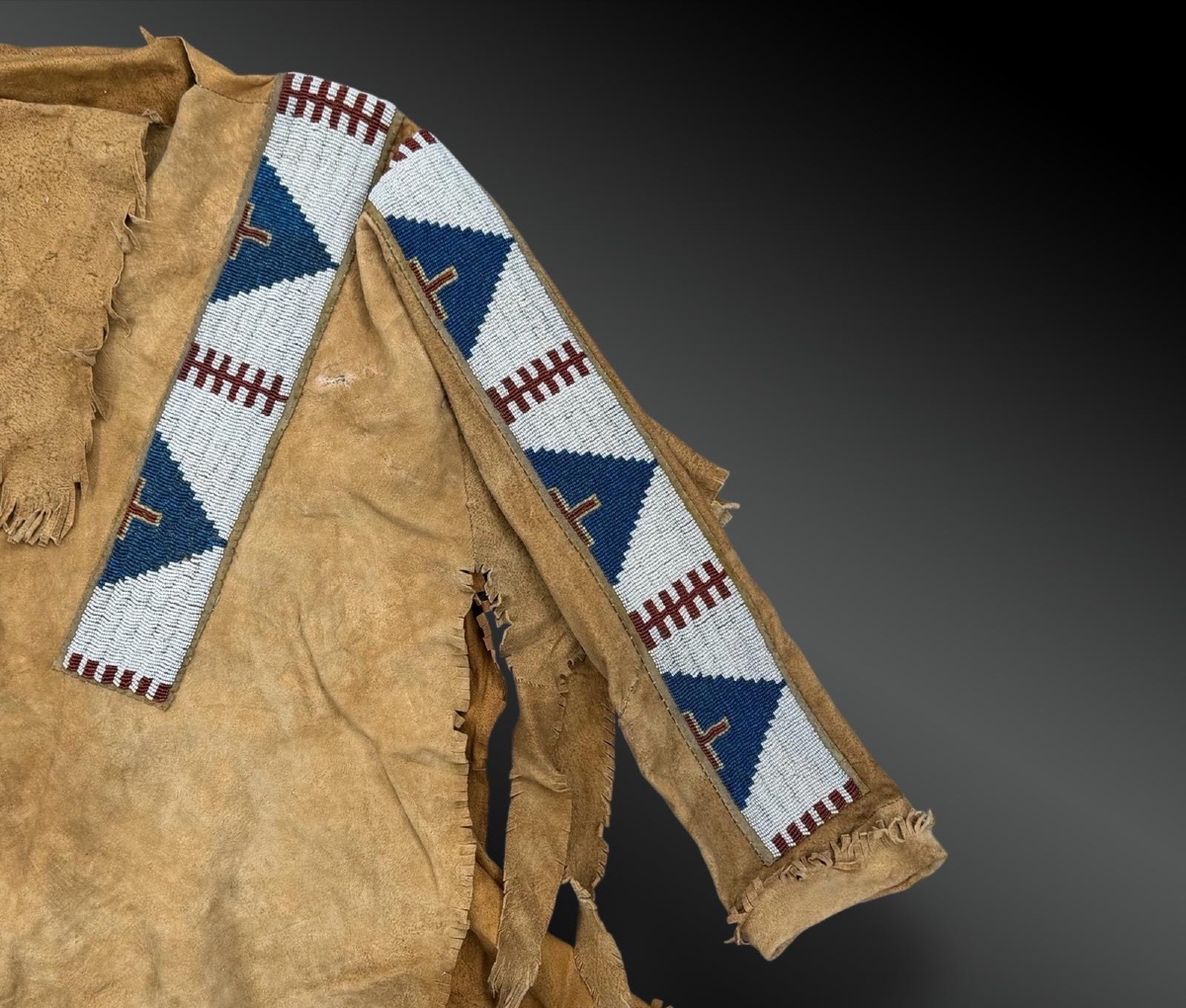
The decoration consists of four long beaded bands—two on the front and two on the back—that extend harmoniously down the sleeves. Made of white, cobalt blue, light blue, reddish-brown, and yellow glass microbeads, it displays a remarkable geometric design composed of large interlocking triangles, whose perfect regularity attests to exceptional mastery of beadwork.
Unlike shirts richly adorned with hair, feathers, or pendants, this piece captivates with the simplicity of its design. The work’s true quality lies in the balance of its proportions, the precision of its lines, and the finesse of its execution—characteristics of the most refined creations from the Great Plains.
The side openings, long interpreted as possible tears, appear to be part of the garment’s very design and likely correspond to a traditional construction method, subject to further material analysis.
Comparative Study
A comparative study based on public collections and specialized literature links this shirt to the works of the Cheyenne and Lakota (Teton Sioux) from the late 19th century.
Its overall construction, long vertical beaded bands, triangular front panel, and geometric decoration show close similarities to several shirts held by the Saint Louis Art Museum, the British Museum, the Cleveland Museum of Art, and the National Museum of the American Indian (Smithsonian Institution).
Research based on the works of Theodore Brasser, John C. Ewers, David W. Penney, Christian Feest, and Colin F. Taylor shows that this decorative arrangement is part of the major clothing traditions of the peoples of the Northern Great Plains between 1880 and 1900.
Comparisons now point more specifically toward a Cheyenne (Tsitsistas/Suhtai) attribution, though scientific caution is warranted due to the reciprocal stylistic influences between Cheyenne and Lakota workshops during this period.
Given the quality of its craftsmanship, the perfect symmetry of its decoration, the remarkable preservation of its beading, and its provenance from the Bernard Souteyrand collection, this shirt ranks among the most elegant examples of this artistic tradition.
Condition
Very good overall condition.
The hide has a uniform and supple patina, with signs of wear consistent with an antique garment that has been worn. The beading is remarkably well-preserved. Any losses are minor and in no way detract from the aesthetic quality or the clarity of the design.
Period: 19th century
Style: Other Style
Condition: Good condition
Reference (ID): 1794126
Availability: In stock