


Deverberie “by Magic Lantern”
Artist: Deverberie
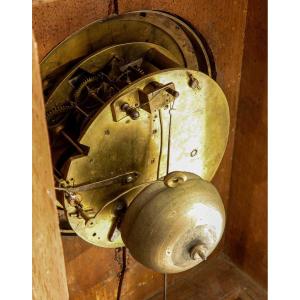
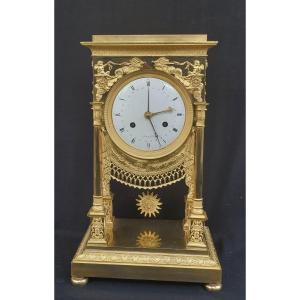
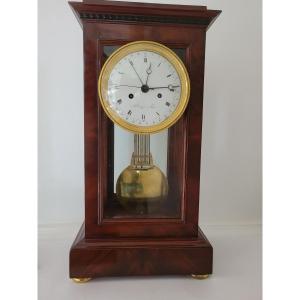
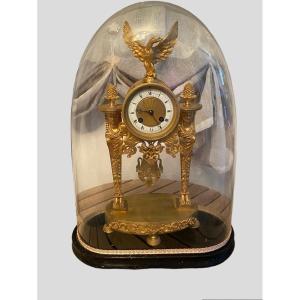
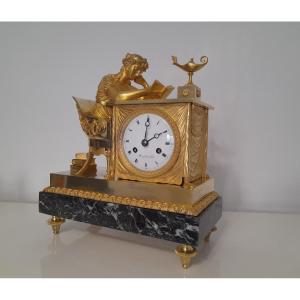
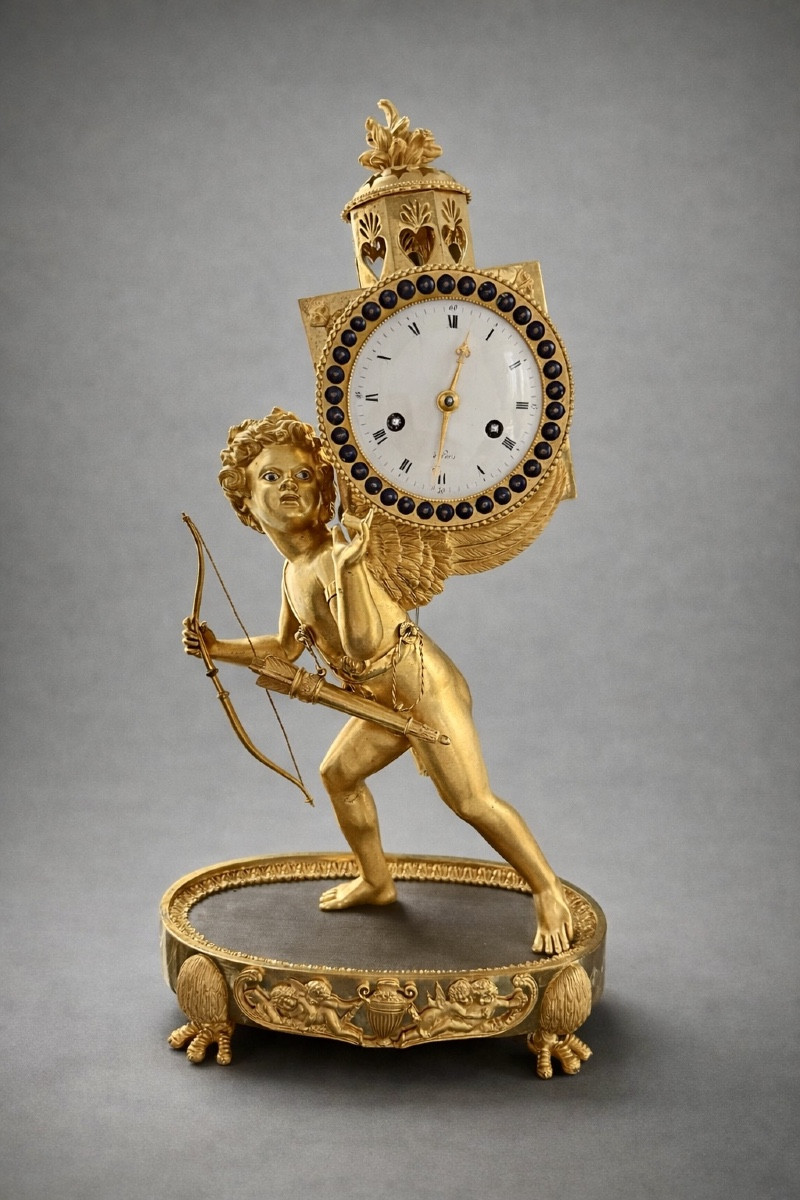
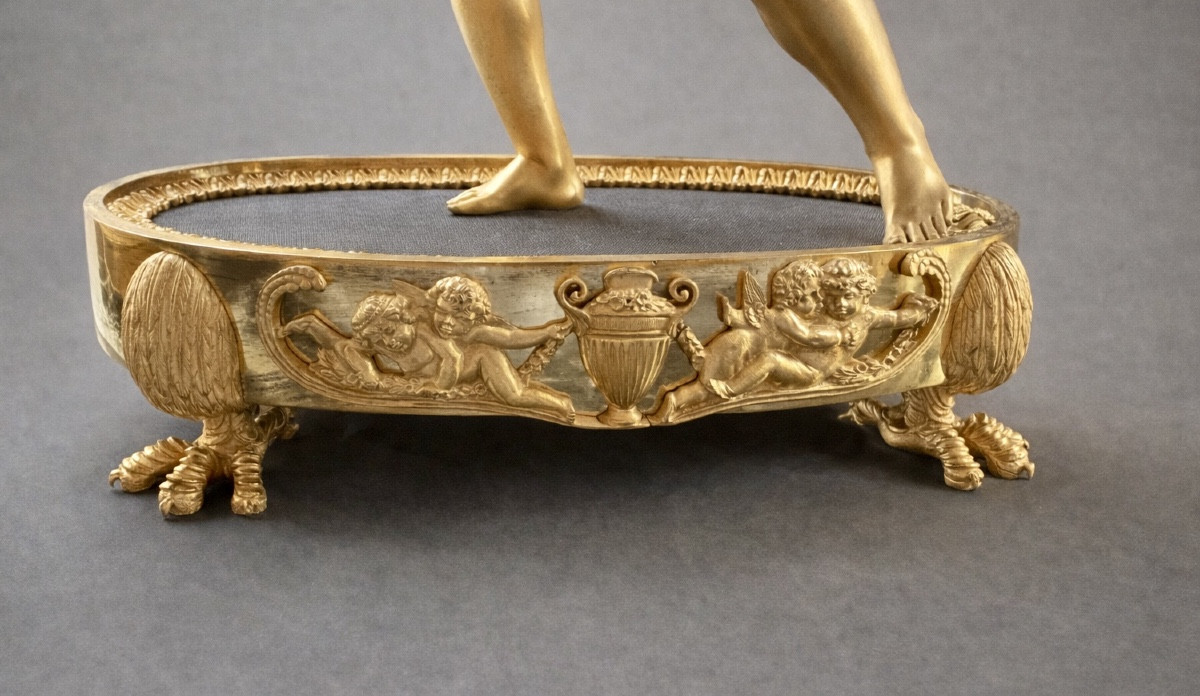
A gilt bronze mantel clock attributed to Jean-Simon Deverberie (1764-1824), Paris, Empire period, circa 1800. Height 46 cm, Width 24 cm, Depth 13 cm. Description: A very fine eight-day gilt bronze mantel clock, the dial in enamel with Roman and Arabic numerals, the hands in gilt bronze. The movement, with an anchor escapement and silk thread suspension, strikes the hours and half-hours, with an external count wheel. The bezel is decorated with gilt pearls and blue enamel rosettes; the case, representing a magic lantern, is surmounted by a flaming torch pierced with hearts and stars. The pendulum lens is in the shape of a butterfly. The case is surmounted by a winged Cupid with enamel eyes, holding a bow and a quiver full of arrows. The oval-shaped plinth rests on eagle-claw feet and features a frieze of winged putti playing around an urn. Historically, a clock with a very similar case, featuring a patinated bronze Cupid, is illustrated in Pierre Kjellberg, Encyclopédie de la Pendule Française du Moyen Age au XXe Siècle, 1997, p. 447, pl. D. A nearly identical clock, in gilt bronze, with a dial signed "Pinart à L'Orient," is illustrated in Elke Niehüser, Die Französische Bronzeuhr, Eine Typologie der Figürlichen Darstellungen, 1997: detail view on the cover; p. 129, pl. 210 and p. 230, pl. 658. The undated catalogue of the Musée François Duesberg illustrates a clock with a case almost identical to the one on p. 38. The "lantern" clocks depicting Cupid carrying a lantern on his back are probably inspired by the numerous prints, drawings, and statuettes of itinerant lantern showmen that circulated in the 19th century. Magic lantern shows, very popular from the late 18th century onward, included all sorts of views: comic, historical, or topographical. Magic lantern shows ended when affordable magic lanterns became available for home use. The invention of the magic lantern, around the mid-17th century, is probably attributed to Christiaan Huygens (1629–1695). It was a primitive projector consisting of an iron box topped with a chimney and a space for a candle or oil lamp. The images, placed in front of the lens and illuminated by a light source, were projected onto a wall or a stretched sheet. In the clock shown, Cupid points to the dial, suggesting an interesting interpretation: perhaps he means that, like the images created by the magic lantern, time—yes, even love—is but an illusion. The pierced hearts adorning the top of the lantern and the flaming torch also refer to love. Biography: Jean-Simon Deverberie (1764–1824) Jean-Simon Deverberie is among the most important Parisian bronze casters of the late 18th century and the first two decades of the following century. Married to Marie-Louise Veron, this craftsman seems to have initially specialized almost exclusively in the creation of clocks, torches, and candelabra, adorned with exotic figures, particularly African characters; Indeed, around 1800 he submitted numerous preparatory drawings of clocks known as "Negro clocks," notably the models called "Africa," "America," and "Indian and Indian Woman Embracing" (the drawings are now held in the Prints Department of the National Library in Paris). He established his workshop successively on rue Barbette from 1800, on rue du Temple around 1804, and finally on rue des Fossés du Temple between 1812 and 1820.
15 000 €
Period: 19th century
Style: Consulat, Empire
Condition: Excellent condition
Reference (ID): 1719744
Availability: In stock
Print