

18th-century Roman School – Nausicaa Leads Odysseus To Alcinoos – Lavis & Plume
Artist: école Romaine Du Xviiiᵉ Siècle
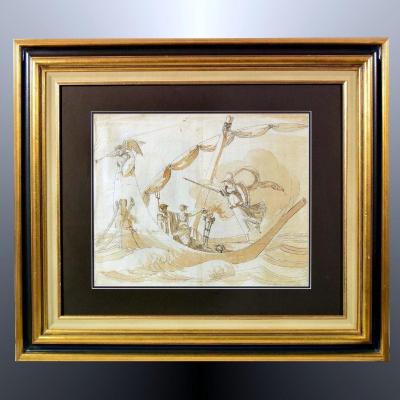
18th-Century Roman School – Nausicaa Leading Ulysses to Her Father Alcinous –
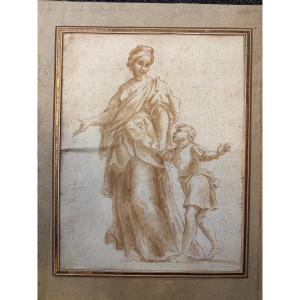
Pen, brown ink wash, and white gouache highlights on paper
Italy, Rome, c. 1750–1780
Drawing dimensions: 31.5 × 23.5 cm
Dimensions with mat: 52 × 37.5 cm
Excellent state of preservation.
Description
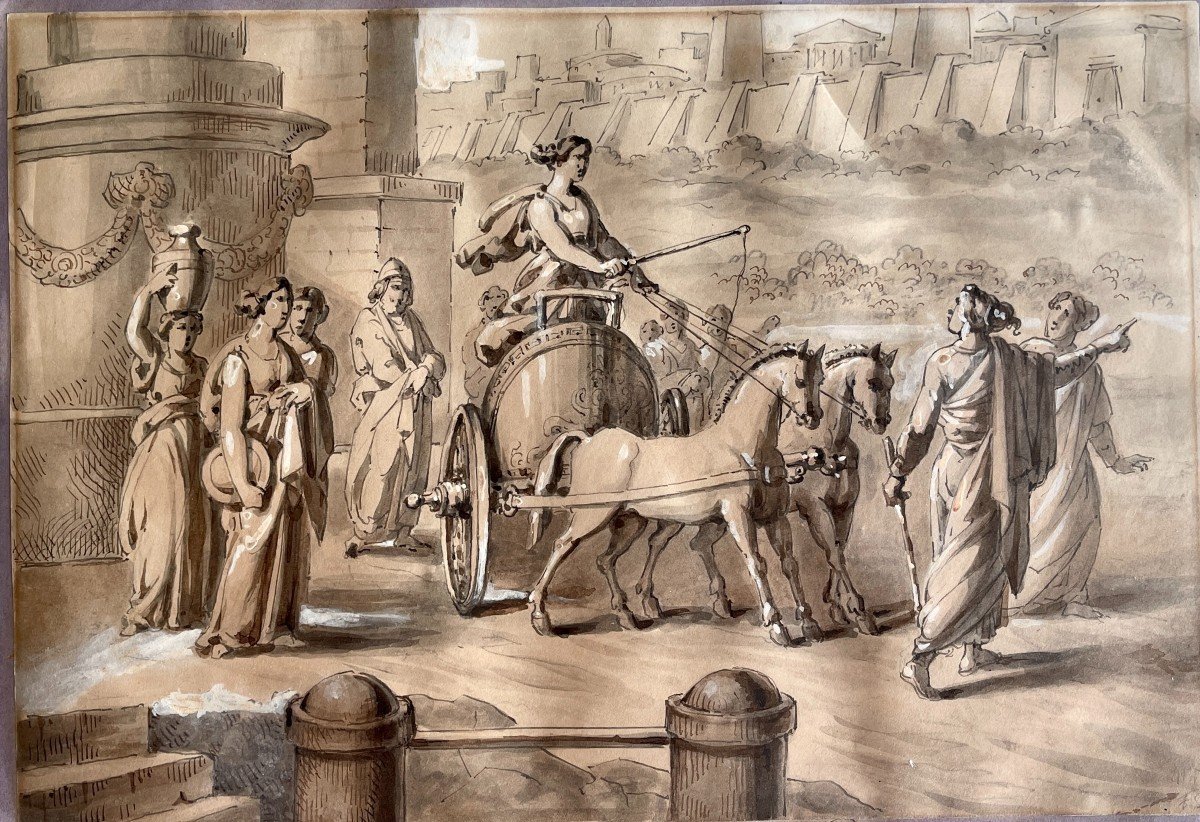
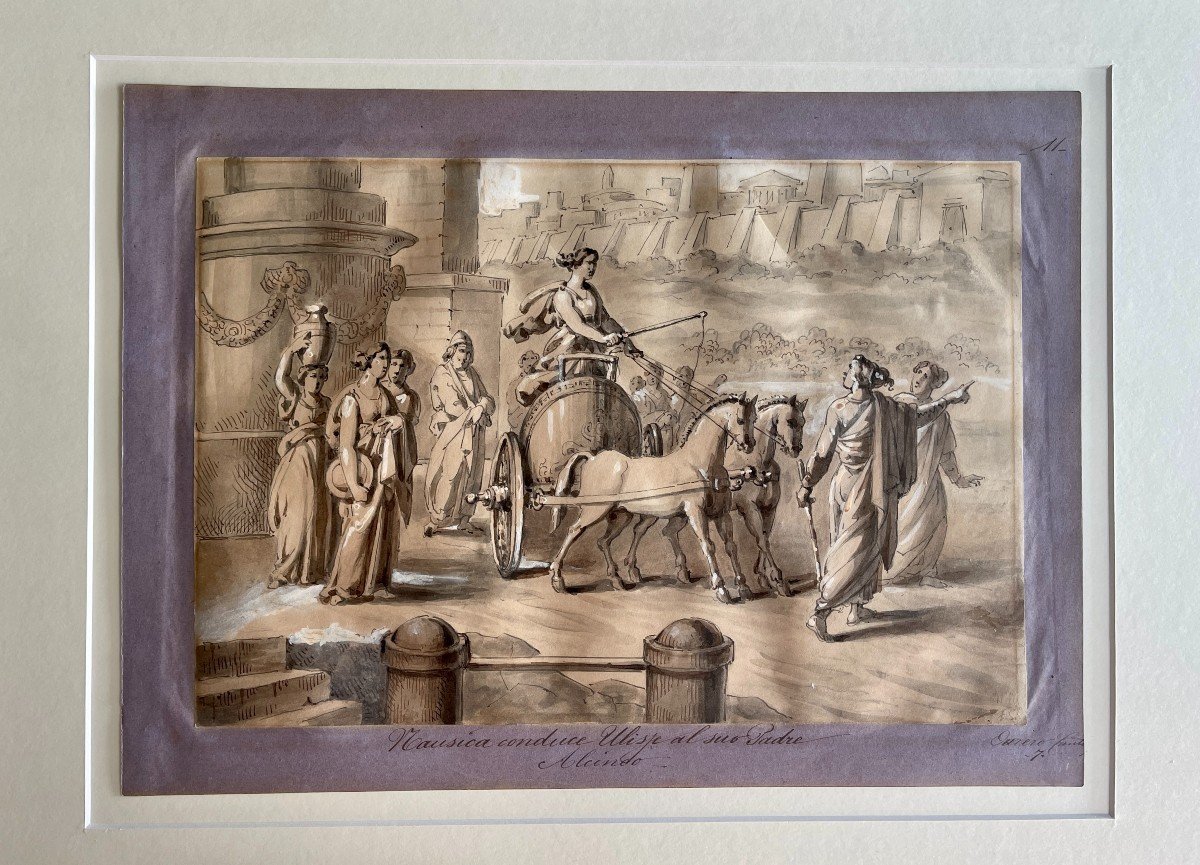
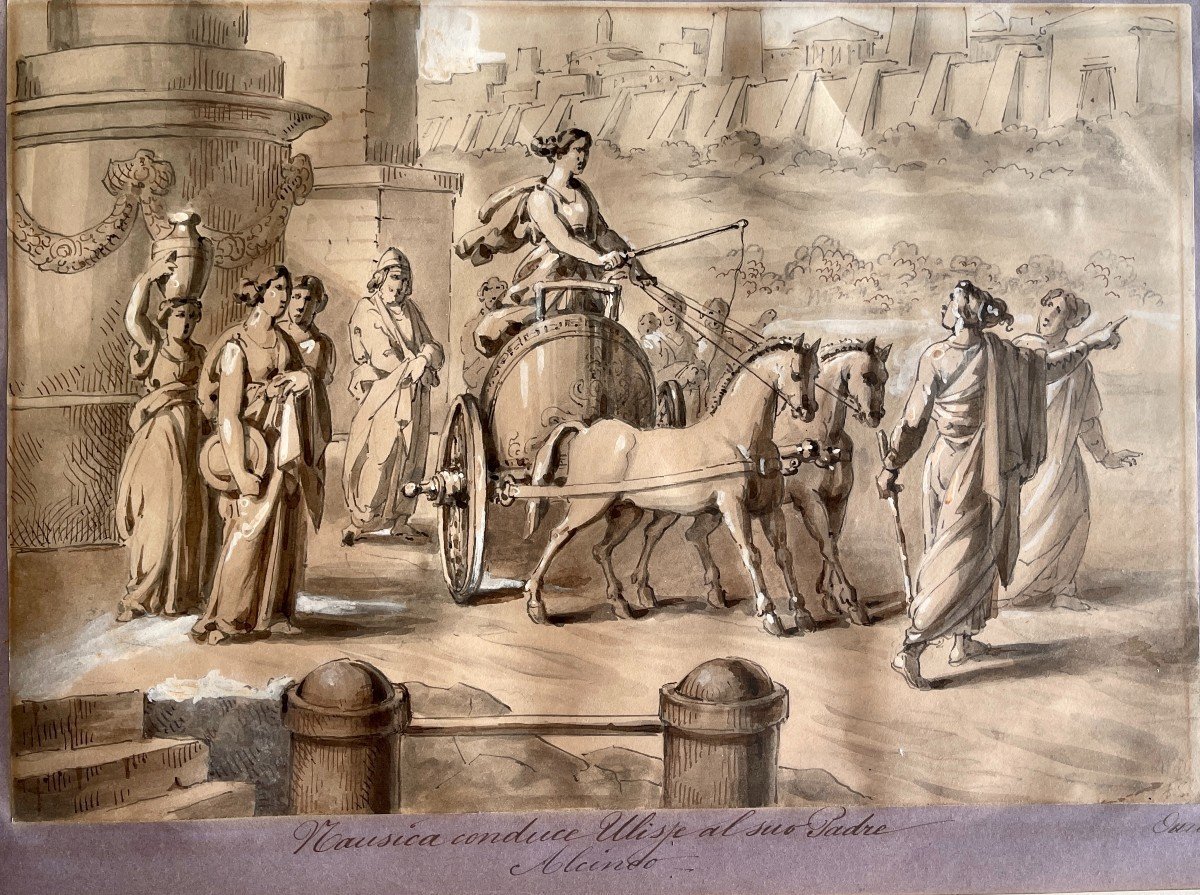
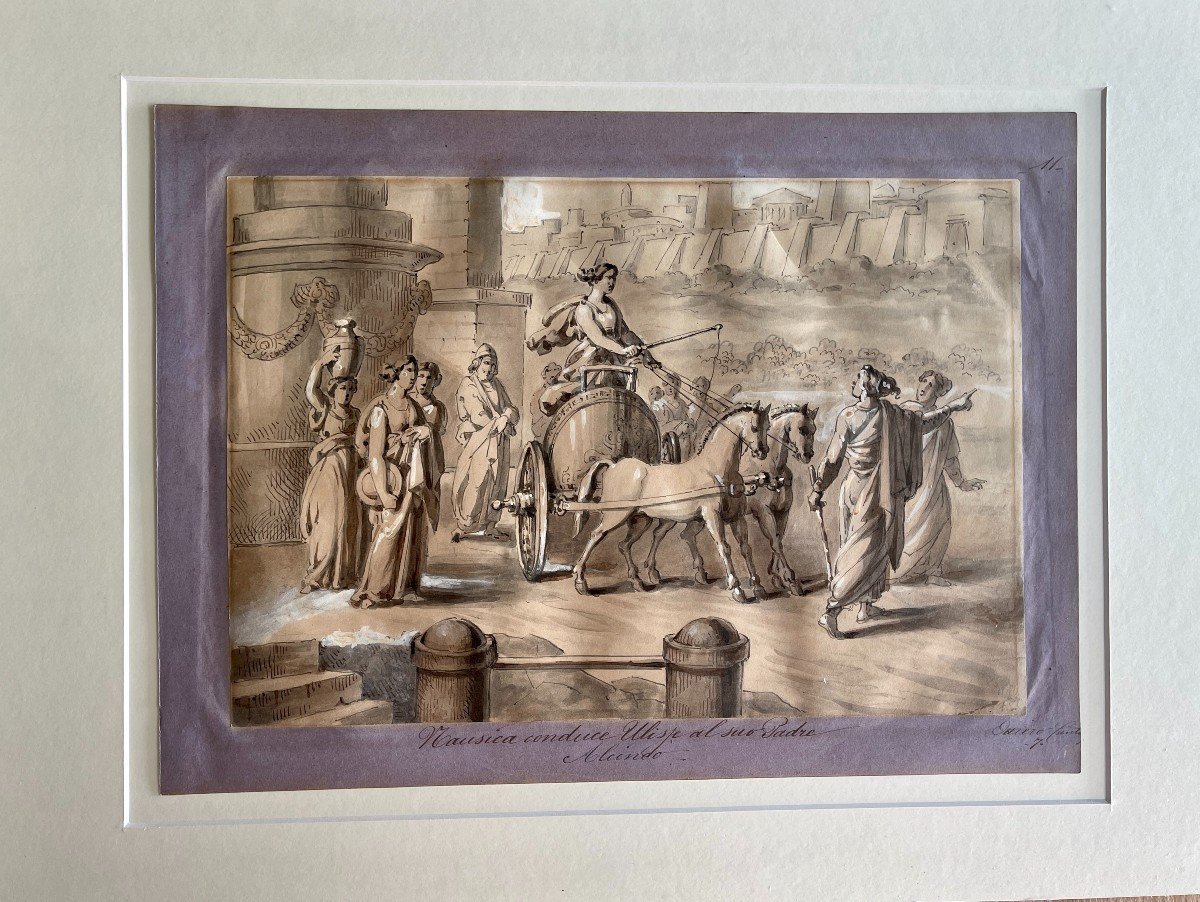
A superb Italian academic drawing executed in pen and brown ink wash, enriched with delicate white gouache highlights, depicting one of the most famous episodes from Homer’s *Odyssey*: Nausicaa guiding Ulysses to the palace of her father Alcinous, King of the Phaeacians.
After surviving a shipwreck caused by Poseidon, Ulysses is found on the shores of Scheria by Princess Nausicaa. Moved by his plight, she directs him to the royal palace, where Alcinous will grant him hospitality before his return to Ithaca.
The drawing illustrates the precise moment the hero is introduced to the royal family.
The scene is arranged with remarkable theatrical staging.
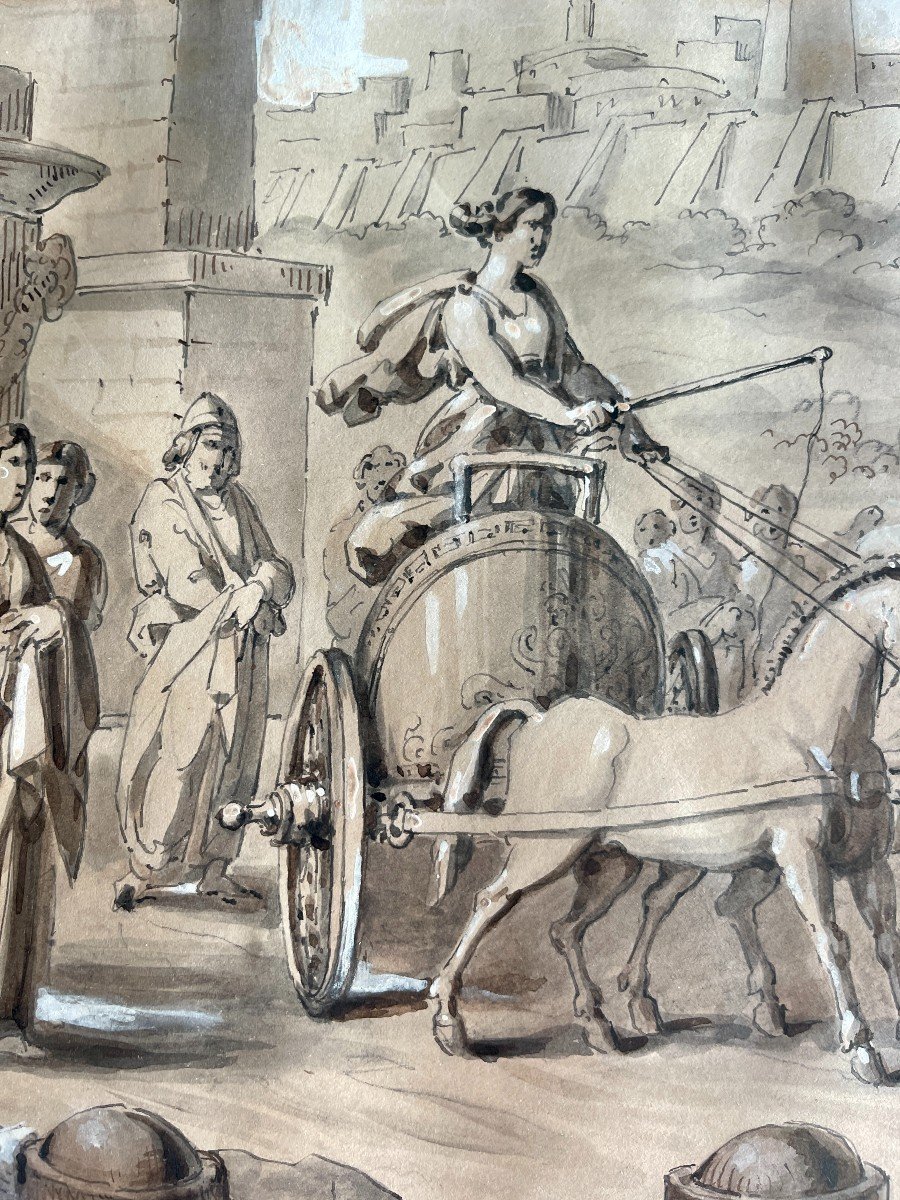
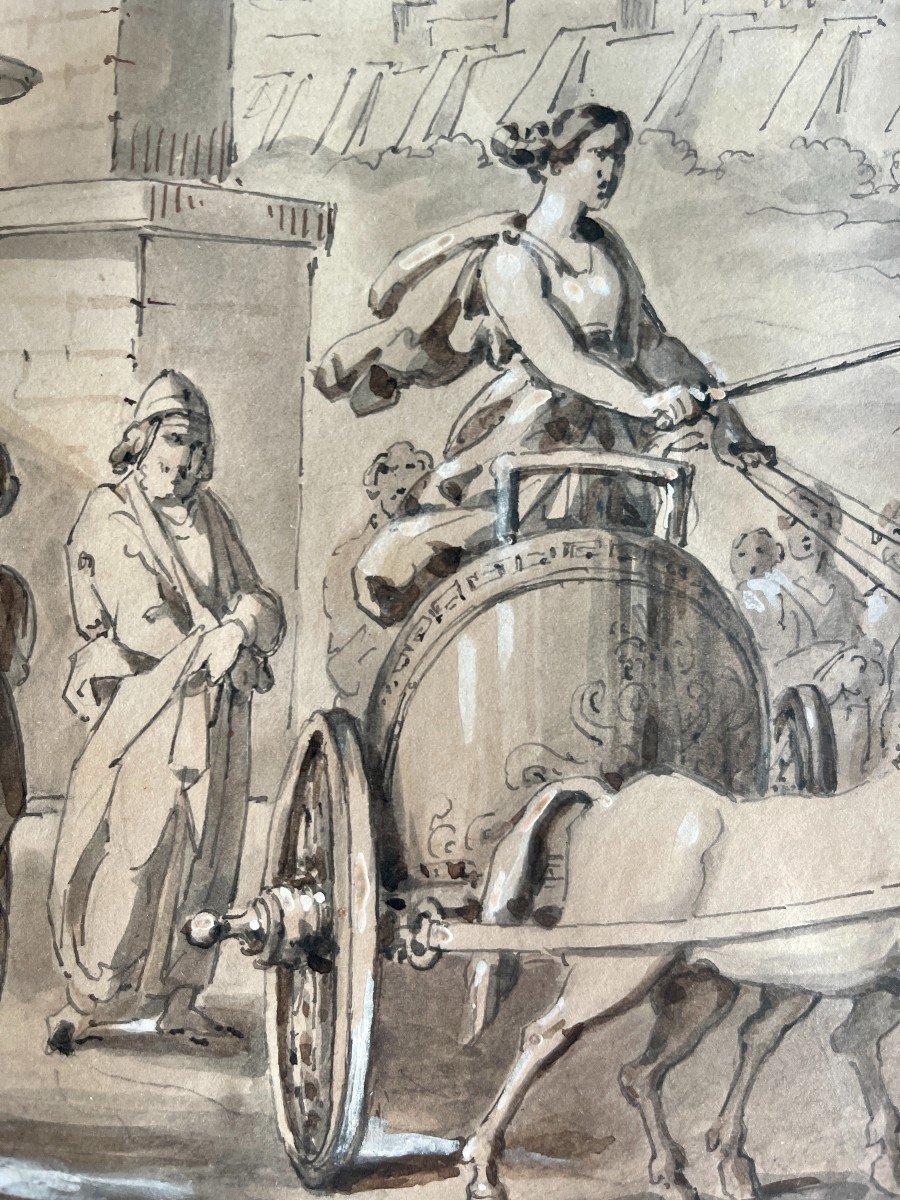
In the center, Nausicaa dominates the composition from her elegant ancient chariot, drawn by two richly harnessed horses.
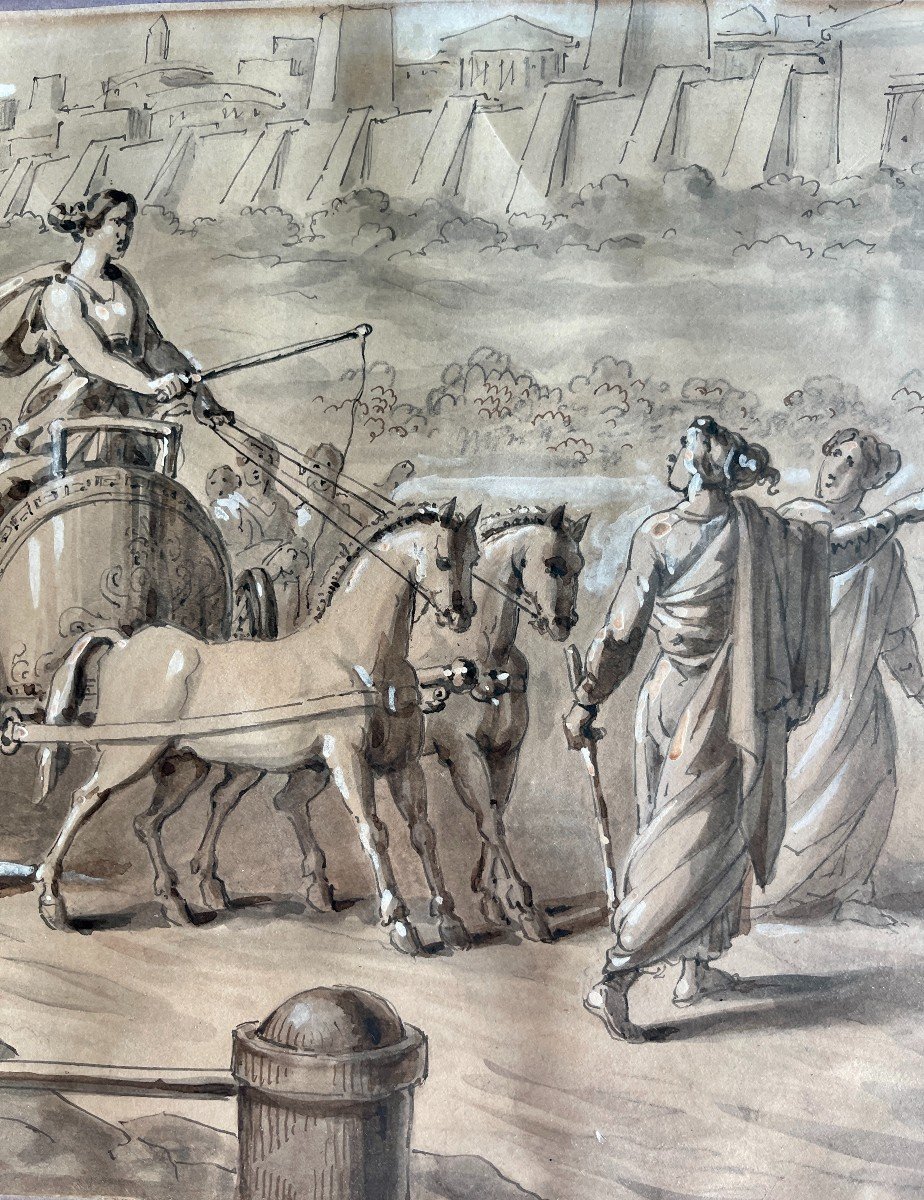
On the right, two figures welcome the traveler, their gestures naturally leading the eye toward the princess.
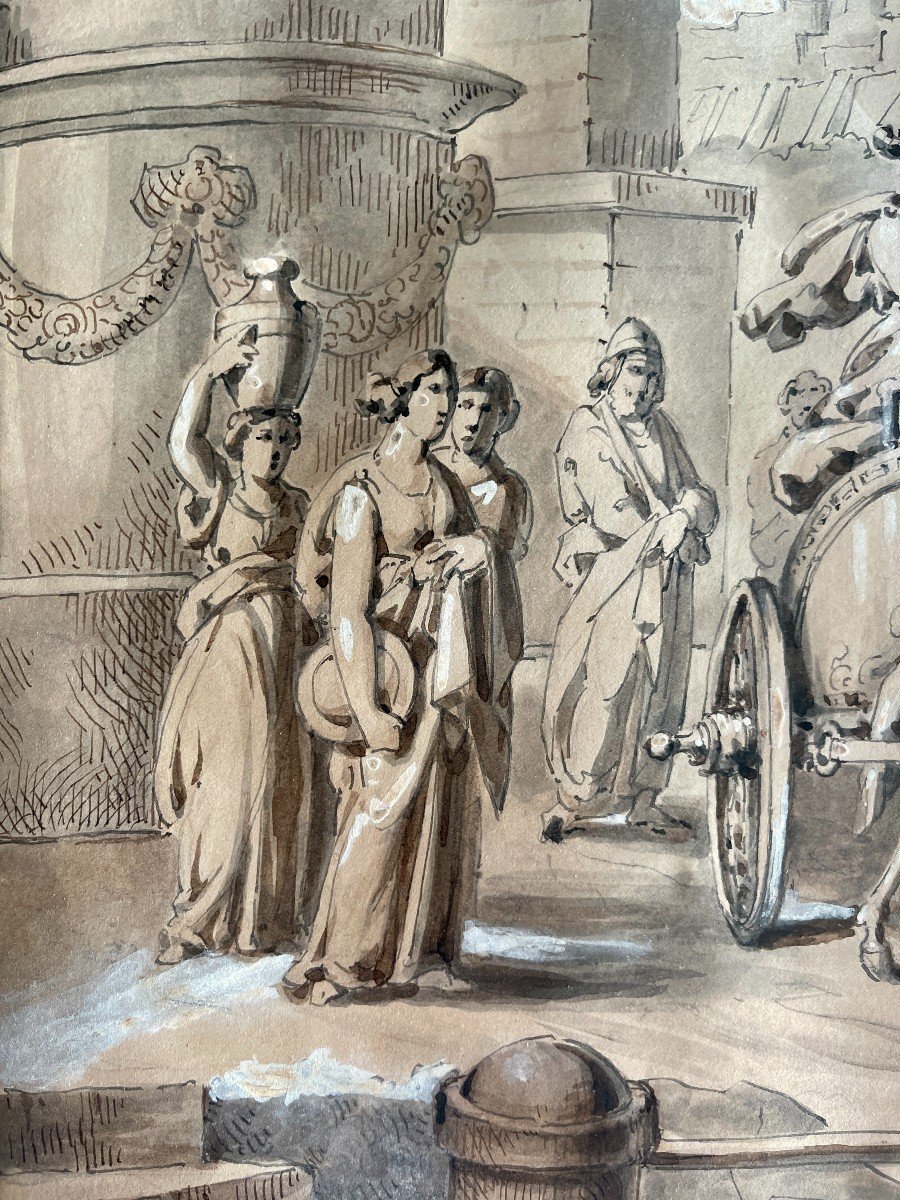
On the left, several young women accompany the procession; some carry amphorae or other items, evoking their return from the river where they had been washing laundry—an episode that immediately precedes this one in the Homeric narrative.
In the background appears a vast, idealized city surrounded by mighty walls, representing Scheria in the architectural style of the Roman Neoclassical taste.
The work presents an exceptionally balanced composition, featuring an interplay of diagonal lines, the movement of drapery, and monumental forms. Stylistic Analysis
The drawing demonstrates perfect academic mastery.
The penwork is lively, precise, and highly confident.
The brown wash subtly modulates the forms through delicate, transparent transitions ranging from warm gray to deeper browns.
White gouache highlights are used sparingly to accentuate:
flesh tones
folds in the drapery
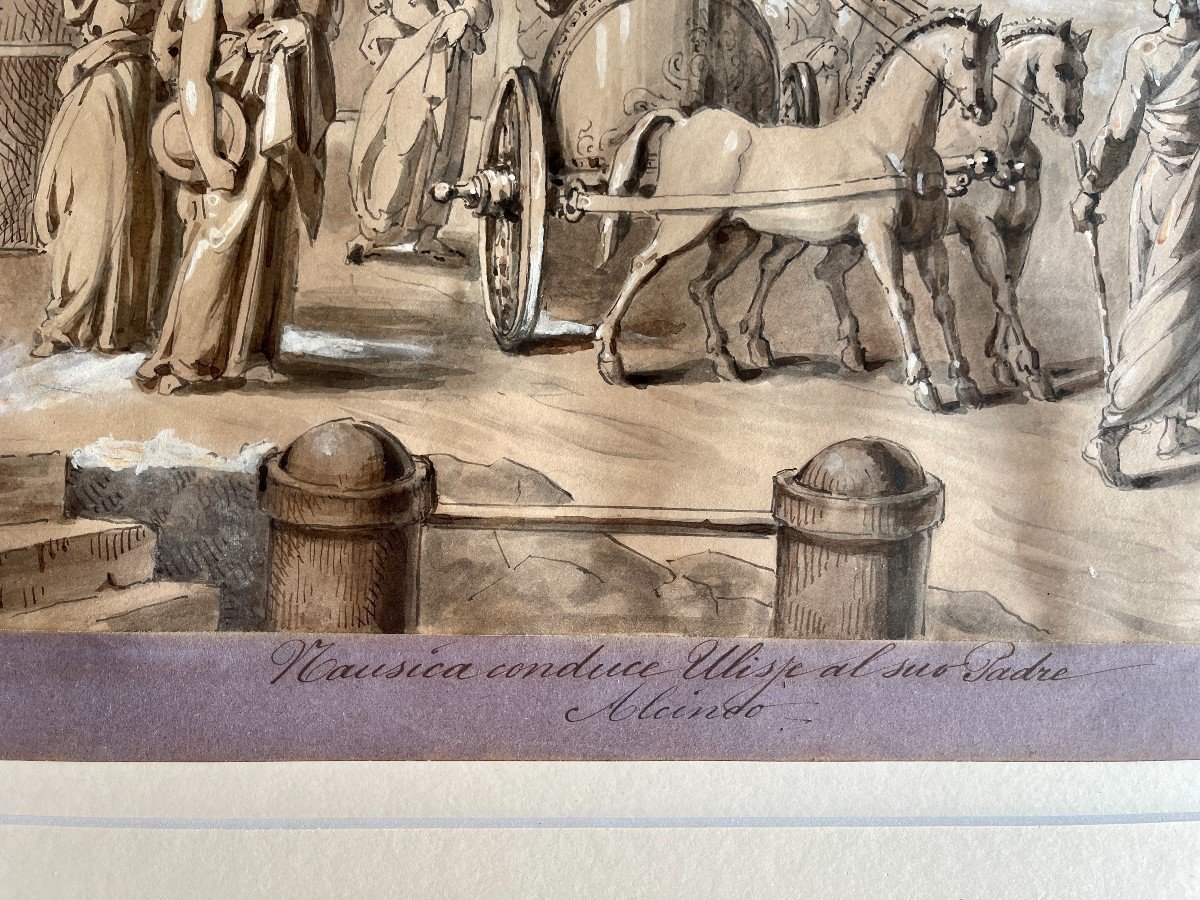
highlights on the horses
edges of the chariot
certain architectural elements
This technique is characteristic of the great Roman workshops of the 18th century, where drawing formed the very foundation of artistic creation.
Light enters from the left, admirably structuring the space.
The modeling recalls preparatory drawings intended for large-scale painted decorations or engravings illustrating ancient texts.
A composition rooted in the *Grand Goût*
The entire composition reflects the emerging Neoclassical style.
The figures derive their gestures directly from ancient sculpture:
elegant *contrapposto*
drapery inspired by Greek marble statues
noble poses
a clearly legible hierarchy of figures
Nausicaa’s chariot serves as the scene's true visual focal point.
The horses are rendered with remarkable attention to detail.
The cityscape, deliberately idealized, evokes the dream-like ancient Rome of the 18th century rather than the Scheria of Homer’s epic.
This kind of transposition is typical of Roman artists of the period.
Historical Note
The subject is drawn from Books VI and VII of Homer’s *Odyssey*.
After leaving Calypso’s island, Odysseus is shipwrecked on the coast of Scheria.
Nausicaa, daughter of King Alcinous and Queen Arete, discovers the exhausted hero.
Displaying exemplary hospitality—a fundamental value of ancient Greek civilization—she leads him to the royal palace, where Alcinous will hear the tale of his adventures before providing a ship to take him back to Ithaca.
This episode represents one of the poetic highlights of the entire *Odyssey*. He embodies:
benevolence
divine protection
sacred hospitality
the passage between trials and the return.
Attribution
This sheet can be linked to the output of Roman workshops active between 1750 and 1780.
Several characteristics support this attribution:
a highly structured, academic drawing style
a taste for the Antique
architecture inspired by Roman monuments
sculptural treatment of the figures
highly refined brown wash
classical use of white highlights
It brings to mind, in particular, the circles of:
Pompeo Batoni
Domenico Corvi
Stefano Pozzi
Gavin Hamilton
Anton Raphael Mengs (entourage)
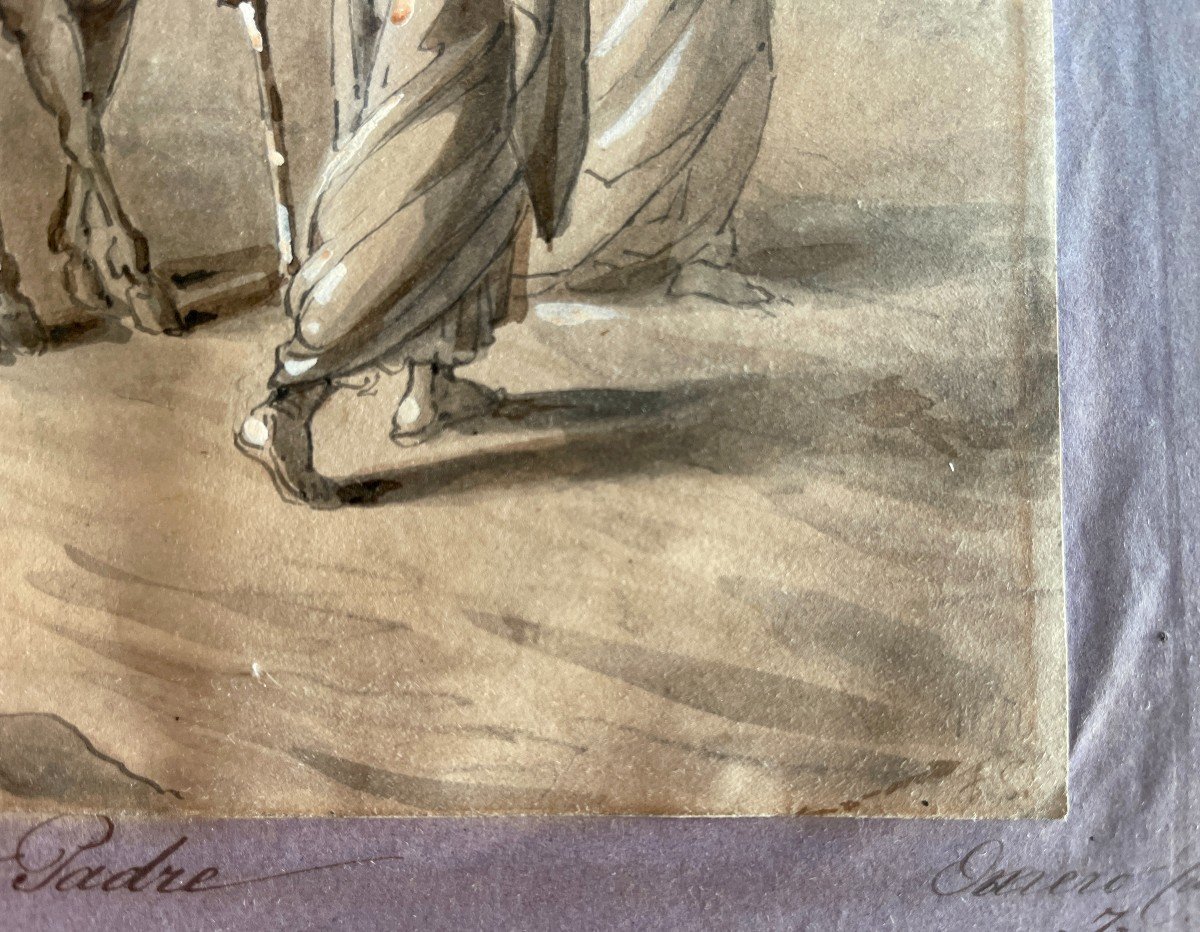
In the absence of a fully legible signature, a cautious attribution to an 18th-century Roman school remains the most rigorous approach today.
The partially visible monogram warrants examination under raking, infrared, or ultraviolet light to clarify its reading.
Comparisons
This work belongs to the great tradition of Italian drawings illustrating Homer, examples of which are held in collections such as:
the Louvre’s Department of Prints and Drawings
the Uffizi Galleries in Florence
the British Museum
the Royal Collection
the Morgan Library in New York
It recalls several compositions executed within the circle of Pompeo Batoni as well as...
It is reminiscent of various compositions associated with Pompeo Batoni, as well as preparatory drawings for Neoclassical decorative schemes created in Rome during the second half of the 18th century.
Condition
Excellent condition.
The paper is remarkably fresh.
No significant foxing.
No tears.
No visible restoration.
The washes have retained their full transparency.
The white highlights remain particularly luminous.
The drawing is presented in an elegant period mount that perfectly showcases the sheet.
Artistic Significance
This work possesses several highly sought-after qualities:
a rare subject drawn directly from Homer
superb graphic quality
remarkable state of preservation
Roman stylistic origins
excellent compositional clarity
refined academic execution
an early Latin inscription that enhances its documentary value.
It will appeal equally to connoisseurs of Old Master drawings and collectors of Classical iconography or Homeric subjects.
#EcoleRomaine #XVIIIeSiecle #AncientDrawing #OldMasterDrawing #ItalianDrawing #RomanSchool #Neoclassicism #GrandTour #Homer #Odyssey #Nausicaa #Ulysses #Alcinous #GreekMythology #Lavis #InkDrawing #BrownInk #CabinetDesDessins #FineArt #WorksOnPaper #ArtCollector #Proantic #ArteCollection #DessinAncien #ArtItalien
Pen, brown ink wash, and white gouache highlights on paper
Italy, Rome, c. 1750–1780
Drawing dimensions: 31.5 × 23.5 cm
Dimensions with mat: 52 × 37.5 cm
Excellent state of preservation.
Description
A superb Italian academic drawing executed in pen and brown ink wash, enriched with delicate white gouache highlights, depicting one of the most famous episodes from Homer’s *Odyssey*: Nausicaa guiding Ulysses to the palace of her father Alcinous, King of the Phaeacians.
After surviving a shipwreck caused by Poseidon, Ulysses is found on the shores of Scheria by Princess Nausicaa. Moved by his plight, she directs him to the royal palace, where Alcinous will grant him hospitality before his return to Ithaca.
The drawing illustrates the precise moment the hero is introduced to the royal family.
The scene is arranged with remarkable theatrical staging.
In the center, Nausicaa dominates the composition from her elegant ancient chariot, drawn by two richly harnessed horses.
On the right, two figures welcome the traveler, their gestures naturally leading the eye toward the princess.
On the left, several young women accompany the procession; some carry amphorae or other items, evoking their return from the river where they had been washing laundry—an episode that immediately precedes this one in the Homeric narrative.
In the background appears a vast, idealized city surrounded by mighty walls, representing Scheria in the architectural style of the Roman Neoclassical taste.
The work presents an exceptionally balanced composition, featuring an interplay of diagonal lines, the movement of drapery, and monumental forms. Stylistic Analysis
The drawing demonstrates perfect academic mastery.
The penwork is lively, precise, and highly confident.
The brown wash subtly modulates the forms through delicate, transparent transitions ranging from warm gray to deeper browns.
White gouache highlights are used sparingly to accentuate:
flesh tones
folds in the drapery
highlights on the horses
edges of the chariot
certain architectural elements
This technique is characteristic of the great Roman workshops of the 18th century, where drawing formed the very foundation of artistic creation.
Light enters from the left, admirably structuring the space.
The modeling recalls preparatory drawings intended for large-scale painted decorations or engravings illustrating ancient texts.
A composition rooted in the *Grand Goût*
The entire composition reflects the emerging Neoclassical style.
The figures derive their gestures directly from ancient sculpture:
elegant *contrapposto*
drapery inspired by Greek marble statues
noble poses
a clearly legible hierarchy of figures
Nausicaa’s chariot serves as the scene's true visual focal point.
The horses are rendered with remarkable attention to detail.
The cityscape, deliberately idealized, evokes the dream-like ancient Rome of the 18th century rather than the Scheria of Homer’s epic.
This kind of transposition is typical of Roman artists of the period.
Historical Note
The subject is drawn from Books VI and VII of Homer’s *Odyssey*.
After leaving Calypso’s island, Odysseus is shipwrecked on the coast of Scheria.
Nausicaa, daughter of King Alcinous and Queen Arete, discovers the exhausted hero.
Displaying exemplary hospitality—a fundamental value of ancient Greek civilization—she leads him to the royal palace, where Alcinous will hear the tale of his adventures before providing a ship to take him back to Ithaca.
This episode represents one of the poetic highlights of the entire *Odyssey*. He embodies:
benevolence
divine protection
sacred hospitality
the passage between trials and the return.
Attribution
This sheet can be linked to the output of Roman workshops active between 1750 and 1780.
Several characteristics support this attribution:
a highly structured, academic drawing style
a taste for the Antique
architecture inspired by Roman monuments
sculptural treatment of the figures
highly refined brown wash
classical use of white highlights
It brings to mind, in particular, the circles of:
Pompeo Batoni
Domenico Corvi
Stefano Pozzi
Gavin Hamilton
Anton Raphael Mengs (entourage)
In the absence of a fully legible signature, a cautious attribution to an 18th-century Roman school remains the most rigorous approach today.
The partially visible monogram warrants examination under raking, infrared, or ultraviolet light to clarify its reading.
Comparisons
This work belongs to the great tradition of Italian drawings illustrating Homer, examples of which are held in collections such as:
the Louvre’s Department of Prints and Drawings
the Uffizi Galleries in Florence
the British Museum
the Royal Collection
the Morgan Library in New York
It recalls several compositions executed within the circle of Pompeo Batoni as well as...
It is reminiscent of various compositions associated with Pompeo Batoni, as well as preparatory drawings for Neoclassical decorative schemes created in Rome during the second half of the 18th century.
Condition
Excellent condition.
The paper is remarkably fresh.
No significant foxing.
No tears.
No visible restoration.
The washes have retained their full transparency.
The white highlights remain particularly luminous.
The drawing is presented in an elegant period mount that perfectly showcases the sheet.
Artistic Significance
This work possesses several highly sought-after qualities:
a rare subject drawn directly from Homer
superb graphic quality
remarkable state of preservation
Roman stylistic origins
excellent compositional clarity
refined academic execution
an early Latin inscription that enhances its documentary value.
It will appeal equally to connoisseurs of Old Master drawings and collectors of Classical iconography or Homeric subjects.
#EcoleRomaine #XVIIIeSiecle #AncientDrawing #OldMasterDrawing #ItalianDrawing #RomanSchool #Neoclassicism #GrandTour #Homer #Odyssey #Nausicaa #Ulysses #Alcinous #GreekMythology #Lavis #InkDrawing #BrownInk #CabinetDesDessins #FineArt #WorksOnPaper #ArtCollector #Proantic #ArteCollection #DessinAncien #ArtItalien
1 980 €
Period: 18th century
Style: Rome and Antic Greece
Condition: Good condition
Material: Paper
Width: 52 cm
Height: 23,5 cm
Reference (ID): 1791882
Availability: In stock
Print