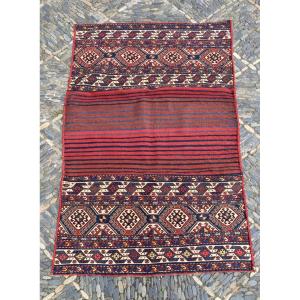
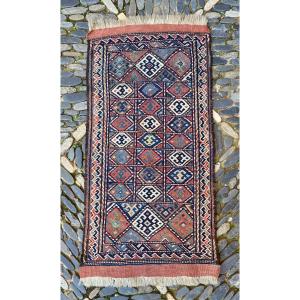
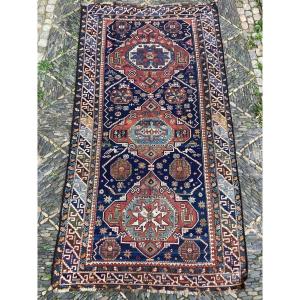
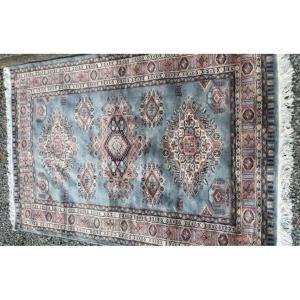
Kuba Carpet, Catalogued. Azerbaijan. Caucasus. Circa 1880. 195 X 135 Cm
This piece is cataloged; see photos.
For Caucasian weavers, blue represented a cosmic element. It went beyond
modern decorative aesthetics and also evoked the depth of twilight in the Caucasus Mountains. This shade recalls the mineral luster of lapis lazuli or the intense blue of ancient ink. In the villages near Shirvan in Azerbaijan, indigo blue held an almost sacred status. It was sometimes said that a rug had to contain deep blue to keep the sky inside the house.
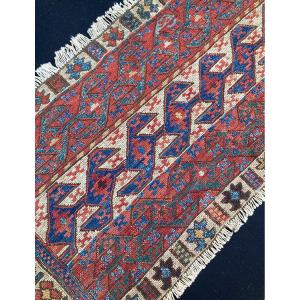
Depth, luminosity, and purity come together to form a strikingly vivid color scheme across the entire central field. The motifs, scattered with extreme precision, appear like constellations of stars—a sort of celestial atlas. Built around two large central motifs in the form of deconstructed crosses and complemented by the same motif divided into two distinct elements on either side, this piece possesses a captivating refinement.
This stylized cross takes on an anthropomorphic form, in which one can also make out the long neck of a bird with its beak curled inward.
To each their own interpretation; however, this powerful symbol, positioned like the four cardinal points, radiates energy and maintains a structural and protective balance across the entire central field.
The narrative vocabulary created by all the other motifs is exceptionally rich. It features numerous rosettes and other floral motifs, scorpions, and even small tarantulas wandering about—four in each cross and four more across the field! A real treat.
Each motif is executed with infinite precision, both in its three-dimensional form and its outlines. Every detail must be seen as irrefutable proof of dazzling dexterity and craftsmanship. You don’t simply describe a piece like this—you immerse yourself in it. My gaze is captivated; I stand before it, my coffee now cold.
The borders featuring diagonal geometric patterns form another continuous protective barrier, flanked on either side by finer borders with floral motifs. It’s magnificent.
The knotted stitch is a work of art; the short pile feels like velvet.
Wool upon wool.
Breathtaking plant-based dyes.
I’ll conclude this piece with another tribute—to my friend Keith; I inevitably think of him. He’s a passionate collector of antique textiles and a discerning connoisseur. It was during one of his trips, some thirty years ago, that he brought this extraordinary piece back with him before entrusting it to me. I mention this also for those who wonder how one goes about collecting pieces as old and precious as these. Surround yourself with the right people!
Circa 1880
Perfect condition
Impeccable borders, backstitched.
Dimensions: 195 x 135 cm
Laurent
Beauty of Kilims
For Caucasian weavers, blue represented a cosmic element. It went beyond
modern decorative aesthetics and also evoked the depth of twilight in the Caucasus Mountains. This shade recalls the mineral luster of lapis lazuli or the intense blue of ancient ink. In the villages near Shirvan in Azerbaijan, indigo blue held an almost sacred status. It was sometimes said that a rug had to contain deep blue to keep the sky inside the house.
Depth, luminosity, and purity come together to form a strikingly vivid color scheme across the entire central field. The motifs, scattered with extreme precision, appear like constellations of stars—a sort of celestial atlas. Built around two large central motifs in the form of deconstructed crosses and complemented by the same motif divided into two distinct elements on either side, this piece possesses a captivating refinement.
This stylized cross takes on an anthropomorphic form, in which one can also make out the long neck of a bird with its beak curled inward.
To each their own interpretation; however, this powerful symbol, positioned like the four cardinal points, radiates energy and maintains a structural and protective balance across the entire central field.
The narrative vocabulary created by all the other motifs is exceptionally rich. It features numerous rosettes and other floral motifs, scorpions, and even small tarantulas wandering about—four in each cross and four more across the field! A real treat.
Each motif is executed with infinite precision, both in its three-dimensional form and its outlines. Every detail must be seen as irrefutable proof of dazzling dexterity and craftsmanship. You don’t simply describe a piece like this—you immerse yourself in it. My gaze is captivated; I stand before it, my coffee now cold.
The borders featuring diagonal geometric patterns form another continuous protective barrier, flanked on either side by finer borders with floral motifs. It’s magnificent.
The knotted stitch is a work of art; the short pile feels like velvet.
Wool upon wool.
Breathtaking plant-based dyes.
I’ll conclude this piece with another tribute—to my friend Keith; I inevitably think of him. He’s a passionate collector of antique textiles and a discerning connoisseur. It was during one of his trips, some thirty years ago, that he brought this extraordinary piece back with him before entrusting it to me. I mention this also for those who wonder how one goes about collecting pieces as old and precious as these. Surround yourself with the right people!
Circa 1880
Perfect condition
Impeccable borders, backstitched.
Dimensions: 195 x 135 cm
Laurent
Beauty of Kilims
3 400 €
Period: 19th century
Style: Orientalism
Condition: Perfect condition
Material: Wool
Length: 195 cm
Width: 135 cm
Reference (ID): 1781271
Availability: In stock
Print