

Antique Silver Reliquary With Relics Of Jesuit Founders, 19th-20th Century
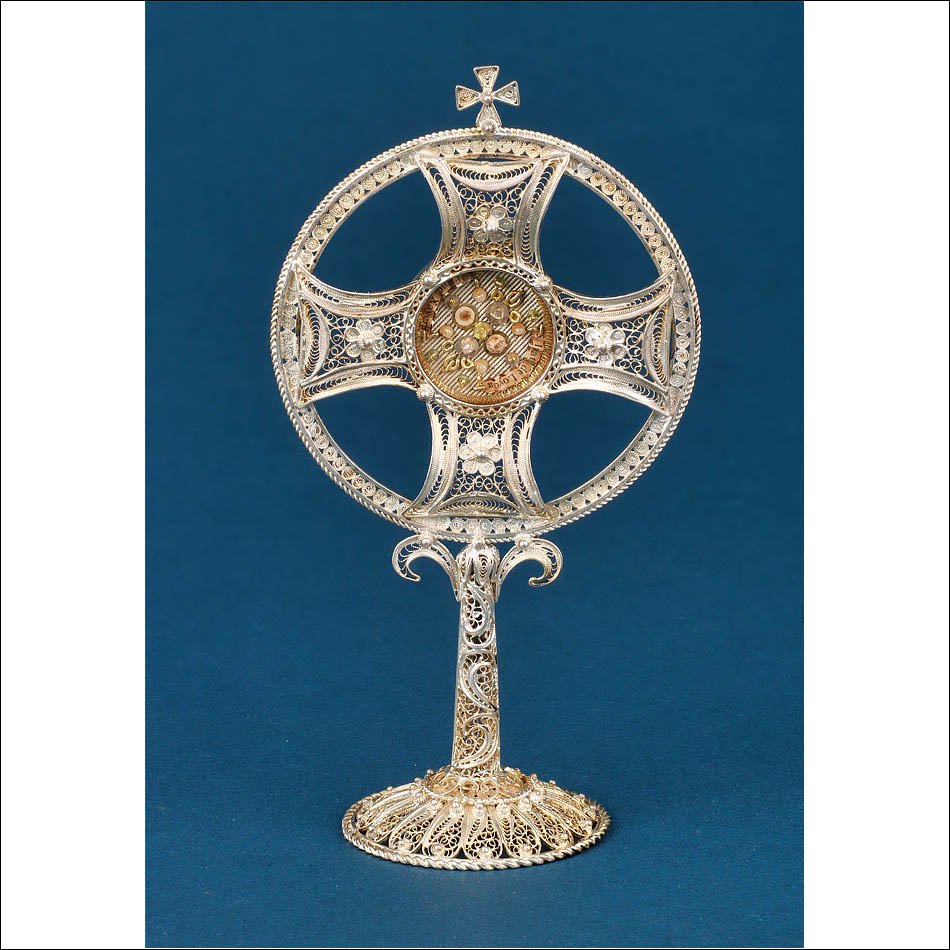
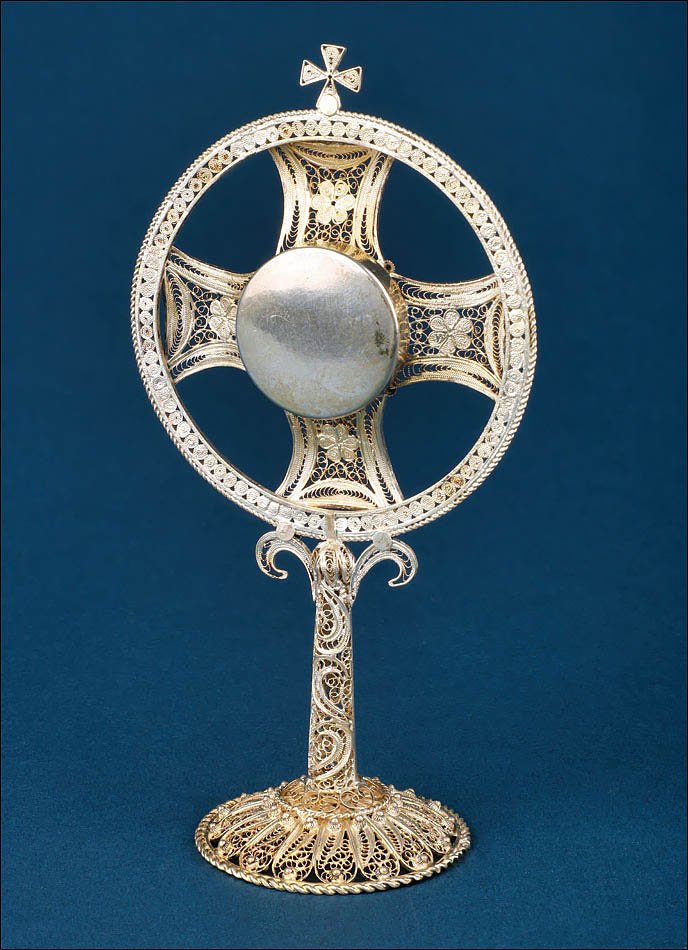
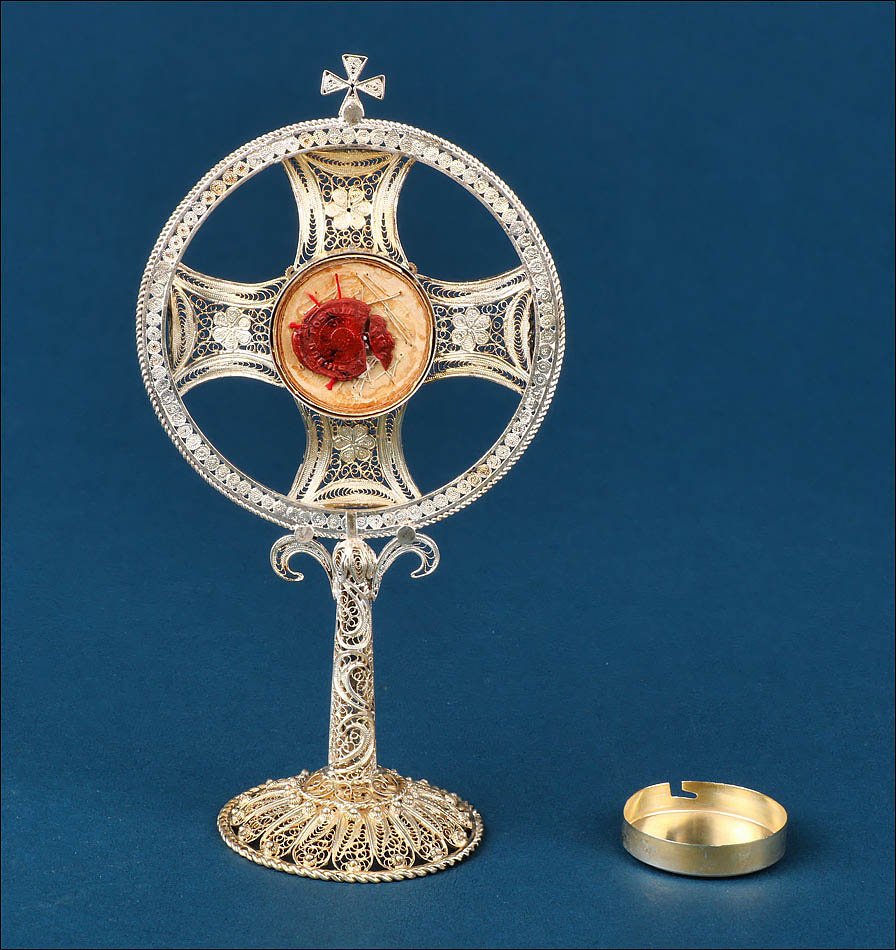
Beautiful antique reliquary, from the late 19th or early 20th century, made in silver filigree and conceived as a table piece, with a silhouette that clearly recalls small devotional monstrances or ostensoriums. It is a reliquary with very airy and light lines, but at the same time with a magnificent presence, thanks to the richness of the filigree work and the beautiful balance between the base, the stem and the large upper circular surround. The whole piece conveys that very special charm of the most delicate religious silverwork.
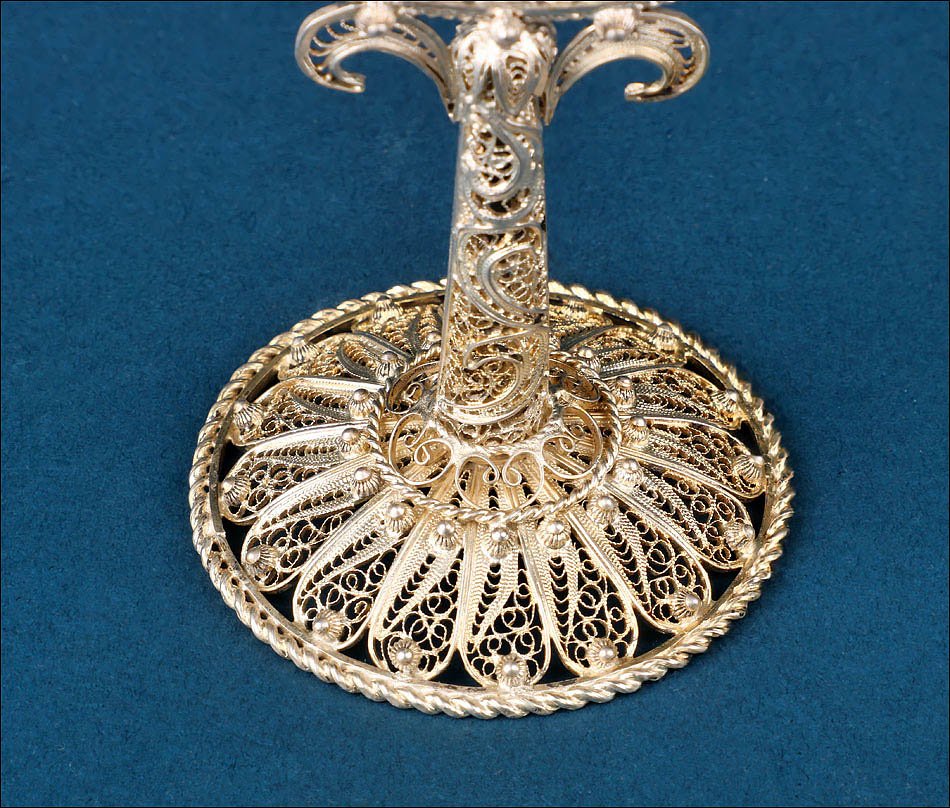
The base is wide and stable, opening like a fan of filigree, with a twisted rope border that finishes the whole very well. The stem, slender and also openwork, connects with the upper part through very elegant scrolls that give movement to the piece without overloading it. The large circular surround is formed by an outer frame of fine and regular filigree, within which there is a cross with broad arms, also worked with silver threads and small floral motifs. The upper finial is formed by a small cross that closes the composition with grace and lightness.
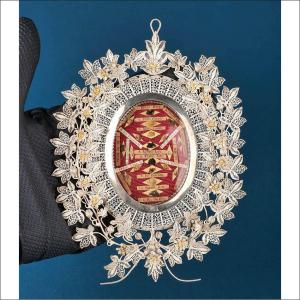
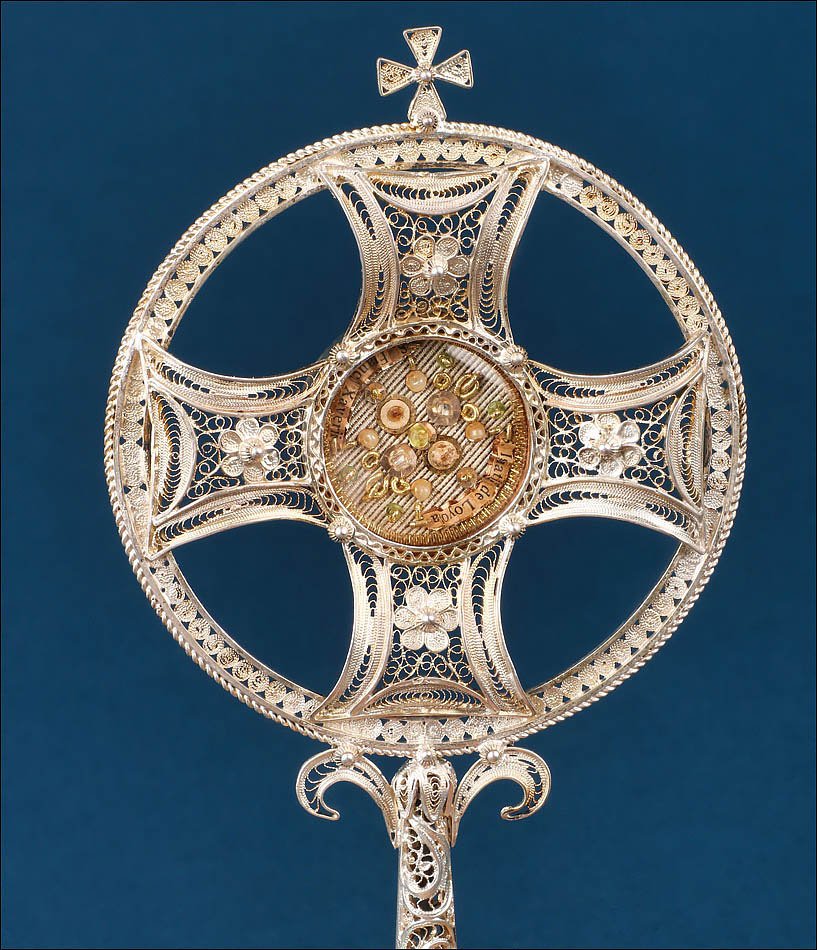
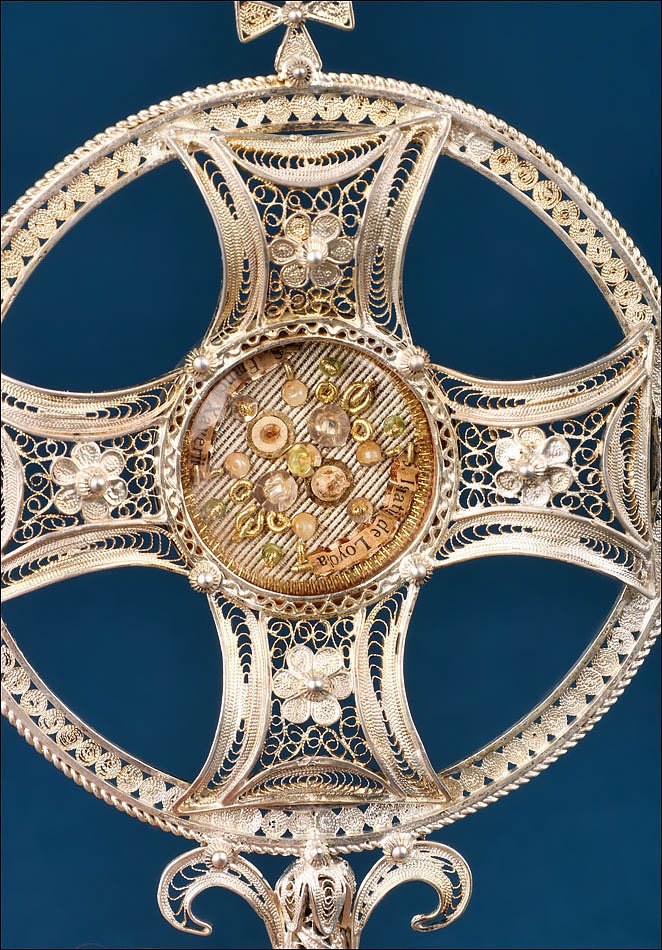
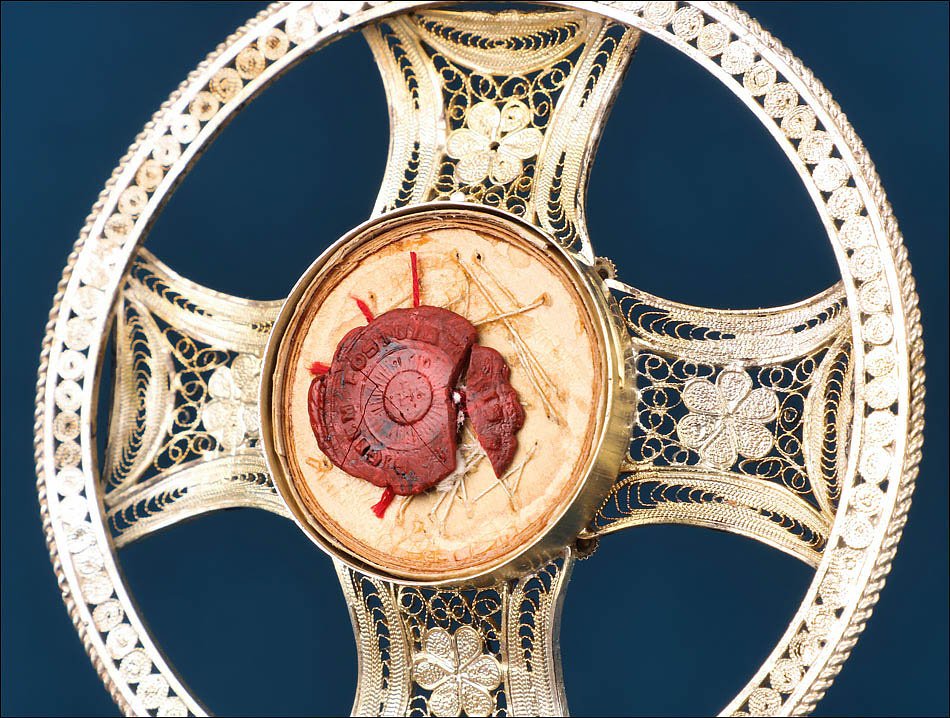
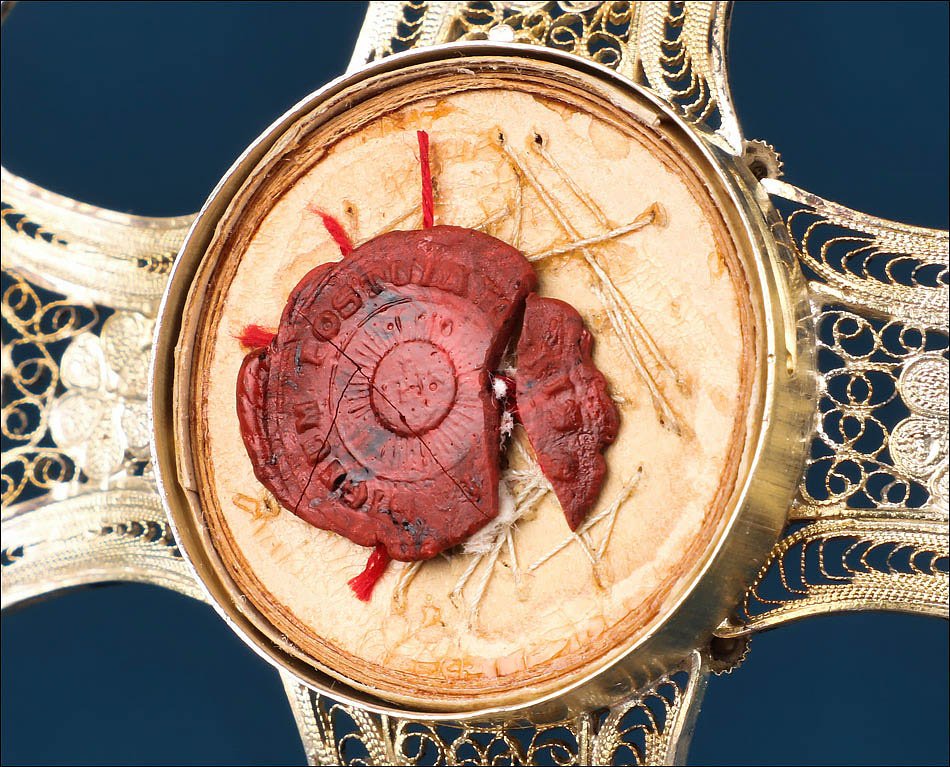
In the centre appears the lunette with the relics, protected on the front by glass. The interior presentation is especially attractive, with a textile background, small ornamental elements and two relics identified by their corresponding labels. One of them can be read as S. Ignatii de Loyola, that is, Saint Ignatius of Loyola. The other seems to correspond to S. Francisci Xavierii, the Latin abbreviation of Saint Francis Xavier. The association of both relics is very interesting, as they belong to the founder of the Society of Jesus and to one of his most famous and universal companions.
Saint Ignatius of Loyola and Saint Francis Xavier are two of the most important figures of 16th-century Catholic spirituality and of the Society of Jesus. Ignatius, a former soldier converted after his wound at Pamplona, founded the Jesuit order and left a profound mark with his Spiritual Exercises. Francis Xavier, one of his first companions, took the Christian mission to India, Southeast Asia and Japan, becoming one of the great missionary saints of the Church. Both were canonized in 1622 and represent the spiritual, intellectual and evangelizing strength of the Jesuit world.
The rear cover can be removed to access the reverse of the lunette, where the wax seal and the fastening threads are preserved. This detail very importantly reinforces the devotional and material interest of the piece, because it shows a certified and sealed relic. It should be noted, however, that although the cover can be removed, the relic cannot be freely taken out of the reliquary, since the sealing threads themselves keep it attached to the whole. The state of conservation is very good. The piece appears to have originally been gilt silver or partially gilt silver, now very worn, so that it presents a predominantly silver tone with a very pleasant slight yellowish nuance.
A very special reliquary, not only because of the light beauty of its silver filigree, but also because of the spiritual strength of the relics it preserves. The joint presence of Saint Ignatius of Loyola and Saint Francis Xavier gives it a deeply Jesuit meaning, ideal for anyone looking for an antique piece with true devotional content, beauty and religious meaning.
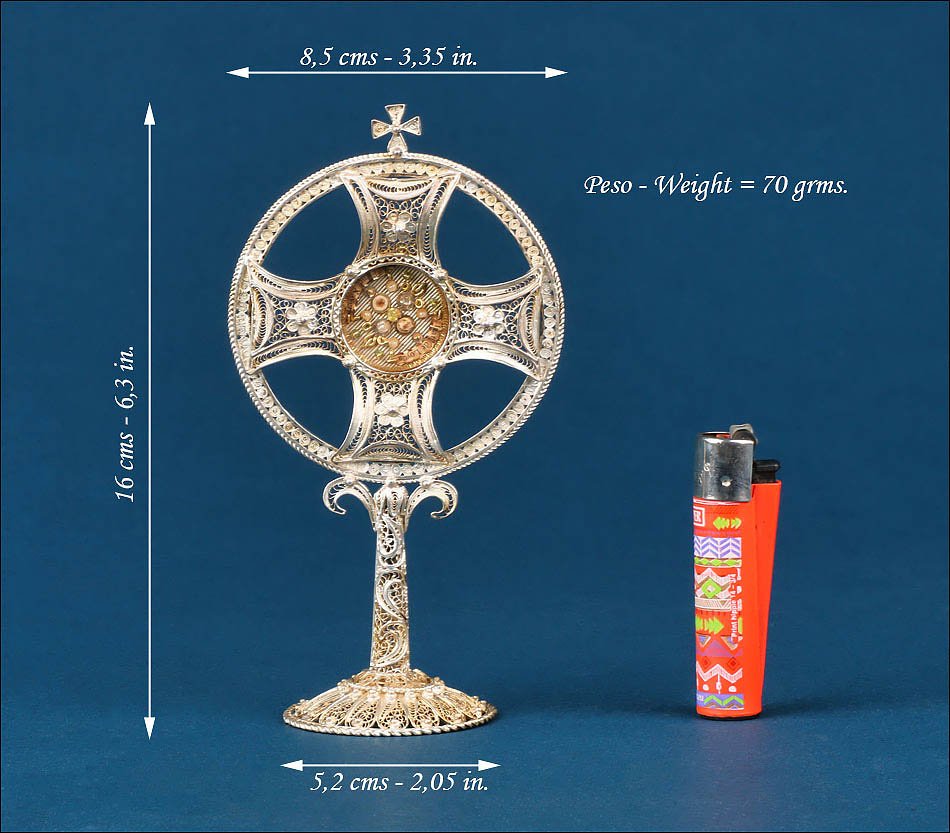
Measurements: Total height: 16 cm (6.30 in). Diameter of the upper part: 8.5 cm (3.35 in). Diameter of the base: 5.2 cm (2.05 in).
History of Saint Ignatius of Loyola and Saint Francis Xavier
Saint Ignatius of Loyola (1491-1556), born in Azpeitia, in the Basque Country, belonged to a noble family and spent his youth as a man-at-arms and courtier in the service of different lords. Educated in the chivalric ideal of his time, he led for years a military and worldly life, marked by a taste for arms, honour and courtly life.
His participation in the defence of Pamplona against the French troops in 1521 radically changed his destiny. During the siege, a cannonball gravely wounded his right leg and also damaged the other, forcing him into a long and painful convalescence in the family castle of Loyola. There, as he did not have novels of chivalry available, he read religious works such as the Life of Christ and accounts of saints, an experience that caused in him a profound inner conversion.
From then on, he progressively abandoned military life and directed his whole existence towards spiritual search and service to the Church. After years of pilgrimage, study and discernment, he developed the Spiritual Exercises, one of the fundamental works of Christian spirituality. Later, together with his first companions, among them Saint Francis Xavier and Peter Faber, he founded in 1540 the Society of Jesus, approved by Pope Paul III.
Saint Ignatius died in Rome in 1556. He was canonized in 1622 and his figure continues to be essential for Jesuit spirituality and for a very important part of the intellectual, educational and missionary life of the modern Catholic Church.
Saint Francis Xavier (1506-1552), a native of Navarre and born in the castle of Xavier, belonged to a noble family and studied at the University of Paris, where he met Ignatius of Loyola and joined the group of companions that would eventually found the Society of Jesus. Initially oriented towards an academic career, the spiritual influence of Ignatius profoundly transformed his life and led him to devote himself fully to the evangelizing mission.
After the approval of the Jesuit order in 1540, he was sent to the East and developed an extraordinary missionary activity in Portuguese India and in various territories of Asia. He travelled enormous distances preaching and organizing Christian communities in Goa, Malacca and the Moluccas, becoming one of the great figures of the Catholic missionary expansion of the 16th century.
In 1549 he arrived in Japan, being one of the first Christian missionaries to enter the country, and showed a remarkable ability to adapt to local cultures. His great final objective was to introduce Christianity into China, but he died in 1552 on the island of Shangchuan, off the Chinese coast, while waiting for authorization to enter the empire.
His fame for holiness became linked to that tireless missionary zeal and to his role as a model of evangelization in distant lands. He was also canonized in 1622 and later proclaimed patron saint of missions and of Catholic evangelization.
The base is wide and stable, opening like a fan of filigree, with a twisted rope border that finishes the whole very well. The stem, slender and also openwork, connects with the upper part through very elegant scrolls that give movement to the piece without overloading it. The large circular surround is formed by an outer frame of fine and regular filigree, within which there is a cross with broad arms, also worked with silver threads and small floral motifs. The upper finial is formed by a small cross that closes the composition with grace and lightness.
In the centre appears the lunette with the relics, protected on the front by glass. The interior presentation is especially attractive, with a textile background, small ornamental elements and two relics identified by their corresponding labels. One of them can be read as S. Ignatii de Loyola, that is, Saint Ignatius of Loyola. The other seems to correspond to S. Francisci Xavierii, the Latin abbreviation of Saint Francis Xavier. The association of both relics is very interesting, as they belong to the founder of the Society of Jesus and to one of his most famous and universal companions.
Saint Ignatius of Loyola and Saint Francis Xavier are two of the most important figures of 16th-century Catholic spirituality and of the Society of Jesus. Ignatius, a former soldier converted after his wound at Pamplona, founded the Jesuit order and left a profound mark with his Spiritual Exercises. Francis Xavier, one of his first companions, took the Christian mission to India, Southeast Asia and Japan, becoming one of the great missionary saints of the Church. Both were canonized in 1622 and represent the spiritual, intellectual and evangelizing strength of the Jesuit world.
The rear cover can be removed to access the reverse of the lunette, where the wax seal and the fastening threads are preserved. This detail very importantly reinforces the devotional and material interest of the piece, because it shows a certified and sealed relic. It should be noted, however, that although the cover can be removed, the relic cannot be freely taken out of the reliquary, since the sealing threads themselves keep it attached to the whole. The state of conservation is very good. The piece appears to have originally been gilt silver or partially gilt silver, now very worn, so that it presents a predominantly silver tone with a very pleasant slight yellowish nuance.
A very special reliquary, not only because of the light beauty of its silver filigree, but also because of the spiritual strength of the relics it preserves. The joint presence of Saint Ignatius of Loyola and Saint Francis Xavier gives it a deeply Jesuit meaning, ideal for anyone looking for an antique piece with true devotional content, beauty and religious meaning.
Measurements: Total height: 16 cm (6.30 in). Diameter of the upper part: 8.5 cm (3.35 in). Diameter of the base: 5.2 cm (2.05 in).
History of Saint Ignatius of Loyola and Saint Francis Xavier
Saint Ignatius of Loyola (1491-1556), born in Azpeitia, in the Basque Country, belonged to a noble family and spent his youth as a man-at-arms and courtier in the service of different lords. Educated in the chivalric ideal of his time, he led for years a military and worldly life, marked by a taste for arms, honour and courtly life.
His participation in the defence of Pamplona against the French troops in 1521 radically changed his destiny. During the siege, a cannonball gravely wounded his right leg and also damaged the other, forcing him into a long and painful convalescence in the family castle of Loyola. There, as he did not have novels of chivalry available, he read religious works such as the Life of Christ and accounts of saints, an experience that caused in him a profound inner conversion.
From then on, he progressively abandoned military life and directed his whole existence towards spiritual search and service to the Church. After years of pilgrimage, study and discernment, he developed the Spiritual Exercises, one of the fundamental works of Christian spirituality. Later, together with his first companions, among them Saint Francis Xavier and Peter Faber, he founded in 1540 the Society of Jesus, approved by Pope Paul III.
Saint Ignatius died in Rome in 1556. He was canonized in 1622 and his figure continues to be essential for Jesuit spirituality and for a very important part of the intellectual, educational and missionary life of the modern Catholic Church.
Saint Francis Xavier (1506-1552), a native of Navarre and born in the castle of Xavier, belonged to a noble family and studied at the University of Paris, where he met Ignatius of Loyola and joined the group of companions that would eventually found the Society of Jesus. Initially oriented towards an academic career, the spiritual influence of Ignatius profoundly transformed his life and led him to devote himself fully to the evangelizing mission.
After the approval of the Jesuit order in 1540, he was sent to the East and developed an extraordinary missionary activity in Portuguese India and in various territories of Asia. He travelled enormous distances preaching and organizing Christian communities in Goa, Malacca and the Moluccas, becoming one of the great figures of the Catholic missionary expansion of the 16th century.
In 1549 he arrived in Japan, being one of the first Christian missionaries to enter the country, and showed a remarkable ability to adapt to local cultures. His great final objective was to introduce Christianity into China, but he died in 1552 on the island of Shangchuan, off the Chinese coast, while waiting for authorization to enter the empire.
His fame for holiness became linked to that tireless missionary zeal and to his role as a model of evangelization in distant lands. He was also canonized in 1622 and later proclaimed patron saint of missions and of Catholic evangelization.
1 000 €
Period: 19th century
Style: Other Style
Condition: Good condition
Material: Sterling silver
Reference (ID): 1780356
Availability: In stock
Print