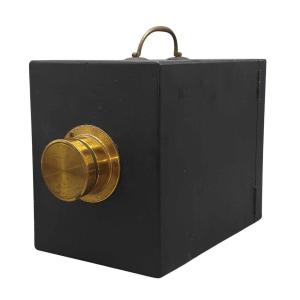
Antique Folding Camera C.p. Goerz Roll-tenax, Germany 1910–1922
The C.P. Goerz Roll-Tenax is a true gem of German engineering created before the merger with Zeiss Ikon. It is an elegant and compact folding camera of impeccable technical quality. Manufactured between 1909 and 1922 in Berlin, this model was designed for 127 film in 4×6.5 cm format and served as a refined alternative to the Kodak Vest Pocket cameras of the same period. Its metal body covered with embossed black leather exudes solidity and distinction, while the embossed inscriptions “GOERZ” and “TENAX” highlight its historical identity.
It is equipped with a C.P. Goerz Tenastigmat f/6.8 7.5 cm lens and a precision Compur shutter (DRP No. 258646). The camera still offers remarkable optical and mechanical performance even more than a century after its manufacture. The lens retains its original transparency, free of fungus or haze, and the shutter mechanism operates smoothly at all speeds. Its folding top viewfinder still preserves the original glass, and the black leather bellows remain completely intact with no cracks or holes. The red rear window for exposure control is still present, a detail that many surviving examples have lost over time, underlining this camera’s excellent preservation.
Its ergonomics and design were ahead of their time. Light, precise, and designed for the traveler who wanted to obtain sharp images without carrying large studio cameras. The Roll-Tenax represented a perfect balance between portability and optical quality, used by both amateur photographers and professionals who appreciated the sharpness of the Tenastigmat and the reliability of the Compur shutter.
This example is mechanically functional, although untested with film, and preserves both the purity of its original lines and the sober character typical of Berlin optical instruments from before the Zeiss merger. Its presence in a display case is striking. A piece that perfectly embodies the essence of early 20th century German camera design.
It is undoubtedly an ideal camera for any serious collection of historical photography or as a decorative object in a vintage office or studio. Its excellent preservation and authenticity make it an exceptional opportunity for lovers of classic photography.
A piece that fascinates not only for its appearance but also for its story. Every screw, every texture of the leather, and every engraving evoke the artisanal precision of a workshop that set optical standards before the Zeiss era. It deserves a prominent place both in a collector’s cabinet and in the memory of those who value the mechanical art of the past.
Dimensions: 13 cm × 6.8 cm (5.12 in × 2.68 in).
History of Goerz
The company C.P. Goerz A.G., founded in Berlin in 1886 by Carl Paul Goerz, was one of the most prestigious optical and photographic firms in Europe before being absorbed by the Zeiss Ikon consortium in 1926. Goerz began by manufacturing optical accessories and cameras for scientific education but soon gained renown for the excellence of its photographic lenses, especially the Dagor line (Double Anastigmat Goerz), considered among the sharpest of its time.
During the 1900s and 1910s Goerz established itself as a leader in portable precision cameras. The Tenax series appeared around 1909 as the German response to the growing demand for compact folding cameras, offering robust bodies, high-quality anastigmatic lenses, and precision shutters such as the Compur by Friedrich Deckel of Munich.
The Roll-Tenax, contemporary with the Kodak Vest Pocket, was designed for the modern photographer of the 1910s, portable, elegant, and technically advanced. The precision of its Tenastigmat f/6.8 lens combined with the Compur shutter made it a reliable tool for both portraits and landscapes.
After World War I, Goerz remained independent for a few more years until it finally merged into Zeiss Ikon A.G. along with Ernemann, Ica, and Contessa-Nettel. Its legacy continued in later camera designs and in the optical quality that defined Zeiss throughout the 20th century. We are professional antique dealers. To see more photos of this item, Please click on this link:
https://www.antiguedades.es/en/antique-cameras/5338-antique-folding-camera-cp-goerz-roll-tenax-germany-19101922.html
It is equipped with a C.P. Goerz Tenastigmat f/6.8 7.5 cm lens and a precision Compur shutter (DRP No. 258646). The camera still offers remarkable optical and mechanical performance even more than a century after its manufacture. The lens retains its original transparency, free of fungus or haze, and the shutter mechanism operates smoothly at all speeds. Its folding top viewfinder still preserves the original glass, and the black leather bellows remain completely intact with no cracks or holes. The red rear window for exposure control is still present, a detail that many surviving examples have lost over time, underlining this camera’s excellent preservation.
Its ergonomics and design were ahead of their time. Light, precise, and designed for the traveler who wanted to obtain sharp images without carrying large studio cameras. The Roll-Tenax represented a perfect balance between portability and optical quality, used by both amateur photographers and professionals who appreciated the sharpness of the Tenastigmat and the reliability of the Compur shutter.
This example is mechanically functional, although untested with film, and preserves both the purity of its original lines and the sober character typical of Berlin optical instruments from before the Zeiss merger. Its presence in a display case is striking. A piece that perfectly embodies the essence of early 20th century German camera design.
It is undoubtedly an ideal camera for any serious collection of historical photography or as a decorative object in a vintage office or studio. Its excellent preservation and authenticity make it an exceptional opportunity for lovers of classic photography.
A piece that fascinates not only for its appearance but also for its story. Every screw, every texture of the leather, and every engraving evoke the artisanal precision of a workshop that set optical standards before the Zeiss era. It deserves a prominent place both in a collector’s cabinet and in the memory of those who value the mechanical art of the past.
Dimensions: 13 cm × 6.8 cm (5.12 in × 2.68 in).
History of Goerz
The company C.P. Goerz A.G., founded in Berlin in 1886 by Carl Paul Goerz, was one of the most prestigious optical and photographic firms in Europe before being absorbed by the Zeiss Ikon consortium in 1926. Goerz began by manufacturing optical accessories and cameras for scientific education but soon gained renown for the excellence of its photographic lenses, especially the Dagor line (Double Anastigmat Goerz), considered among the sharpest of its time.
During the 1900s and 1910s Goerz established itself as a leader in portable precision cameras. The Tenax series appeared around 1909 as the German response to the growing demand for compact folding cameras, offering robust bodies, high-quality anastigmatic lenses, and precision shutters such as the Compur by Friedrich Deckel of Munich.
The Roll-Tenax, contemporary with the Kodak Vest Pocket, was designed for the modern photographer of the 1910s, portable, elegant, and technically advanced. The precision of its Tenastigmat f/6.8 lens combined with the Compur shutter made it a reliable tool for both portraits and landscapes.
After World War I, Goerz remained independent for a few more years until it finally merged into Zeiss Ikon A.G. along with Ernemann, Ica, and Contessa-Nettel. Its legacy continued in later camera designs and in the optical quality that defined Zeiss throughout the 20th century. We are professional antique dealers. To see more photos of this item, Please click on this link:
https://www.antiguedades.es/en/antique-cameras/5338-antique-folding-camera-cp-goerz-roll-tenax-germany-19101922.html
270 €
Period: 20th century
Style: Other Style
Condition: Good condition
Length: 6,8 cm (2,68 in)
Height: 13 cm (5,12 in )
Reference (ID): 1657037
Availability: In stock
Print