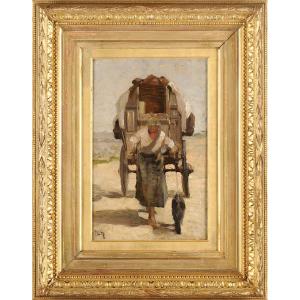


Paul-louis Martin Des Amoignes (1850–1925) The Gypsies
Paul-Louis MARTIN des AMOIGNES
(Saint Benin d’Azy 1850 – Nevers 1925)
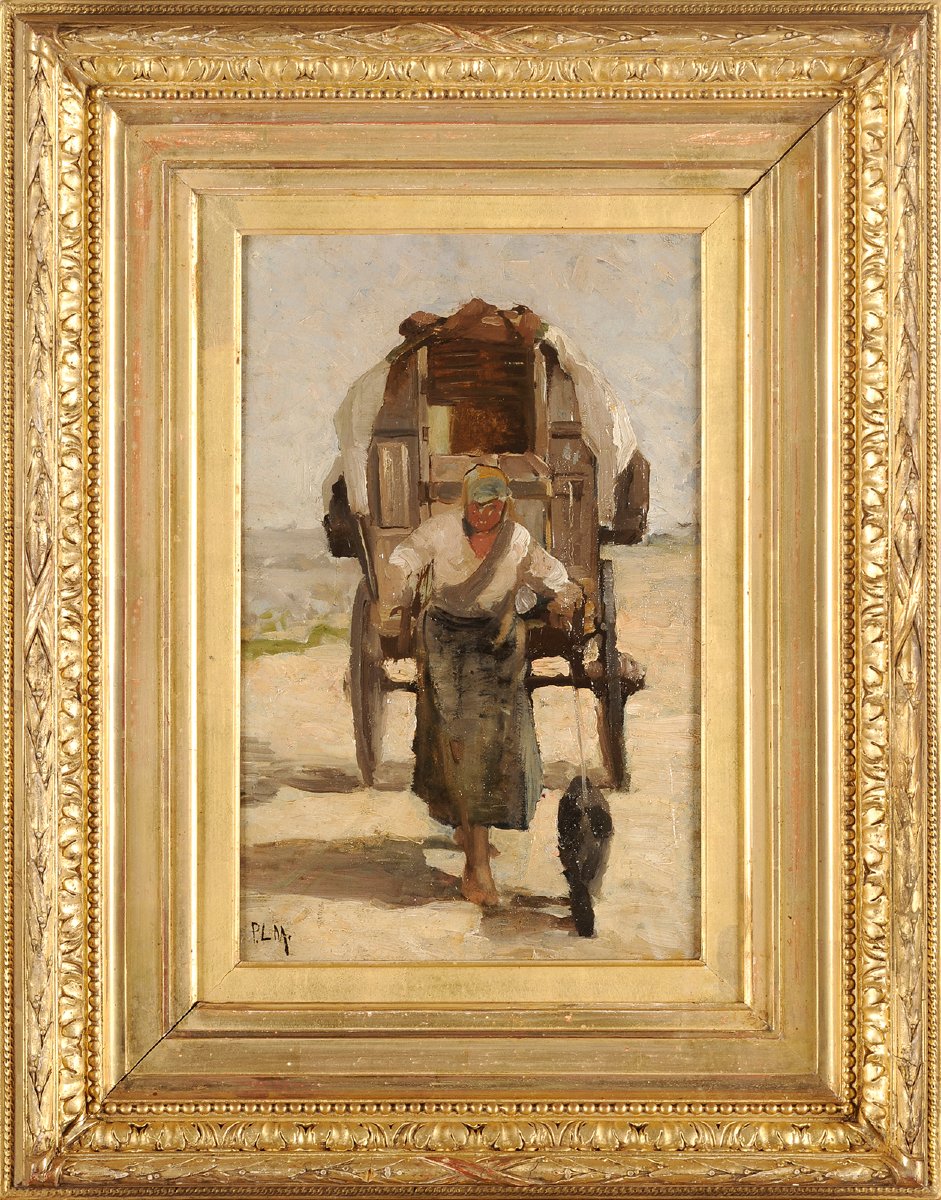
The Gypsies
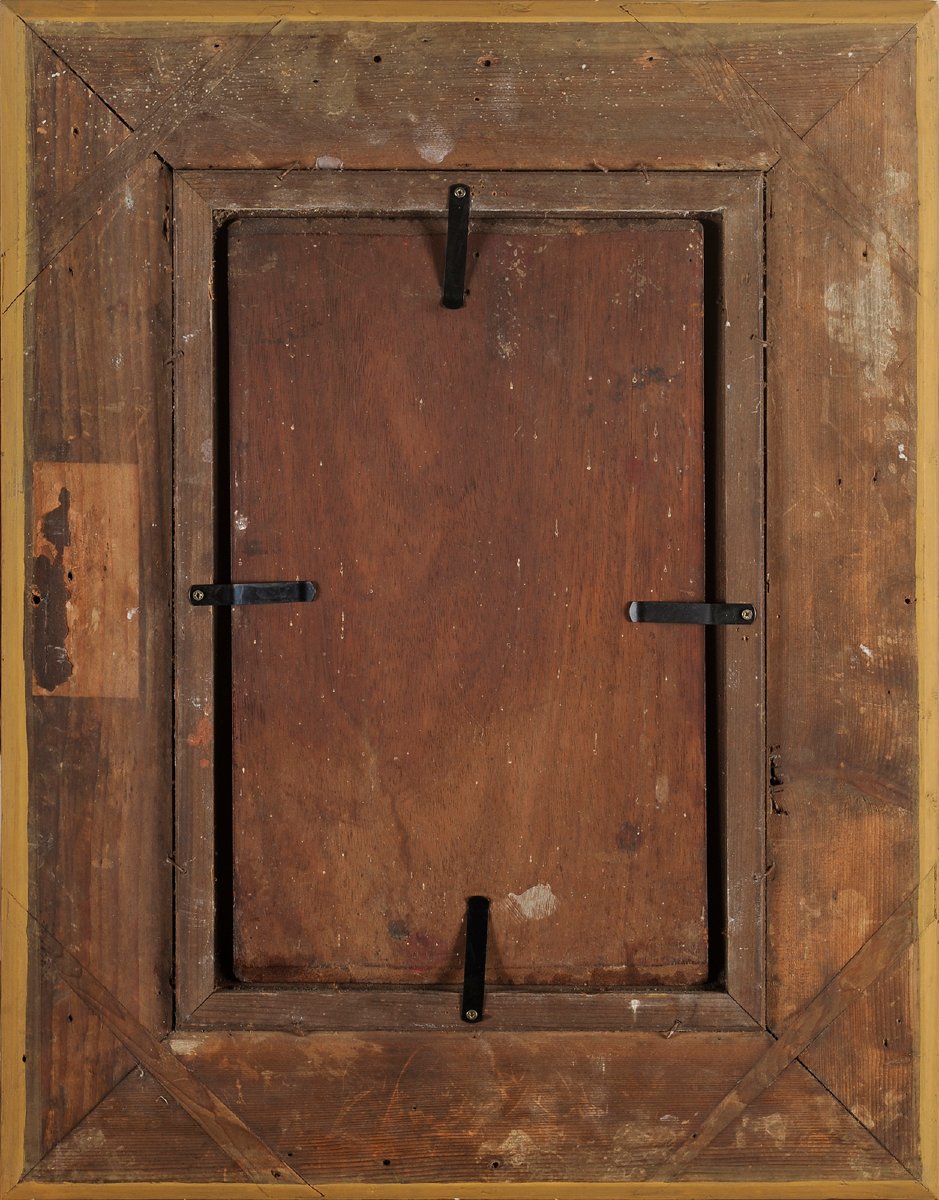
Oil on panel
H. 37 cm; W. 23 cm
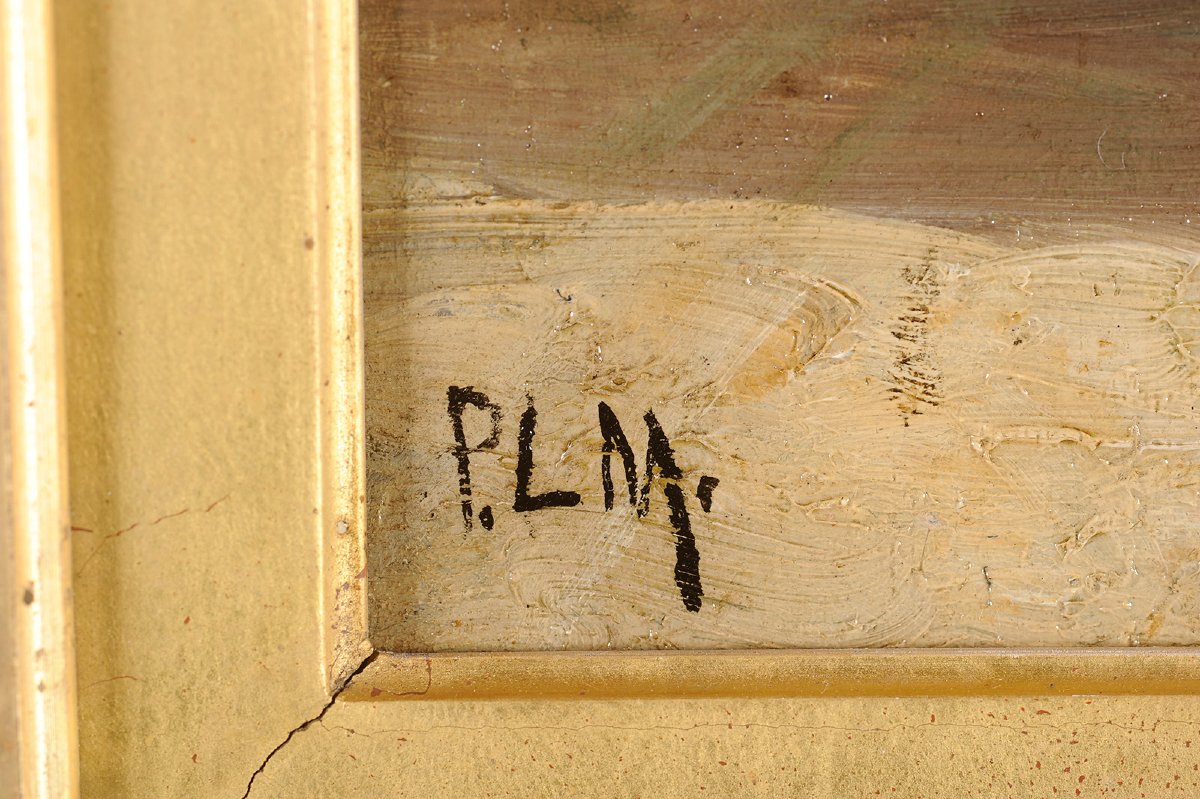
Monogrammed “PLM” in the lower left corner
Circa 1886
Provenance: Private collection, Bordeaux
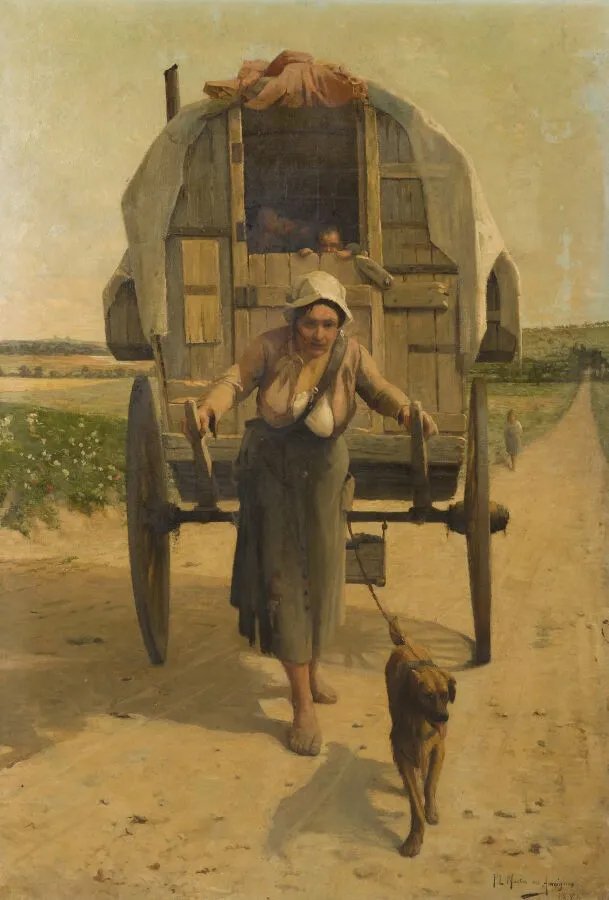
Related work: Final work, 141 x 97 cm, sold at auction in Bordeaux in the winter of 2024/25.
Paul Louis Martin des Amoignes (1850–1925) remains a prominent figure in French regional painting at the turn of the 19th and 20th centuries. Born in Saint-Benin-d’Azy, in the Nièvre department, he belongs to that generation of artisans who became artists, whose careers were shaped by hard work, local support, and tenacious determination. Initially trained as a carriage painter, he gradually turned away from craftsmanship to devote himself to fine art.
His entry into the world of fine arts was made possible by the kindness of the painter Hector Hanoteau, who welcomed him into his Parisian studio, as well as by the support of the architect Bouveault de Monteignier. It was Hanoteau who gave him the artist name “des Amoignes,” in reference to a region in the Nièvre department, in order to help him forge his own identity within an already bustling artistic milieu.
His work is deeply rooted in the Morvan region: landscapes, scenes of rural life, and church interiors make up a body of work that is sensitive and faithful to the naturalist spirit. Similar in his approach to painters such as Jules Bastien-Lepage, Martin des Amoignes strove to depict with precision and emotion the daily life of a changing peasant world.
Beginning in 1881, he exhibited regularly at the Salon des Artistes Français, where he was honored in 1898 for his painting “La saison des blés.” This recognition, confirmed in 1900 by his promotion to the rank of Officer of the Academy, established his work within the artistic landscape of his time. Together with his wife, Élisabeth Wedekind—a painter of flowers—they formed an artistic couple deeply involved in the cultural life of the Nièvre region, particularly within the Groupe d’émulation artistique du Nivernais.
In 1903, he settled in Nevers, where he continued his artistic practice while actively participating in the local art scene. His art, which gained recognition even abroad, captivates viewers with its accuracy of tone and depth of observation. The Nevers Museum now houses several of his iconic paintings, which reflect his keen attention to the character of places and the gestures of everyday life.
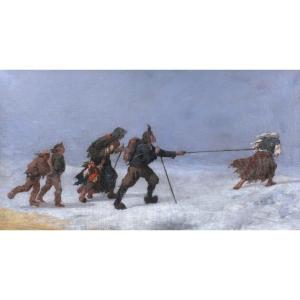
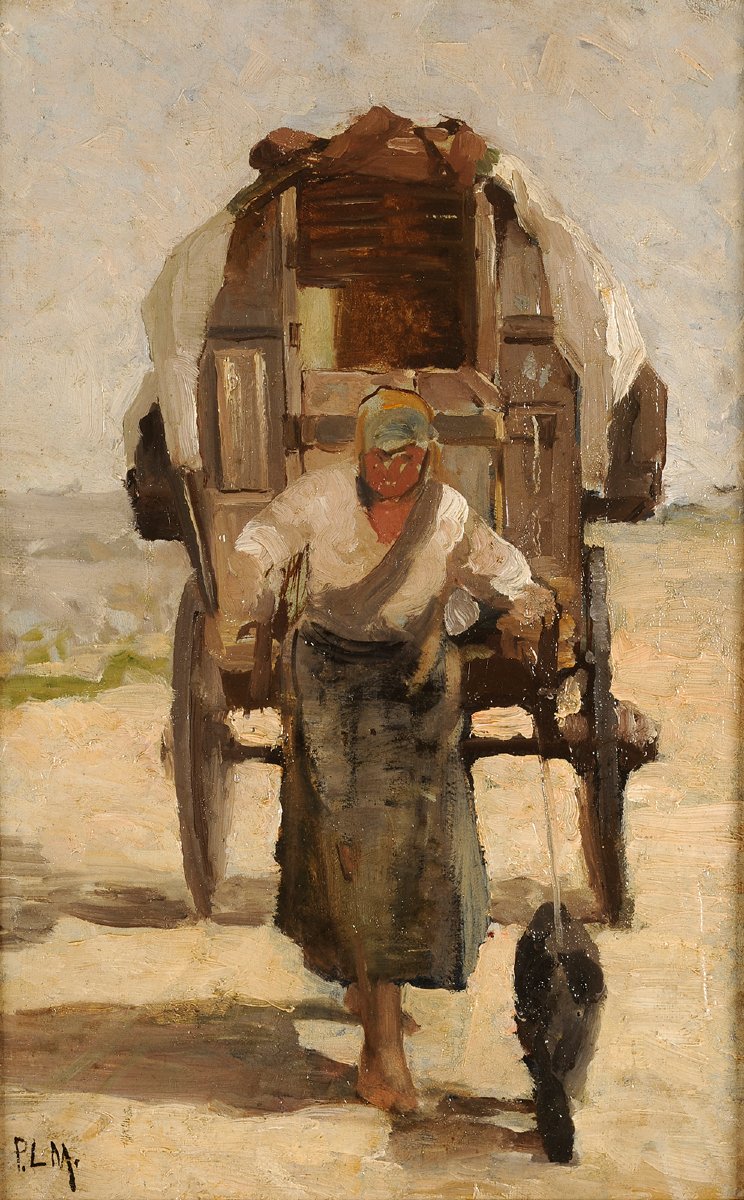
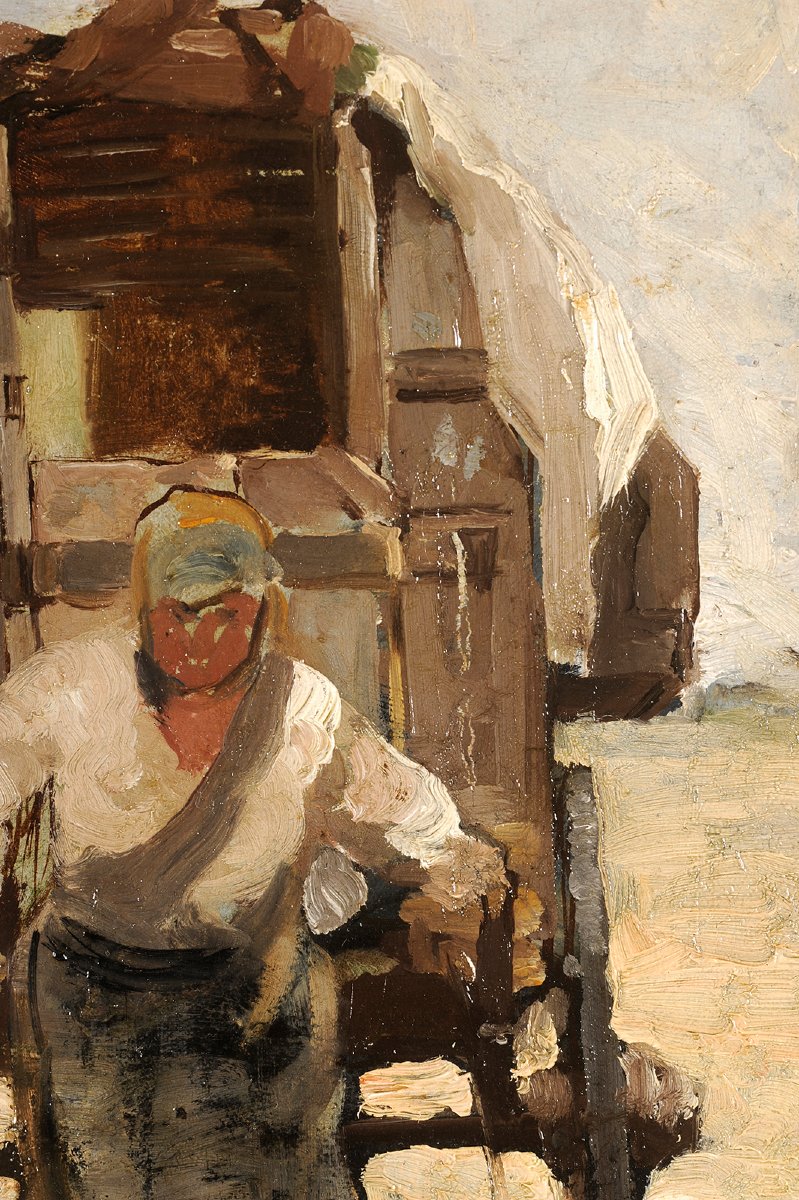
This painting by Martin des Amoignes, created around 1886, is fully in line with the naturalist movement of the late 19th century. It depicts a woman pulling a wagon along a path, with children inside. A dog on a leash accompanies this humble procession.
The work is striking for its frontal and tightly framed composition, in which the human figure, viewed from a slight bird’s-eye perspective, commands the viewer’s attention along a central vertical axis, framed by the dark structure of the wagon. This framing creates a tension between the roughness of the gesture and the monumentality of the subject, while highlighting an iconography of marginality—a theme then in vogue in social realism.
The painterly treatment, with its rapid, impasto brushwork, evokes a rough, almost raw realism reminiscent of the work of the Barbizon School and Jules Bastien-Lepage. The color palette, dominated by earthy tones and bleached ochres, helps convey the aridity of the soil and the dust in the air, while the deliberately neutral sky reinforces the figure’s sense of isolation.
The attention paid to the figure’s gestures and the materiality of her clothing, combined with a background reduced to a faint horizon line, focuses the viewer’s gaze on the physical labor and the precarious condition of the woman depicted. One can discern an almost ethnographic desire to document everyday life on the periphery—that of nomads, outcasts, or peasants in transit.
Finally, the “P.L.M.” monogram in the lower left corner links this work to Martin des Amoignes’s final painting; this sketch attests to his commitment to on-site painting, attentive to the social realities of his time.
Period: 19th century
Style: Napoleon 3rd
Condition: Perfect condition
Material: Oil painting on wood
Length: 37 cm hors cadre
Width: 23 cm hors cadre
Reference (ID): 1780299
Availability: In stock