

Saint Pierre - Val-de-loire - 15th Century - France
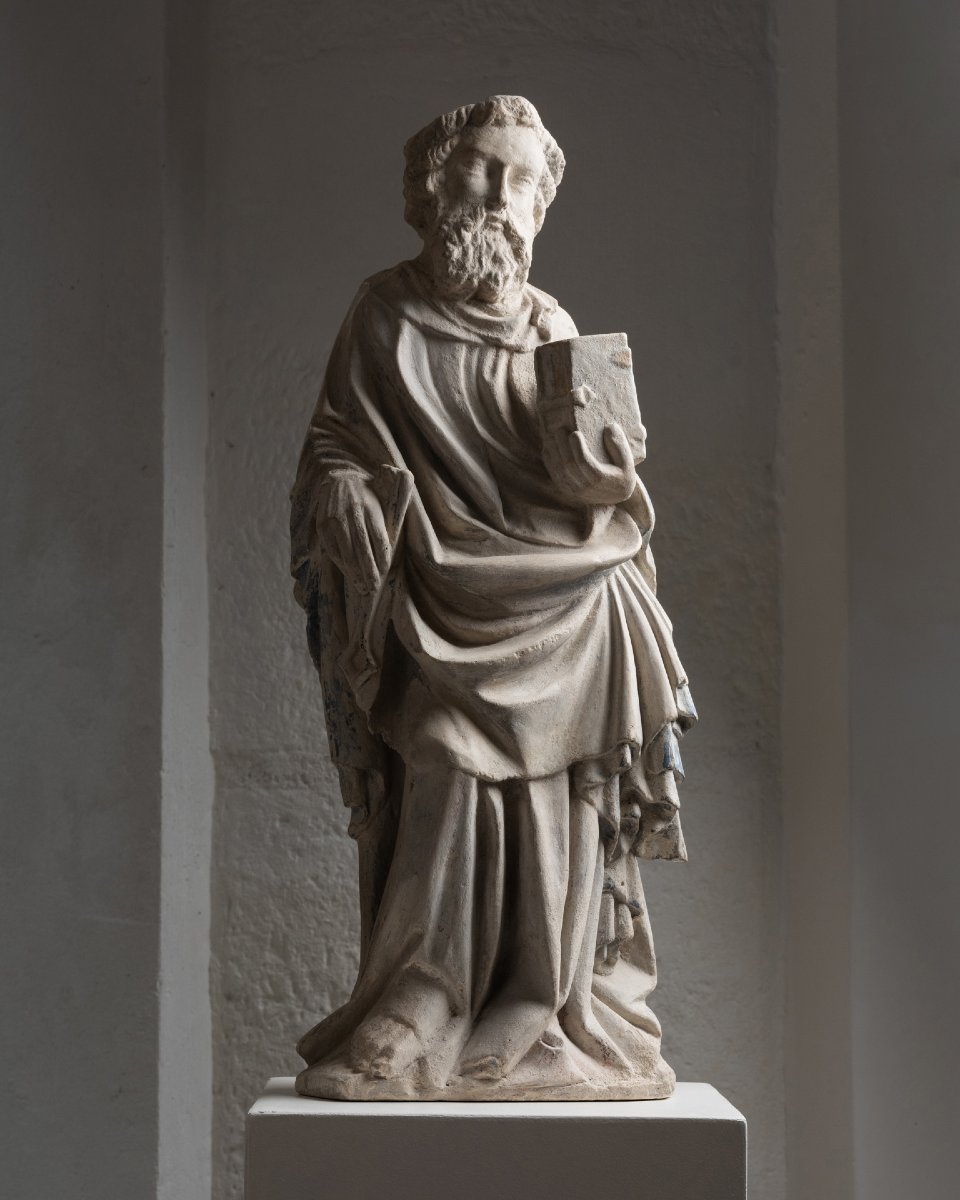
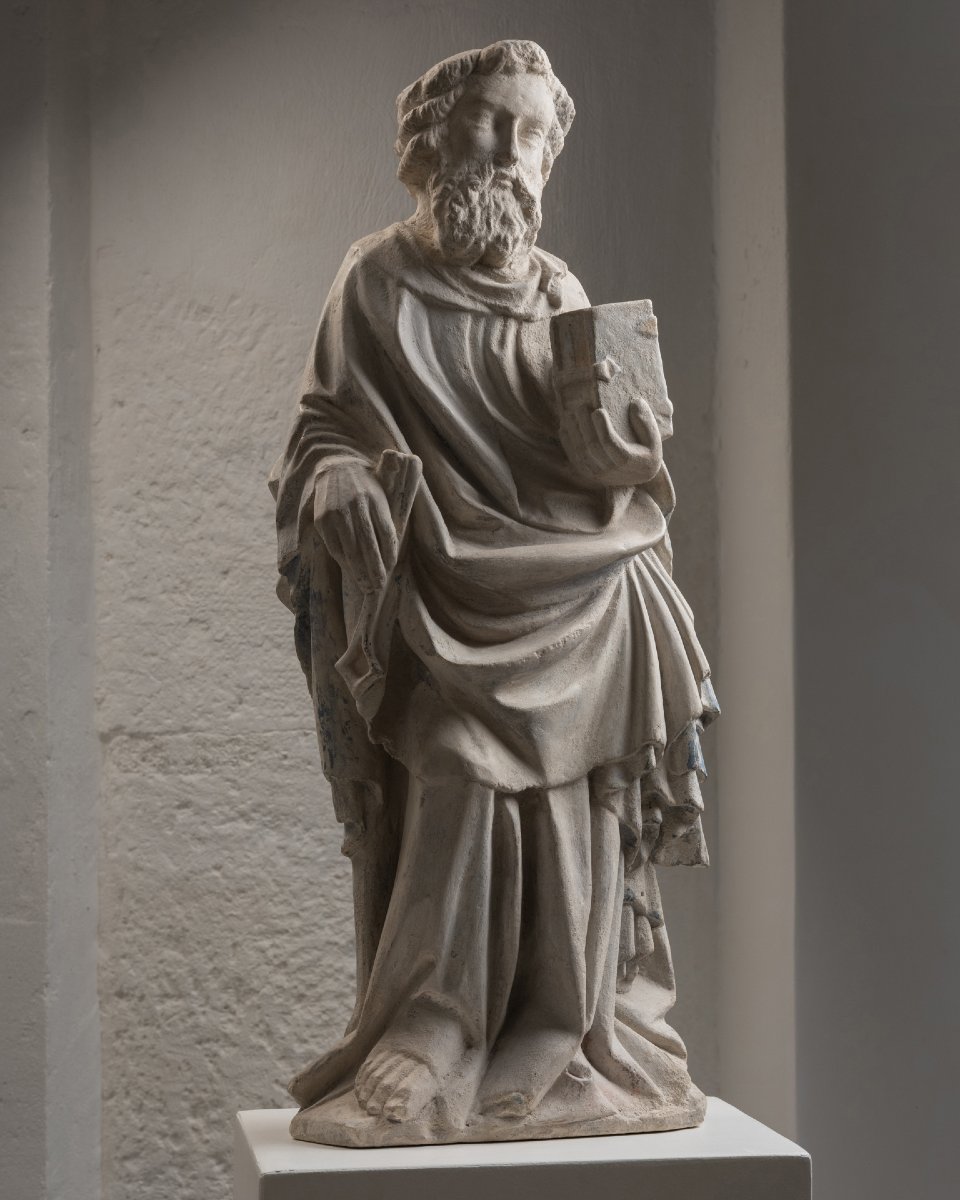
This stone sculpture depicts the apostle Saint Peter standing, holding a book in his left hand and the keys—his traditional attribute—in his right. Dating from the 15th century, it follows the tradition of religious statuary from the late Middle Ages. It originates from the Loire Valley, as evidenced by its tuffeau stone.
The apostle, recognizable by his curly beard and his hair stylized into broad strands, is depicted in the round, draped in a loose cloak whose vertical folds give structure to the composition. The figure adopts a slight sway of the hips, lending the whole a certain suppleness despite the frontal nature of the pose.
During the Middle Ages, sculpted representations of saints played an essential role in the decorative programs of churches. Placed in niches, on portals, or incorporated into altarpieces, these figures helped spread Christian iconography and instruct the faithful. They brought the major figures of the Christian tradition to life and supported the practice of devotion. Stone, a durable material widely used in monumental sculpture, allows for the creation of works designed to stand the test of time while blending seamlessly into religious architecture.
In Christian iconographic tradition, Saint Peter occupies a central place. Considered the first of the apostles and the first bishop of Rome, he is generally depicted as a middle-aged man with a full beard and wavy hair. He is the symbolic guardian of the keys to the Kingdom of Heaven, attributes that refer to his role as the foundation of the Church. The book he holds, meanwhile, symbolizes the transmission of the divine word and the apostle’s spiritual authority.
The saint’s face, framed by wavy hair and a full beard, has stylized yet expressive features. His serious and focused expression contributes to the image of a figure imbued with wisdom and authority. The rendering of the drapery is a major element of the composition: the deep, vertical folds enliven the surface of the stone and guide the viewer’s gaze toward the saint’s slender silhouette. The saint is also depicted barefoot, an important iconographic detail in the representation of the apostles, which refers to the ideal of humility and simplicity associated with Christ’s first disciples.
A significant change occurred in the iconography of saints beginning in the final decades of the 12th century. Artists began to associate individual attributes with the saints, allowing them to be identified with certainty. Thus, there was a shift from a relatively abstract iconographic system—which emphasized above all the saint’s spiritual status—to a more concrete system that highlighted biographical aspects and distinctive signs linked to their lives or missions. These attributes made it easier for the faithful to recognize the figures depicted and brought them closer to these figures.
Gothic sculpture played a major role in the dissemination of these distinctive symbols. Artists increasingly used attributes to identify the saints, particularly in the sculpted ensembles of portals, where inscriptions were often difficult to read on a monumental scale. Attributes thus became a true visual language, comparable to that of coats of arms, based on a set of immediately recognizable forms and symbols.
Thus, this 15th-century stone sculpture is fully in keeping with the tradition of late Gothic religious sculpture. Through the solemnity of its posture, the richness of its drapery, and the presence of its symbolic attributes, it attests to the importance accorded to the figure of Saint Peter in medieval religious culture and illustrates how sculptural art helped make sacred figures accessible and recognizable to the faithful.
Period: Before 16th century
Style: Renaissance, Louis 13th
Condition: Good condition
Material: Stone
Width: 25 cm
Height: 65 cm
Reference (ID): 1780053
Availability: In stock