


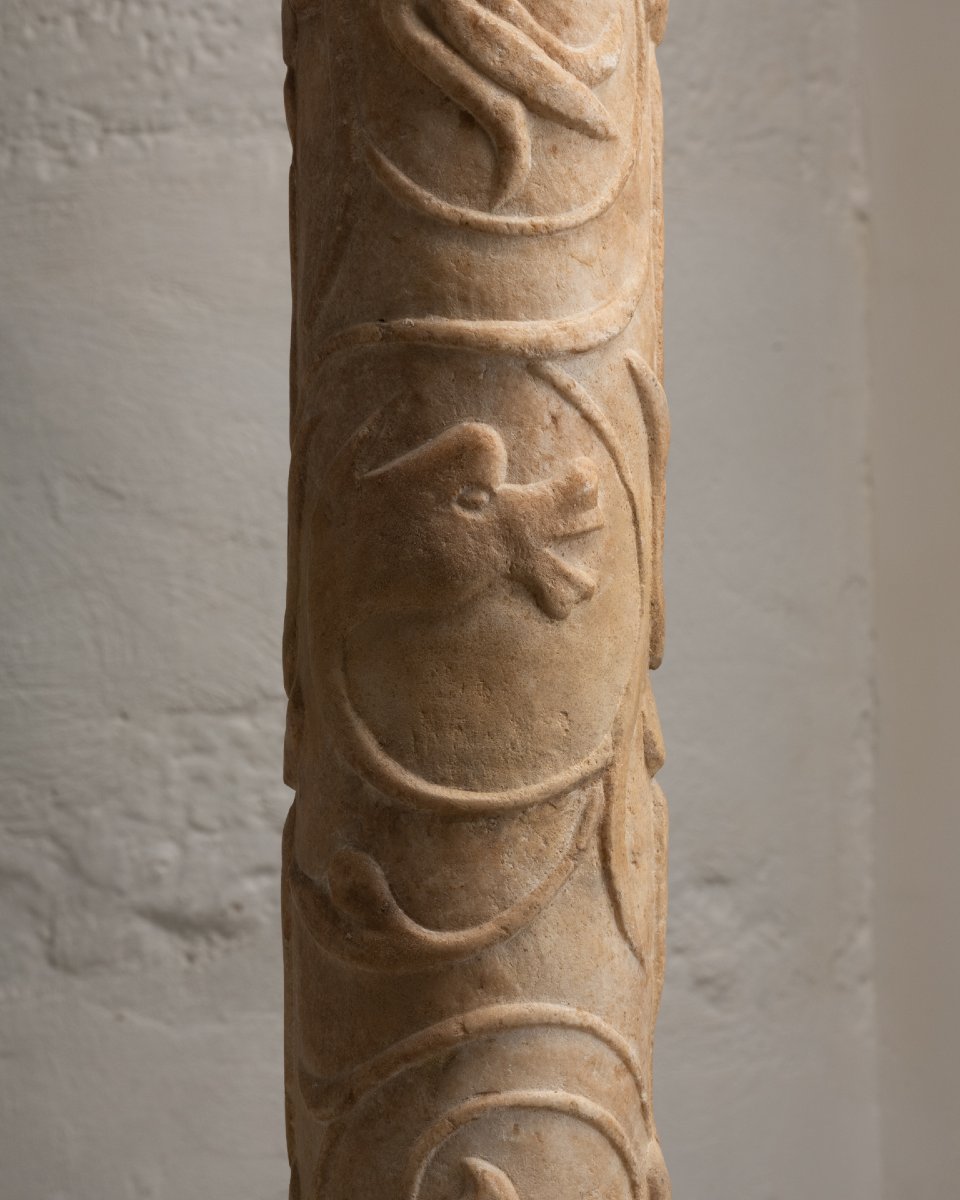


Byzantine-inspired Romanesque Column – Tuscany, Italy – 12th Century
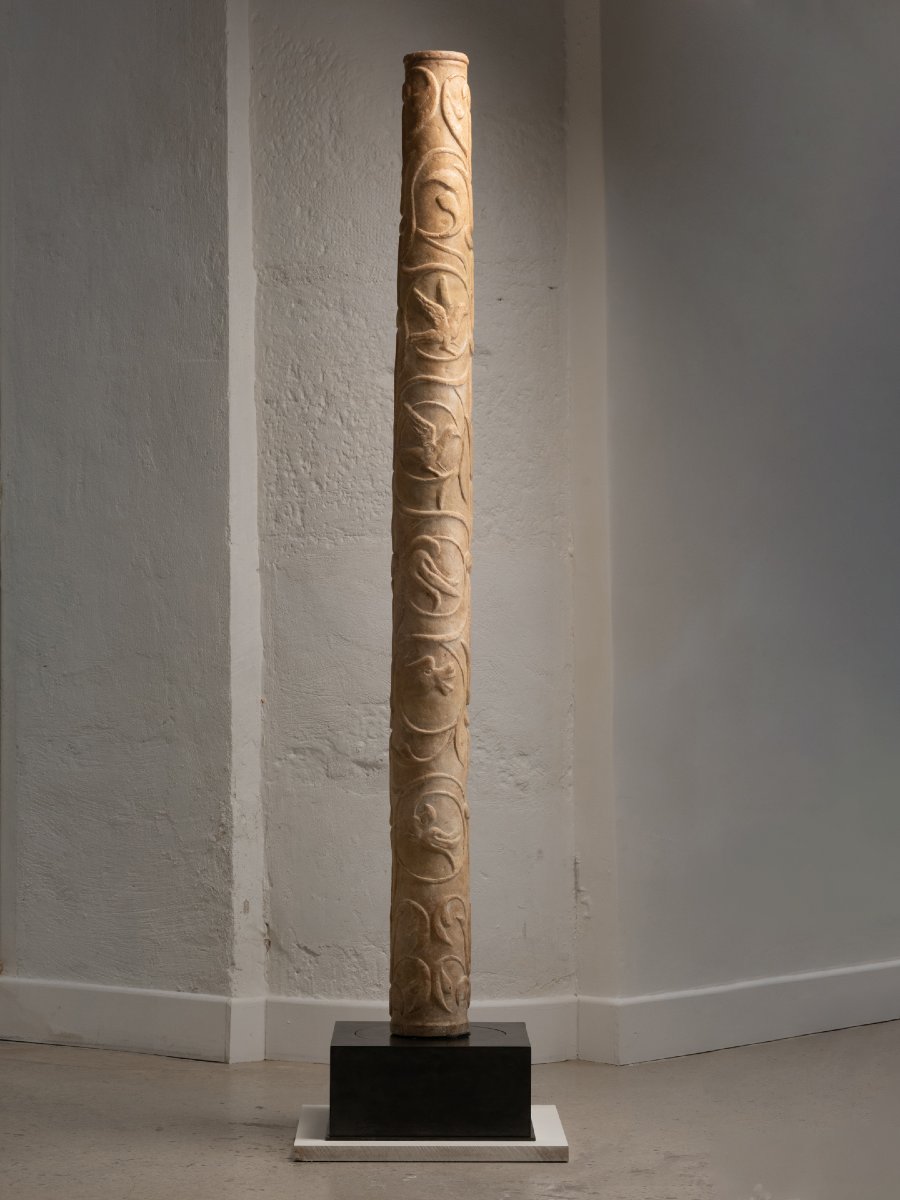
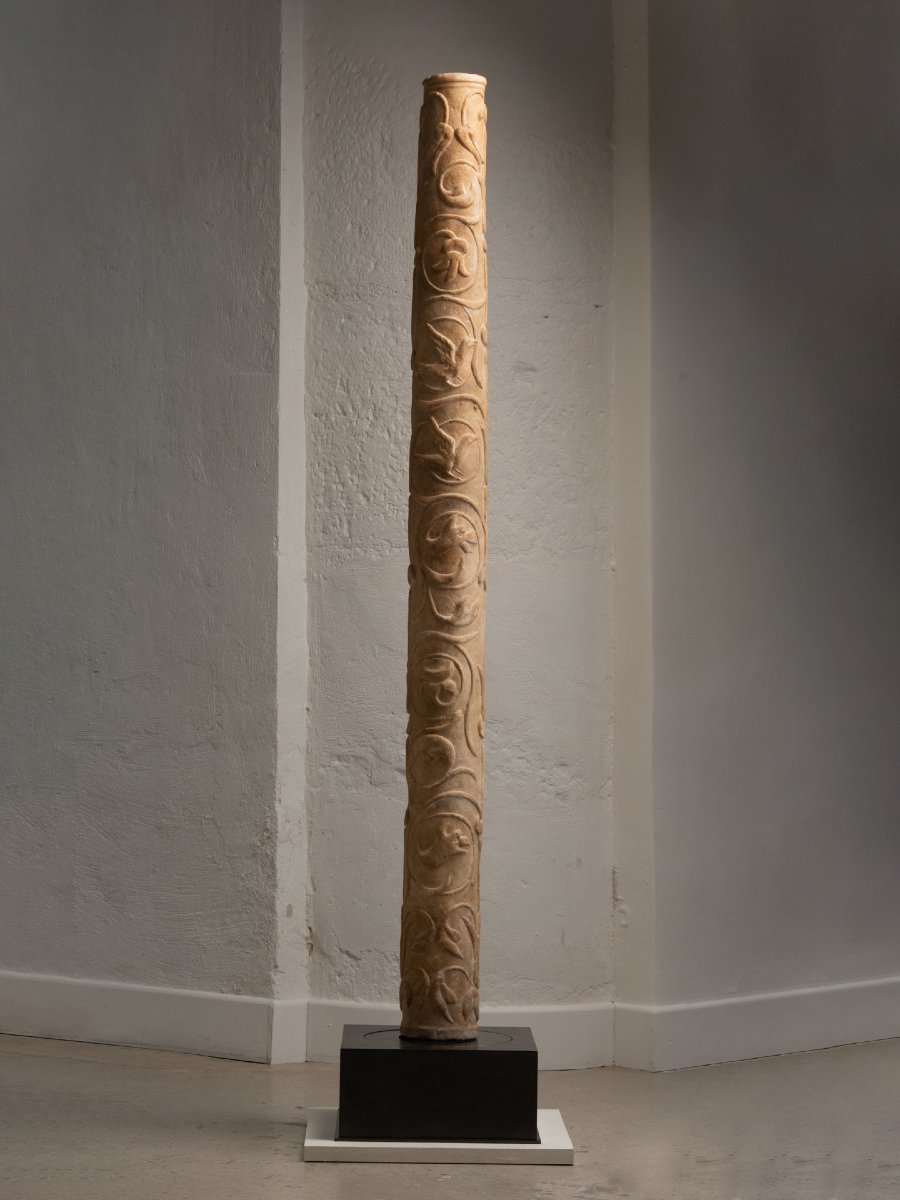
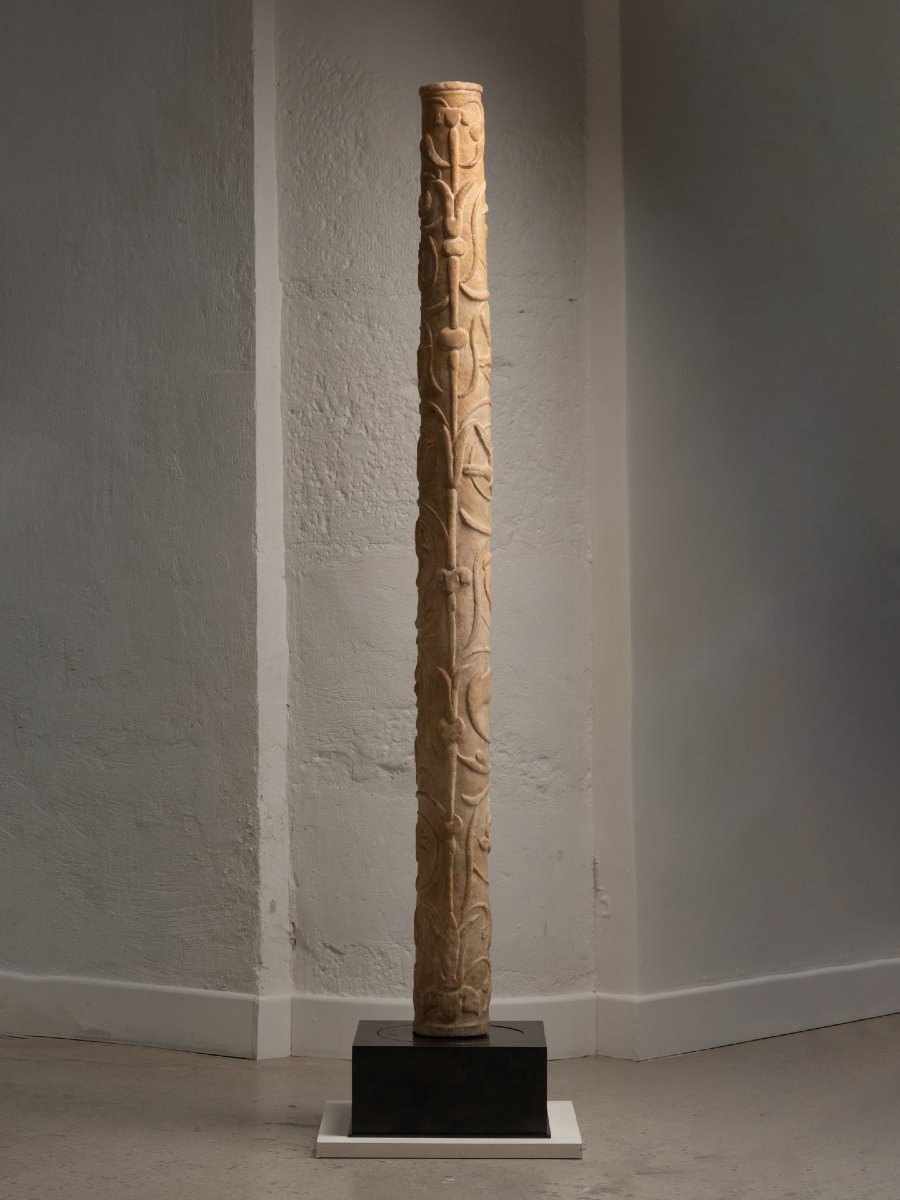
This Romanesque marble column, dating from the 12th century and originating from the Lucca area, is a slender sculpted element entirely decorated with foliage motifs in relief. The decoration unfolds vertically along the shaft, structured by a continuous coil of plant stems forming volutes.
The main motif is a continuous scroll that winds in an ascending spiral along the column. Unlike more rigid compositions, the stems here are not strictly symmetrical: they undulate gracefully, forming irregular volutes that give rhythm to the surface. These coils seem almost to adapt to the verticality of the column, naturally guiding the eye from bottom to top.
Within these plant-like loops appear several birds, carved in slight relief. They are not simply placed on top of the decoration: their bodies are integrated into the very curves of the scrollwork. They play an essential role: far from being mere decorative motifs, they embody powerful symbolism in the medieval imagination. Their wings, reminiscent of angelic depictions, evoke the lightness of the spirit in contrast to the heaviness of the material world. Thus, the bird motif can be interpreted as an allusion to spiritual elevation, a central theme in Romanesque art.
The decoration is not limited to these avian figures: griffin heads are also visible, integrated into the plant motifs. These hybrid creatures, combining the earthly strength of the lion with the celestial elevation of the eagle, reinforce the symbolic dimension of the decoration by embodying both the duality between earth and sky, protective vigilance, and—in the Christian context—an allusion to the dual nature of Christ. In the ascent suggested by the column, the griffin heads—hybrid creatures bridging earth and sky—appear as intermediary figures accompanying this ascent and embodying the transition from the material world to the spiritual world.
The leaves and fruits are grafted directly onto the stems of the scrollwork, forming their tips and enriching their coils. They evoke forms derived from the ancient acanthus, but with a simplification typical of Romanesque art, alternating between passing above and below, creating an effect of continuous movement and ornamental density. The volutes are arranged according to a decorative logic in which the sculptor’s imagination plays an important role, while maintaining a certain coherence in the sequence of forms.
The ensemble fully corresponds to the “tralcio abitato” (inhabited vine tendril) motif, in which the vine tendril becomes a living space, populated by creatures. Rooted in an ancient tradition whose origins date back to Greek art—notably the acanthus motif—before developing in Roman art, particularly in Augustan friezes, this type of decoration was subsequently transmitted and transformed in early Christian and Byzantine art. Here, the fusion of plant and animal forms is particularly successful: birds and griffins do not disrupt the decorative order; rather, they are an integral part of it.
Finally, the verticality of the column, combined with this ascending decoration, can reinforce a symbolic interpretation. The foliage itself can be understood as a metaphor for the spiritual journey, marked by detours and trials, while the creatures that inhabit it—the birds and griffins—accompany this ascent. The ensemble depicts a transition from the earthly world to the spiritual world, a characteristic feature of Romanesque thought and aesthetics.
We can compare it to the half-columns of the portico of the Church of San Martino in Lucca, which are one of the most characteristic elements of Lombard Romanesque architecture. Integrated into powerful composite pillars, they give rhythm to the façade while reinforcing the ensemble’s sense of verticality and monumentality. Their arrangement reflects a quest for balance between architectural mass and ornamentation, typical of the Romanesque vocabulary.
Similarly, the half-columns of our building contribute to the visual structure of the façade by creating a play of shadows and reliefs that animates the wall surface. Those at San Martino are part of a monumental system designed to support vast arcades. This comparison highlights the enduring presence of this decorative motif in Romanesque art, where the half-column serves not only as a supporting element but also as a means of organizing space and accentuating the building’s solemn character.
Period: Before 16th century
Style: Renaissance, Louis 13th
Condition: Good condition
Material: Marble
Diameter: 10 cm
Height: 130 cm
Reference (ID): 1780066
Availability: In stock