




Sedes Sapientiae – Catalonia, Spain – 13th Century
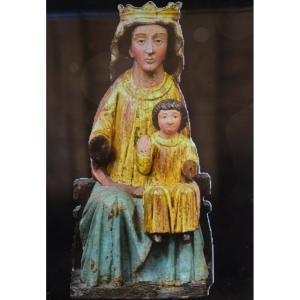
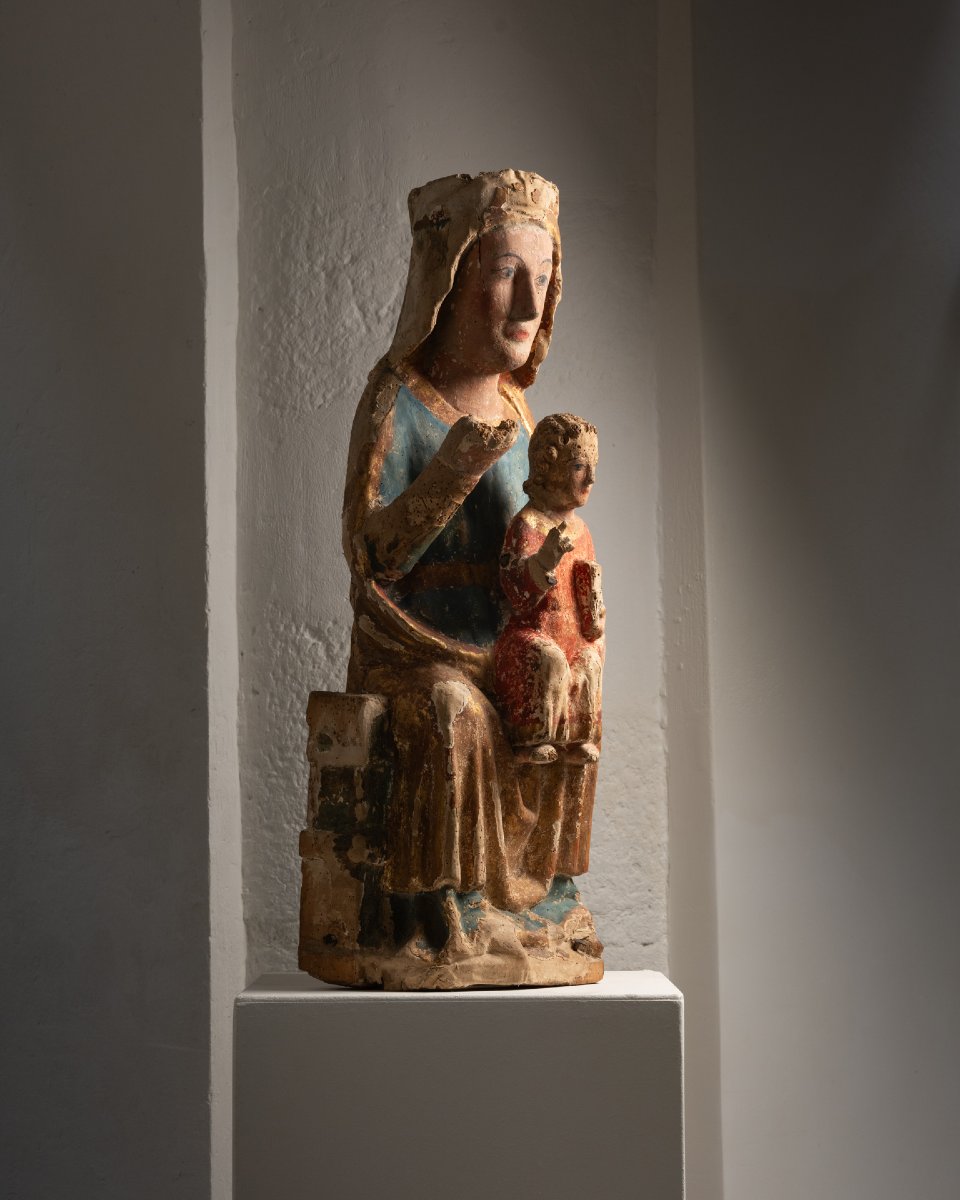
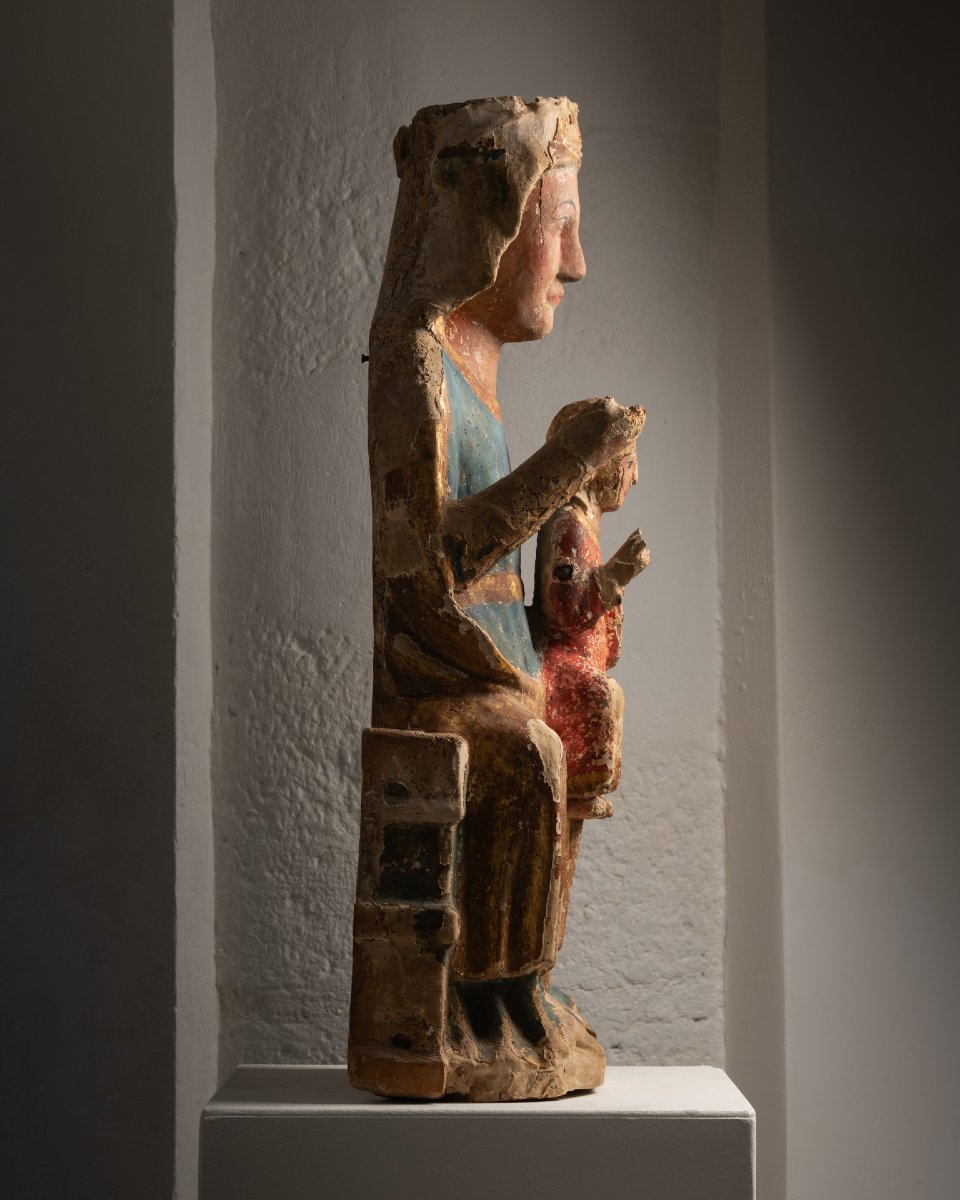
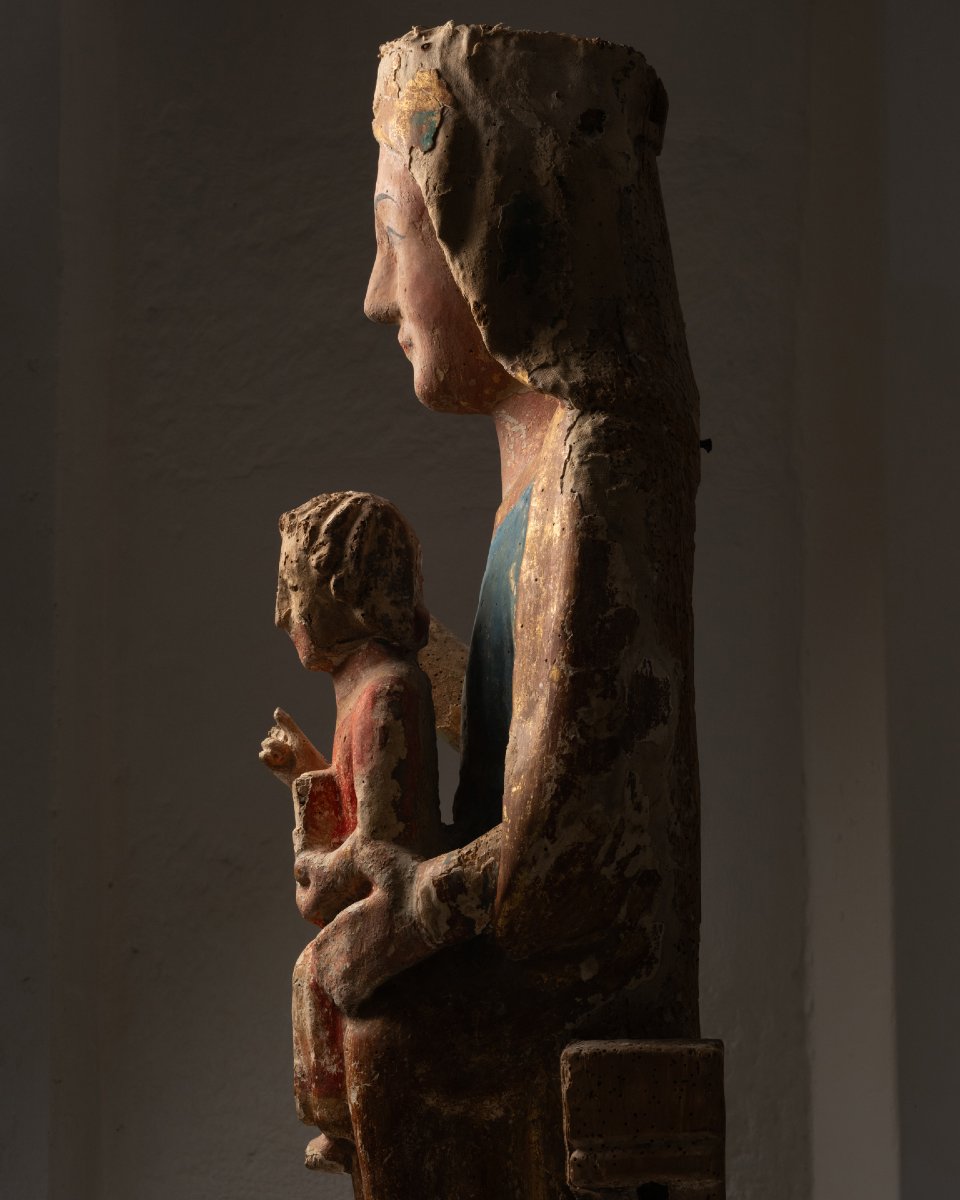
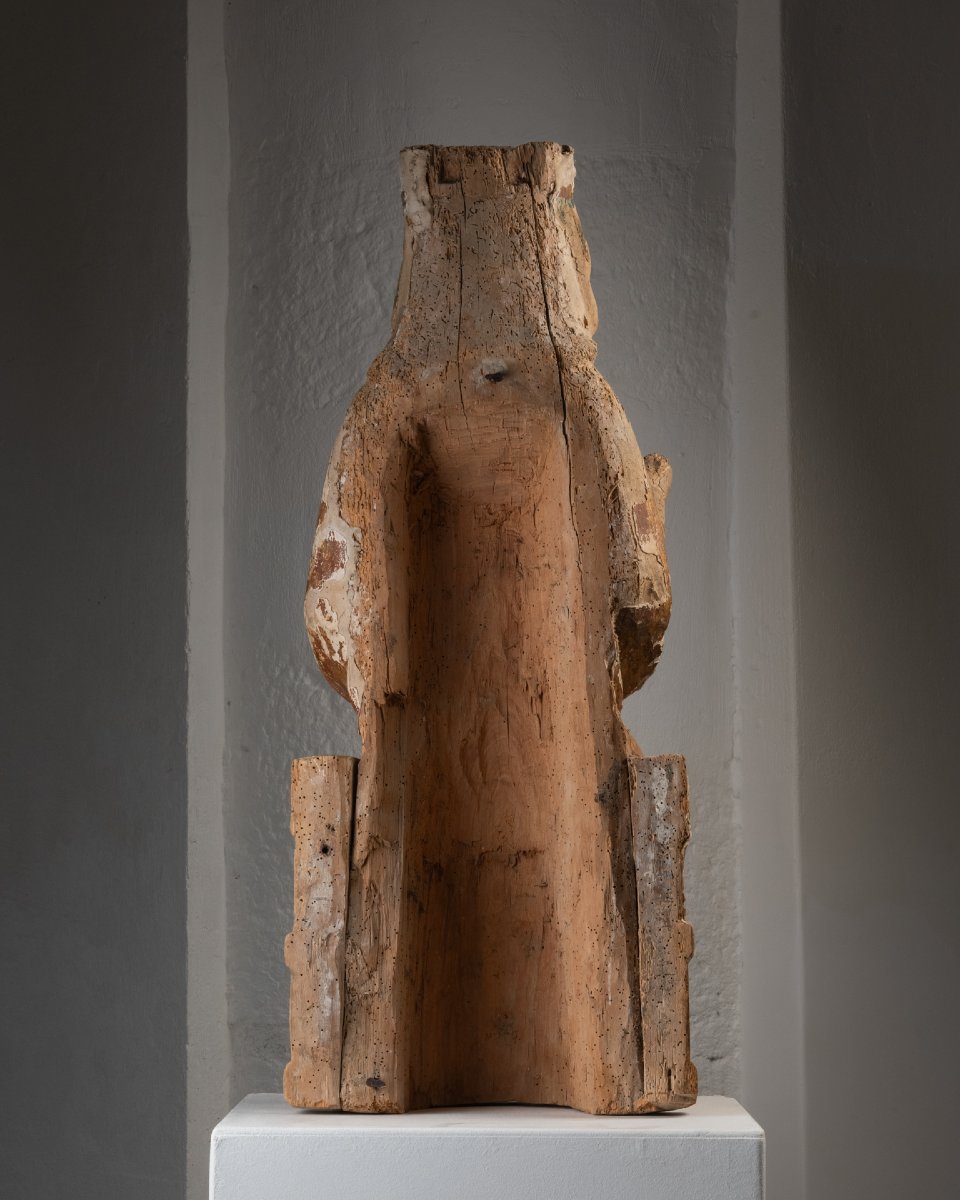
This 13th-century Catalan sculpture, carved from a block of wood with a hollowed-out back, covered with fabric, polychromed, and gilded, belongs to the iconographic type known as the Sedes Sapientiae, or “Throne of Wisdom.” It depicts the Virgin seated in majesty, holding the Child on her lap, but according to a model in which the mother now becomes the dominant figure: beginning in the 13th century, the image emphasizes the centrality of the Virgin, whose body becomes the living seat of Christ, rather than merely a maternal support.
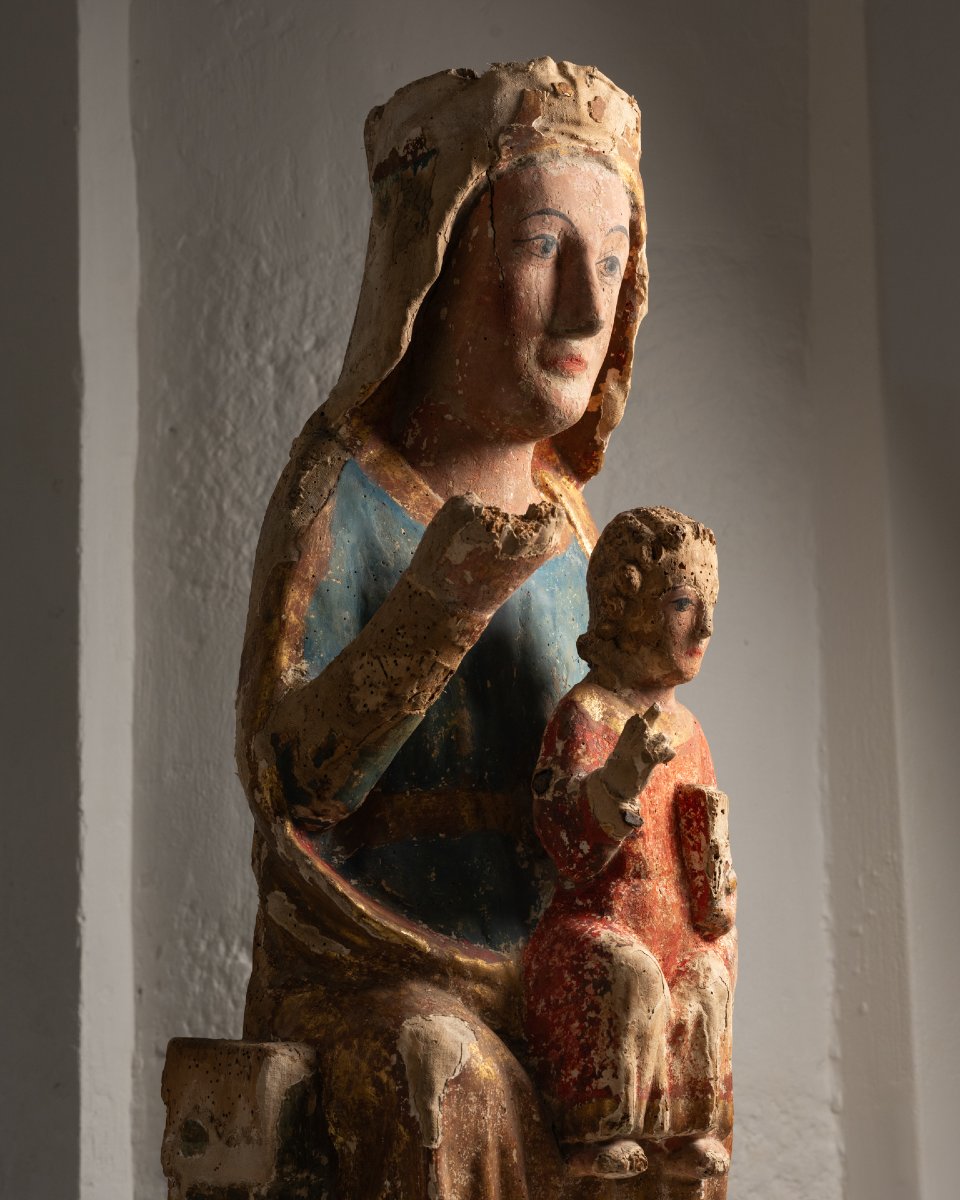
The sculpture still retains a significant portion of its original polychromy, a rare occurrence since most such works have been extensively restored or entirely repainted over the centuries.
Here, vibrant traces of blue, red, and gold remain, testifying to the chromatic richness characteristic of Spanish art, renowned for its intense colors. The fabric backing beneath the paint reveals a meticulous technique intended not only to give substance to the sculpture but also to enrich its surface and visual presence.
The Virgin is seated on an architectural throne imbued with powerful symbolism. This seat carries multiple layers of meaning: it evokes the heavenly Jerusalem, the spiritual center of the world, but also the ancient marble thrones, whose hieratic form is here transposed into sacred wood. In Catalonia, as elsewhere in Europe, these images draw on the earliest depictions of the seated Virgin, venerated as early as the 4th century and found in manuscripts and on the earliest Gothic portals.
The treatment of the drapery is revealing: the folds still fall in a soft U-shape, a sign of an intermediate stylization—neither rigid as in more archaic works nor completely fluid as in later Gothic creations. The Child is no longer frontally centered: he is seated on one of his mother’s knees, his subdued position emphasizing the preeminence of the throne embodied by the Virgin. She is likely holding an apple, a traditional symbol of redemption, while the Child also carries an object, a sign of his spiritual sovereignty.
The work falls squarely within the category of medieval sacred art. It was not designed to be merely admired as a beautiful object, but to embody a divine presence. It was meant to have an effect on the viewer. In medieval Europe, faith was as much a matter of sight as it was of experience: “to see” was equivalent to “to believe.” The Church controlled the faithful’s gaze, directing what was to be contemplated or revered; the sculpted image became a point of convergence between perception and theological truth.
This spiritual power is particularly evident in the treatment of the face and the gaze. The eyes are enlarged and deep, so that they look the faithful straight in the eye. This orientation creates a direct encounter with the faithful’s gaze and a mystical call. The sculpture seems to hypnotize, fascinate, and produce what medieval clerics described as a “mirror effect”: in contemplating the Virgin, the believer sees not only the holy image but also the reflection of his or her own soul. The ecstatic quality of the face, which is slightly frozen in expression, conveys this tension between the earthly present and the divine presence.
This work belongs to a tradition that arrived early in France in the 12th century but was introduced later in Spain, where two types of Virgins can be distinguished: those that perpetuate archaic forms and those influenced by the Carolingian heritage. Spanish Virgins are often recognizable by their lack of a crown, replaced by a simple veil, as well as by the simplicity of the drapery, despite the richness of the colors still visible here.
Thus, this sculpture demonstrates how matter can be transcended by its form. Wood, a humble earthly material, becomes the medium for a higher reality. The enthroned Virgin is not merely a devotional object: she is an instrument of mediation, a body in which the divine takes residence, a tool for contemplation and transformation. She perfectly illustrates this medieval theology in which sculpture was not inert but a presence: it taught, protected, fascinated, and converted.
This sculpture can be compared to the famous Virgin in Majesty housed at the Metropolitan Museum of Art in New York, created in Catalonia in the 13th century. As in this Catalan work, the Virgin is depicted seated on a throne, holding the Christ Child on her lap according to the iconographic type of the Sedes Sapientiae (“Throne of Wisdom”), in which Mary becomes the earthly seat of divine wisdom incarnated by Christ.
Period: Before 16th century
Style: Renaissance, Louis 13th
Condition: Good condition
Material: Gilted wood
Width: 32 cm
Height: 76 cm
Reference (ID): 1780075
Availability: In stock