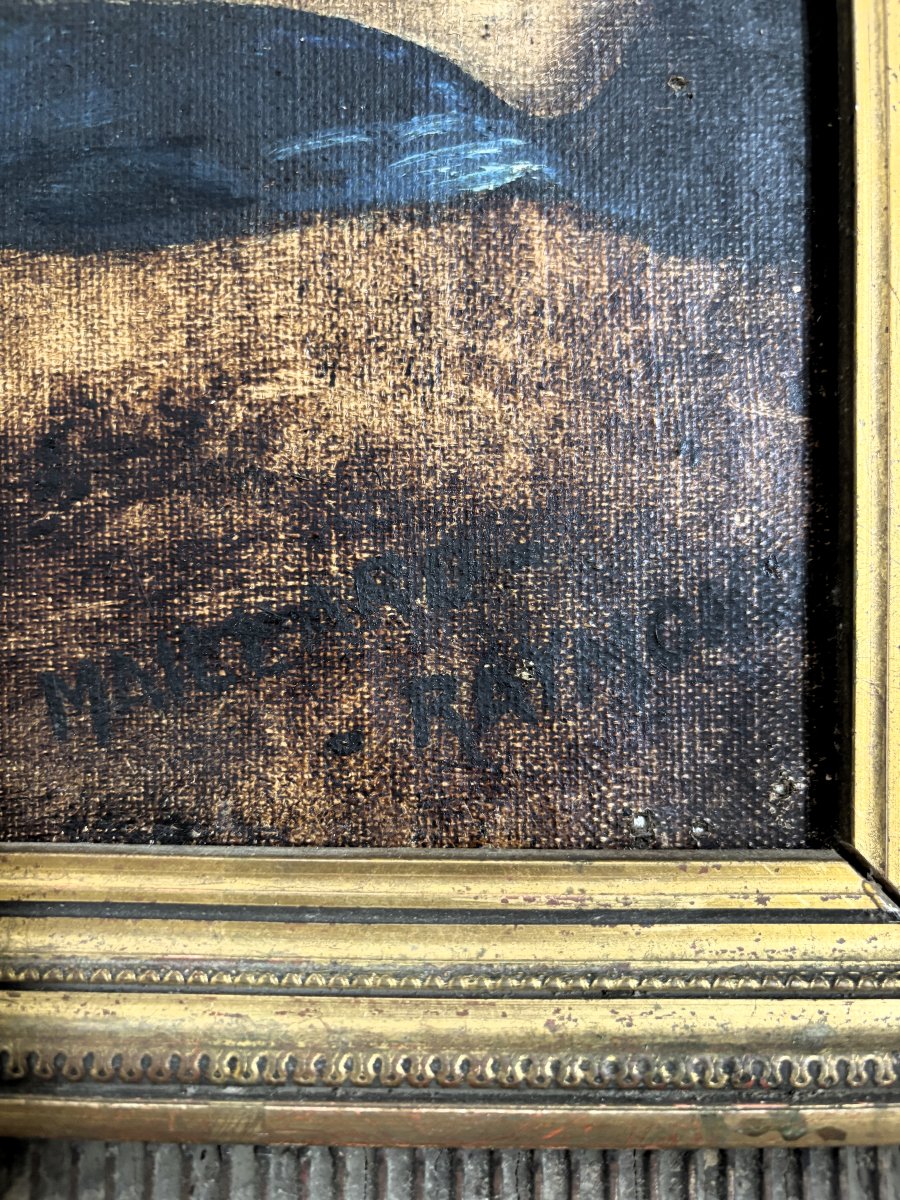
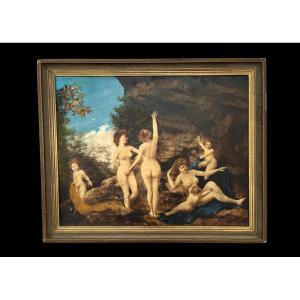


R. Maillard – The Bathers (modern Painting, 20th Century) – Genre Scene/landscape/nude
Raymond Maillard
Les Baigneuses
20th Century
Oil on canvas
Framed dimensions : 84,5 x 105 cm (33 1/3 x 41 1/3 in.)
Historical context
Raymond Maillard is a highly elusive figure on the art market today. Active during the first half of the twentieth century, he exhibited regularly at major Parisian salons, including the Salon des Indépendants in 1920 and 1922.
His participation in the 1920 Salon des Indépendants attracted notable critical attention and earned him mention in several contemporary newspapers. Most significantly, his work was singled out by Louis Vauxcelles, one of the most influential art critics of his generation, who cited Maillard alongside such distinguished artists as Maurice Vlaminck, Suzanne Valadon, and Marcel Gromaire in the fine arts column of Excelsior on January 28, 1920.
Although the Salon des Indépendants presented an exceptionally large number of works, only a select group received critical distinction for their “vigor, taste, and spirit of inquiry and innovation” (La Libre Parole, January 30, 1920). Maillard’s paintings were among those highlighted, the critic recognizing in them a “genuine talent" (La Libre Parole, January 30, 1920). His depictions of women and landscapes particularly captured the attention of reviewers and were associated with a broader artistic movement advocating a return “to integrity and to true painting” (Le Journal du Peuple, January 29, 1920). Such assessments positioned Maillard within the generation of artists seeking to reconcile modern sensibilities with the enduring values of pictorial craftsmanship.
In 1922, Maillard exhibited three paintings at the Salon des Indépendants (Regrets, Les Papillons, and Automne) as well as Côtes de Bretagne at the Salon de l’École Française. These works prompted the following appraisal in the Revue Moderne des Arts et de la Vie (March 30, 1922):
“[Raymond Maillard] establishes himself as an original painter, devoted to sound draftsmanship and vigorous color. His manner at times possesses genuine strength through the decisiveness and candor of his brushwork, as well as the intensity of certain expressions. He is a sensitive and sincere artist who perceives the poetry of beings and things, and who strives to interpret their living beauty with lyrical conviction.”
— C. de Cordis
Earlier, Maillard had already drawn considerable praise for Nuit d’Automne, exhibited at the Salon d’Automne of 1919. Art critic Camille Le Serre identified the painting as one of the outstanding successes of the exhibition, underscoring the favorable reception that Maillard’s work enjoyed among contemporary commentators.
Despite this critical recognition during his lifetime, Raymond Maillard remains a little-studied artist today, and works by his hand appear only rarely on the market. The surviving paintings testify to the qualities repeatedly praised by his contemporaries: a refined sense of drawing, a confident handling of color, and a poetic vision that balances lyrical sensitivity with pictorial strength.
Les Baigneuses stands at the intersection of several artistic traditions. First and foremost, it clearly draws upon the academic legacy of the nineteenth century. The female nudes (though rendered here with a greater sense of naturalism and picturesque charm), the subject itself, the balanced composition, and the emphasis placed on draftsmanship all recall the principles upheld by the leading exponents of the academic tradition.
At the same time, a number of elements align the painting with the Symbolist sensibility. The scene is imbued with a dreamlike and ambiguous atmosphere, while narrative time appears suspended. The figures seem absorbed in a state of contemplation; no decisive action takes place, and the gesture of the central figure, though suggestive of deeper meaning, remains ultimately enigmatic. The relationship between nature and the feminine archetype is equally significant. Within Symbolist thought, the female figure frequently embodies natural, spiritual, or psychological forces, and the women depicted here may be understood within that tradition. The spatial structure of the composition itself further encourages a symbolic reading: the contrast between the luminous landscape opening to the left and the shadowed rocky grotto to the right suggests a dialogue between opposing realms, whether physical, psychological, or metaphysical.
Finally, while the painting cannot be classified as naïve art in the strict sense, it displays certain characteristics that may evoke that aesthetic universe. Space is constructed with only limited adherence to the conventional rules of perspective, and the narrative remains deliberately elusive and indeterminate. In this respect, the work recalls the poetic ambiguity found in some of the allegorical compositions of Henri Rousseau, where figures inhabit worlds governed less by realism than by imagination and symbolic resonance.
The resulting synthesis is particularly compelling. Les Baigneuses combines the formal discipline of academic painting with the introspective atmosphere of Symbolism, while incorporating a poetic freedom that lends the work its distinctive and enduring charm. The painting thus bears witness to the persistence and reinterpretation of academic traditions in the decades following the emergence of the avant-garde movements of the early twentieth century. While Cubism, Fauvism, and abstraction profoundly transformed the language of modern painting, many artists continued to pursue a figurative practice rooted in the artistic ideals of Antiquity, the Renaissance, and the eighteenth century. This tendency became particularly prominent in the years following the First World War and is commonly associated with the broader phenomenon known as the Retour à l’Ordre (“Return to Order”).
The historical significance of the present work lies precisely in its position within this cultural and artistic context. Rather than embracing the radical formal innovations that defined much of the contemporary avant-garde, the artist reengages with established pictorial traditions, adapting them to the sensibilities of a new era. As such, the work embodies the productive tension that characterized much of European art in the first decades of the twentieth century: the coexistence of modern experimentation and enduring classical ideals.
Description
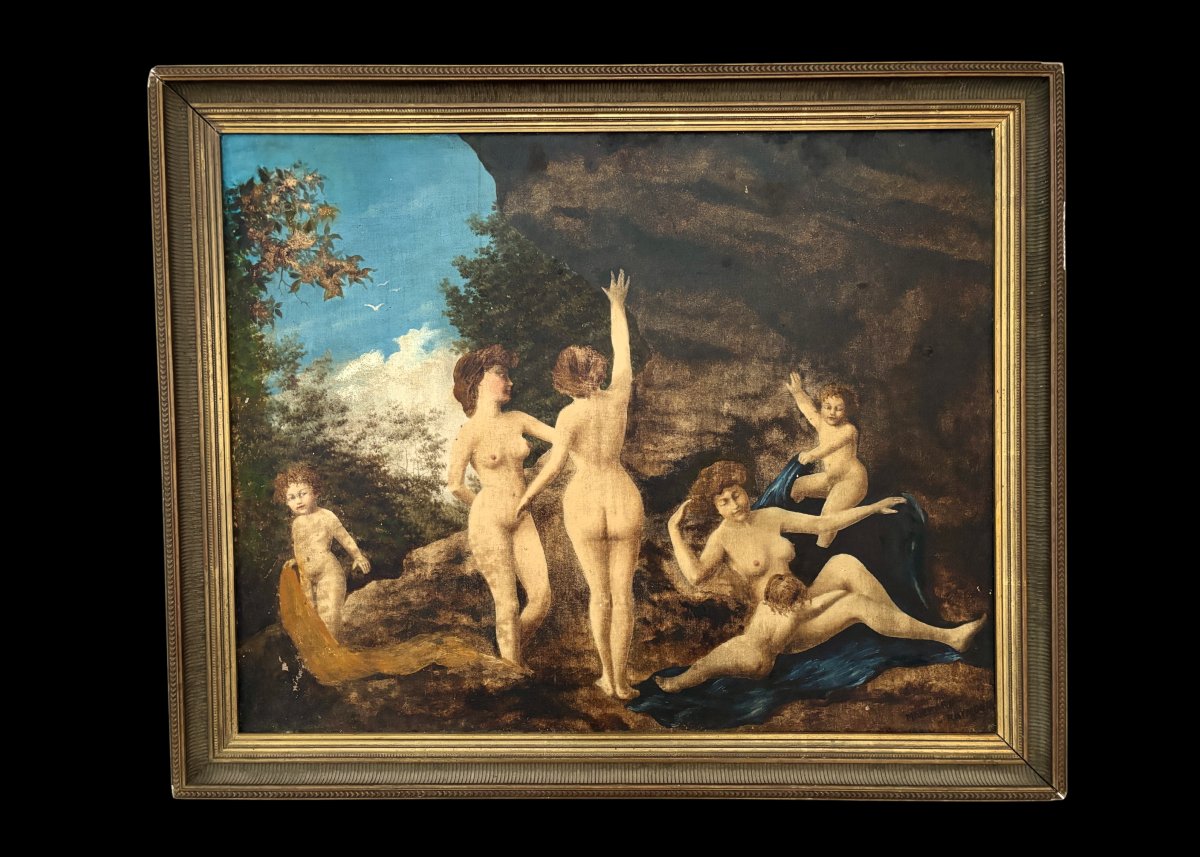
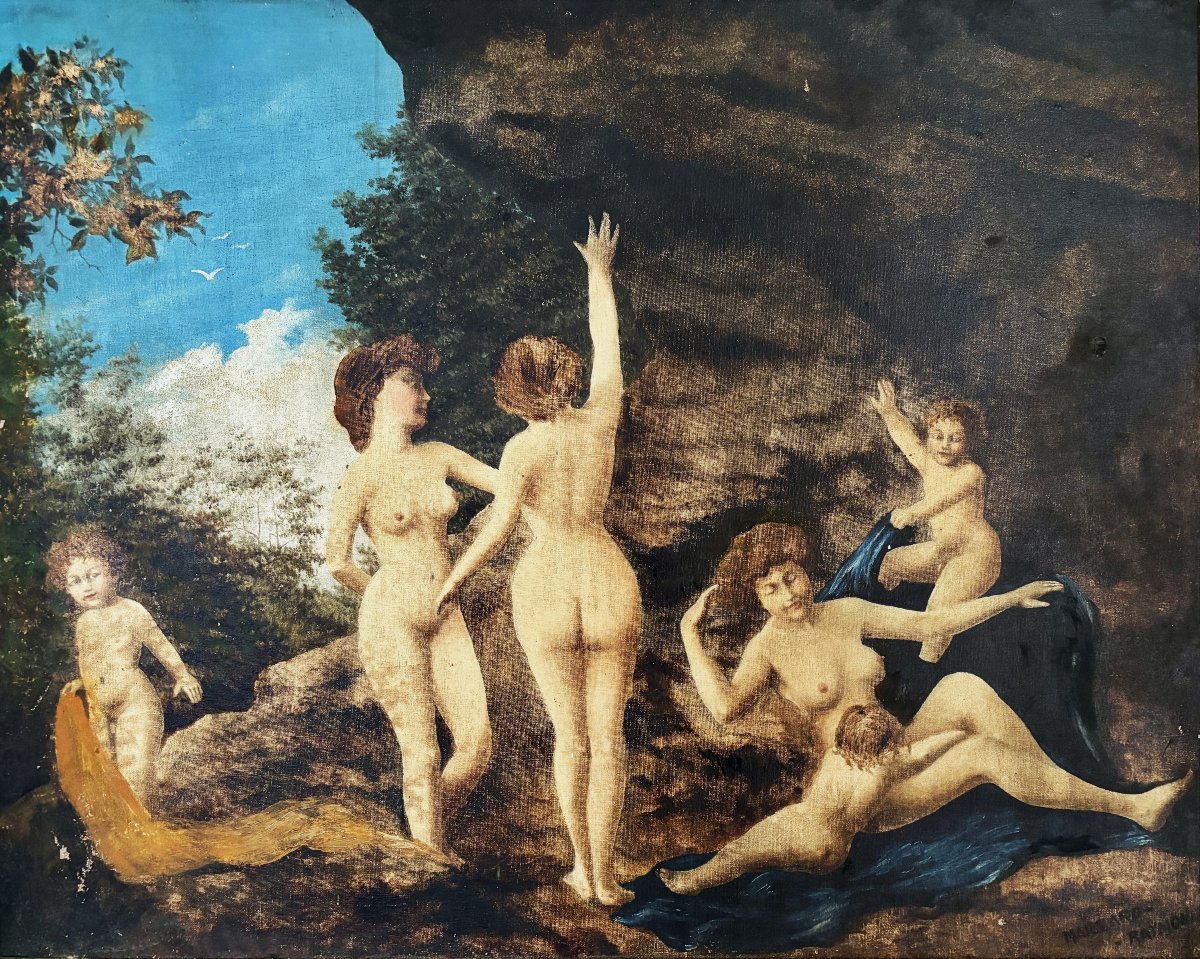
The composition is structured around a pyramidal arrangement formed by a group of three female figures accompanied by three children. The six nude figures inhabit a rocky setting that opens onto a luminous sky.
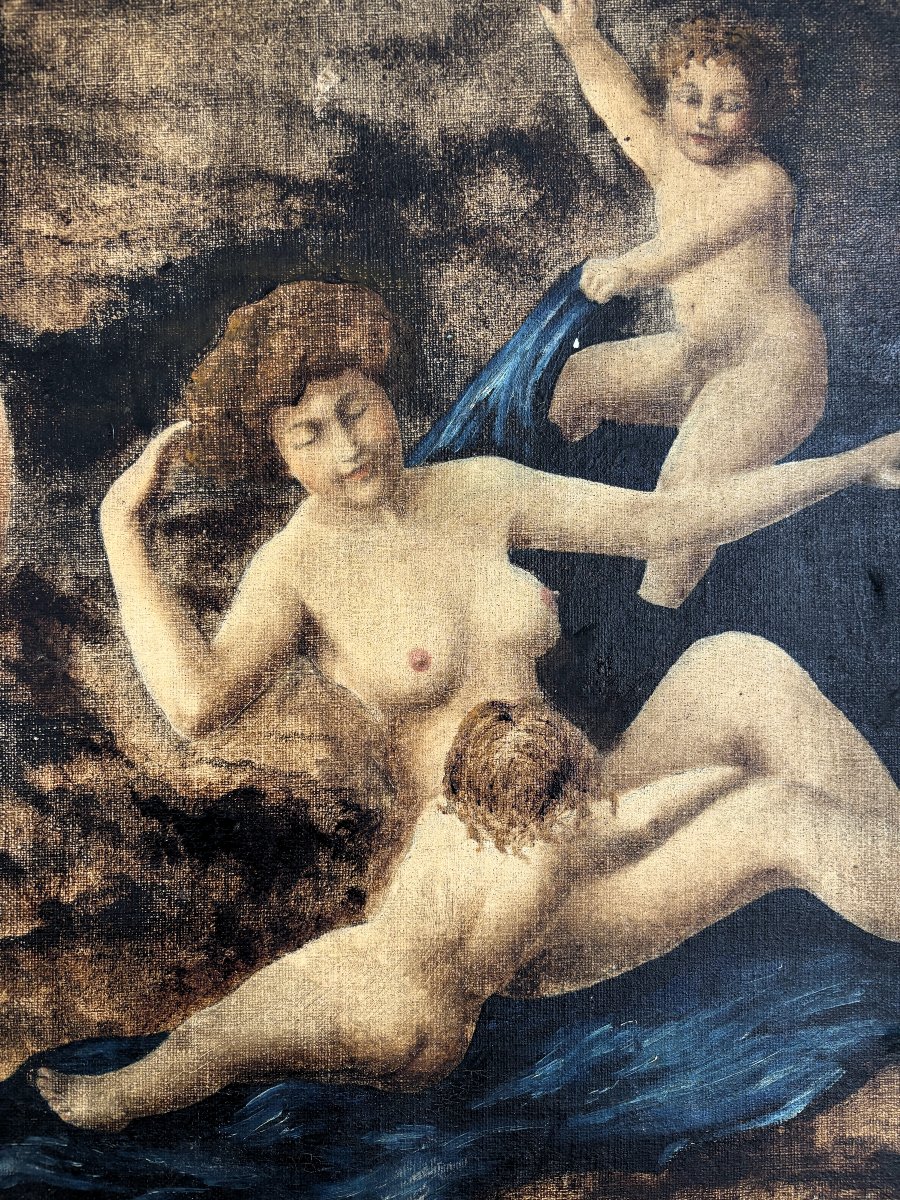
At the far right, a child partially wrapped in drapery sits upon a rock. The raised arm creates an upward movement that echoes that of the central figure. Below, a woman is depicted in a pose that is both sensual and maternal: her reclining body mirrors the diagonals traced by the landscape on the left side of the composition, while a second child lying at her feet engages with her presence, reinforcing the atmosphere of repose that permeates the scene. The blue drapery enveloping this first group introduces a cool chromatic accent within an ensemble otherwise dominated by browns and ochres.
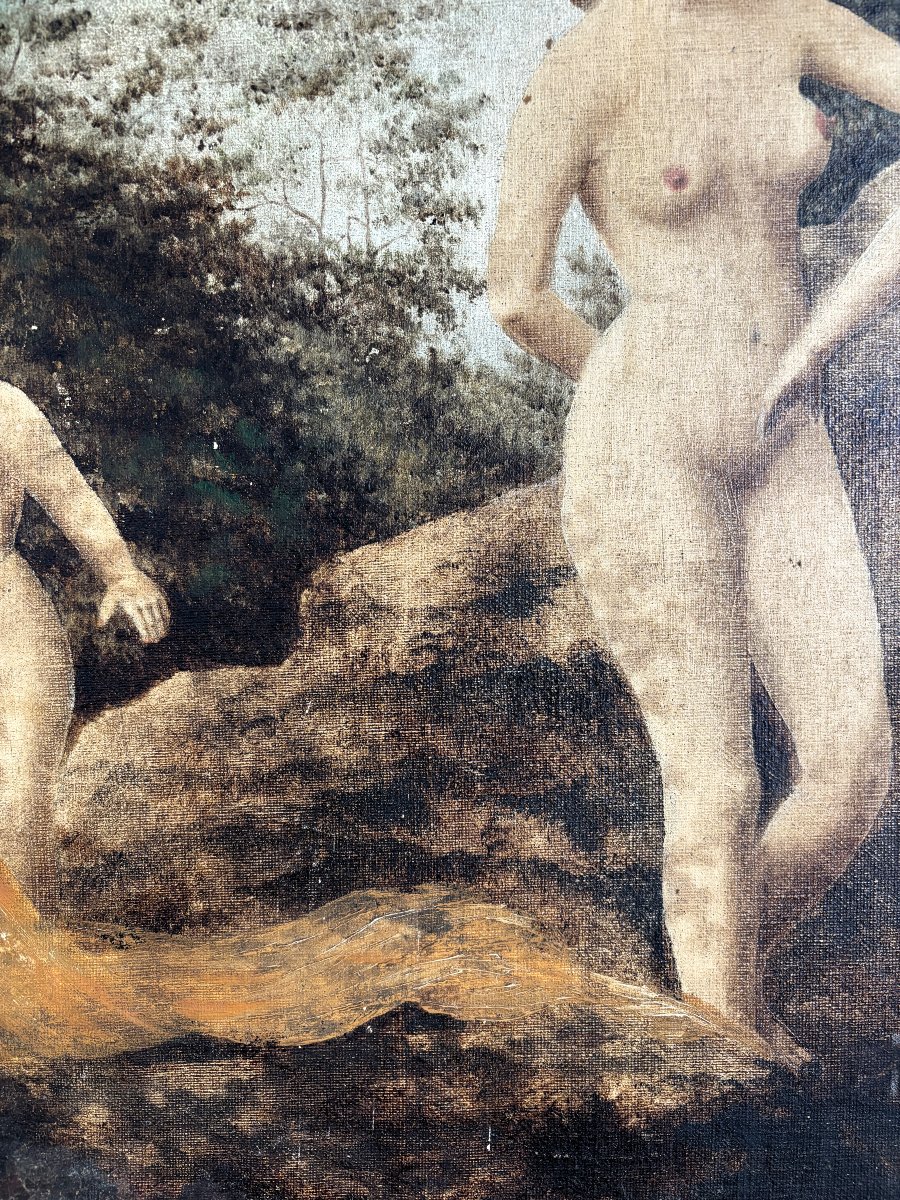
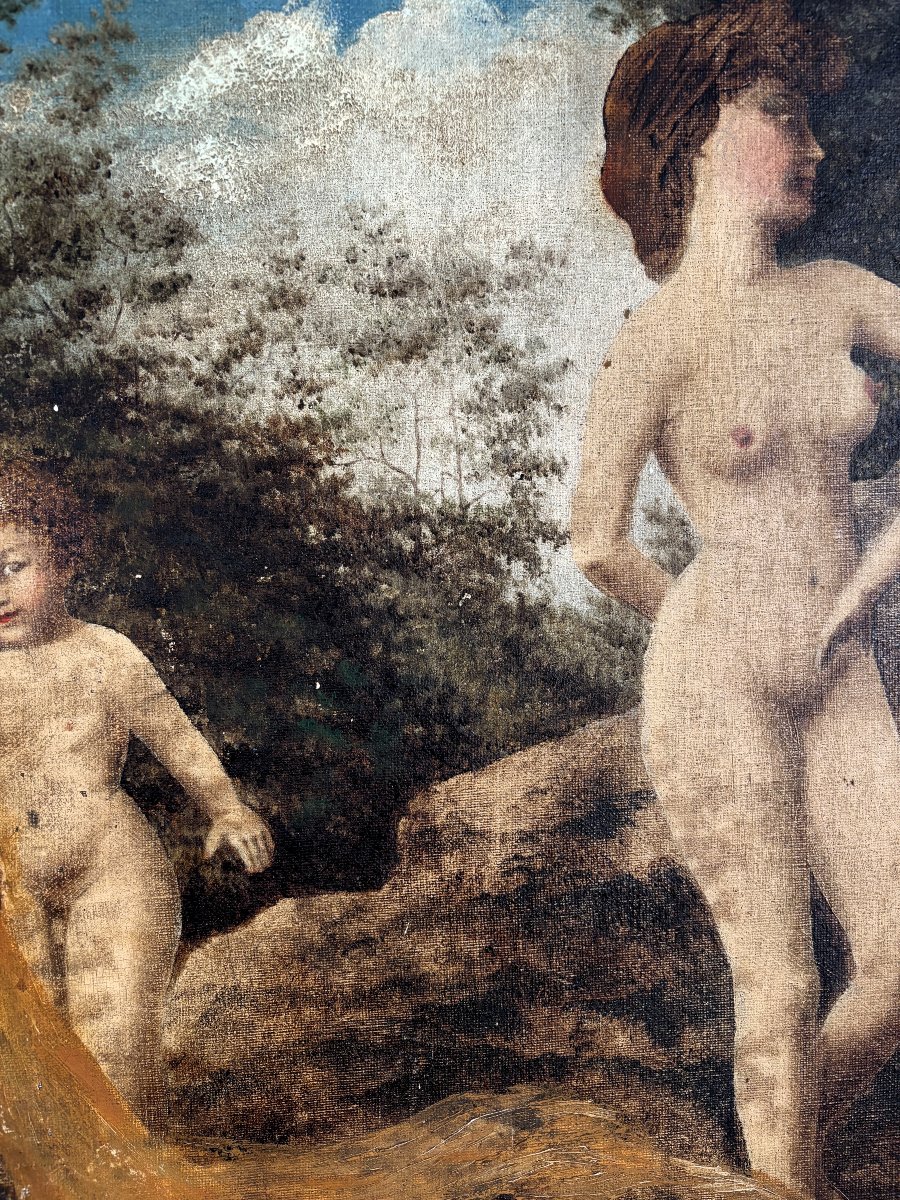
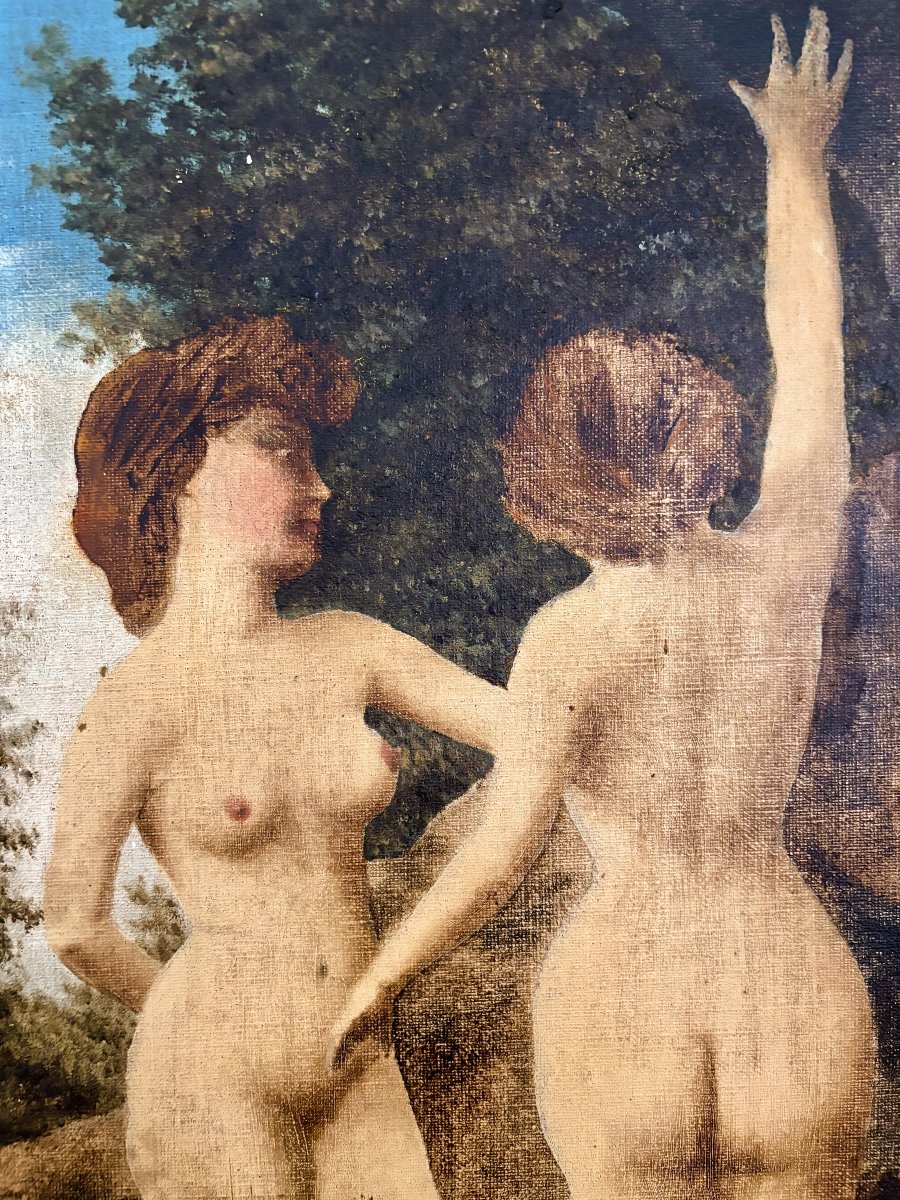
At the center of the composition stands the principal figure, a woman seen from behind who occupies the painting’s vertical axis. Her raised arm commands the composition and directs the viewer’s gaze toward the rocky outcrop towering above the group; this gesture serves as the work’s true visual fulcrum. To her left, a second woman shown in profile turns her face toward her companion in an attitude of silent exchange. Together, the two figures form a balanced pairing whose graceful volumes contrast with the rugged textures and angular contours of the surrounding rocks.
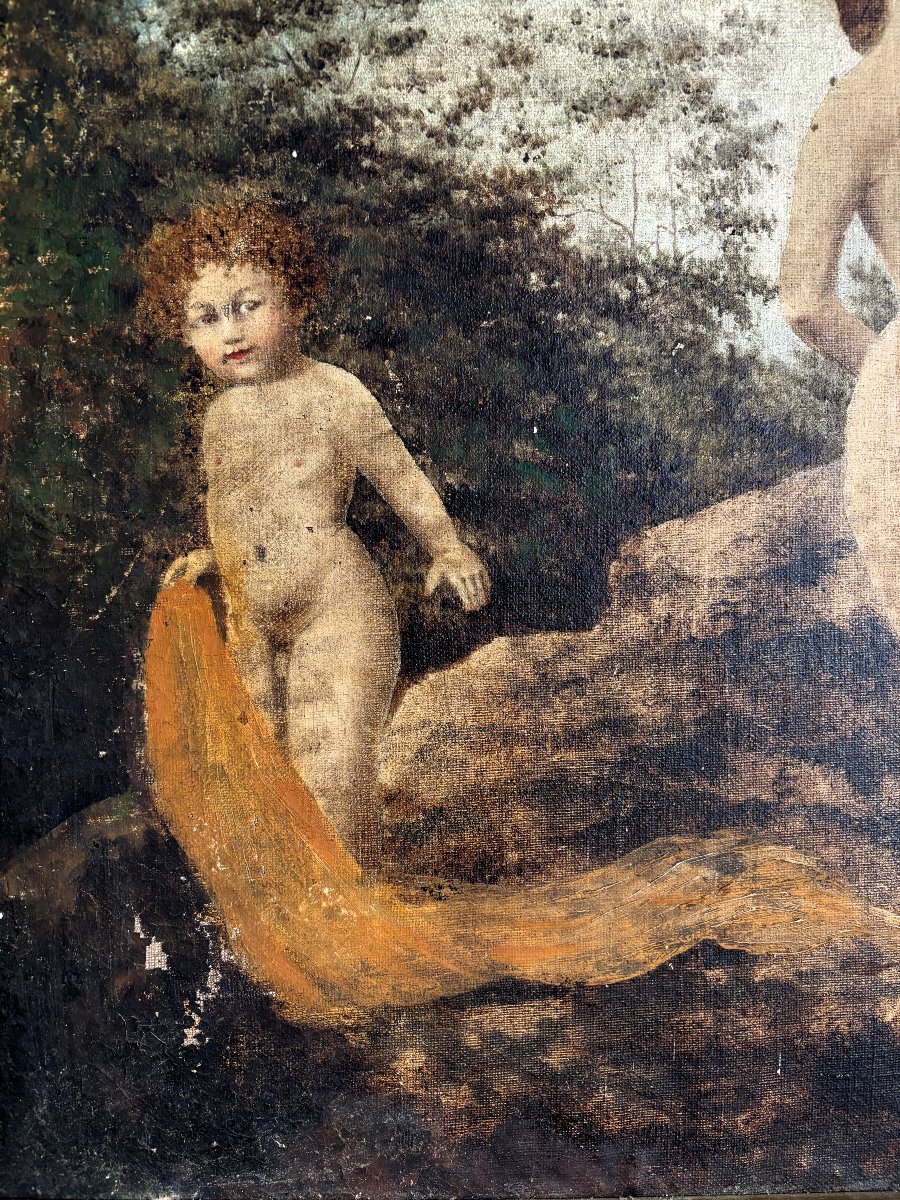
At the far left, a third child holds an orange drapery that visually responds to the blue fabric on the opposite side of the composition. While the child engages the viewer with a direct gaze, a radiant landscape unfolds behind him, effectively counterbalancing the protective darkness of the grotto.
The treatment of flesh is characterized by soft modeling and subtle tonal transitions. The palette remains deliberately restrained, dominated by earthy browns, pale flesh tones, and a few carefully placed accents of color. The figures exhibit a degree of formal simplification, while the landscape functions less as a realistic setting than as a poetic backdrop. The composition is harmonious and well balanced, with color masses thoughtfully distributed throughout. The overall effect is one of serenity and gentle contemplation. The faces are rendered with particular delicacy, revealing the artist’s sensitivity to expression and form. The contrast between the luminous landscape and the sheltering darkness of the cave may be interpreted as an evocation of the passage between untamed nature and the civilized world, or perhaps between dream and reality.
Condition
The painting is presented in a frame and remains on its original canvas. Overall, it is in good condition. The canvas is properly stretched, and the composition retains a pleasing visual presence. Colors remain distinct and luminous throughout.
Scattered minor paint losses are visible in the sky, within areas of vegetation, and in both lower corners of the composition. Several surface abrasions should be noted across the left portion of the painting, extending from the foreground up toward the horizon line. Approximately ten minute white paint accretions, ranging from 0.1 to 0.3 cm in size, are dispersed across the surface. The palette is moderately muted by light surface soiling, particularly in the sky passages. Under raking light, several areas of restoration become apparent, notably in the hair of the female figure shown in profile, in both draperies, and within portions of the grotto.
While the painting presents well and requires no immediate intervention, a professional conservation treatment would likely enhance its overall appearance, recovering the full brilliance of the original palette and improving the visual coherence of the surface.
Period: 20th century
Style: Modern Art
Condition: En l'etat
Material: Oil painting
Length: 71,5 cm
Width: 91 cm
Reference (ID): 1777364
Availability: In stock