

Late 18th Century, Early 19th Century, Venus Of Urbino
Late 18th century, early 19th century
Venus of Urbino
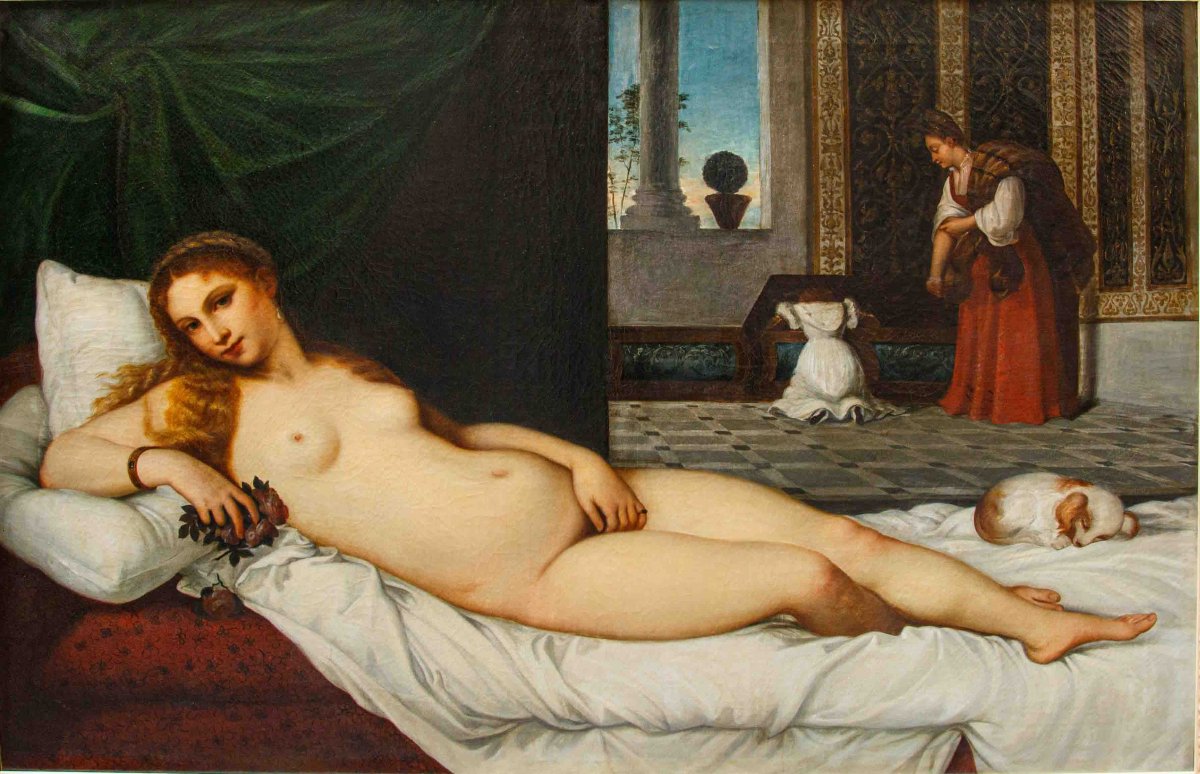
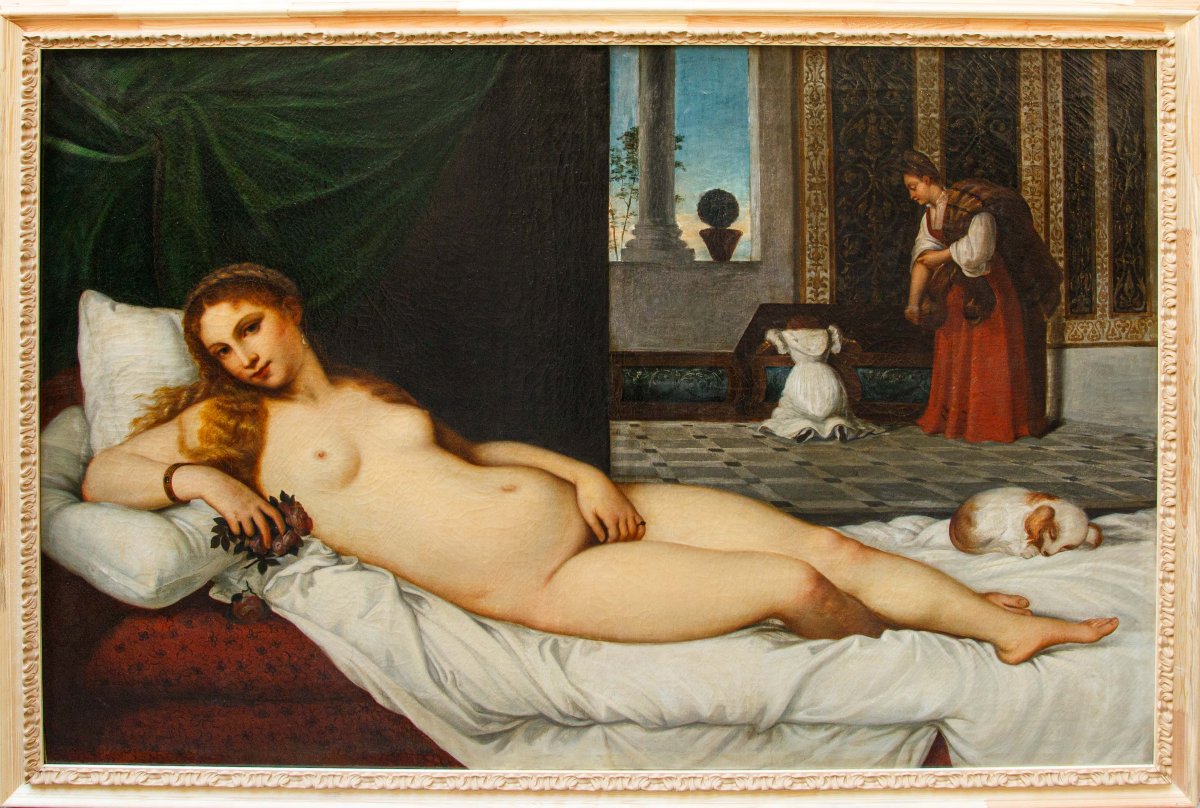
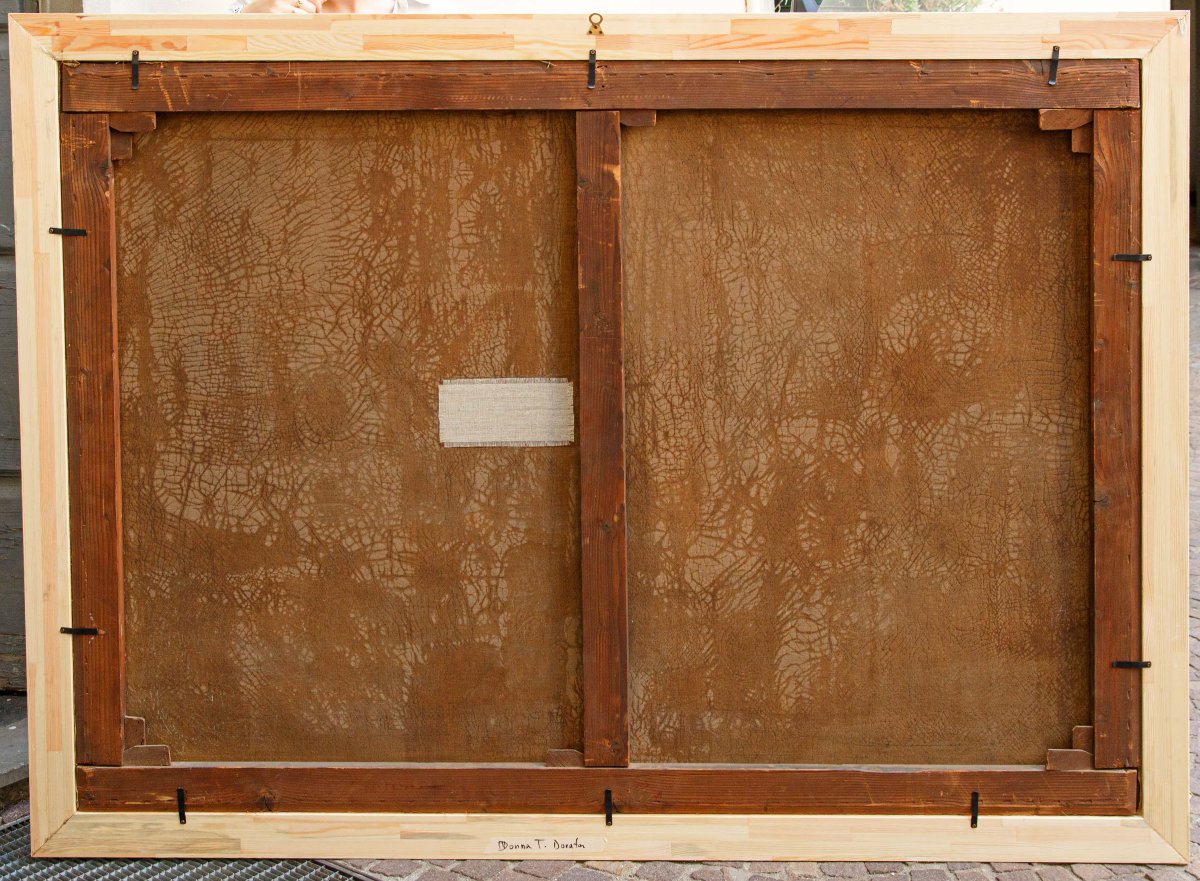
Oil on canvas, 117 x 158 cm
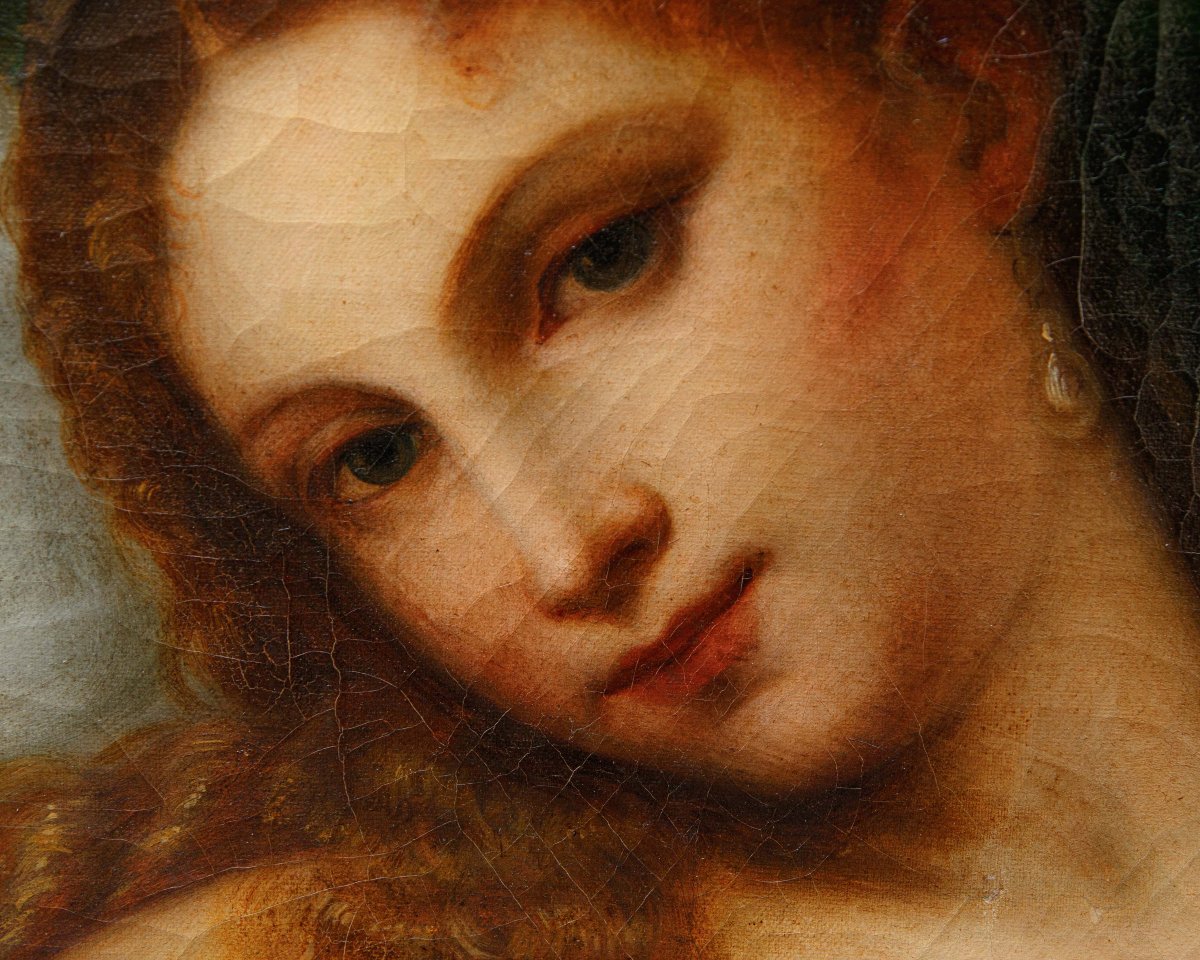
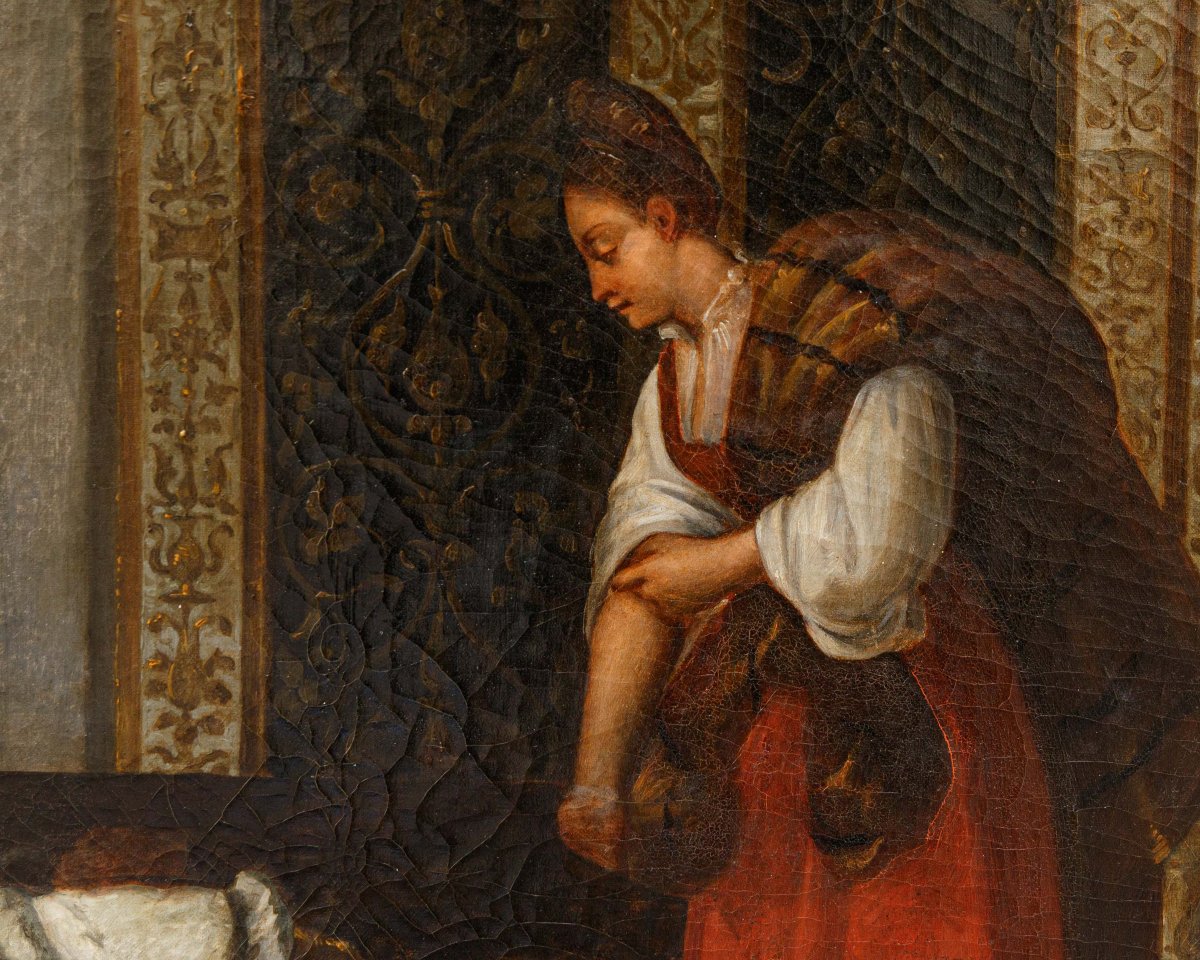
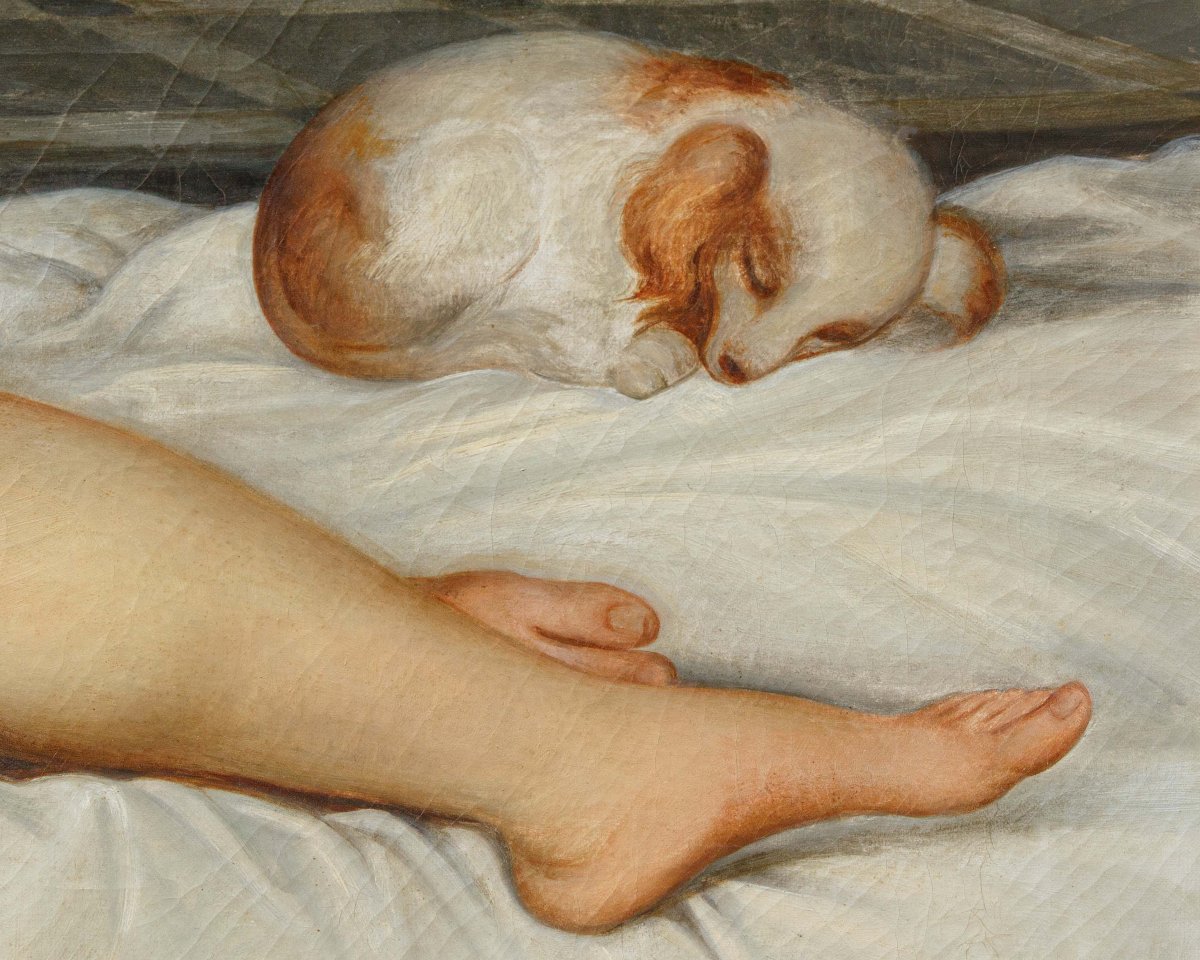
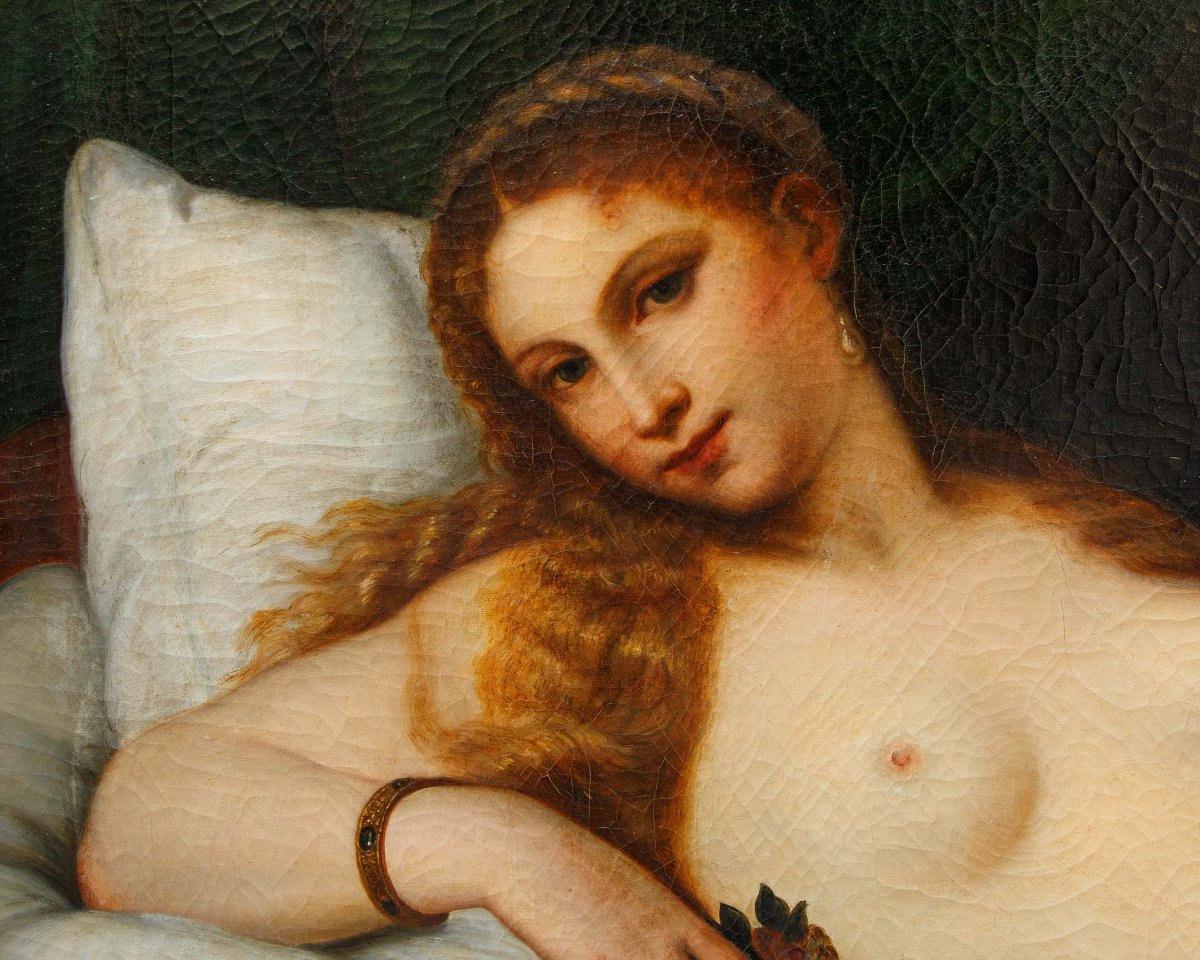
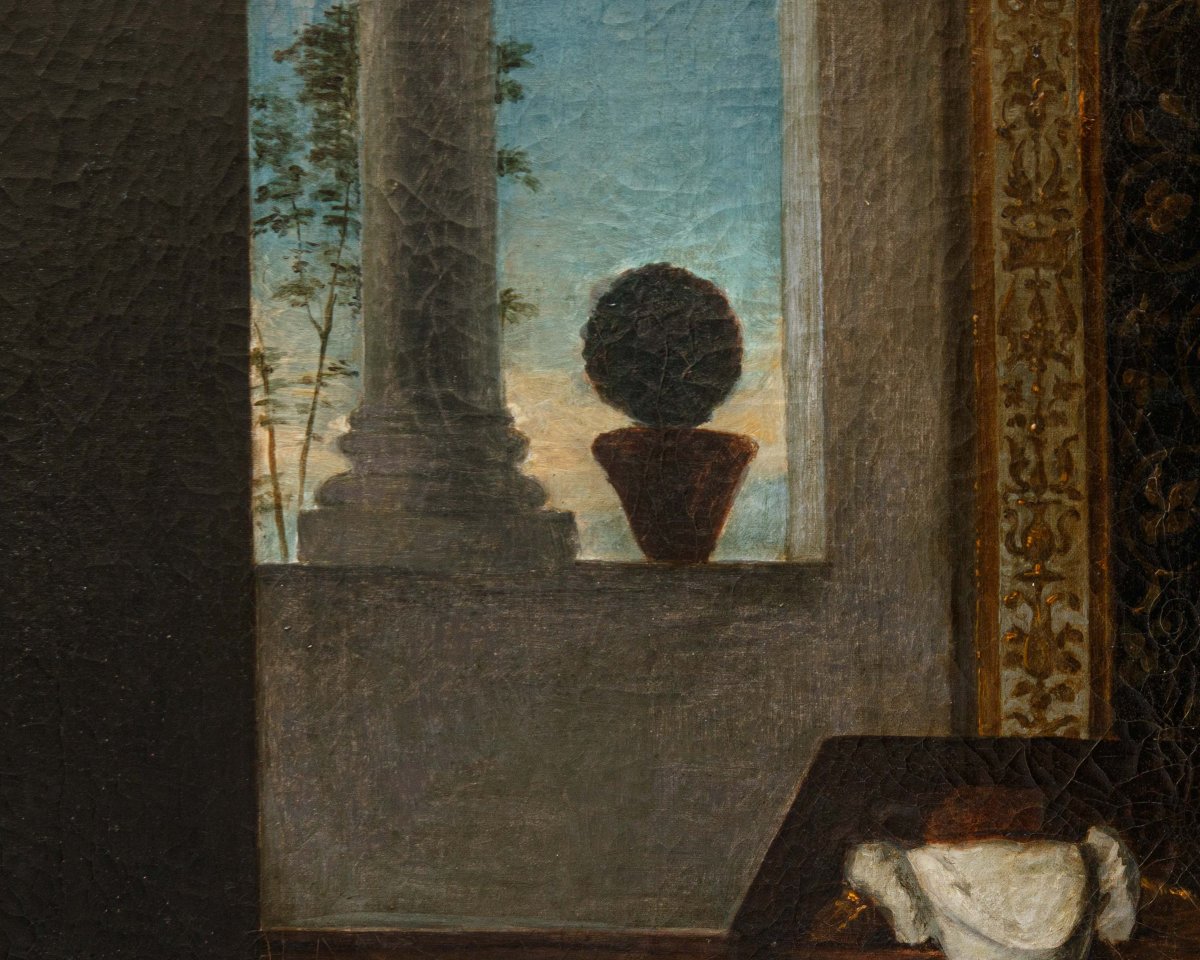
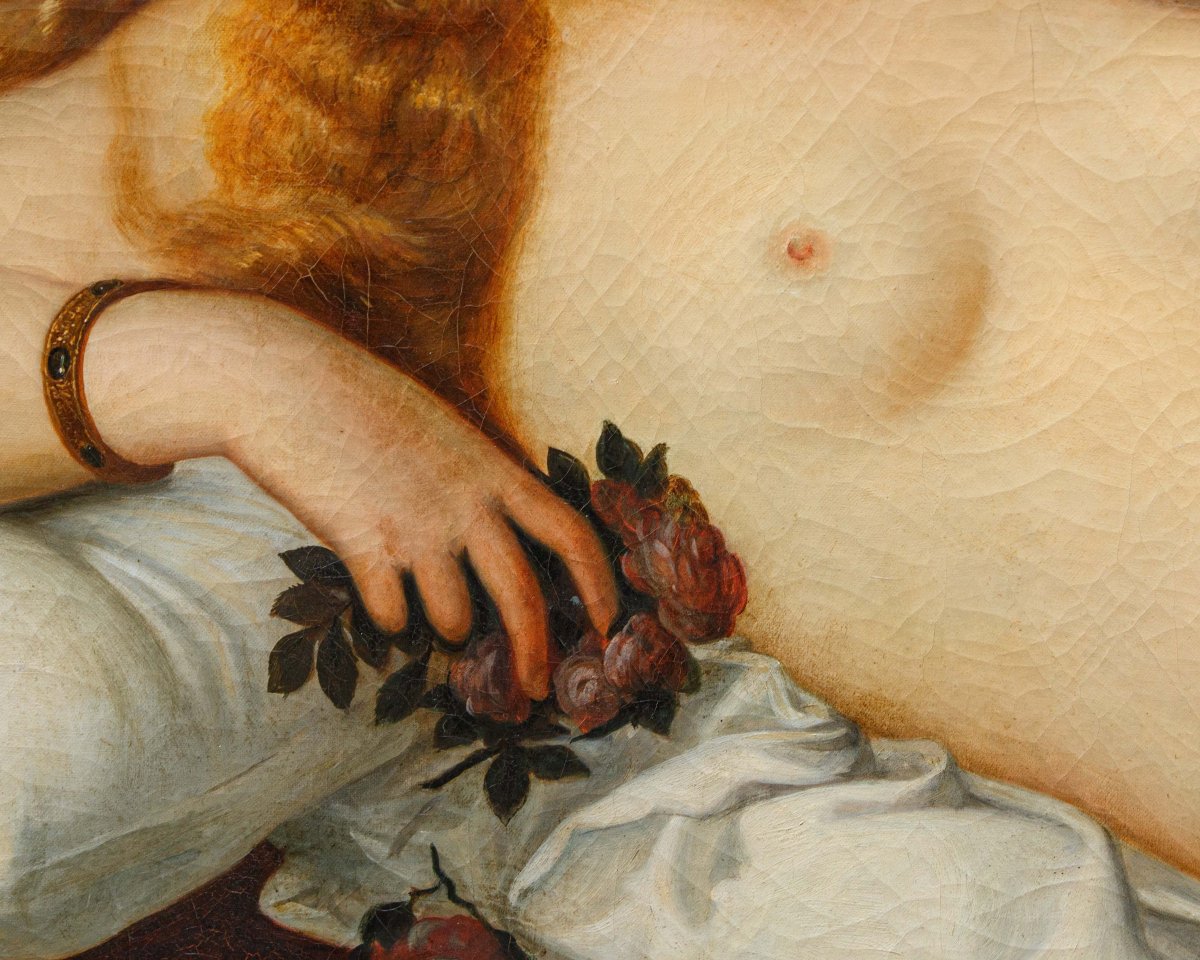
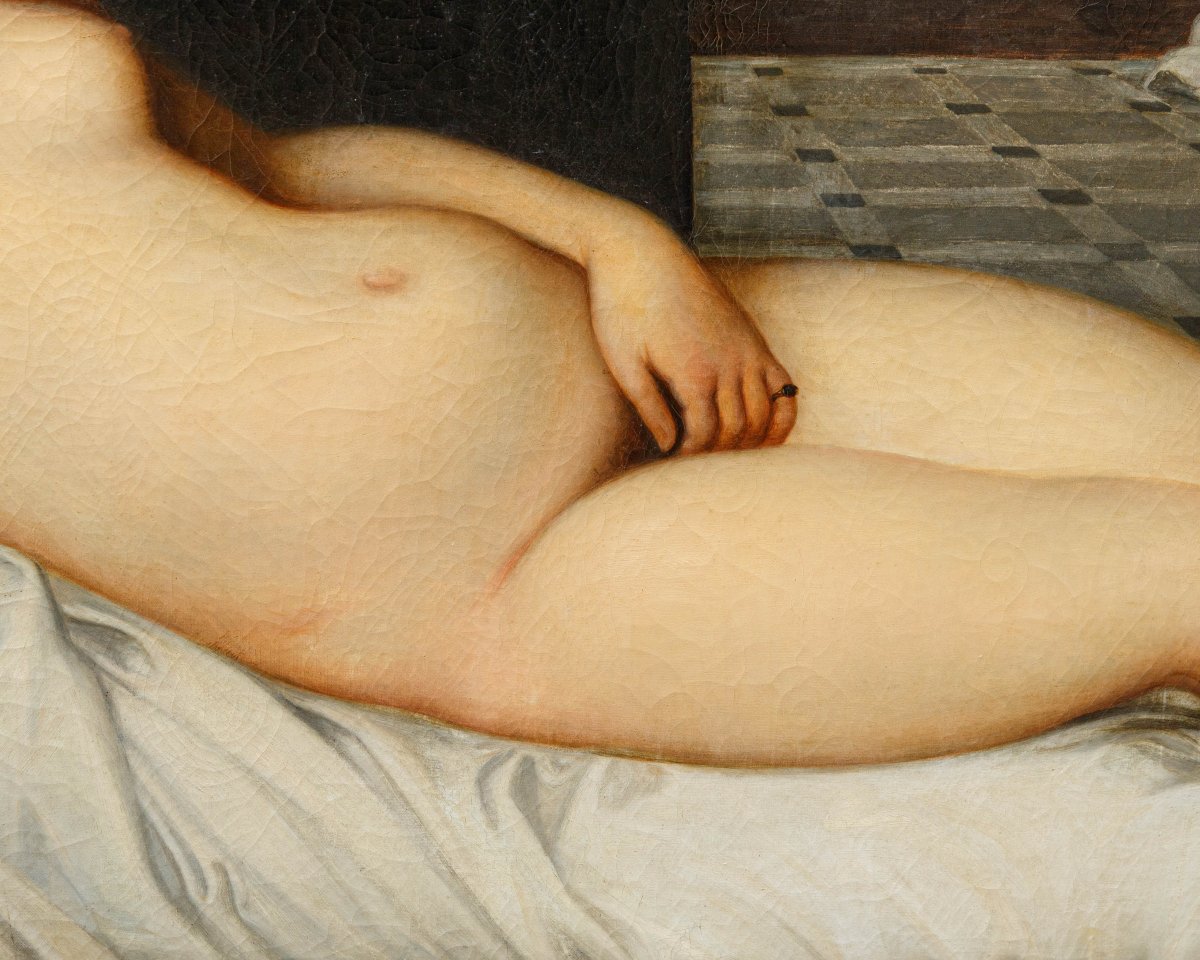
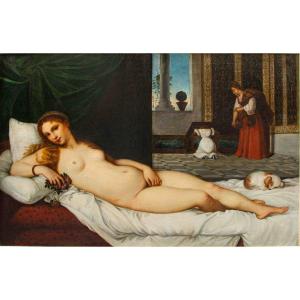
The canvas depicts a young nude woman reclining on a bed covered with a white sheet, her upper body raised and supported by soft white pillows. The figure turns her head toward the viewer with a direct and composed gaze, while her left hand modestly covers her pubis—a gesture reminiscent of the classical type of the Modest Venus—and her right hand slowly lets a few red roses slip from her grasp, a flower that has always been sacred to the goddess. At her feet, curled up on the bed, sleeps a small dog rendered with affectionate realism. In the background, a parted green curtain offers a glimpse of a Renaissance interior: two maids are rummaging through a chest, one kneeling to search among the fabrics, the other, dressed in red with an elegant hairstyle, already holding a rich gown over her shoulder. This copy, executed between the late 18th and early 19th centuries, reproduces Titian’s famous original with remarkable fidelity.
The Venus of Urbino was commissioned by Guidobaldo II della Rovere, scion of the Duchy of Urbino, who in March 1538 urgently urged his agent in Venice to obtain a “nude woman” painted by Titian. The work was intended for his very young wife, Giulia da Varano, whom he had married in 1534 for political reasons: the painting was meant to serve as an educational model, persuading her of the joys of marriage in an allegorical and culturally refined manner. Titian depicted the goddess by toning down the mythological references in favor of a modern and recognizable domestic setting, transforming the deity into a living, present woman, capable of meeting the viewer’s gaze directly.
Venus immediately gained widespread fame, leading to a surge in requests for copies and variations from both Titian and other Venetian painters. In 1631, Vittoria della Rovere, the last descendant of the dynasty, married Ferdinando II de’ Medici, bringing to Florence a priceless collection of works, including the famous painting, which has been housed in the Uffizi ever since. In the centuries that followed, the painting became a must-see for every cultured traveler and was mentioned in countless guidebooks. Jean-Auguste-Dominique Ingres made a copy of it in 1821, now at the Walters Art Gallery in Baltimore; even Giuseppe Verdi owned a reproduction of it in his studio at Villa Sant’Agata. The Venus of Urbino follows in the footsteps of Giorgione’s Venus of Dresden, of which it represents a more explicit and provocative version: there, the goddess slept, unaware of the gaze of others; here, however, she seeks it out and welcomes it. It was precisely this sense of self-aware presence that served as a model for generations of artists: Francisco Goya with *La Maja Desnuda*, Ingres with *La Grande Odalisque*, and finally Édouard Manet, who copied the painting in 1856 and precisely recreated its setting for his 1865 Olympia, a scandalous work that transposed the Renaissance theme into modern-day Paris, ideally closing a circle spanning three centuries.
Period: 18th century
Style: Other Style
Condition: Good condition
Material: Oil painting
Width: 158
Height: 117
Reference (ID): 1775106
Availability: In stock