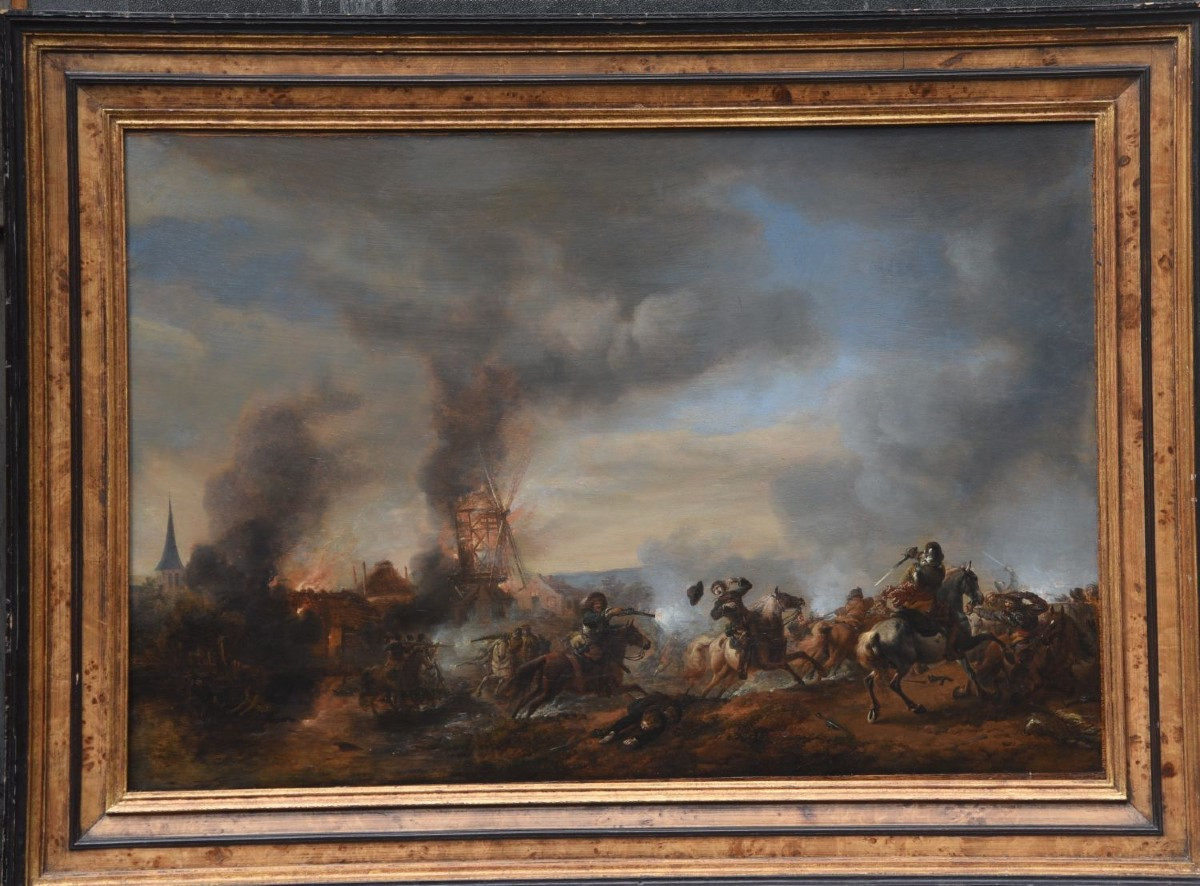
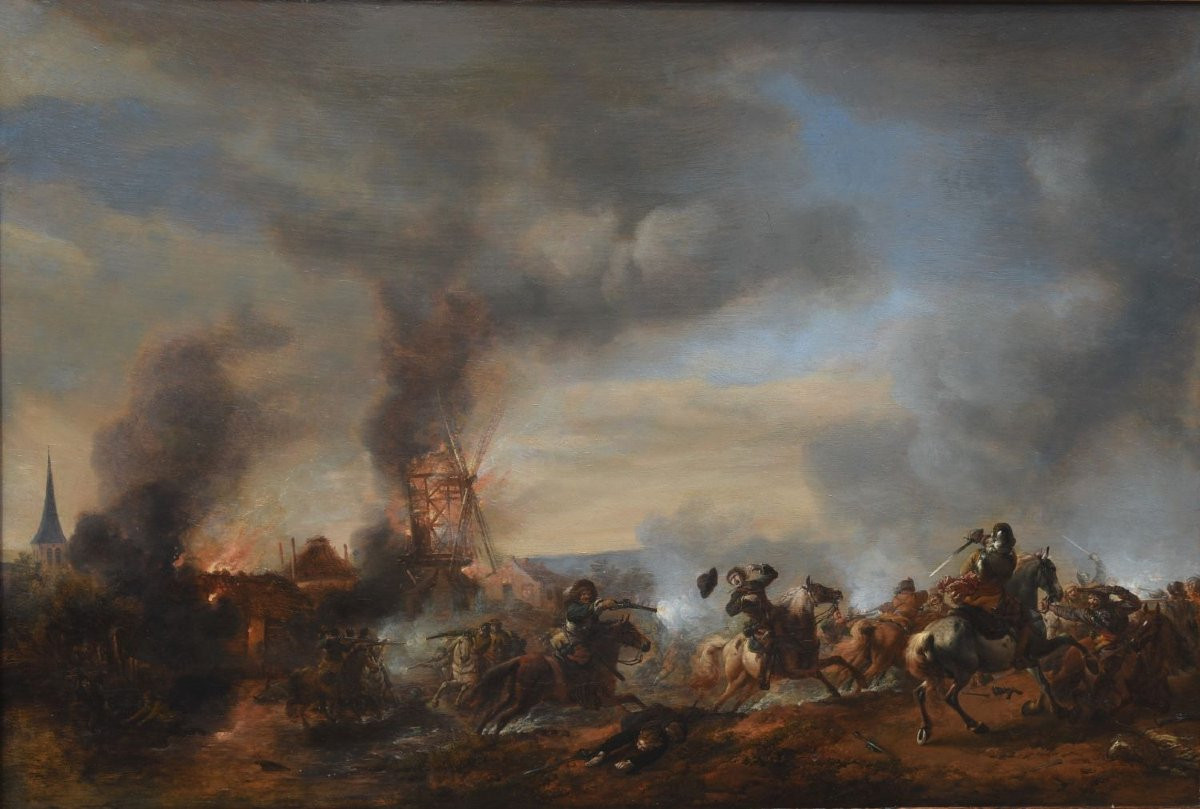
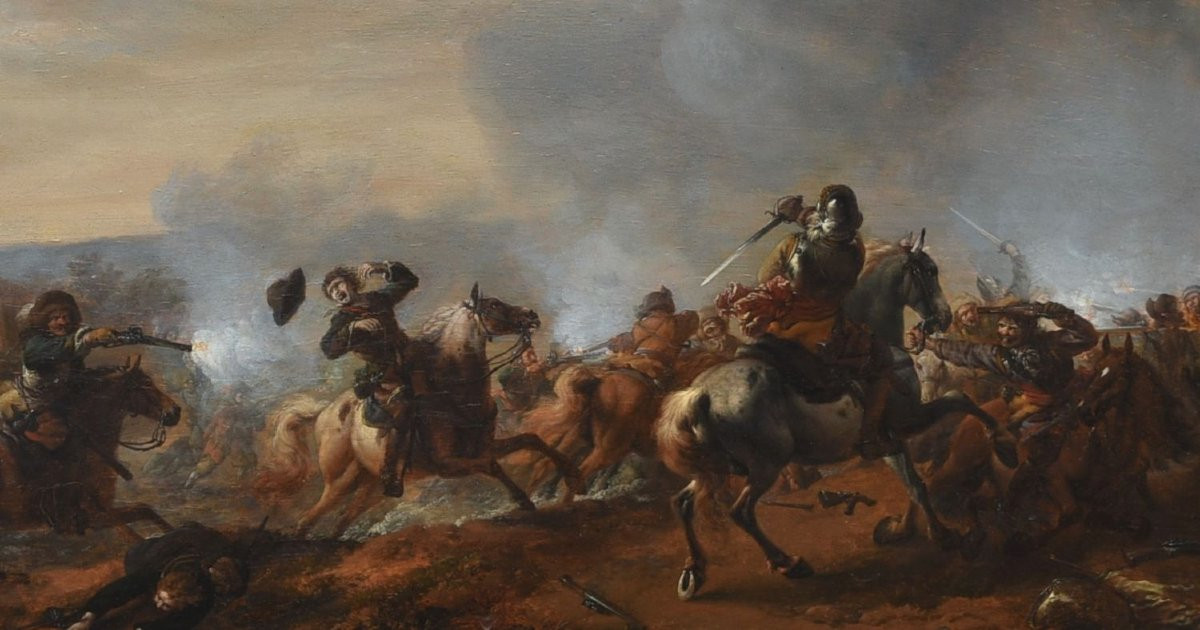
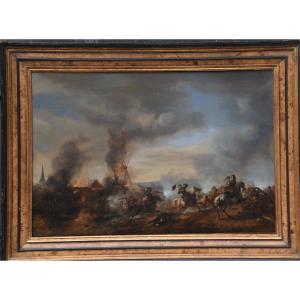


A Cavalry Charge Against A Burning Windmill – Philips Wouwerman, 17th Century
Artist: Phipilps Wouwerman
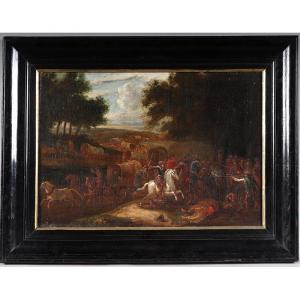
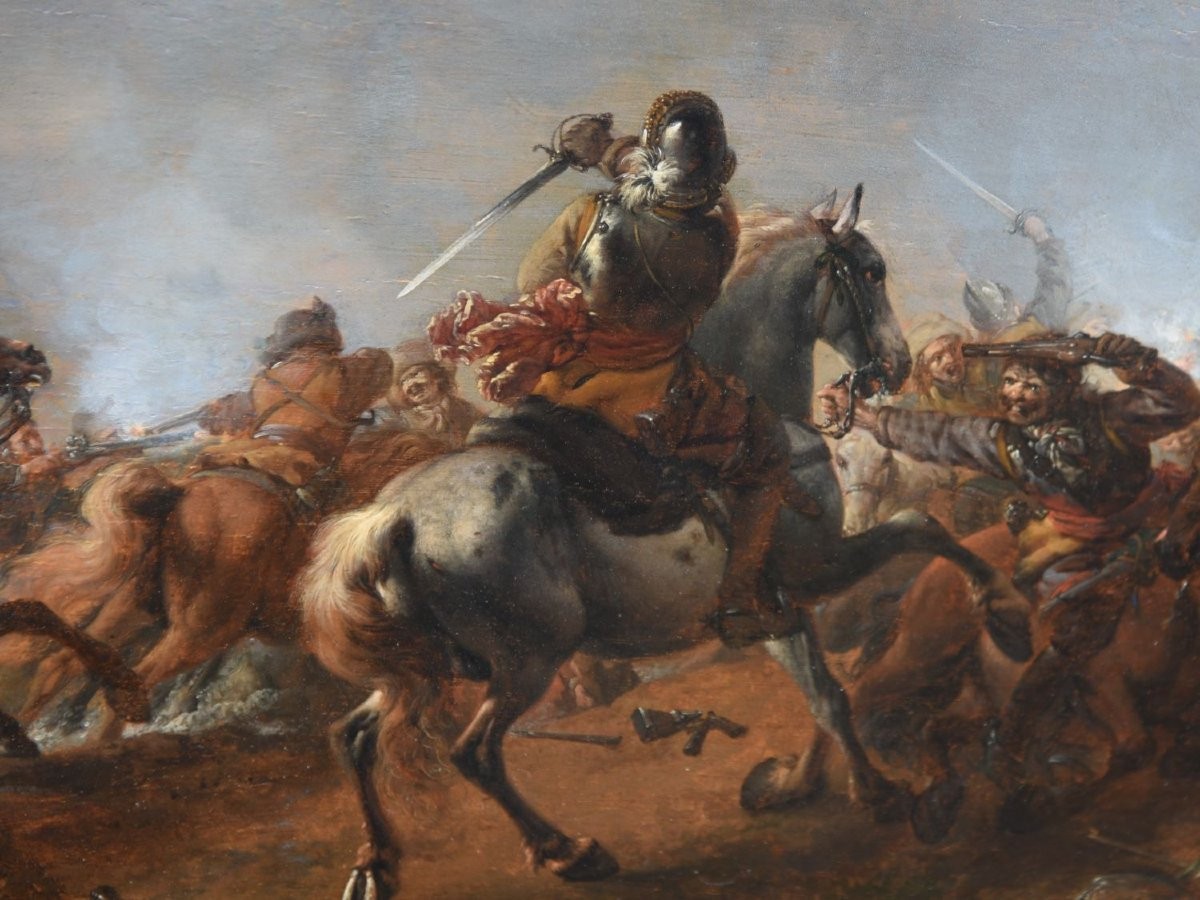
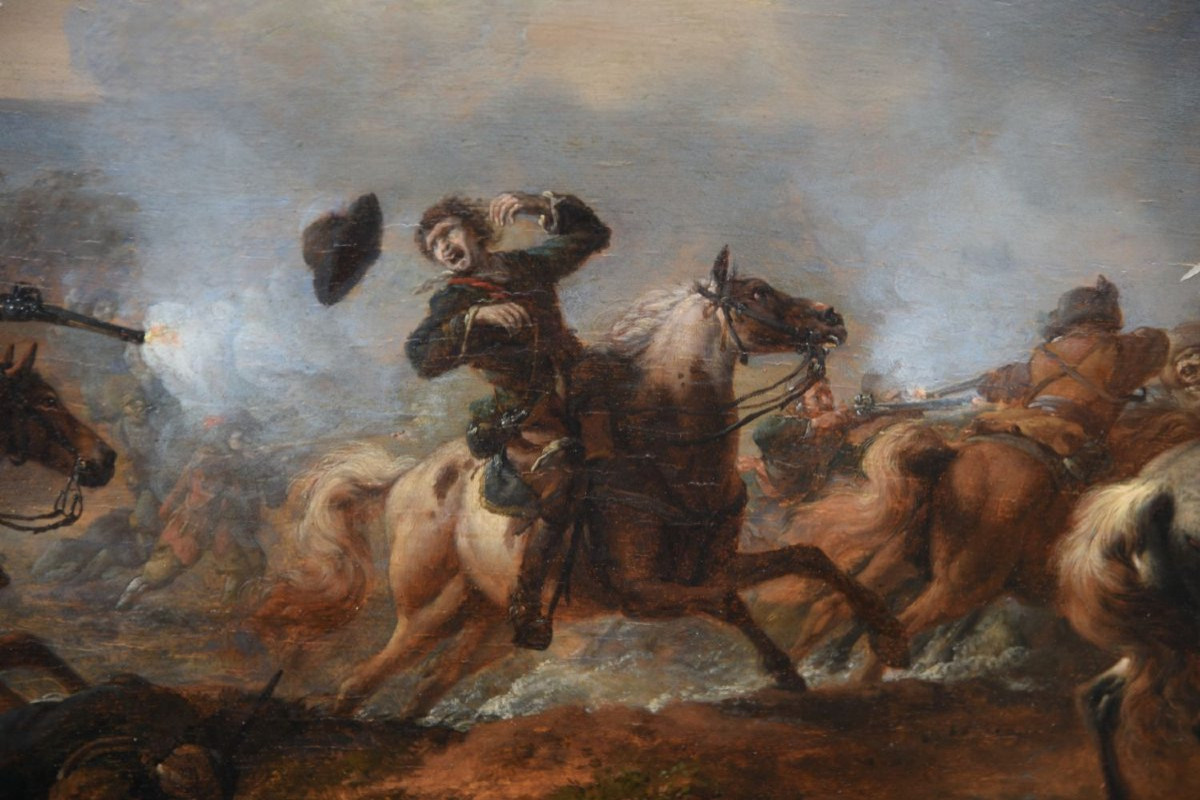
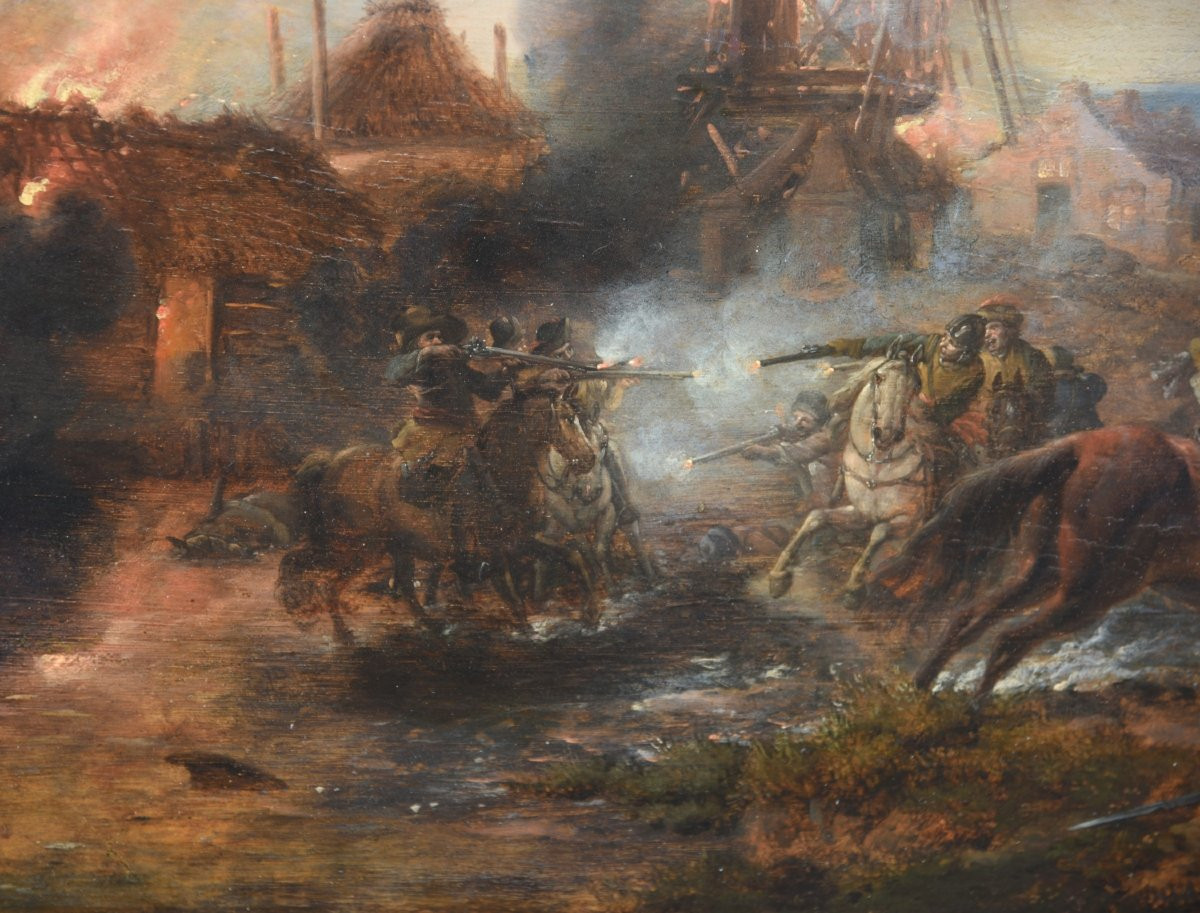
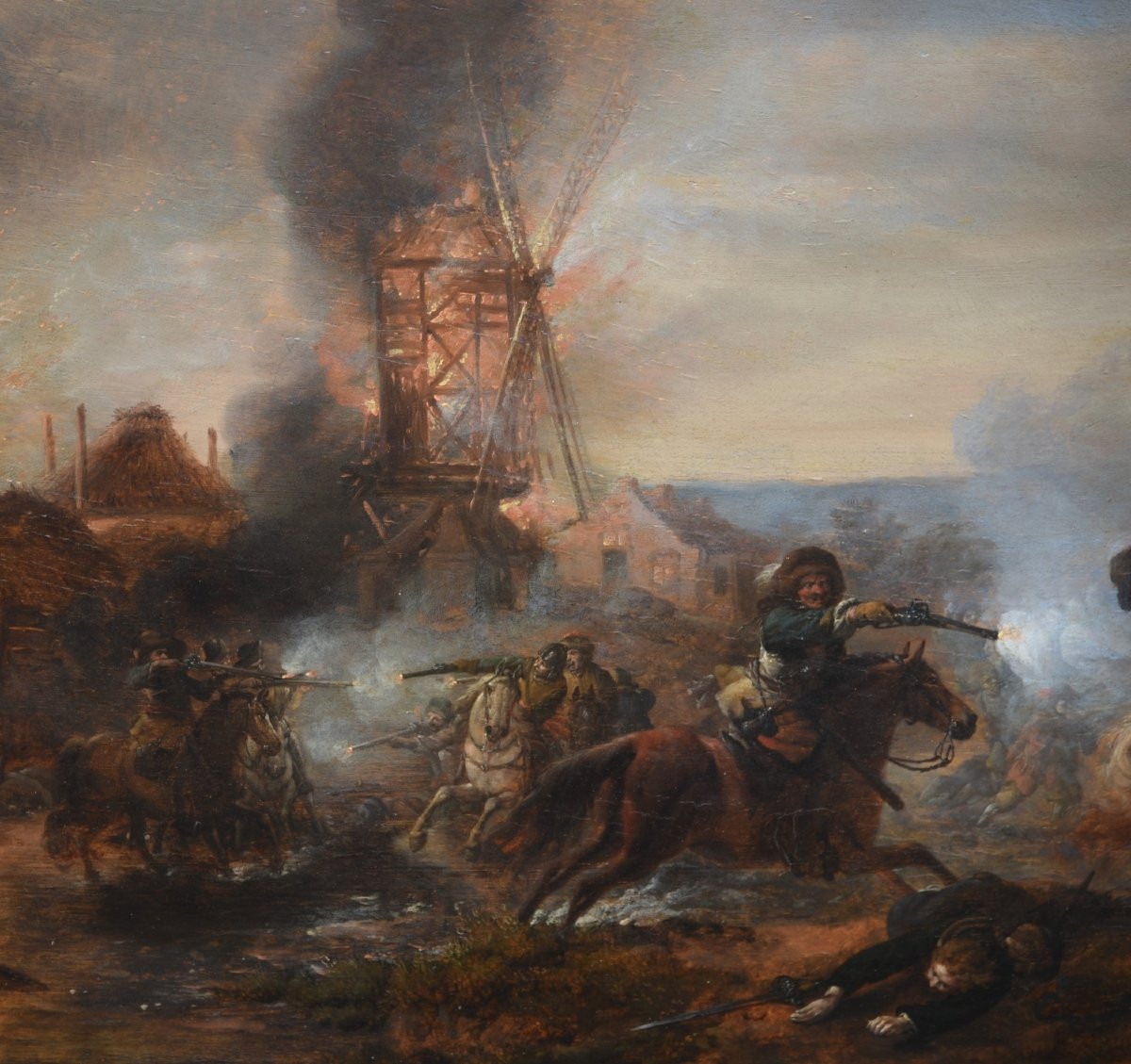
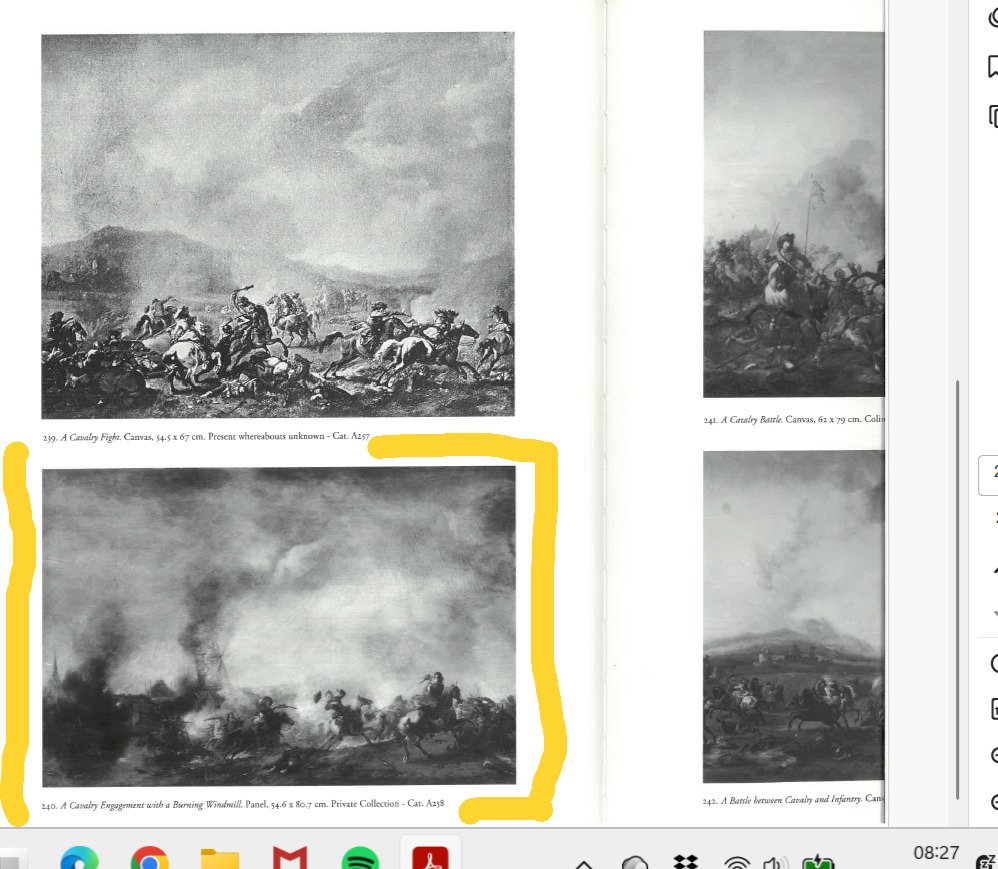
The painting depicts a cavalry battle scene set in a rural Northern European landscape, organized according to a broad, airy horizontal composition. The main action unfolds in the foreground, with riders captured in rapid, crisscrossing movements, galloping horses, and fallen figures, while in the background the scene gradually opens up toward an atmospheric horizon dominated by rural architecture and a burning windmill, a distinctive iconographic element.
The spatial construction is entrusted to a progression of planes, typical of Philips Wouwerman, in which the action is concentrated in the foreground but is balanced by a broad landscape. The arrangement of the figures is not chaotic: each group is calibrated to guide the viewer's gaze along dynamic diagonals, a recurring compositional solution in the master's autograph works.
A decisive element is the depiction of the horses, which is one of Wouwerman's main distinctive features. The animals are depicted with:
• precise and natural anatomy
• varied and believable postures
• fluid, never stiff movement
• perfect integration between horse and rider
This ability to combine energy and formal control is one of the artist's most recognizable signatures and is rarely matched by his followers.
The brushstrokes, loose yet controlled, alternate heavier strokes in the foreground figures with lighter, more atmospheric strokes in the background. This technical differentiation, combined with his mastery of light, is fully consistent with Wouwerman's stylistic maturity. The sky, streaked with smoke and clouds, is not merely a backdrop, but an integral part of the narrative: the light filters and modulates the forms, contributing to the drama of the scene without weighing it down.
The color palette, dominated by warm browns, pearly grays, muted blues, and touches of ochre, is typical of Wouwerman's work, as is the use of luminous accents on harnesses, flesh tones, and metallic details to enliven the composition.
From an iconographic perspective, the presence of the mill, the chivalric scenes, and the rural setting place the work within one of Wouwerman's most characteristic and appreciated genres, frequently replicated by the artist in autograph variants now held in European museums and historical collections.
Finally, the overall quality of the work—in terms of compositional certainty, stylistic coherence, technical skill, and narrative force—clearly surpasses that of a workshop or simple follower, placing it at a level compatible with the direct hand of the master.
________________________________________
LITERATURE
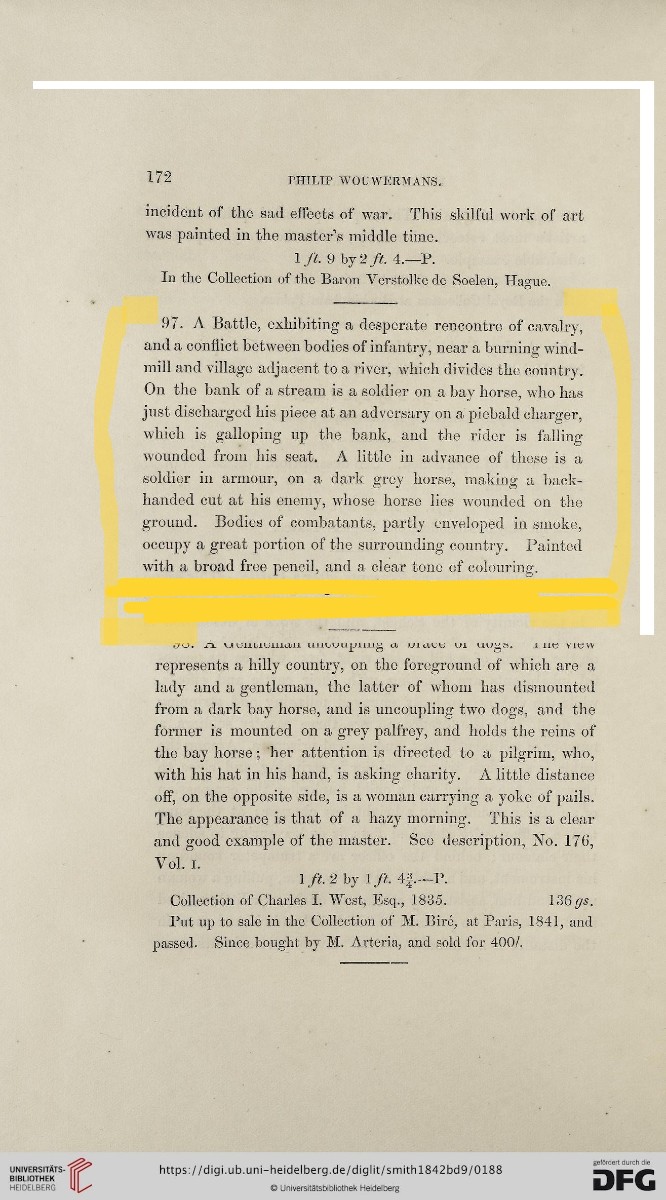
• J. Smith, Supplement to the Catalogue Raisonné of the Works of the Most Eminent Dutch, Flemish, and French Painters, London 1842, vol. 9, p. 172, no. 97
The page is numbered 172 in the original edition, but the entry is still no. 97:
“Smith, vol. 9, 97” = John Smith, Supplement, volume 9, entry no. 97 (page 172 of the 1842 edition)
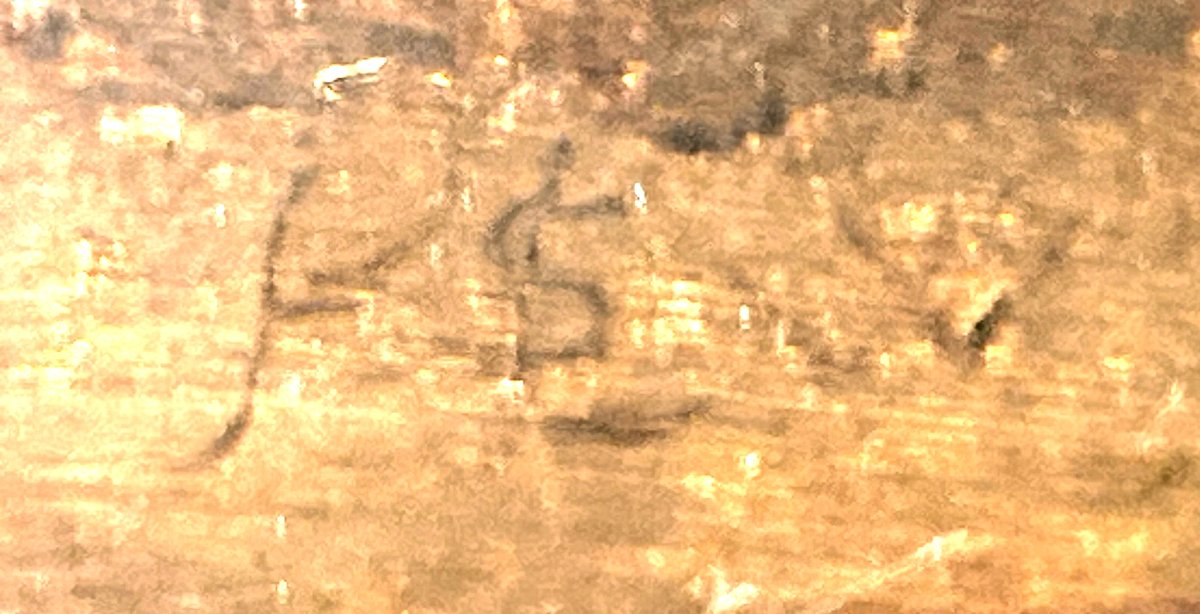
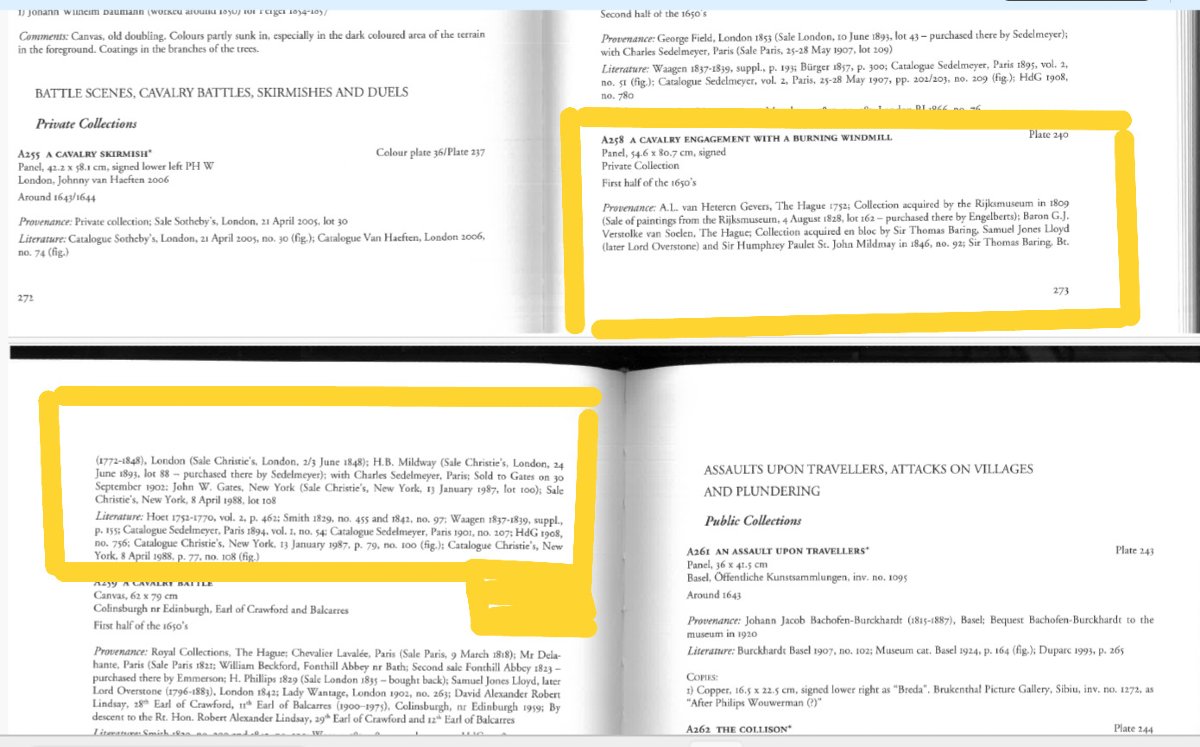
This entry describes a painting by Philips Wouwerman, now known as A Cavalry Engagement with a Burning Windmill, monogrammed PSW BOTTOM RIGHT.
Smith describes:
Subject
A cavalry scene, with:
• mounted soldiers in the foreground
• a burning windmill in the background
• dynamic atmosphere, typical of his battle pieces
• white and bay horses, rendered with his usual mastery
• figures arranged diagonally, with a strong sense of movement
Signature / Monogram
Smith specifies that the painting is monogrammed.
Smith indicates the monogram "P S W"
The monogram PSW is certified as authentic by Smith.
Smith considers it:
• an authentic work
• of excellent quality
• representative of the artist's mature period
John Smith (1781–1855)
John Smith was a 19th-century British art dealer and art historian, known for creating the first major systematic catalogue raisonné of Dutch, Flemish, and French painters. His work is considered fundamental to the history of European collecting.
Characteristics of her method
• Detailed descriptions of the paintings
• Measurements, subjects, pictorial quality
• Prices achieved at auction
• Known provenances
• Locations in private collections and museums
• Information on signatures and monograms
• Sequentially numbered works
Birgit Schumacher (catalog 2006)
The painting is included as A258 in her catalogue raisonné.
PSW is a rare but authentic monogram, historically attested and recognized by scholars.
Birgit Schumacher (catalog 2006)
The painting is included as A258 in her catalogue raisonné.
Birgit Schumacher, Philips Wouwerman (1619–1668). The Horse Painter of the Golden Age, 2 vols., Doornspijk 2006.
Entry A258 can be found:
• Volume I, pp. 273–274
• Volume II, plate 240 (reproduction of the painting)
Birgit Schumacher – Art Historian
Birgit Schumacher is a German art historian, internationally recognized as one of the leading scholars of the work of Peter Paul Rubens. His most important work is the catalogue raisonné of Rubens' paintings, published in 2006, today considered one of the fundamental tools for:
• attributions
• comparative studies
• museum cataloging
• expertise and market valuations
. Areas of Specialization
• 17th-Century Flemish Painting
• Works of Peter Paul Rubens
• Attributions and Stylistic Analysis
• Scientific Cataloging
Monogram:
o PSW accepted as a rare but historically attested variant
o consistent with documentary tradition (Smith, Waagen, auction catalogs)
Provenance
Schumacher, for A258, reconstructs a long and continuous provenance, which in summary is:
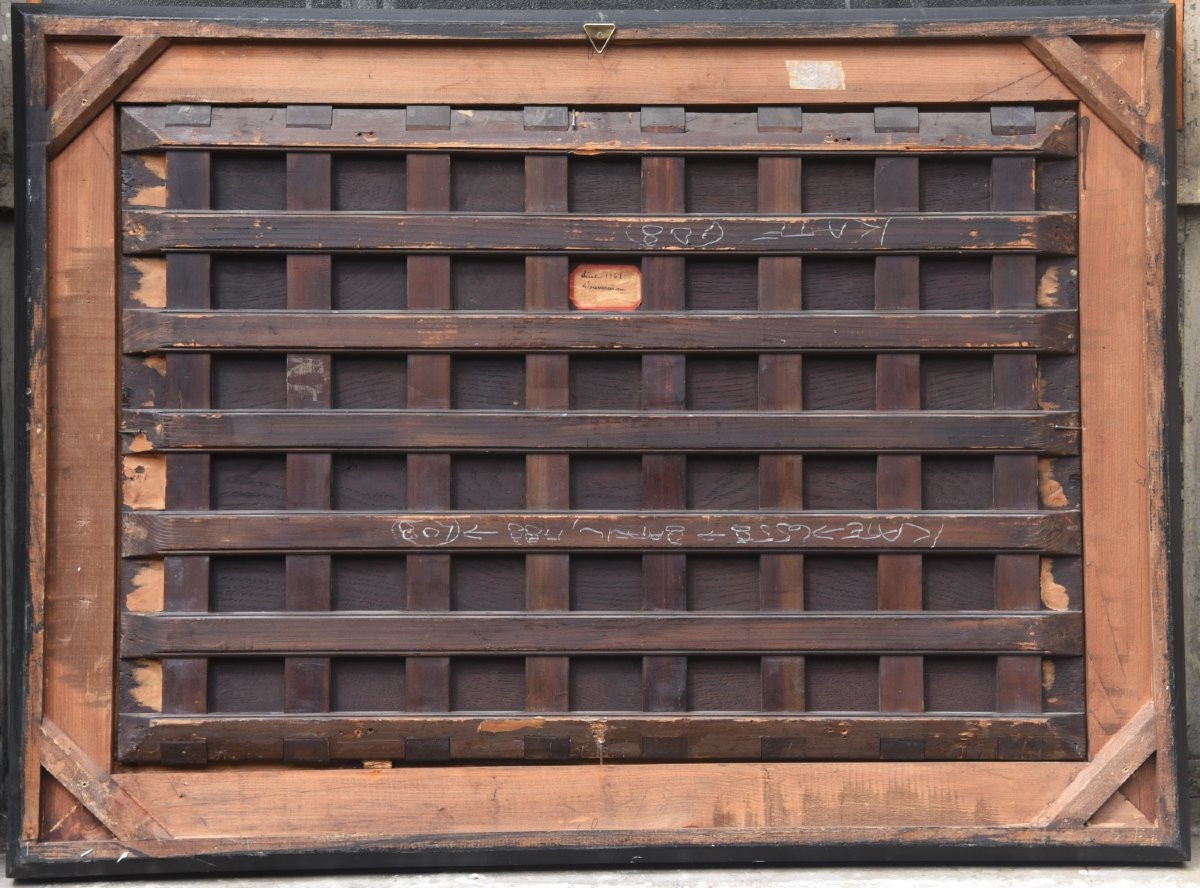
1. Adriaan Leonard van Heteren Gevers, The Hague – collection 1752
2. Koninklijk Museum, Amsterdam – gift 1809
3. Auction 1828, lot 162 – purchased by Brondgeest
4. Baron G. J. Verstolk van Soelen, The Hague
5. 1846: Purchased en bloc by Sir Thomas Baring, Samuel Jones Lloyd (Lord Overstone), and Sir Humphrey Mildmay
6. Mildmay Auction, Christie's, London, 1893
7. Charles Sedelmayer, Paris – sold to John W. Gates in 1902
8. John W. Gates, New York – private collection
9. Christie's New York, 1987 and 1988 auctions
10. Galleria Caretto, Turin (1988)
11. European private collection (recent state)
Philips Wouwerman
Philips Wouwerman (Haarlem, 1619 – 1668) is one of the most important Dutch painters of the 17th century, famous above all for his battle, cavalry, and military scenes, but also for his animated landscapes and genre scenes.
Probably trained in his father's workshop and influenced by Flemish battle painting, Wouwerman developed a personal style characterized by:
• extraordinary skill in depicting horses
• dynamic yet balanced compositions
• refined use of light and atmosphere
• narrative attention combined with formal elegance
His works were enormously successful during his lifetime and, especially in the 18th century, were highly sought after by major European collections, entering royal and aristocratic collections in the Netherlands, France, England, Germany, and Italy. Many painters worked in his workshop or under his influence, giving rise to a vast body of followers and imitators.
Today, Wouwerman's autograph works are held in major international museums and are considered benchmarks of Dutch battle painting.
The work can be viewed and appraised by experts in Italy.
The spatial construction is entrusted to a progression of planes, typical of Philips Wouwerman, in which the action is concentrated in the foreground but is balanced by a broad landscape. The arrangement of the figures is not chaotic: each group is calibrated to guide the viewer's gaze along dynamic diagonals, a recurring compositional solution in the master's autograph works.
A decisive element is the depiction of the horses, which is one of Wouwerman's main distinctive features. The animals are depicted with:
• precise and natural anatomy
• varied and believable postures
• fluid, never stiff movement
• perfect integration between horse and rider
This ability to combine energy and formal control is one of the artist's most recognizable signatures and is rarely matched by his followers.
The brushstrokes, loose yet controlled, alternate heavier strokes in the foreground figures with lighter, more atmospheric strokes in the background. This technical differentiation, combined with his mastery of light, is fully consistent with Wouwerman's stylistic maturity. The sky, streaked with smoke and clouds, is not merely a backdrop, but an integral part of the narrative: the light filters and modulates the forms, contributing to the drama of the scene without weighing it down.
The color palette, dominated by warm browns, pearly grays, muted blues, and touches of ochre, is typical of Wouwerman's work, as is the use of luminous accents on harnesses, flesh tones, and metallic details to enliven the composition.
From an iconographic perspective, the presence of the mill, the chivalric scenes, and the rural setting place the work within one of Wouwerman's most characteristic and appreciated genres, frequently replicated by the artist in autograph variants now held in European museums and historical collections.
Finally, the overall quality of the work—in terms of compositional certainty, stylistic coherence, technical skill, and narrative force—clearly surpasses that of a workshop or simple follower, placing it at a level compatible with the direct hand of the master.
________________________________________
LITERATURE
• J. Smith, Supplement to the Catalogue Raisonné of the Works of the Most Eminent Dutch, Flemish, and French Painters, London 1842, vol. 9, p. 172, no. 97
The page is numbered 172 in the original edition, but the entry is still no. 97:
“Smith, vol. 9, 97” = John Smith, Supplement, volume 9, entry no. 97 (page 172 of the 1842 edition)
This entry describes a painting by Philips Wouwerman, now known as A Cavalry Engagement with a Burning Windmill, monogrammed PSW BOTTOM RIGHT.
Smith describes:
Subject
A cavalry scene, with:
• mounted soldiers in the foreground
• a burning windmill in the background
• dynamic atmosphere, typical of his battle pieces
• white and bay horses, rendered with his usual mastery
• figures arranged diagonally, with a strong sense of movement
Signature / Monogram
Smith specifies that the painting is monogrammed.
Smith indicates the monogram "P S W"
The monogram PSW is certified as authentic by Smith.
Smith considers it:
• an authentic work
• of excellent quality
• representative of the artist's mature period
John Smith (1781–1855)
John Smith was a 19th-century British art dealer and art historian, known for creating the first major systematic catalogue raisonné of Dutch, Flemish, and French painters. His work is considered fundamental to the history of European collecting.
Characteristics of her method
• Detailed descriptions of the paintings
• Measurements, subjects, pictorial quality
• Prices achieved at auction
• Known provenances
• Locations in private collections and museums
• Information on signatures and monograms
• Sequentially numbered works
Birgit Schumacher (catalog 2006)
The painting is included as A258 in her catalogue raisonné.
PSW is a rare but authentic monogram, historically attested and recognized by scholars.
Birgit Schumacher (catalog 2006)
The painting is included as A258 in her catalogue raisonné.
Birgit Schumacher, Philips Wouwerman (1619–1668). The Horse Painter of the Golden Age, 2 vols., Doornspijk 2006.
Entry A258 can be found:
• Volume I, pp. 273–274
• Volume II, plate 240 (reproduction of the painting)
Birgit Schumacher – Art Historian
Birgit Schumacher is a German art historian, internationally recognized as one of the leading scholars of the work of Peter Paul Rubens. His most important work is the catalogue raisonné of Rubens' paintings, published in 2006, today considered one of the fundamental tools for:
• attributions
• comparative studies
• museum cataloging
• expertise and market valuations
. Areas of Specialization
• 17th-Century Flemish Painting
• Works of Peter Paul Rubens
• Attributions and Stylistic Analysis
• Scientific Cataloging
Monogram:
o PSW accepted as a rare but historically attested variant
o consistent with documentary tradition (Smith, Waagen, auction catalogs)
Provenance
Schumacher, for A258, reconstructs a long and continuous provenance, which in summary is:
1. Adriaan Leonard van Heteren Gevers, The Hague – collection 1752
2. Koninklijk Museum, Amsterdam – gift 1809
3. Auction 1828, lot 162 – purchased by Brondgeest
4. Baron G. J. Verstolk van Soelen, The Hague
5. 1846: Purchased en bloc by Sir Thomas Baring, Samuel Jones Lloyd (Lord Overstone), and Sir Humphrey Mildmay
6. Mildmay Auction, Christie's, London, 1893
7. Charles Sedelmayer, Paris – sold to John W. Gates in 1902
8. John W. Gates, New York – private collection
9. Christie's New York, 1987 and 1988 auctions
10. Galleria Caretto, Turin (1988)
11. European private collection (recent state)
Philips Wouwerman
Philips Wouwerman (Haarlem, 1619 – 1668) is one of the most important Dutch painters of the 17th century, famous above all for his battle, cavalry, and military scenes, but also for his animated landscapes and genre scenes.
Probably trained in his father's workshop and influenced by Flemish battle painting, Wouwerman developed a personal style characterized by:
• extraordinary skill in depicting horses
• dynamic yet balanced compositions
• refined use of light and atmosphere
• narrative attention combined with formal elegance
His works were enormously successful during his lifetime and, especially in the 18th century, were highly sought after by major European collections, entering royal and aristocratic collections in the Netherlands, France, England, Germany, and Italy. Many painters worked in his workshop or under his influence, giving rise to a vast body of followers and imitators.
Today, Wouwerman's autograph works are held in major international museums and are considered benchmarks of Dutch battle painting.
The work can be viewed and appraised by experts in Italy.
58 000 €
Period: 17th century
Style: Renaissance, Louis 13th
Condition: Excellent condition
Material: Oil painting on wood
Width: 56
Height: 82
Reference (ID): 1761392
Availability: In stock
Print