

Hermann Corrodi, “the Sabil Qaitbay On The Esplanade Of The Dome Of The Rock, Jerusalem”
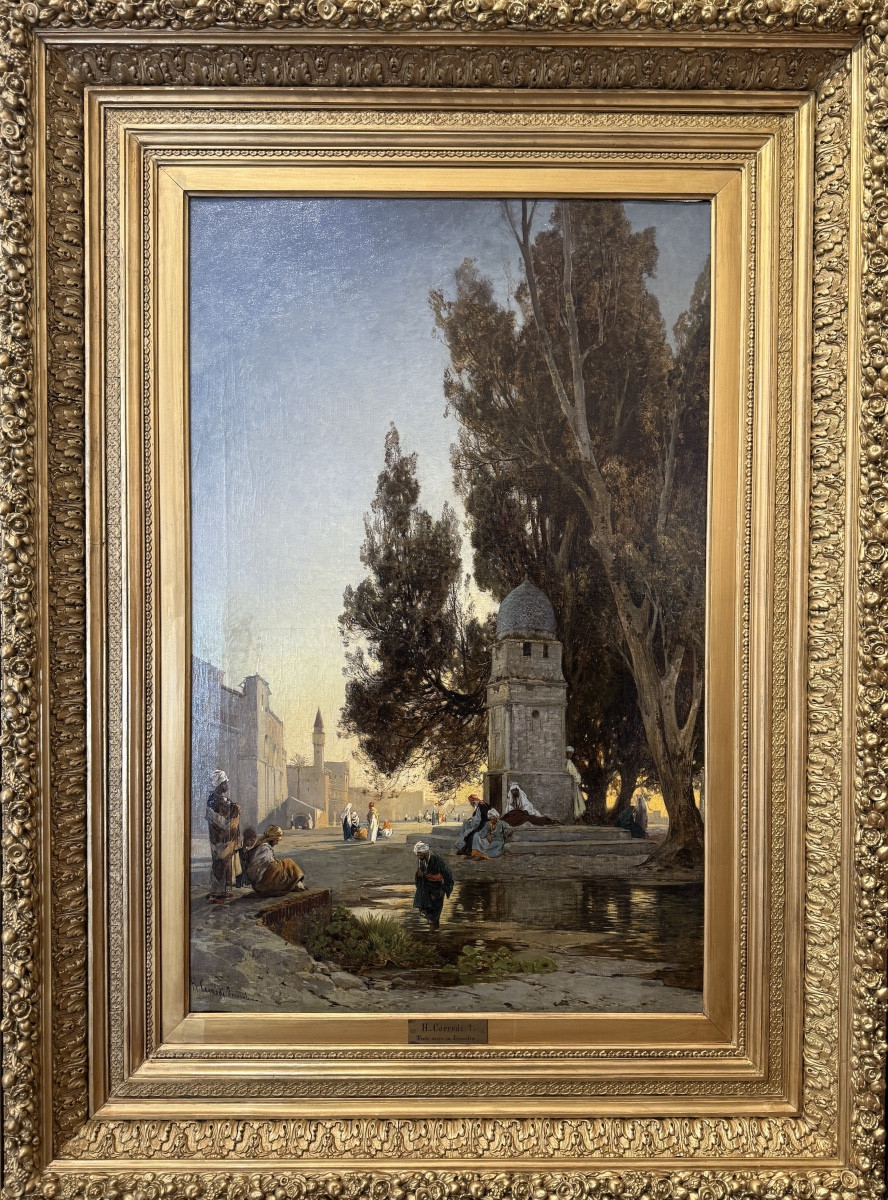
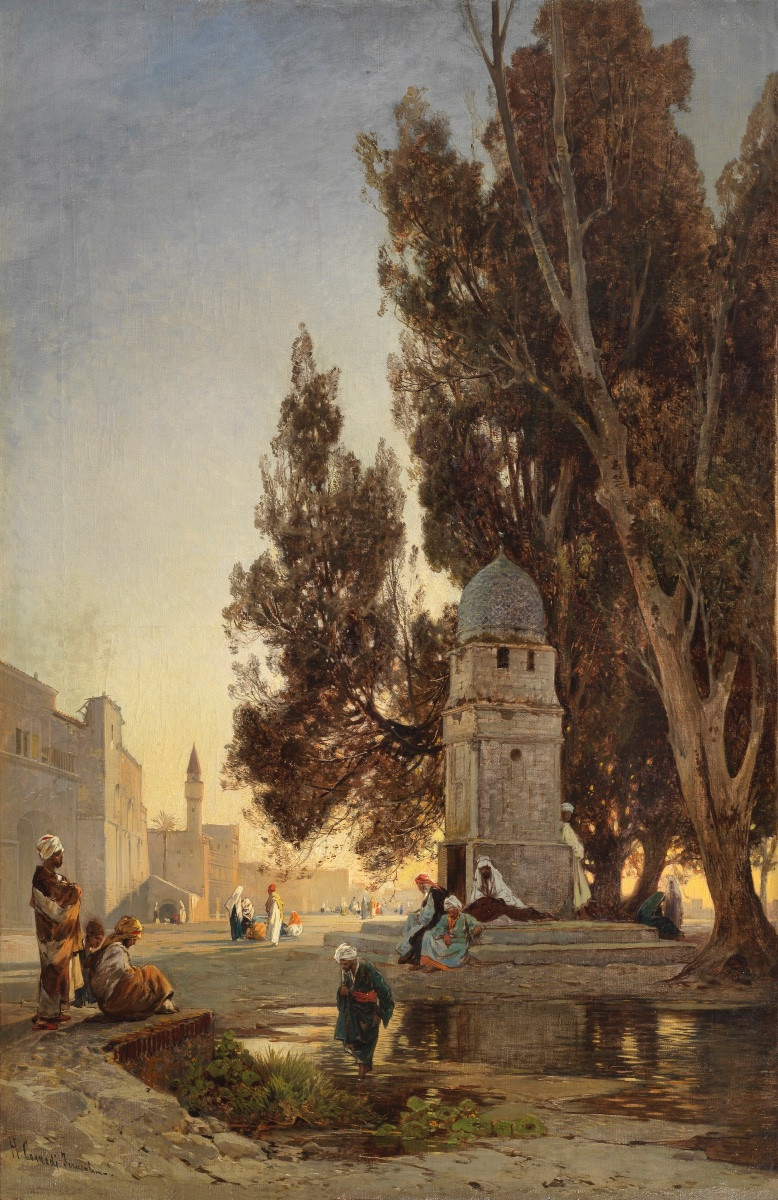
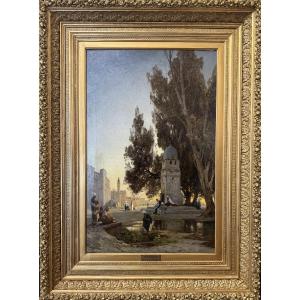
Hermann Corrodi (Frascati 1844 - Rome 1905), "The Sabil Qaitbay on the esplanade of the Dome of the Rock, Jerusalem", second half of the 19th century.
Oil on canvas, 100 x 65 cm.
Signed "H. Corrodi Jerusalem" lower left.
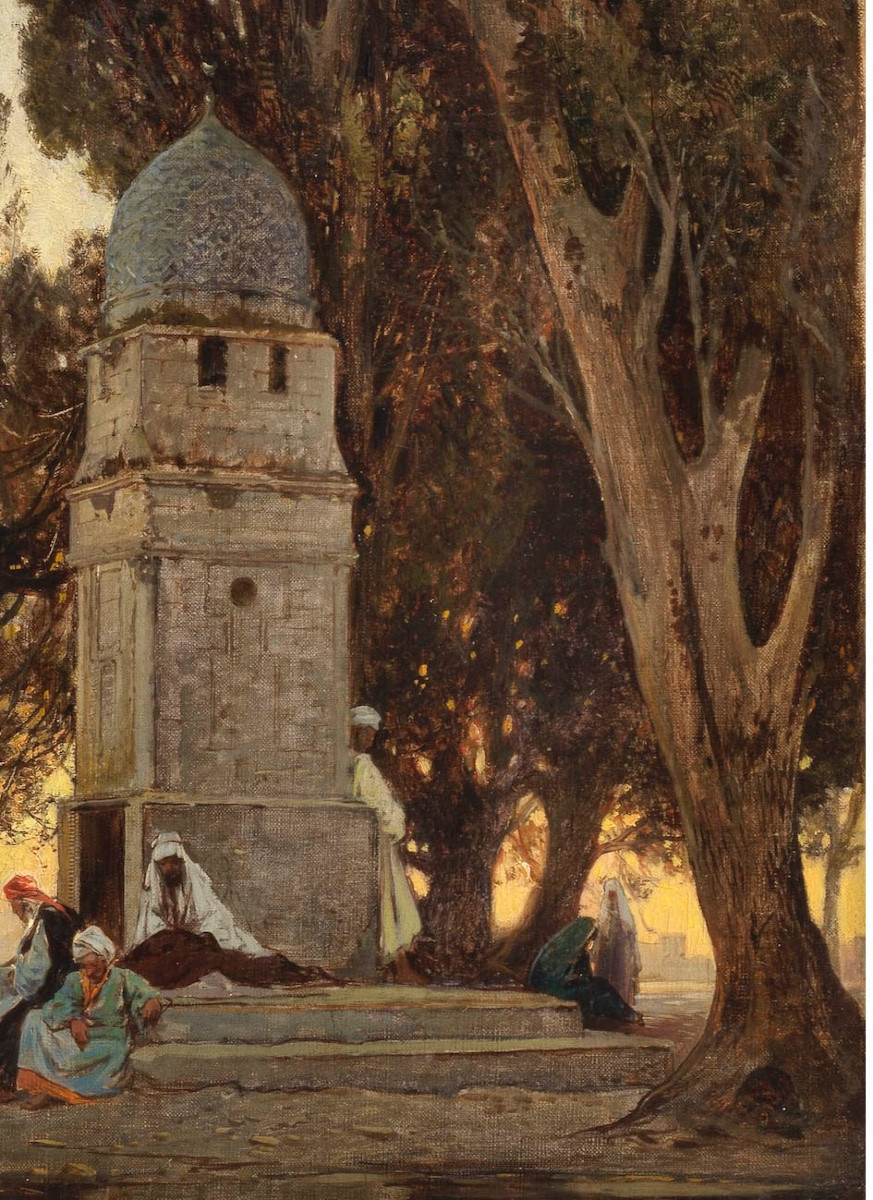
The painting depicts a view of the Qayt Bay fountain, still located next to the Al-Ashrafiyya Madrasa, along the promenade leading to the Al-Aqsa Mosque in the Old City of Jerusalem. The Qayt Bay fountain, also known as the Sabil Qaitbay, is an example of Mamluk architecture, built by the Sultan of the same name in the late 15th century. Between 1882 and 1883, Sultan Abdul Hamid II, a major patron, had the building restored by his aides, giving it the appearance we see today.
The sabil is a type of public fountain typical of Islamic architecture; always located near a mosque, its function is to provide visitors with clean, drinkable water to quench their thirst and perform ritual ablutions before prayer.
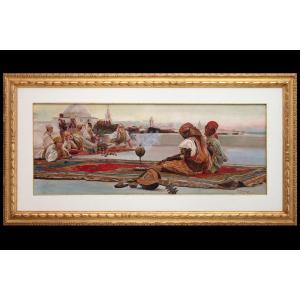
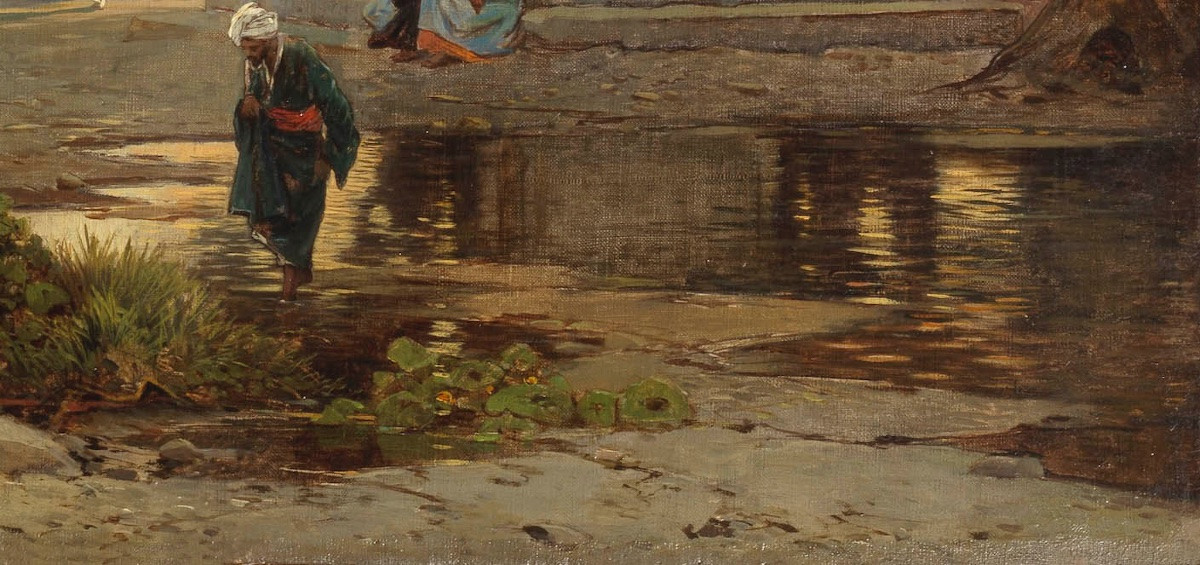
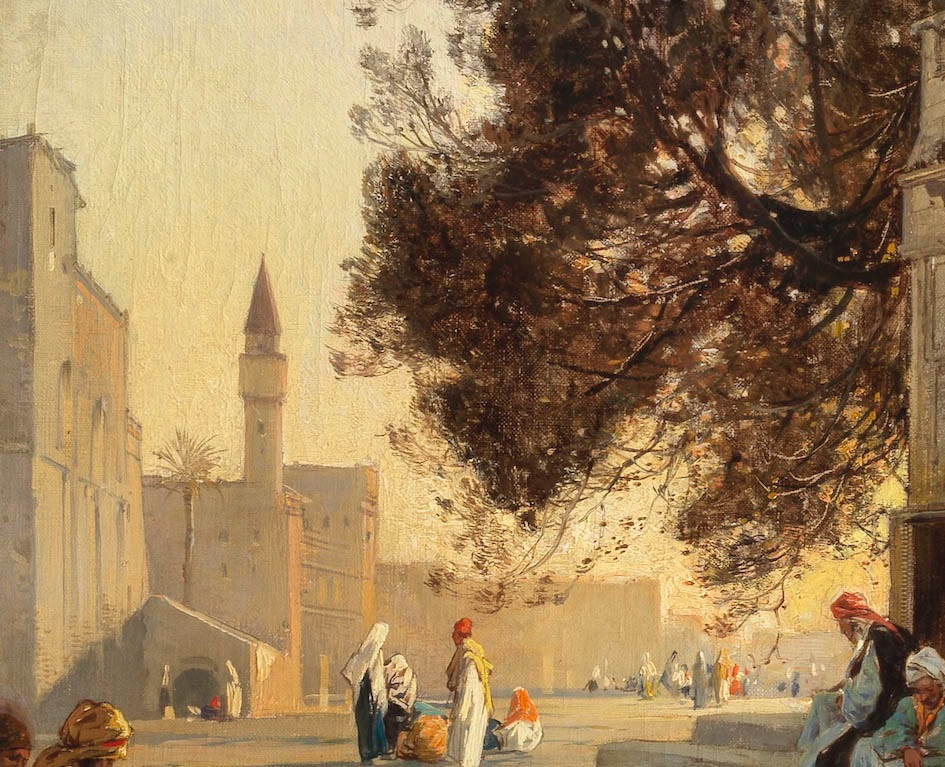
The scene, set at dusk, shows several Muslim men seated in a recollected pose; amber lights and earthy shadows reflect on the placid surface of a small pool of water. A little further on, two women, recognizable by their colorful veils, converse in the shade of sycamore trees.
Reality and fantasy meet, as often happens, in Corrodi's canvases: the painting, although signed as if it were painted live in the Holy City, was in reality probably executed later in his studio, based on sketches from his travels.
This can be determined by observing the details: the fountain's architecture has been modified, appearing more slender and slender in the artist's work; although the decorative frieze of the pointed dome resembles the original, the grated windows on the sides are missing. The presence of the figures themselves is an artifice, as is the unnatural positioning of the sycamore trees, arranged around the Sabil Qaitbay.
Similar in subject matter and depiction type is The Sacred Fountain before the Mosque of Omar in Jerusalem, purchased by the German Emperor Wilhelm II for his private collection.
A work that evokes distant landscapes and peoples, it suits the tastes of the painter's Western patrons and their personal conception of the Orient.
BIOGRAPHY
Hermann Corrodi was born in 1844, the son of Zurich painter Salomon Corrodi. Corrodi's father was of Italian descent, and despite his Swiss origins and education, he moved first to Milan and then to Florence, where he met and married a wealthy fellow citizen. He eventually moved to Rome, where he settled permanently. Hermann Corrodi was born in the province of Rome, in the municipality of Frascati, in the family's summer home. Along with his younger brother Arnold, Hermann was initially taught by his father to paint in a naturalism rich in light and color effects. The two brothers were later sent to Geneva, where they studied under the painter and engraver Alexandre Calame, before returning to Rome to complete their studies at the Accademia di San Luca. In 1866, he joined the Deutsches Künstlerverein, an association of German painters in the city. The two Corrodis then set off for Europe, coming into contact with established artists and wealthy patrons. In Paris, where they traveled in 1872, they met the painters of historical and neoclassical scenes Ernst Meissonier and Jean-Léon Gérôme, and then stayed briefly in London as guests of the Dutch painter Lawrence Alma-Tadema. At the end of the year, they visited the Munich International Exhibition; in early 1873, they spent a few weeks in Capri before traveling to the annual exhibition in Vienna, where Hermann Corrodi was awarded a gold medal for his painting, Pine Forest. In 1874, his brother Arnold, with whom he shared a studio in Rome, died prematurely, and Hermann fell into a deep depression that put a halt to his artistic activity.
After overcoming his grief two years later, he resumed his painting career; following his marriage to an Englishwoman, he managed to gain recognition and commissions from England as well. He then resumed the travels that had characterized his youth, this time moving to the East, which fascinated the artist as the cradle of the most important monotheistic religions. Corrodi visited Constantinople, then Syria and Egypt; among his most important clients was the German Emperor Wilhelm II, who purchased the canvas The Sacred Fountain before the Mosque of Omar in Jerusalem for his private collection, while the English royals purchased his views of Cyprus. During the summer months, he traveled to Germany, where he held painting studios for the nobility and the imperial court in Baden-Baden and Homburg.
In 1892, yet another tragedy struck Corrodi: his Roman home and studio, where the painter kept all his works, as well as his collection of oriental objects and his late brother's paintings, caught fire; the fire was devastating. In the early 1900s, he commissioned a palace for his new home and studio, with an adjoining space for his exhibitions. Unfortunately, Corrodi died prematurely in 1905, without ever seeing his home completed.
Even after the destructive fire of 1892, the painter's works are rare and hard to find, held primarily by private collectors. Two of his watercolors are in the Galleria comunale of Palazzo Braschi, while the landscape Napoleon's Tower in Corsica is on display in the rooms of Palazzo Montecitorio. Other paintings by him are held in Zurich, including engravings of river landscapes and the oil on canvas Charles V's Tower near La Spezia. The Royal Picture Gallery of England houses works purchased by Queen Victoria, including Roman views, Queen Victoria on the Terrace of Villa Palmieri, and Sirens in a Grotto on Capri.
Period: 19th century
Style: Napoleon 3rd
Condition: Excellent condition
Material: Oil painting
Length: 65
Height: 100
Reference (ID): 1750708
Availability: In stock