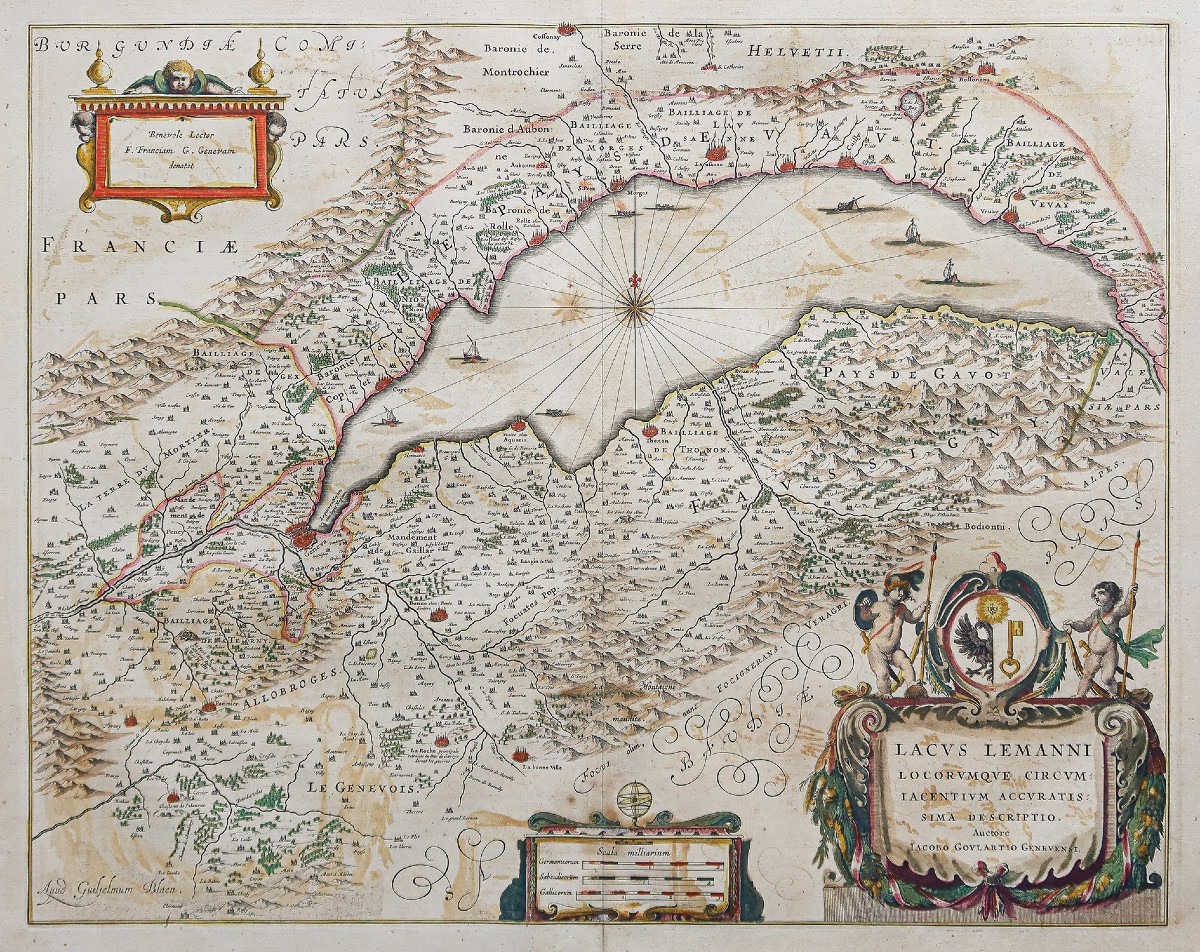
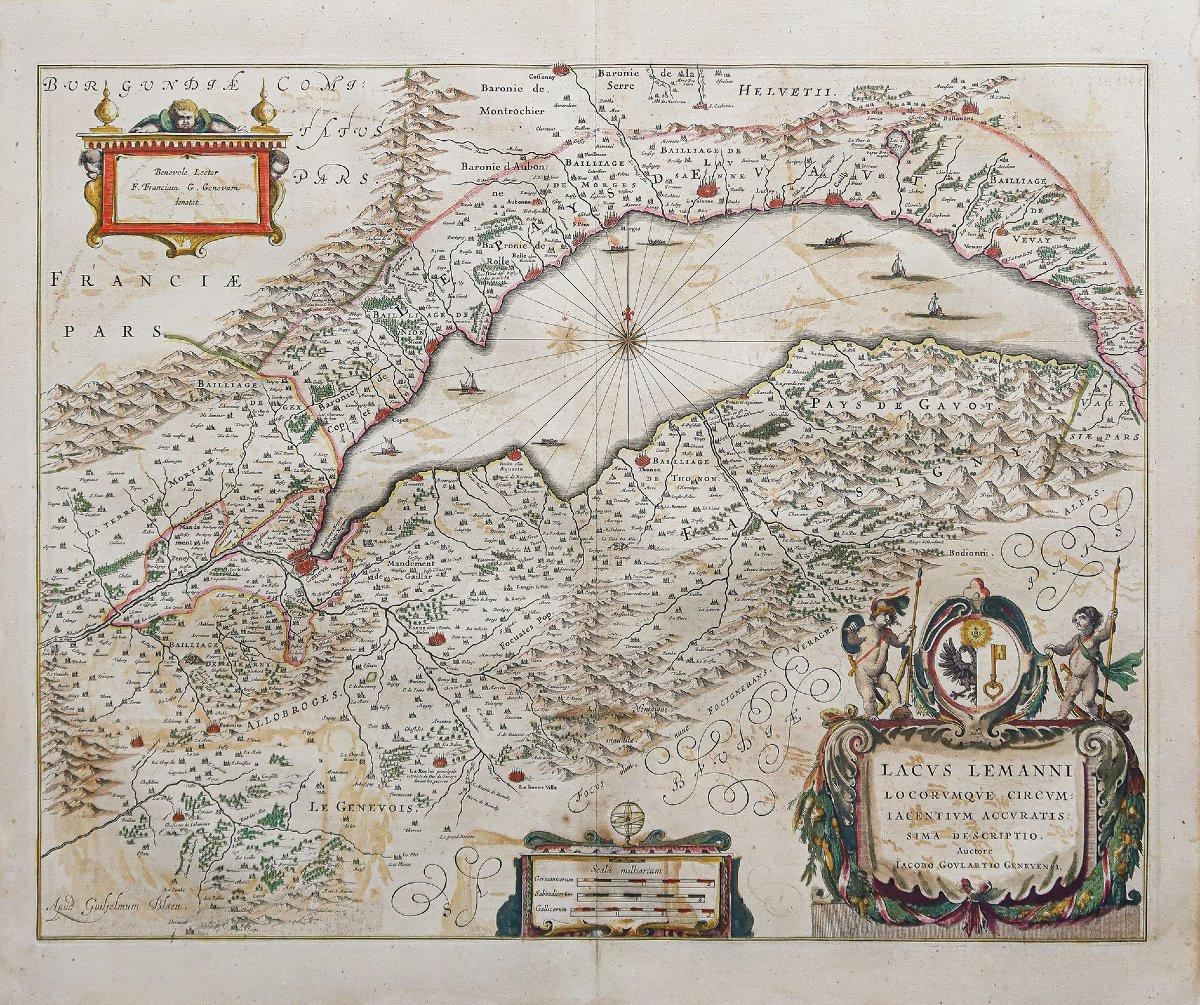
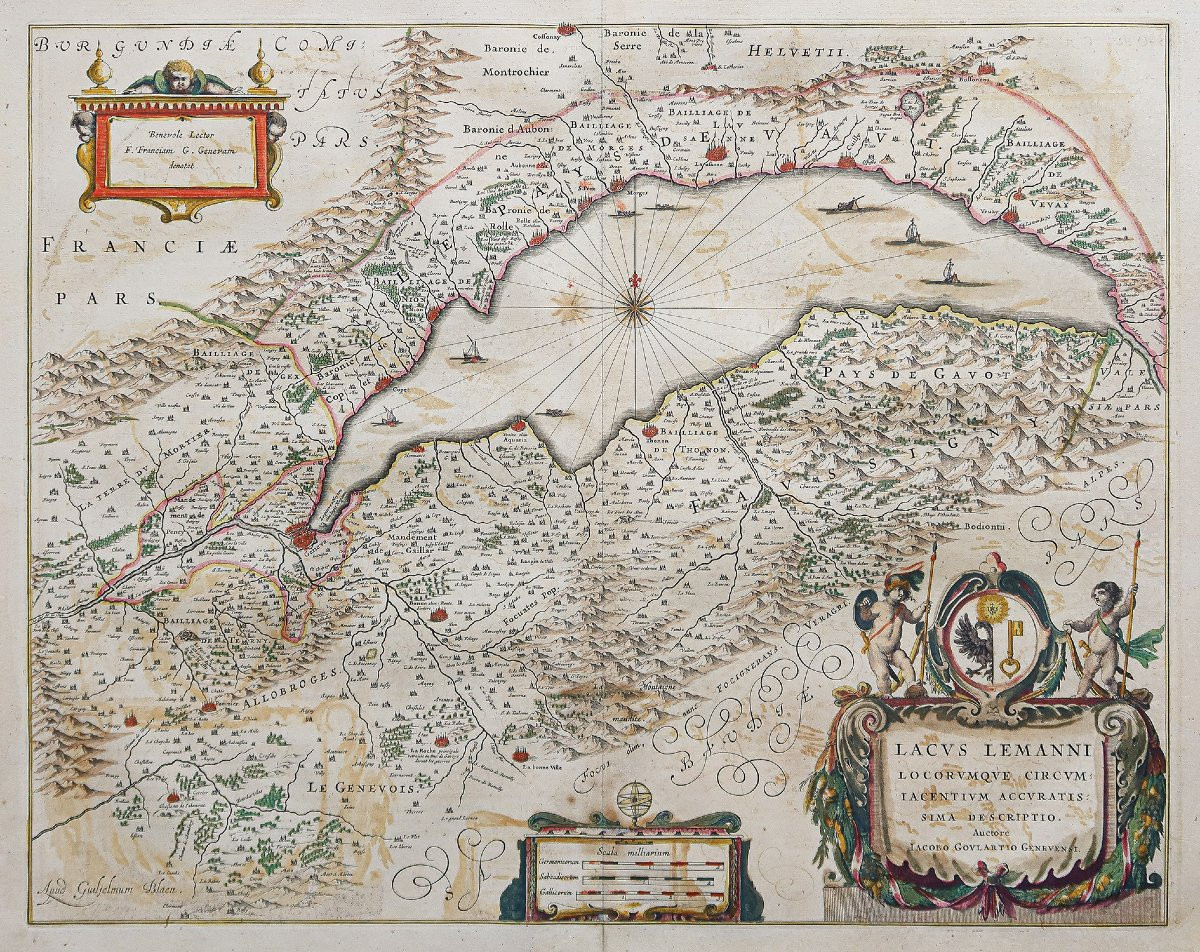


Antique Map Of Lake Geneva - Switzerland - Savoie
Artist: Guilhem Blaeu
Epreuve
originale réalisée en 1635.
Guilhem Blaeu éditeur. Beaux coloris anciens.
Texte explicatif en latin au verso.
Report de pigments, avec fine oxydation homogène.
Bon état.
Format feuille : 56,5 x 48 cm.
Format gravure : 52,5 x 41,5 cm.
Original antique map of 1635.
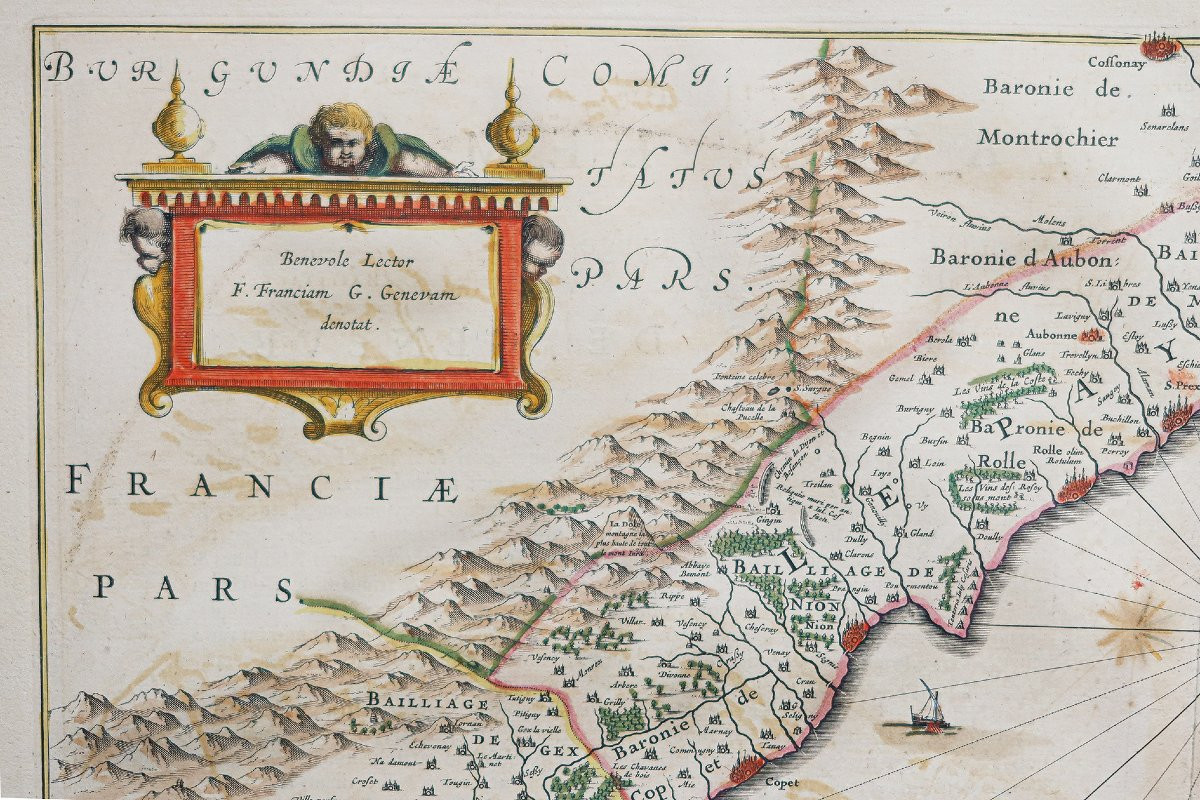
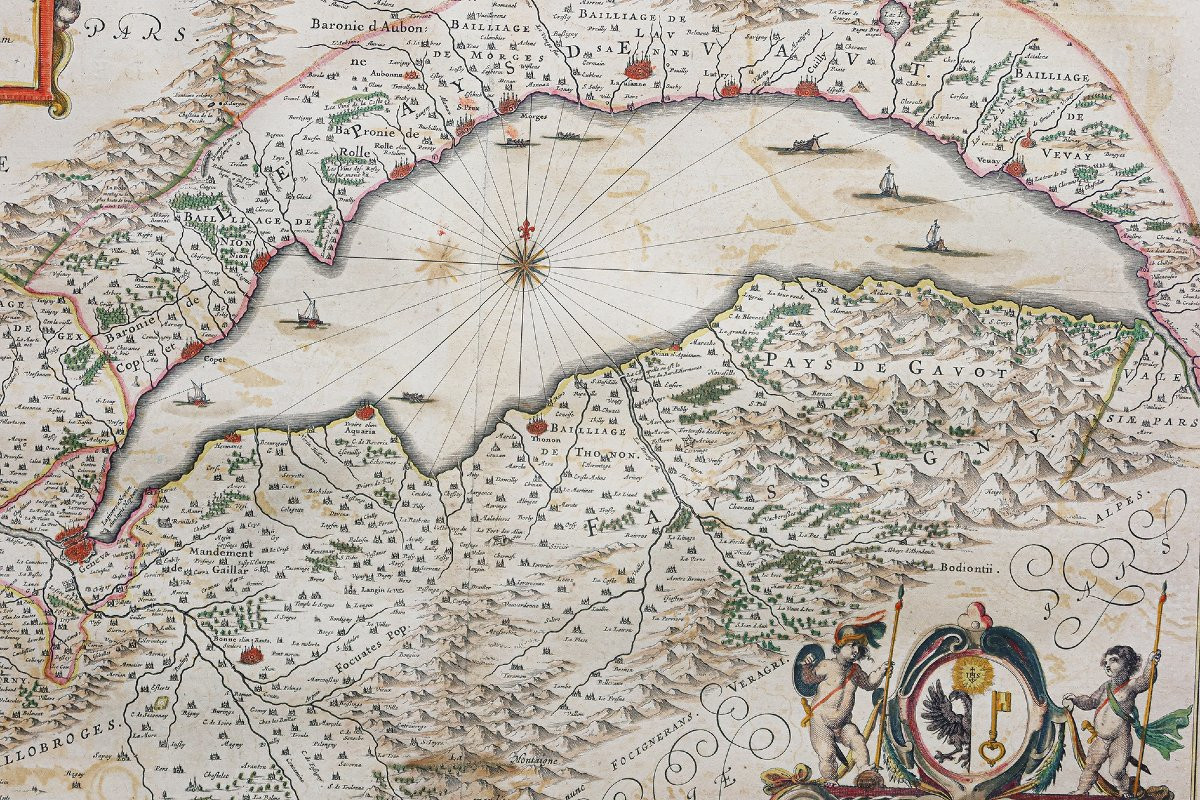
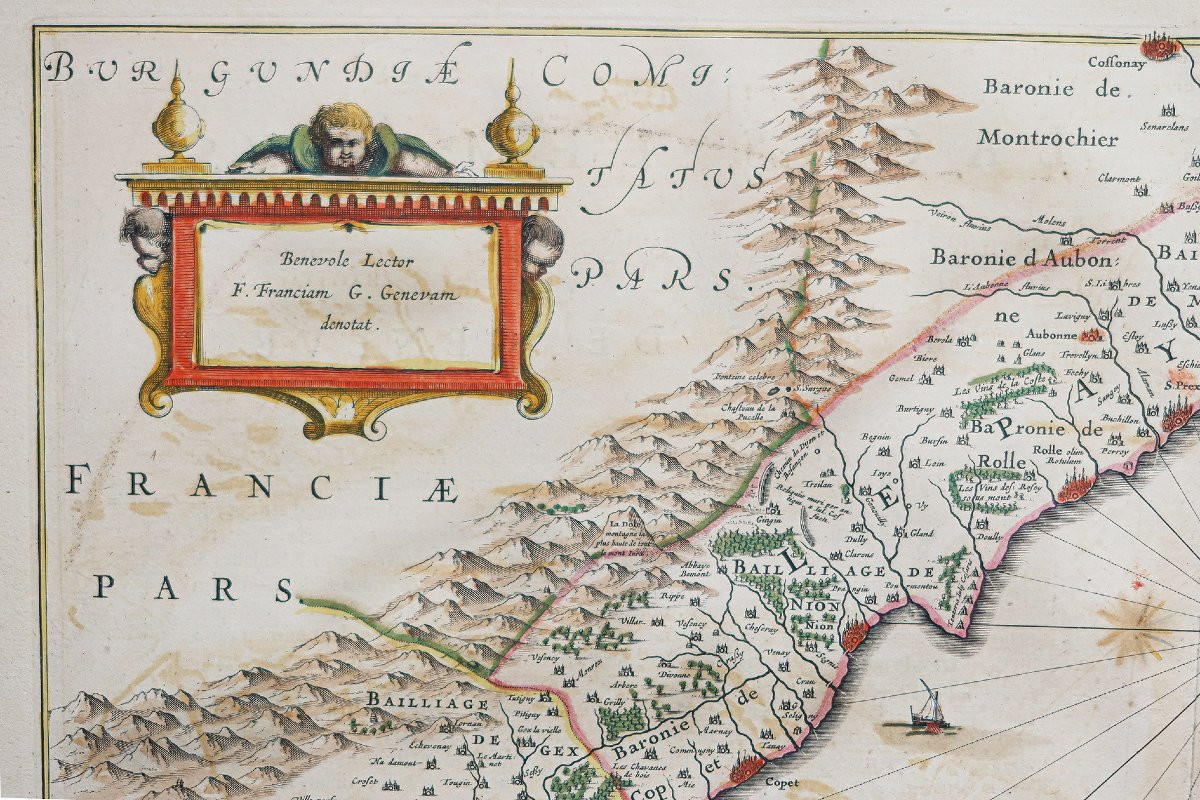
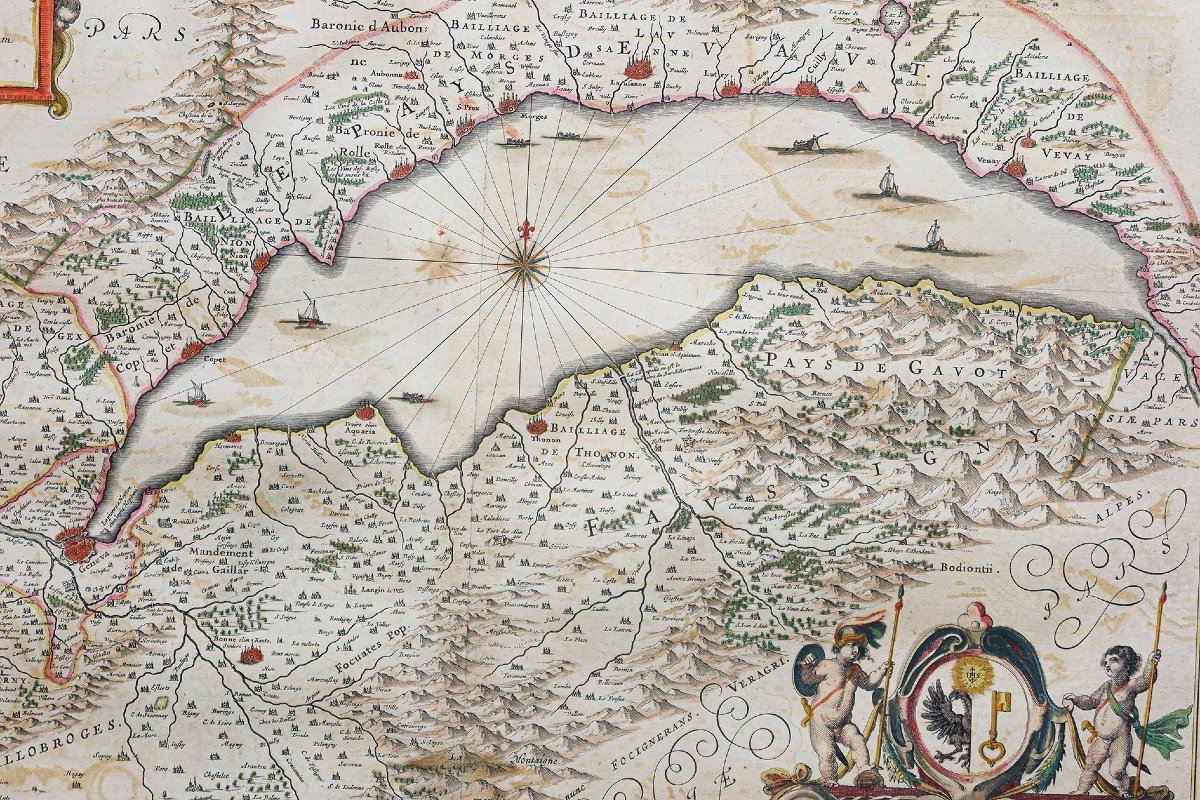
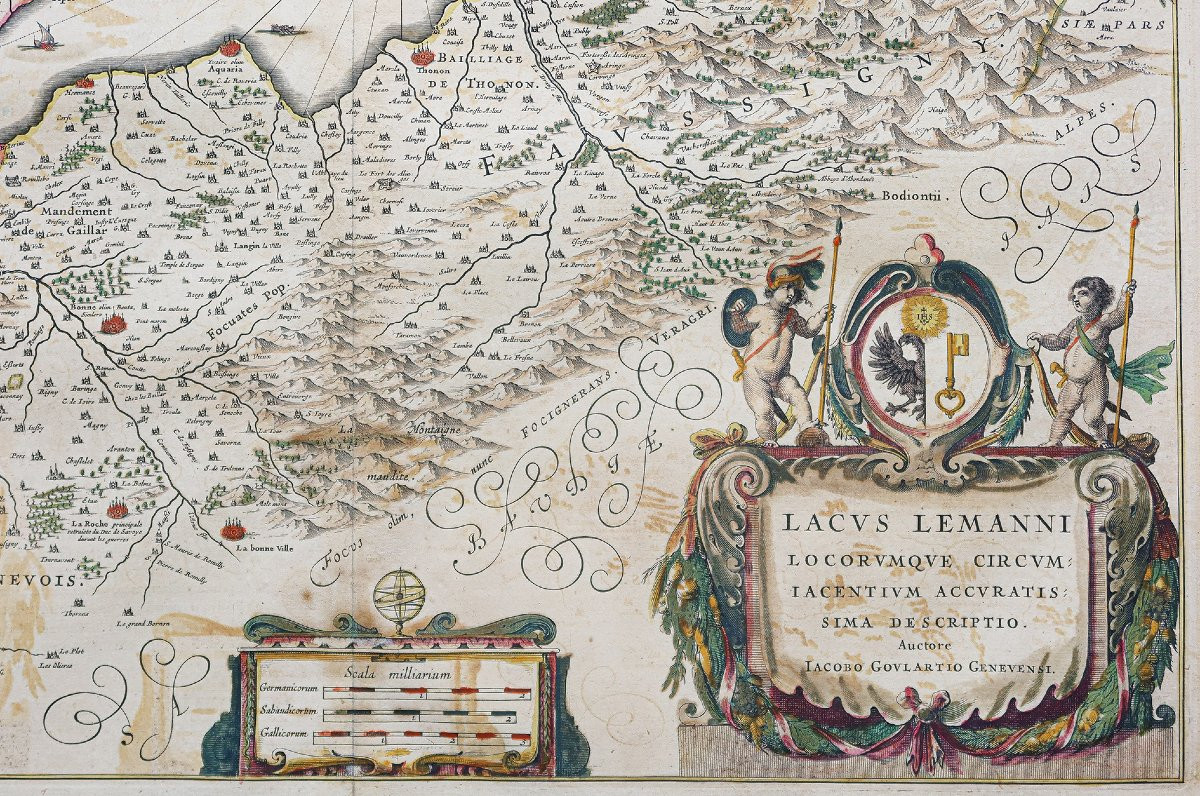
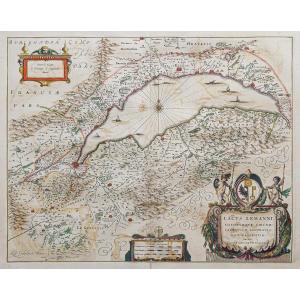
Carte originale de Blaeu en première édition latine. Echelle des lieux. Large cartouche de titre décoratif. Armoiries de Genève.
Au début du 17e siècle, Amsterdam est en train de devenir l’une des villes les plus commerçantes d’Europe, base de la Compagnie néerlandaise des Indes orientales, centre bancaire européen et du commerce du diamant. Ses habitants se distinguaient par leurs compétences intellectuelles et leur savoir-faire exceptionnel. En cette période propice de l'histoire des provinces du Nord, Willem Janszoon Blaeu, né à Alkmaar en 1571 est formé à l'astronomie et aux sciences par Tycho Brahe, le célèbre astronome danois qui fonda une entreprise à Amsterdam en 1599 de fabrication de globes et d'instruments scientifiques. L'entreprise ne tarde pas à prendre de l'expansion, publiant des cartes, des ouvrages topographiques, des livres de cartes marines et des collections de globes. Ses premiers travaux les plus remarquables sont une carte de la Hollande (1604), une belle carte du monde (1605-06) et Het Licht der Zeevaerdt (La lumière de la navigation), un atlas marin.Au même moment, Blaeu préparait un atlas majeur destiné à inclure les cartes les plus récentes de l’ensemble du monde connu, mais la progression d’un si vaste projet reste lente, malgré l’achat onéreux de 40 cuivres de cartes de l’édition de Mercator ainsi que le fond de cuivre de la publication de cartes de Jodocus Hondius. En 1630, un volume de 60 cartes portant le titre Atlantis Annex fut publié. Cinq années se sont écoulées avant la publication des deux premiers volumes de son atlas mondial, Atlas Novus ou le Theatrum Orbis Terrarum. À la même époque, Blaeu fut nommé hydrographe de la Compagnie des Indes orientales. En 1638, Blaeu mourut et l'entreprise passa aux mains de ses fils, Joan et Cornelis, qui poursuivirent et élargirent les ambitieux projets de leur père. Après la mort de Cornelis, Joan dirigea l’entreprise seul et une collection de cartes en 6 volumes fut finalement achevée vers 1655. La préparation d’une collection encore plus grande, Atlas Major, vit le jour et fut publié en 1662 en 9 volumes puis 11 volumes et enfin 12 volumes pour l’édition avec texte français. Cette collection réunissait près de 600 cartes double page et 3000 textes explicatifs au verso des cartes. C’était et reste l’œuvre la plus magnifique jamais réalisée en son genre ; son contenu géographique n’était peut-être pas aussi à jour ni aussi exact que son auteur l’aurait souhaité, mais toute carence dans cette direction était plus que compensée par la finesse des gravures et leurs colorations, les cartouches élaborés, les détails picturaux et héraldiques en particulier et la splendide calligraphie. En 1672, un incendie détruisit l'imprimerie de Blaeu dans la Gravenstraat et un an après, Joan Blaeu décéda. Les stocks de cartes restants furent progressivement dispersés. Certains des cuivres d’impression ont été achetés par les cartographes, F. de Wit, Schenk et Valck, avant la fermeture définitive vers 1695.Il convient de mentionner ici qu'il existe souvent une confusion entre l'aîné Blaeu et son rival Jan Jansson (Johannes Janssonius). Jusqu’en 1619, Blaeu signa souvent ses œuvres Guilielmus Janssonius ou Willems Jans Zoon, mais après cette période, il semble avoir opté pour Guilielmus ou G. Blaeu.
Proof made in 1635.
Guilhem Blaeu publisher.Beautifulcolors.
Explanatoryin Latin on verso.
Pigment reportpigments, with fine homogeneous oxidation.
Good condition.
Formatsheet : 56.5 x 48 cm.
Engravingengraving : 52,5 x 41,5 cm.
Originalantique map of 1635.
Original mapBlaeu's original first Latin edition. Scale of locations. Largedecorative title cartouche. Coat of arms of Geneva.
At the beginning of the 17thcentury, Amsterdam was becoming one of Europe's most important tradingbase of the Dutch East India Company, a center of European banking and the diamond trade.European banking and diamond-trading center. Its inhabitants distinguished themselvesintellectual skills and exceptional know-how.In this propitious period in the history of the northern provinces, Willem Janszoon Blaeu, born in Alkmaar in 1571, was trained in astronomy and science by Tycho Brahe, the famous Danish astronomer who founded a company in Amsterdam in 1599 to manufacture globes and scientific instruments. The company soon expanded, publishing maps, topographical works, chart books and globe collections. His most notable early works include a map of Holland (1604), a beautiful map of the world (1605-06) and Het Licht der Zeevaerdt (The Light of Navigation), a marine atlas.At the same time, Blaeu was preparing a major atlas intended to include the most recent maps of the entire known world, but progress on such a vast project remained slow, despite the costly purchase of 40 copperplates of maps from Mercator's edition, as well as the copper background from the publication of maps by Jodocus Hondius. In 1630, a volume of 60 maps bearing the title Atlantis Annex was published. Five years passed before the publication of the first two volumes of his world atlas, Atlas Novus or the Theatrum Orbis Terrarum. At the same time, Blaeu was appointed hydrographer to the East India Company.In 1638, Blaeu died and the company passed into the hands of his sons, Joan and Cornelis, who continued and expanded their father's ambitious projects. After Cornelis's death, Joan ran the business alone, and a 6-volume map collection was finally completed around 1655. Preparations began for an even larger collection, Atlas Major, which was published in 1662 in 9 volumes, then 11 volumes, and finally 12 volumes for the edition with French text. This collection included almost 600 double-page maps and 3,000 explanatory texts on the reverse of the maps. It was and remains the most magnificent work ever produced of its kind; its geographical content may not have been as up-to-date or as accurate as its author would have wished, but any shortcomings in this direction were more than compensated for by the finesse of the engravings and their colorations, the elaborate cartouches, the pictorial and heraldic details in particular, and the splendid calligraphy. In 1672, a fire destroyed Blaeu's printing works in the Gravenstraat, and a year later Joan Blaeu died. The remaining stocks of cards were gradually dispersed. Some of the printing coppers were purchased by cartographers F. de Wit, Schenk and Valck, before the definitive closure around 1695.It's worth mentioning here that there is often confusion between the elder Blaeu and his rival Jan Jansson (Johannes Janssonius). Until 1619, Blaeu often signed his works Guilielmus Janssonius or Willems Jans Zoon, but after this period, he seems to have opted for Guilielmus or G. Blaeu. Blaeu.
Guilhem Blaeu éditeur. Beaux coloris anciens.
Texte explicatif en latin au verso.
Report de pigments, avec fine oxydation homogène.
Bon état.
Format feuille : 56,5 x 48 cm.
Format gravure : 52,5 x 41,5 cm.
Original antique map of 1635.
Carte originale de Blaeu en première édition latine. Echelle des lieux. Large cartouche de titre décoratif. Armoiries de Genève.
Au début du 17e siècle, Amsterdam est en train de devenir l’une des villes les plus commerçantes d’Europe, base de la Compagnie néerlandaise des Indes orientales, centre bancaire européen et du commerce du diamant. Ses habitants se distinguaient par leurs compétences intellectuelles et leur savoir-faire exceptionnel. En cette période propice de l'histoire des provinces du Nord, Willem Janszoon Blaeu, né à Alkmaar en 1571 est formé à l'astronomie et aux sciences par Tycho Brahe, le célèbre astronome danois qui fonda une entreprise à Amsterdam en 1599 de fabrication de globes et d'instruments scientifiques. L'entreprise ne tarde pas à prendre de l'expansion, publiant des cartes, des ouvrages topographiques, des livres de cartes marines et des collections de globes. Ses premiers travaux les plus remarquables sont une carte de la Hollande (1604), une belle carte du monde (1605-06) et Het Licht der Zeevaerdt (La lumière de la navigation), un atlas marin.Au même moment, Blaeu préparait un atlas majeur destiné à inclure les cartes les plus récentes de l’ensemble du monde connu, mais la progression d’un si vaste projet reste lente, malgré l’achat onéreux de 40 cuivres de cartes de l’édition de Mercator ainsi que le fond de cuivre de la publication de cartes de Jodocus Hondius. En 1630, un volume de 60 cartes portant le titre Atlantis Annex fut publié. Cinq années se sont écoulées avant la publication des deux premiers volumes de son atlas mondial, Atlas Novus ou le Theatrum Orbis Terrarum. À la même époque, Blaeu fut nommé hydrographe de la Compagnie des Indes orientales. En 1638, Blaeu mourut et l'entreprise passa aux mains de ses fils, Joan et Cornelis, qui poursuivirent et élargirent les ambitieux projets de leur père. Après la mort de Cornelis, Joan dirigea l’entreprise seul et une collection de cartes en 6 volumes fut finalement achevée vers 1655. La préparation d’une collection encore plus grande, Atlas Major, vit le jour et fut publié en 1662 en 9 volumes puis 11 volumes et enfin 12 volumes pour l’édition avec texte français. Cette collection réunissait près de 600 cartes double page et 3000 textes explicatifs au verso des cartes. C’était et reste l’œuvre la plus magnifique jamais réalisée en son genre ; son contenu géographique n’était peut-être pas aussi à jour ni aussi exact que son auteur l’aurait souhaité, mais toute carence dans cette direction était plus que compensée par la finesse des gravures et leurs colorations, les cartouches élaborés, les détails picturaux et héraldiques en particulier et la splendide calligraphie. En 1672, un incendie détruisit l'imprimerie de Blaeu dans la Gravenstraat et un an après, Joan Blaeu décéda. Les stocks de cartes restants furent progressivement dispersés. Certains des cuivres d’impression ont été achetés par les cartographes, F. de Wit, Schenk et Valck, avant la fermeture définitive vers 1695.Il convient de mentionner ici qu'il existe souvent une confusion entre l'aîné Blaeu et son rival Jan Jansson (Johannes Janssonius). Jusqu’en 1619, Blaeu signa souvent ses œuvres Guilielmus Janssonius ou Willems Jans Zoon, mais après cette période, il semble avoir opté pour Guilielmus ou G. Blaeu.
Proof made in 1635.
Guilhem Blaeu publisher.Beautifulcolors.
Explanatoryin Latin on verso.
Pigment reportpigments, with fine homogeneous oxidation.
Good condition.
Formatsheet : 56.5 x 48 cm.
Engravingengraving : 52,5 x 41,5 cm.
Originalantique map of 1635.
Original mapBlaeu's original first Latin edition. Scale of locations. Largedecorative title cartouche. Coat of arms of Geneva.
At the beginning of the 17thcentury, Amsterdam was becoming one of Europe's most important tradingbase of the Dutch East India Company, a center of European banking and the diamond trade.European banking and diamond-trading center. Its inhabitants distinguished themselvesintellectual skills and exceptional know-how.In this propitious period in the history of the northern provinces, Willem Janszoon Blaeu, born in Alkmaar in 1571, was trained in astronomy and science by Tycho Brahe, the famous Danish astronomer who founded a company in Amsterdam in 1599 to manufacture globes and scientific instruments. The company soon expanded, publishing maps, topographical works, chart books and globe collections. His most notable early works include a map of Holland (1604), a beautiful map of the world (1605-06) and Het Licht der Zeevaerdt (The Light of Navigation), a marine atlas.At the same time, Blaeu was preparing a major atlas intended to include the most recent maps of the entire known world, but progress on such a vast project remained slow, despite the costly purchase of 40 copperplates of maps from Mercator's edition, as well as the copper background from the publication of maps by Jodocus Hondius. In 1630, a volume of 60 maps bearing the title Atlantis Annex was published. Five years passed before the publication of the first two volumes of his world atlas, Atlas Novus or the Theatrum Orbis Terrarum. At the same time, Blaeu was appointed hydrographer to the East India Company.In 1638, Blaeu died and the company passed into the hands of his sons, Joan and Cornelis, who continued and expanded their father's ambitious projects. After Cornelis's death, Joan ran the business alone, and a 6-volume map collection was finally completed around 1655. Preparations began for an even larger collection, Atlas Major, which was published in 1662 in 9 volumes, then 11 volumes, and finally 12 volumes for the edition with French text. This collection included almost 600 double-page maps and 3,000 explanatory texts on the reverse of the maps. It was and remains the most magnificent work ever produced of its kind; its geographical content may not have been as up-to-date or as accurate as its author would have wished, but any shortcomings in this direction were more than compensated for by the finesse of the engravings and their colorations, the elaborate cartouches, the pictorial and heraldic details in particular, and the splendid calligraphy. In 1672, a fire destroyed Blaeu's printing works in the Gravenstraat, and a year later Joan Blaeu died. The remaining stocks of cards were gradually dispersed. Some of the printing coppers were purchased by cartographers F. de Wit, Schenk and Valck, before the definitive closure around 1695.It's worth mentioning here that there is often confusion between the elder Blaeu and his rival Jan Jansson (Johannes Janssonius). Until 1619, Blaeu often signed his works Guilielmus Janssonius or Willems Jans Zoon, but after this period, he seems to have opted for Guilielmus or G. Blaeu. Blaeu.
650 €
Period: 17th century
Style: Other Style
Condition: Good condition
Material: Paper
Reference (ID): 1735445
Availability: In stock
Print