

Conrad Meili – Portrait Of Kuni Matsuo – Pencil Drawing – 1930 – Signed
Artist: Meili Conrad (1895 Zurich – 1969 Asnières)
Onrad Meili (Zurich, 1895 – Anières, 1969)
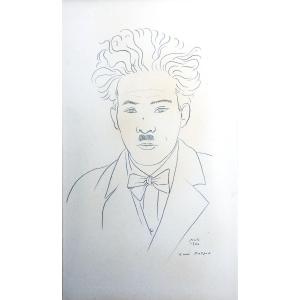
Portrait of Kuni Matsuo, 1930
Pencil on paper
45 × 26 cm
Signed Meili, dated 1930 and titled Kuni Matsuo lower right
Slightly yellowed, some foxing
This pencil portrait depicts Kuni Matsuo (1899–1975), a central figure in Franco-Japanese cultural mediation during the interwar period. Arriving in Paris in 1922 to study literature at the University of Paris, Matsuo developed an intense career as a journalist, translator, and cultural mediator. He founded or co-founded several journals and associations dedicated to Franco-Japanese rapprochement, and in 1930 became a member of the executive committee of the Franco-Japanese Intellectual Rapprochement. His works published in French—translations of haiku, anthologies of Japanese poets, and studies on Buddhism—appeared at G. Crès, Mercure de France, and Félix Alcan. He was also a familiar figure in Parisian literary and artistic circles frequented by Foujita, Kikou Yamata, and other prominent members of the Japanese community in Paris.
The author of the portrait, Conrad Meili, moved in the same circles. A student of Ferdinand Hodler and a notable contributor to the realist school, he joined the Société Nationale des Beaux-Arts in the late 1920s and settled in Paris in 1930. It was in Paris that he met the novelist Kikou Yamata, whom he married in 1932 and who was already well-established in Parisian literary circles. Kikou Yamata and Kuni Matsuo were regulars in these same circles, making a meeting between the two men almost certain. This drawing, executed in 1930—the very year Meili settled in Paris—testifies to this burgeoning friendship between artists and intellectuals united by their dual connection to Japanese culture and Parisian life.
The portrait adopts an economy of means characteristic of Meili's drawings: the supple and continuous pencil line precisely constructs the face while maintaining an almost ethereal lightness. The abundant, wavy hair contrasts with the calm fixity of the gaze, while the bow tie lends the sitter the elegance of a literary dandy. The bare background focuses all attention on the subject's personality.
A document of great historical value, at the crossroads of the artistic and literary worlds of interwar Paris.
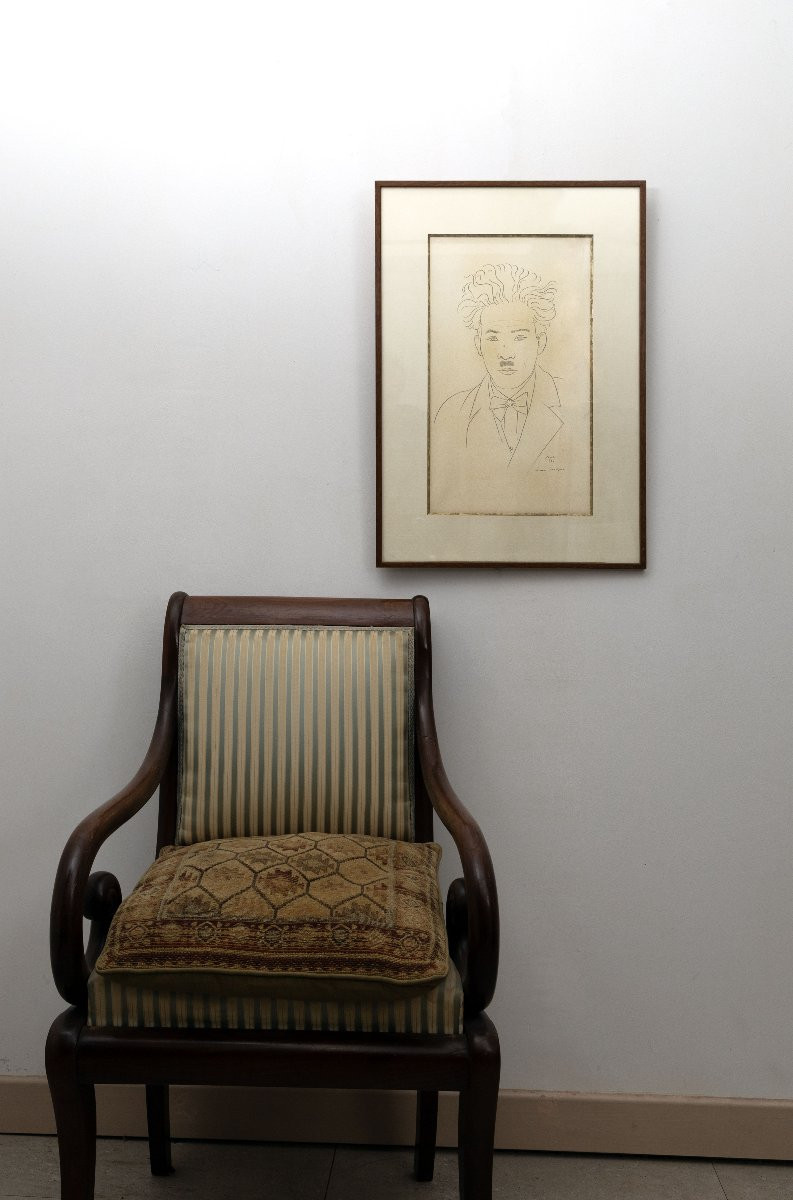
Framing: wide cream mat, varnished wooden frame, a few minor scratches.
Artwork on display at the gallery (07240).
Shipping: please contact us for shipping costs within France and internationally.
Portrait of Kuni Matsuo, 1930
Pencil on paper
45 × 26 cm
Signed Meili, dated 1930 and titled Kuni Matsuo lower right
Slightly yellowed, some foxing
This pencil portrait depicts Kuni Matsuo (1899–1975), a central figure in Franco-Japanese cultural mediation during the interwar period. Arriving in Paris in 1922 to study literature at the University of Paris, Matsuo developed an intense career as a journalist, translator, and cultural mediator. He founded or co-founded several journals and associations dedicated to Franco-Japanese rapprochement, and in 1930 became a member of the executive committee of the Franco-Japanese Intellectual Rapprochement. His works published in French—translations of haiku, anthologies of Japanese poets, and studies on Buddhism—appeared at G. Crès, Mercure de France, and Félix Alcan. He was also a familiar figure in Parisian literary and artistic circles frequented by Foujita, Kikou Yamata, and other prominent members of the Japanese community in Paris.
The author of the portrait, Conrad Meili, moved in the same circles. A student of Ferdinand Hodler and a notable contributor to the realist school, he joined the Société Nationale des Beaux-Arts in the late 1920s and settled in Paris in 1930. It was in Paris that he met the novelist Kikou Yamata, whom he married in 1932 and who was already well-established in Parisian literary circles. Kikou Yamata and Kuni Matsuo were regulars in these same circles, making a meeting between the two men almost certain. This drawing, executed in 1930—the very year Meili settled in Paris—testifies to this burgeoning friendship between artists and intellectuals united by their dual connection to Japanese culture and Parisian life.
The portrait adopts an economy of means characteristic of Meili's drawings: the supple and continuous pencil line precisely constructs the face while maintaining an almost ethereal lightness. The abundant, wavy hair contrasts with the calm fixity of the gaze, while the bow tie lends the sitter the elegance of a literary dandy. The bare background focuses all attention on the subject's personality.
A document of great historical value, at the crossroads of the artistic and literary worlds of interwar Paris.
Framing: wide cream mat, varnished wooden frame, a few minor scratches.
Artwork on display at the gallery (07240).
Shipping: please contact us for shipping costs within France and internationally.
250 €
Period: 20th century
Style: Modern Art
Condition: Excellent condition
Material: Paper
Width: 26 cm à vue / 44,5 cm encadré
Height: 45 cm à vue / 63,5 cm encadré
Reference (ID): 1731843
Availability: In stock
Print