THIS OBJECT WAS SOLD
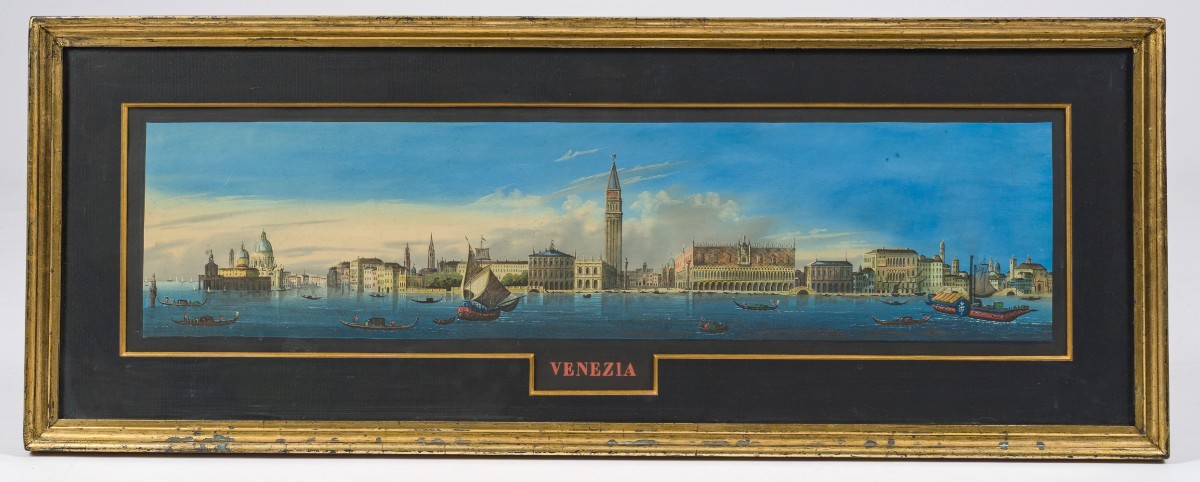
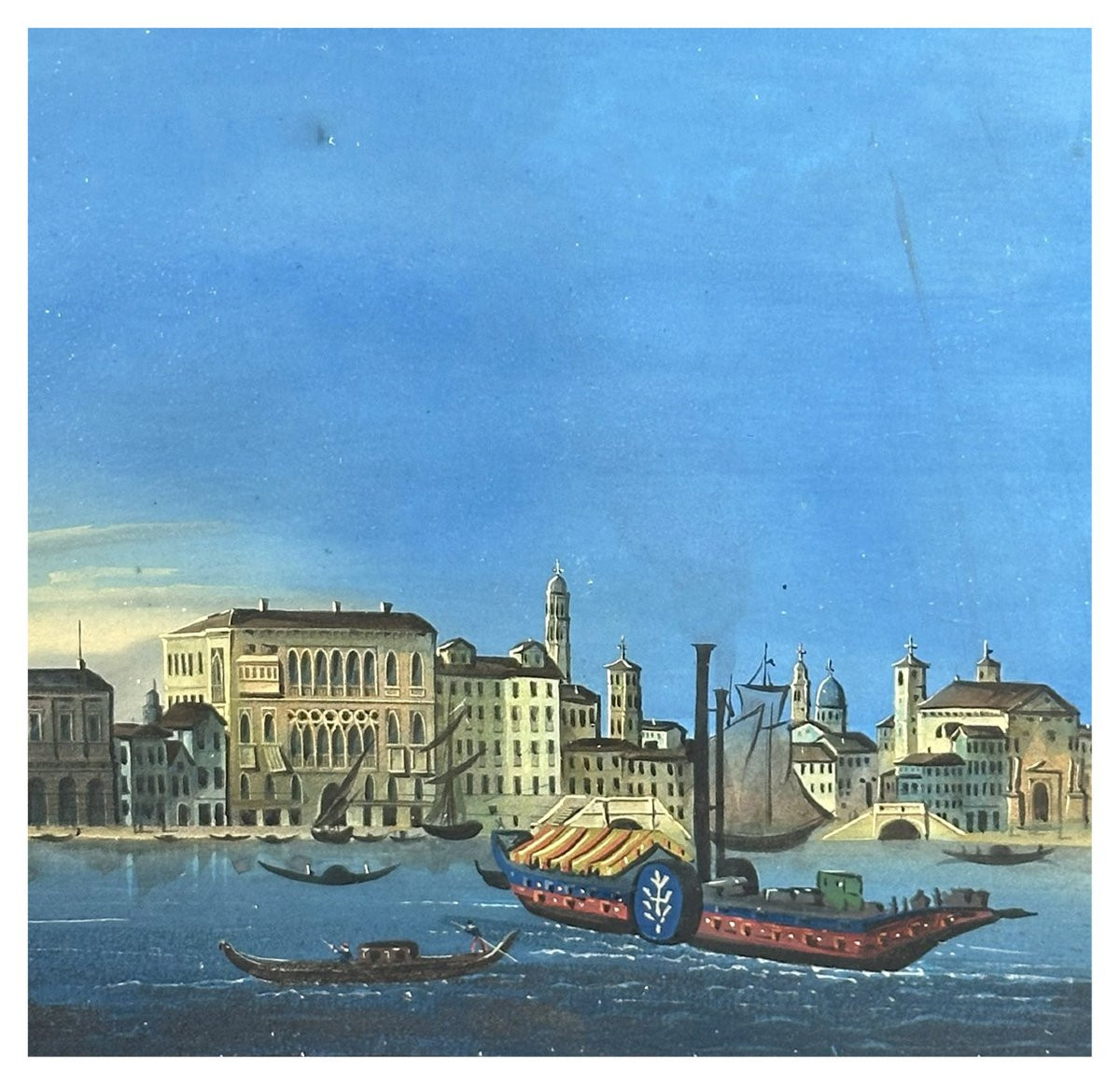
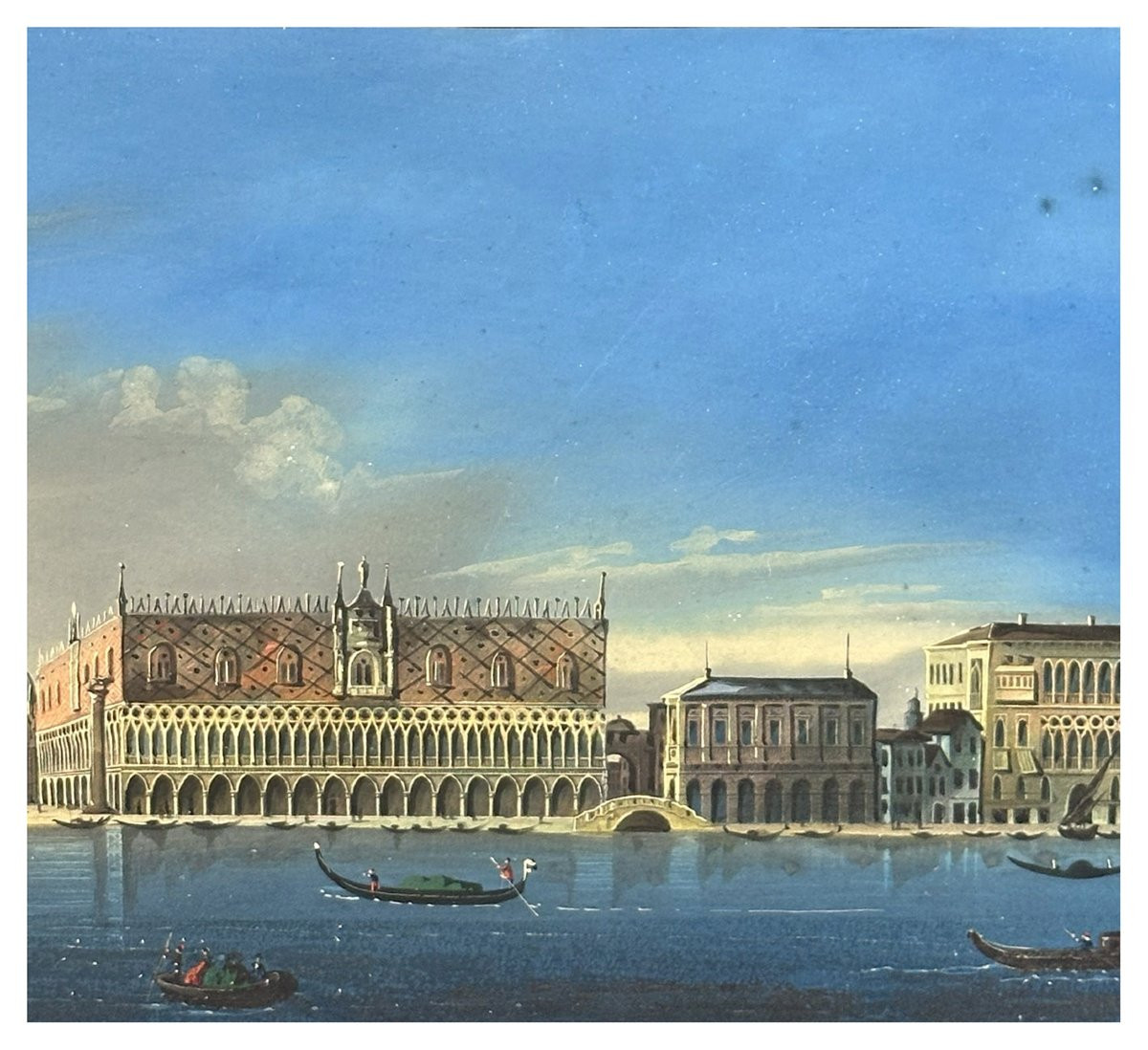
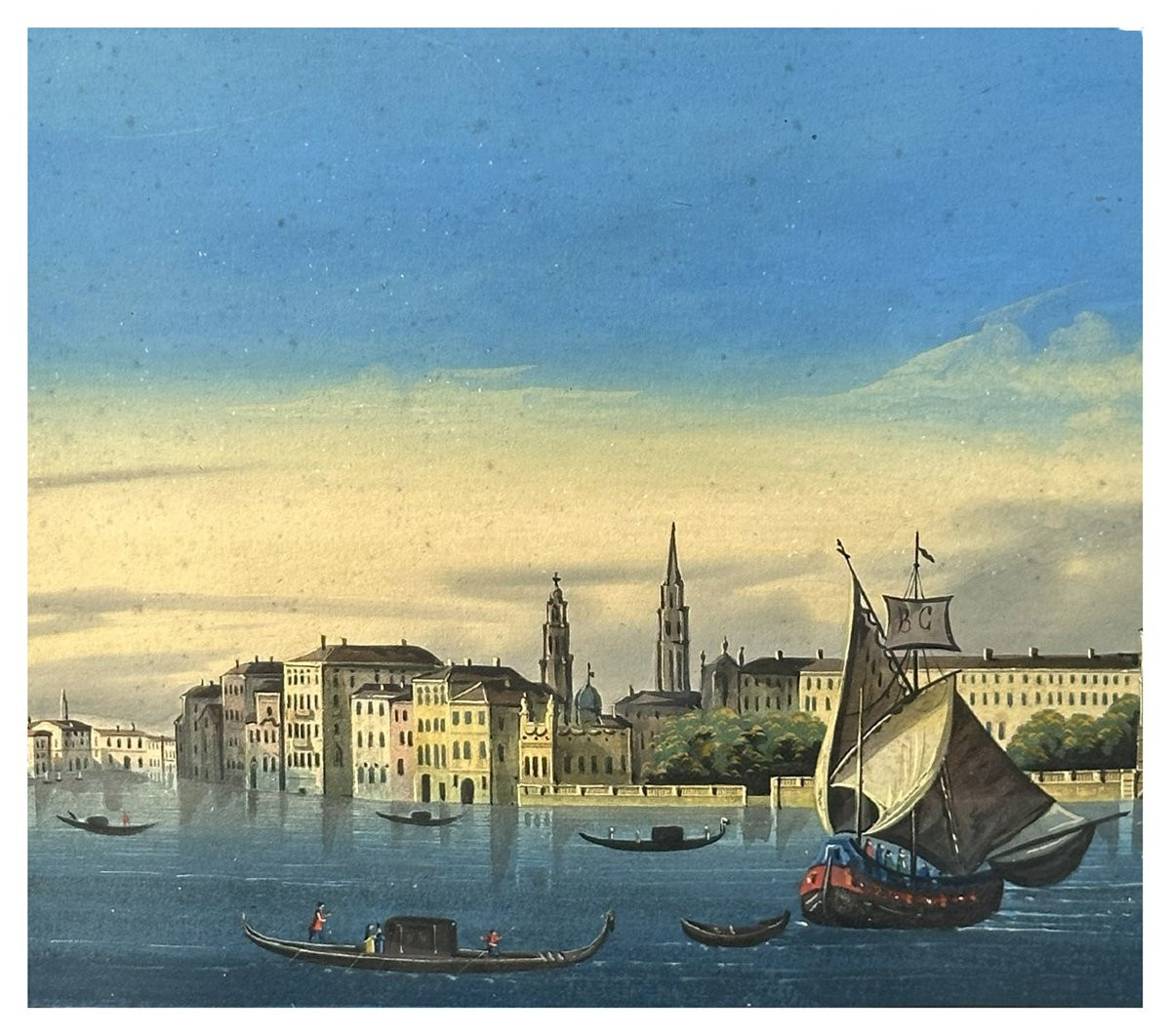
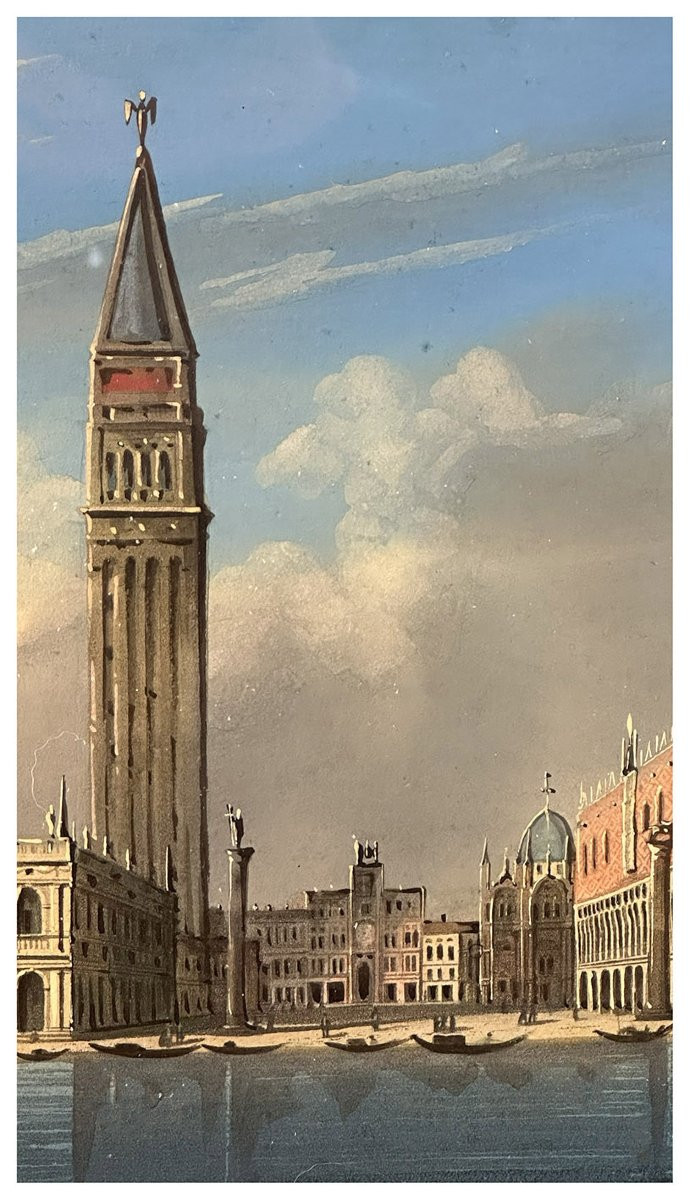
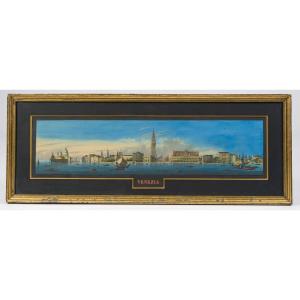
Giovanni Biasin, View Of St. Mark's Basin With Gondolas And Sailing Vessels. Gouache On Paper


Giovanni Basin
Venice, 1835 – Rovigo, 1912
View of St. Mark's Basin with Gondolas and Sailing Vessels
Gouache on paper, 29 x 92 cm
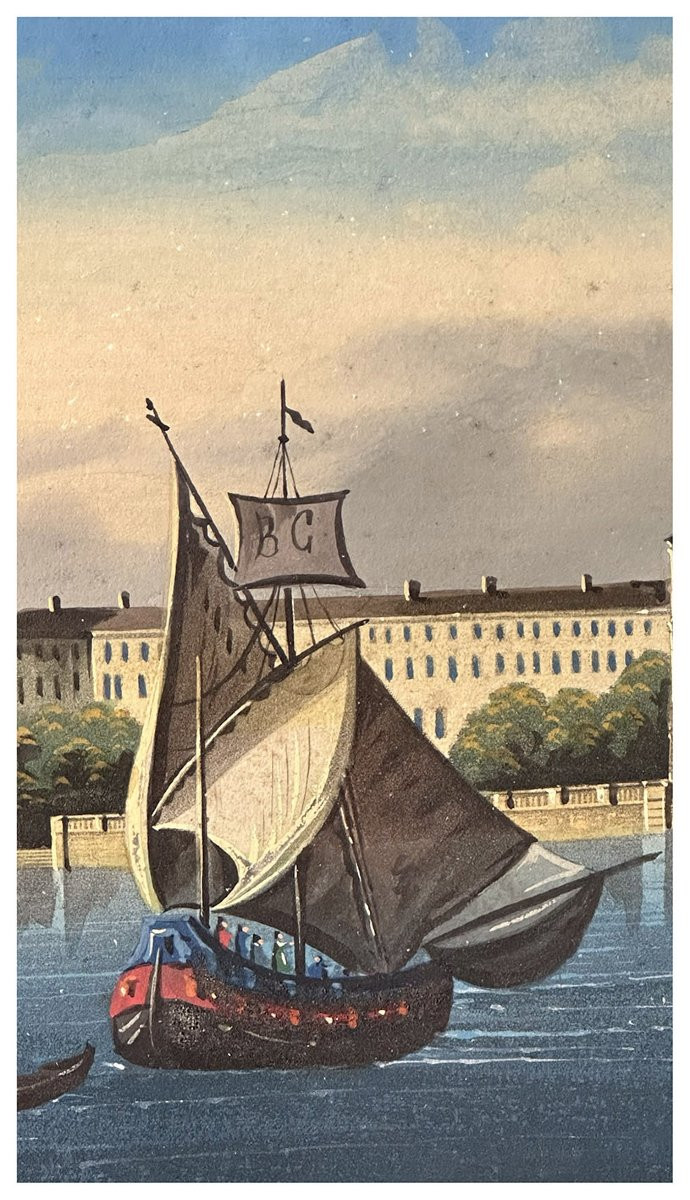
Monogram "GB" on a boat's sail
Framed, 42 x 110 cm
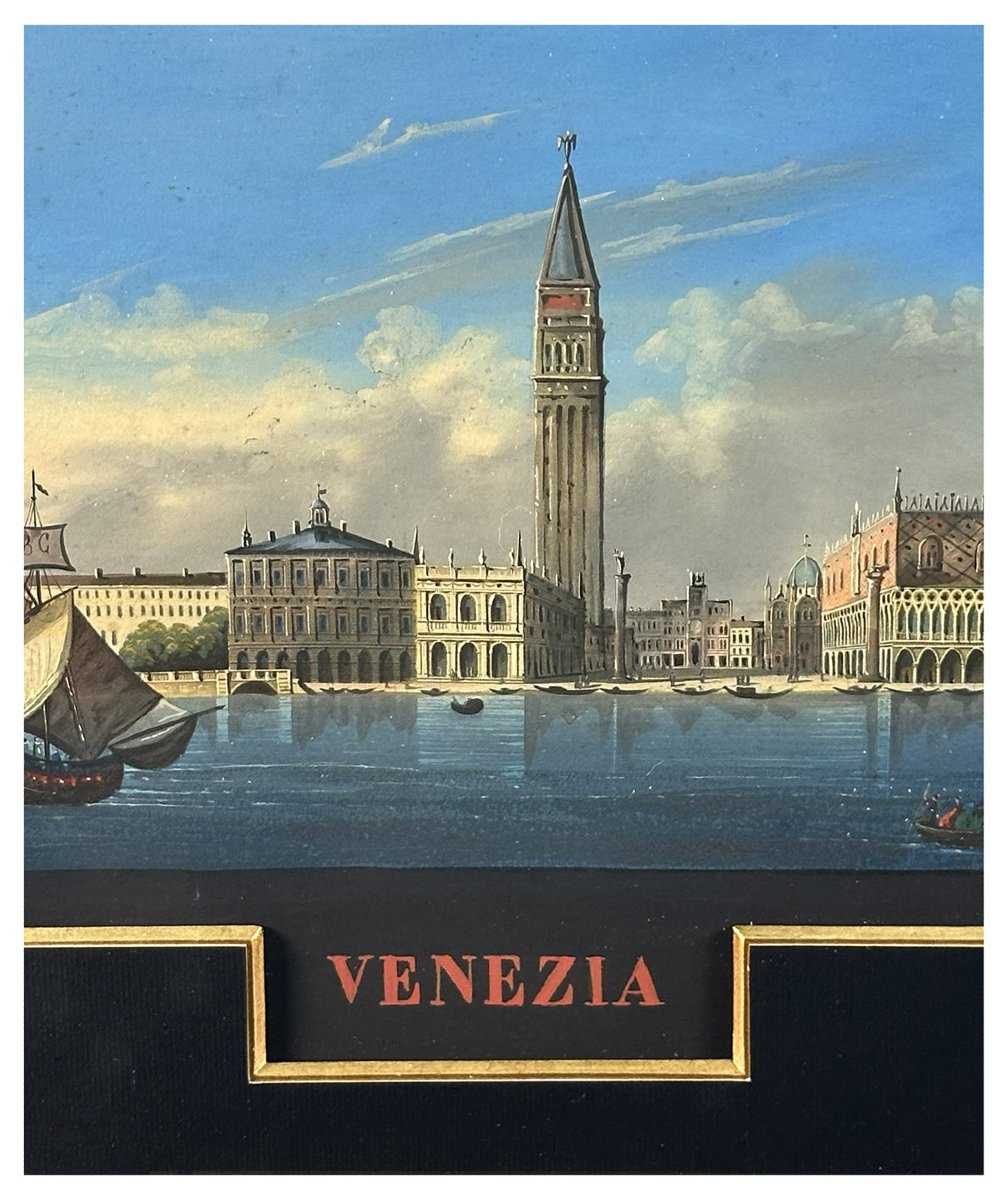
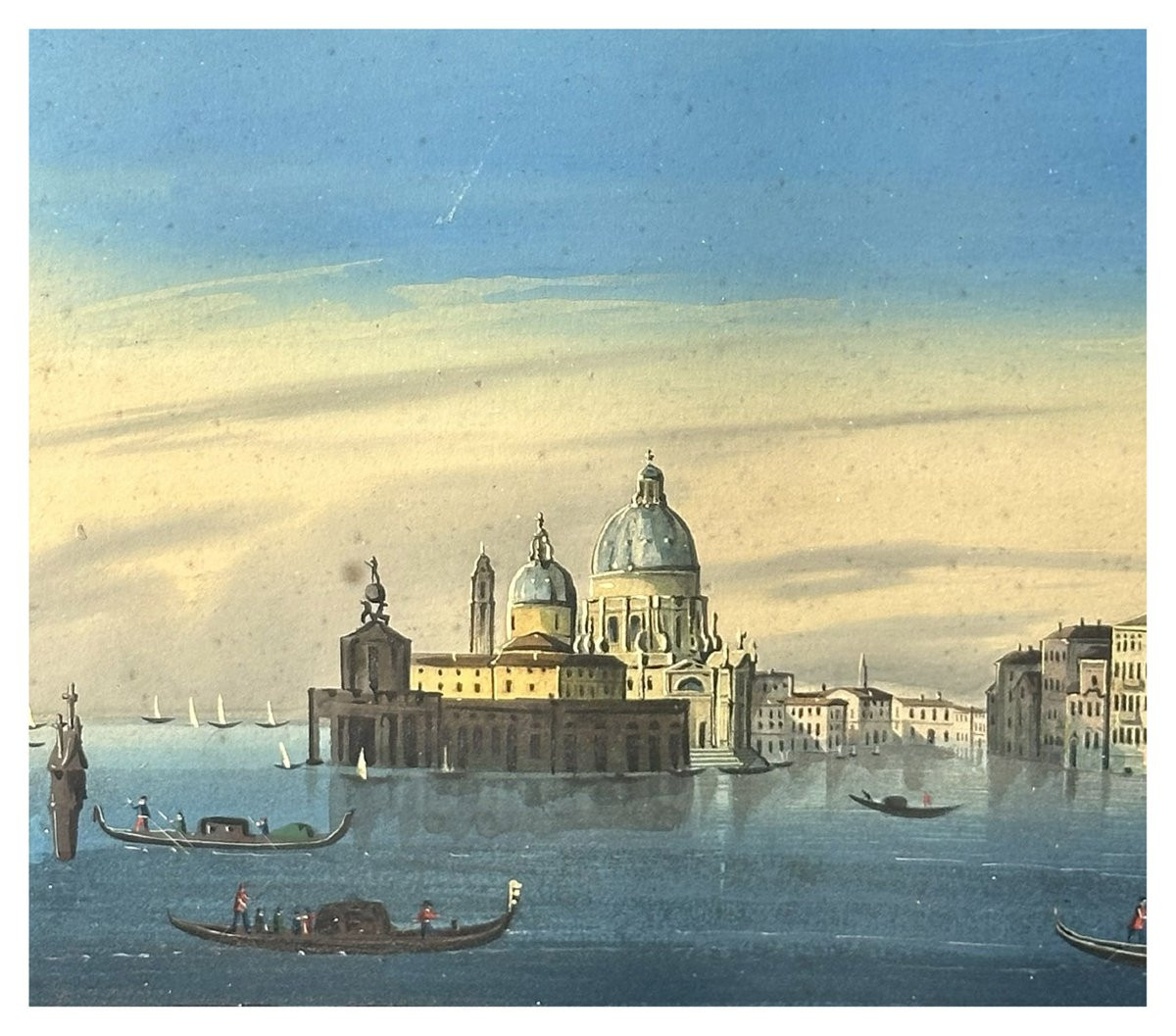
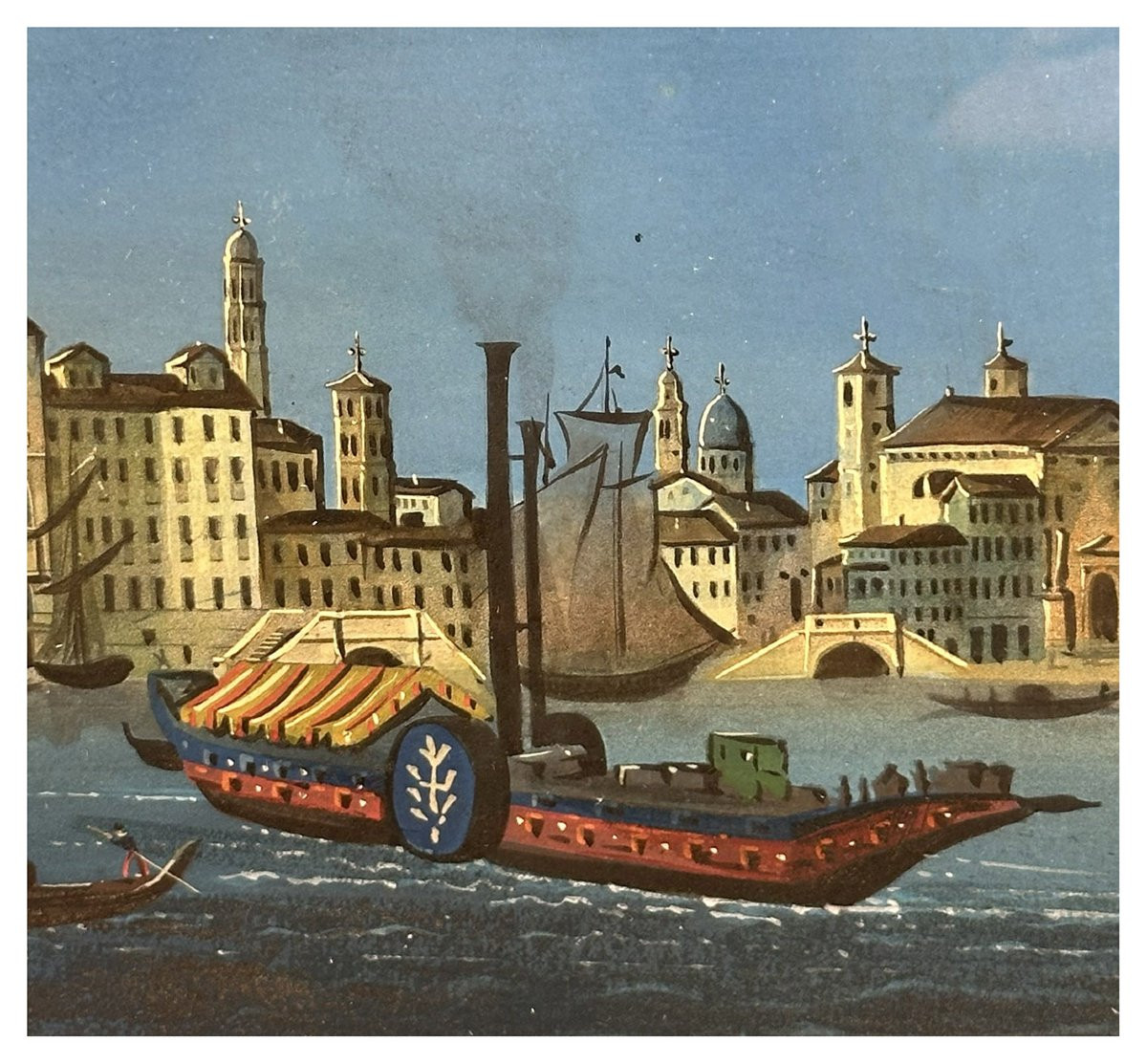
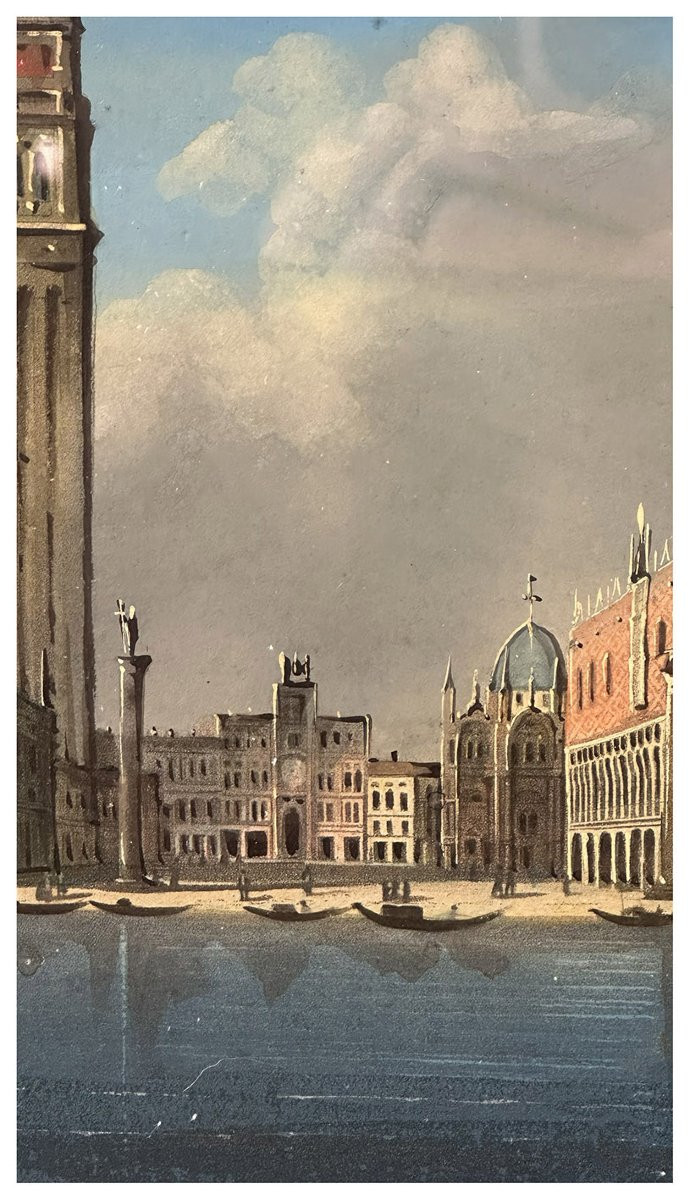
The painting unfolds in a markedly horizontal format—almost a panoramic strip—and encompasses the entire view of St. Mark's Basin from the water, according to the classic perspective of Venetian vedutism. On the left, the Punta della Dogana and the dome of Santa Maria della Salute dominate the lagoon skyline; in the center rises the Campanile di San Marco, flanked by the Procuratie, the Doge's Palace with its Gothic arches, and the Mint; to the right, the scene opens up to further buildings along the Molo, before fading into the basin.
The foreground is animated by the comings and goings of typically Venetian boats: sleek, black-lined gondolas glide across the dark water, while at center-right, a lateen-rigged felucca—whose mainsail prominently features the monogram GB, the artist's discreet yet unmistakable signature—occupies the scene with its vibrant color and movement. In the background, to the left, we glimpse the Island of San Giorgio and the open lagoon.
The sky makes up almost the upper half of the composition: a broad Venetian blue, streaked with thin cirrus clouds and cumulus clouds gathering toward the right, illuminated by the distinctive light that has made the lagoon one of the most beloved subjects of European painting. The palette, dominated by deep blues, pale azures, and pale ochres for the architecture, betrays the training of a painter who perfectly understood the chromatic rendering of gouache—a favored technique for collectors' views—and who knew how to calibrate tonal values to achieve an effect of luminosity and transparency.
The elongated format, the choice of vantage point from the basin, and the topographical precision of the buildings directly reference the famous 22-meter Panorama of Venice preserved in Palazzo Roverella, of which this gouache represents a precious and rare collector's version.
ATTRIBUTIVE NOTE
The attribution to Giovanni Biasin is certain and based on two converging elements. The first is paleographical: the initials GB, the artist's usual signature in his small- and medium-format works, are clearly painted on the sail of the felucca at the center of the composition. The second is typological: the bold horizontal format—with a width/height ratio of approximately 3:1—absolutely echoes the compositional structure of the large Diorama Biasin of Rovigo (22 m × 1.75 m), created in 1887, of which this gouache is a smaller-scale counterpart, intended for private enjoyment and the collector's market. Even the choice of perspective—the open basin, with the Salute on the left and the Molo front on the right—matches the great Rovigo prototype.
HISTORICAL AND ARTISTIC CONTEXT
The tradition of the Venetian view is one of the oldest and most glorious in Italian painting. Born in the eighteenth century with Luca Carlevaris and brought to its peak by Giovanni Antonio Canal, known as Canaletto (1697–1768) and Francesco Guardi (1712–1793), it survived and transformed throughout the nineteenth century, adapting to the changing tastes of the bourgeoisie and the export market for views—highly sought after by English, German, and Austrian collectors visiting Venice as part of the Grand Tour.
Giovanni Biasin's work fits perfectly into this vein, inheriting and reinterpreting the Venetian view tradition with a keen eye for the spectacularization techniques typical of nineteenth-century visual culture—panoramas, dioramas, optical views—without sacrificing the quality of the drawing and topographical accuracy. His training took place at the Academy of Fine Arts in Venice, but his artistic language was enriched by contacts with the European art scene through the Universal Exhibitions in Paris and other international centers.
Alongside Biasin, other masters working in the same field of 19th-century Venetian views are now being re-evaluated by critics. Among the most significant are the brothers Carlo and Giovanni Grubacs (Giovanni: Pola c. 1800 – Venice 1879; Carlo: Pola c. 1801 – Venice after 1870), painters of Istrian origin who were active in Venice for much of the 19th century. They specialized in views of the Grand Canal and the Basin of St. Mark, blending Canaletto's precision with a chromatic sensibility already tinged with Romanticism. Their works—primarily oil on canvas but also in gouache—have achieved significant prices at recent international auctions, demonstrating the market's renewed interest in this school.
Venice, 1835 – Rovigo, 1912
View of St. Mark's Basin with Gondolas and Sailing Vessels
Gouache on paper, 29 x 92 cm
Monogram "GB" on a boat's sail
Framed, 42 x 110 cm
The painting unfolds in a markedly horizontal format—almost a panoramic strip—and encompasses the entire view of St. Mark's Basin from the water, according to the classic perspective of Venetian vedutism. On the left, the Punta della Dogana and the dome of Santa Maria della Salute dominate the lagoon skyline; in the center rises the Campanile di San Marco, flanked by the Procuratie, the Doge's Palace with its Gothic arches, and the Mint; to the right, the scene opens up to further buildings along the Molo, before fading into the basin.
The foreground is animated by the comings and goings of typically Venetian boats: sleek, black-lined gondolas glide across the dark water, while at center-right, a lateen-rigged felucca—whose mainsail prominently features the monogram GB, the artist's discreet yet unmistakable signature—occupies the scene with its vibrant color and movement. In the background, to the left, we glimpse the Island of San Giorgio and the open lagoon.
The sky makes up almost the upper half of the composition: a broad Venetian blue, streaked with thin cirrus clouds and cumulus clouds gathering toward the right, illuminated by the distinctive light that has made the lagoon one of the most beloved subjects of European painting. The palette, dominated by deep blues, pale azures, and pale ochres for the architecture, betrays the training of a painter who perfectly understood the chromatic rendering of gouache—a favored technique for collectors' views—and who knew how to calibrate tonal values to achieve an effect of luminosity and transparency.
The elongated format, the choice of vantage point from the basin, and the topographical precision of the buildings directly reference the famous 22-meter Panorama of Venice preserved in Palazzo Roverella, of which this gouache represents a precious and rare collector's version.
ATTRIBUTIVE NOTE
The attribution to Giovanni Biasin is certain and based on two converging elements. The first is paleographical: the initials GB, the artist's usual signature in his small- and medium-format works, are clearly painted on the sail of the felucca at the center of the composition. The second is typological: the bold horizontal format—with a width/height ratio of approximately 3:1—absolutely echoes the compositional structure of the large Diorama Biasin of Rovigo (22 m × 1.75 m), created in 1887, of which this gouache is a smaller-scale counterpart, intended for private enjoyment and the collector's market. Even the choice of perspective—the open basin, with the Salute on the left and the Molo front on the right—matches the great Rovigo prototype.
HISTORICAL AND ARTISTIC CONTEXT
The tradition of the Venetian view is one of the oldest and most glorious in Italian painting. Born in the eighteenth century with Luca Carlevaris and brought to its peak by Giovanni Antonio Canal, known as Canaletto (1697–1768) and Francesco Guardi (1712–1793), it survived and transformed throughout the nineteenth century, adapting to the changing tastes of the bourgeoisie and the export market for views—highly sought after by English, German, and Austrian collectors visiting Venice as part of the Grand Tour.
Giovanni Biasin's work fits perfectly into this vein, inheriting and reinterpreting the Venetian view tradition with a keen eye for the spectacularization techniques typical of nineteenth-century visual culture—panoramas, dioramas, optical views—without sacrificing the quality of the drawing and topographical accuracy. His training took place at the Academy of Fine Arts in Venice, but his artistic language was enriched by contacts with the European art scene through the Universal Exhibitions in Paris and other international centers.
Alongside Biasin, other masters working in the same field of 19th-century Venetian views are now being re-evaluated by critics. Among the most significant are the brothers Carlo and Giovanni Grubacs (Giovanni: Pola c. 1800 – Venice 1879; Carlo: Pola c. 1801 – Venice after 1870), painters of Istrian origin who were active in Venice for much of the 19th century. They specialized in views of the Grand Canal and the Basin of St. Mark, blending Canaletto's precision with a chromatic sensibility already tinged with Romanticism. Their works—primarily oil on canvas but also in gouache—have achieved significant prices at recent international auctions, demonstrating the market's renewed interest in this school.
Explore similar pieces and discover your ideal find:
Gouache Paintings