

Antonio Fasan, Homage To Matisse, Oil On Panel, 67 X 53 Cm
Artist: Antonio Fasan
Antonio Fasan
Padua, 1902 – Padua, 1985
Homage to Matisse
Oil on panel, 67 × 53 cm
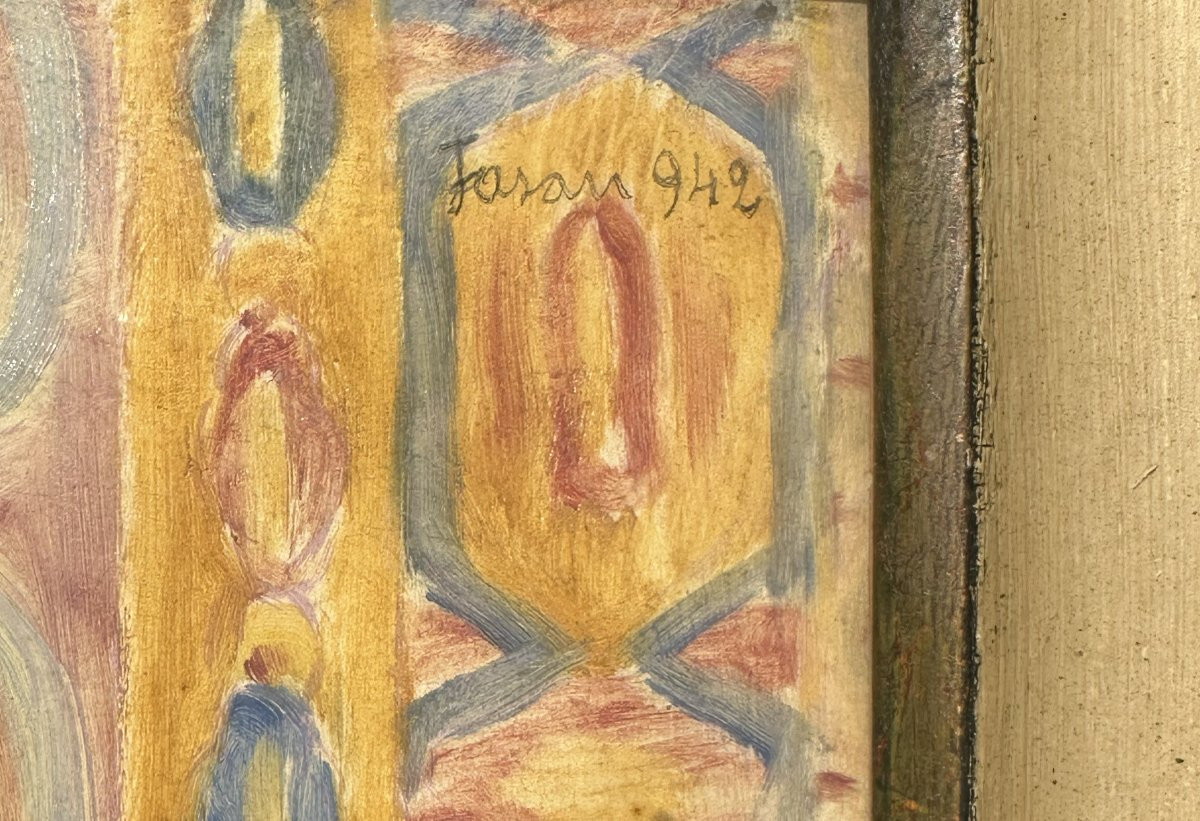
Signed and dated in pencil upper right: Fasan 942
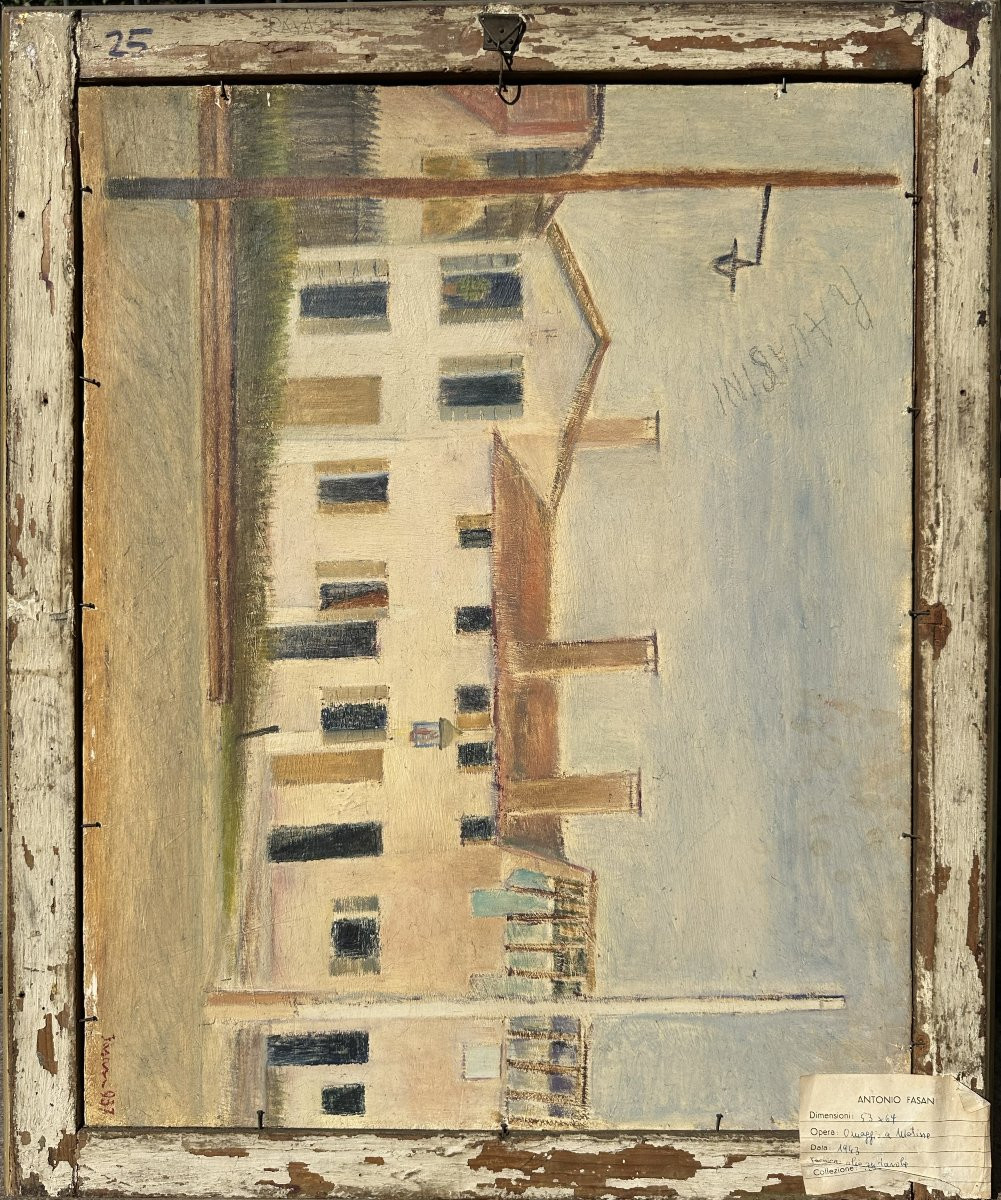
On the reverse: painting signed and dated Fasan 937 depicting a largefarmhouse;
handwritten label in the lower right with the following information: Antonio Fasan /Dimensions: 53 × 64 / Work: Homage to Matisse / Date: 1943 / Technique: oil onwood / Collection: (...)
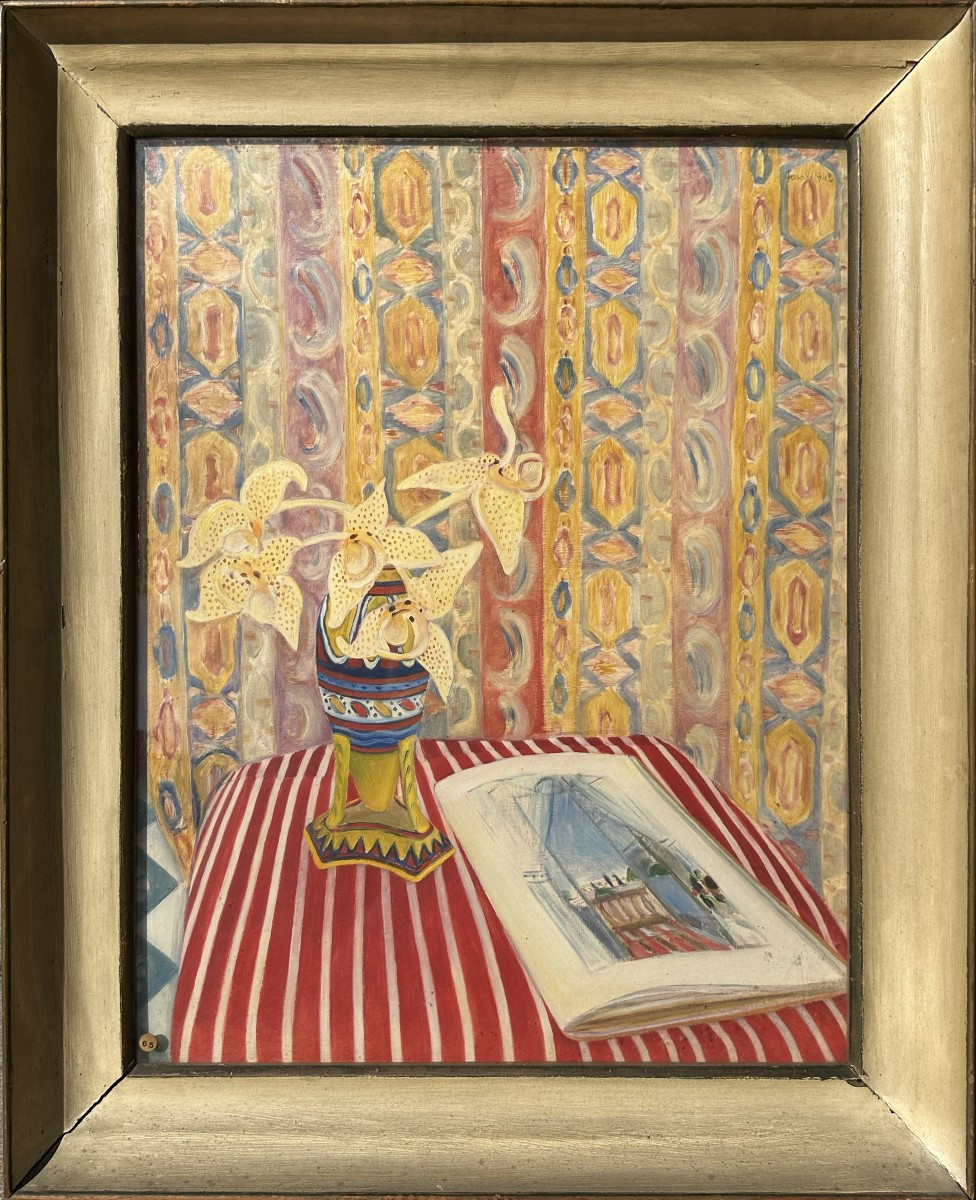
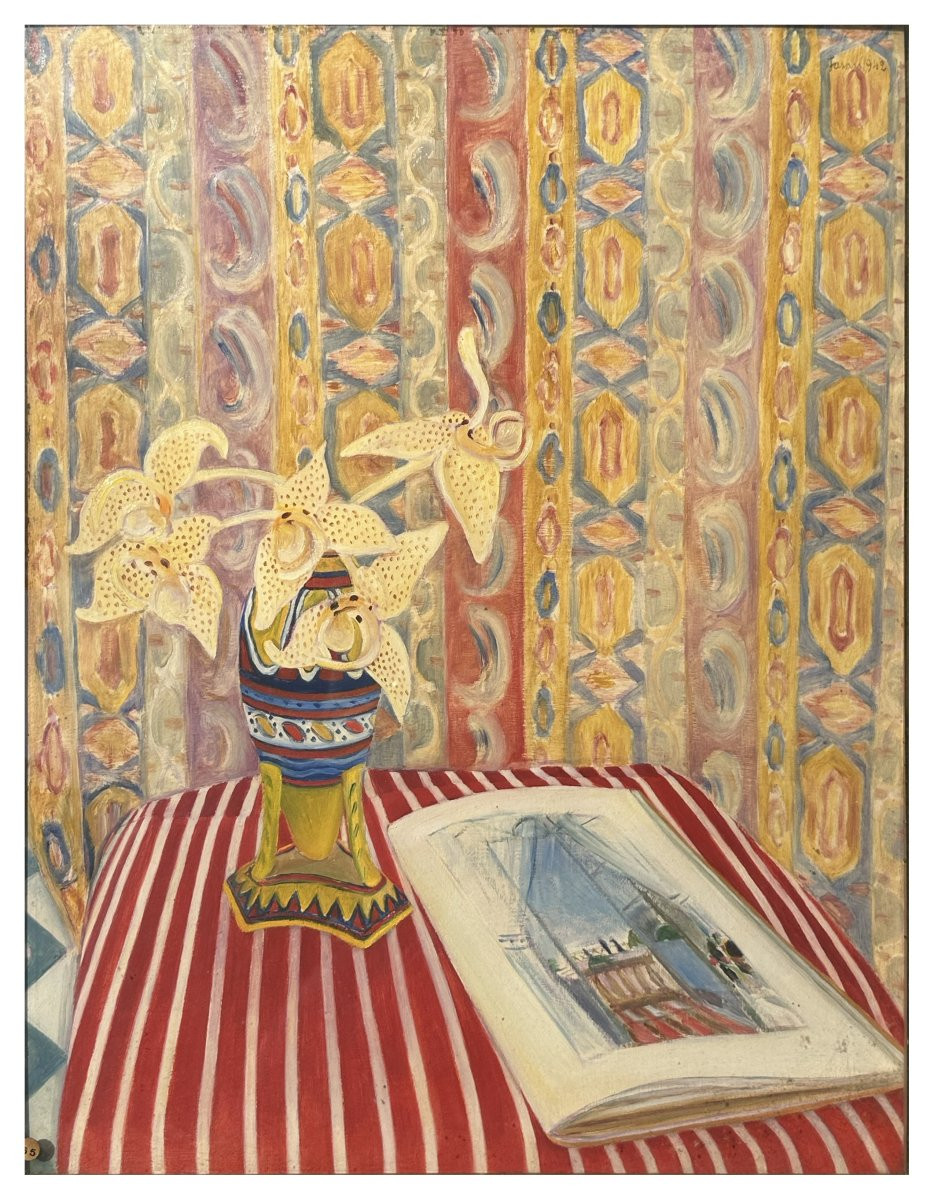
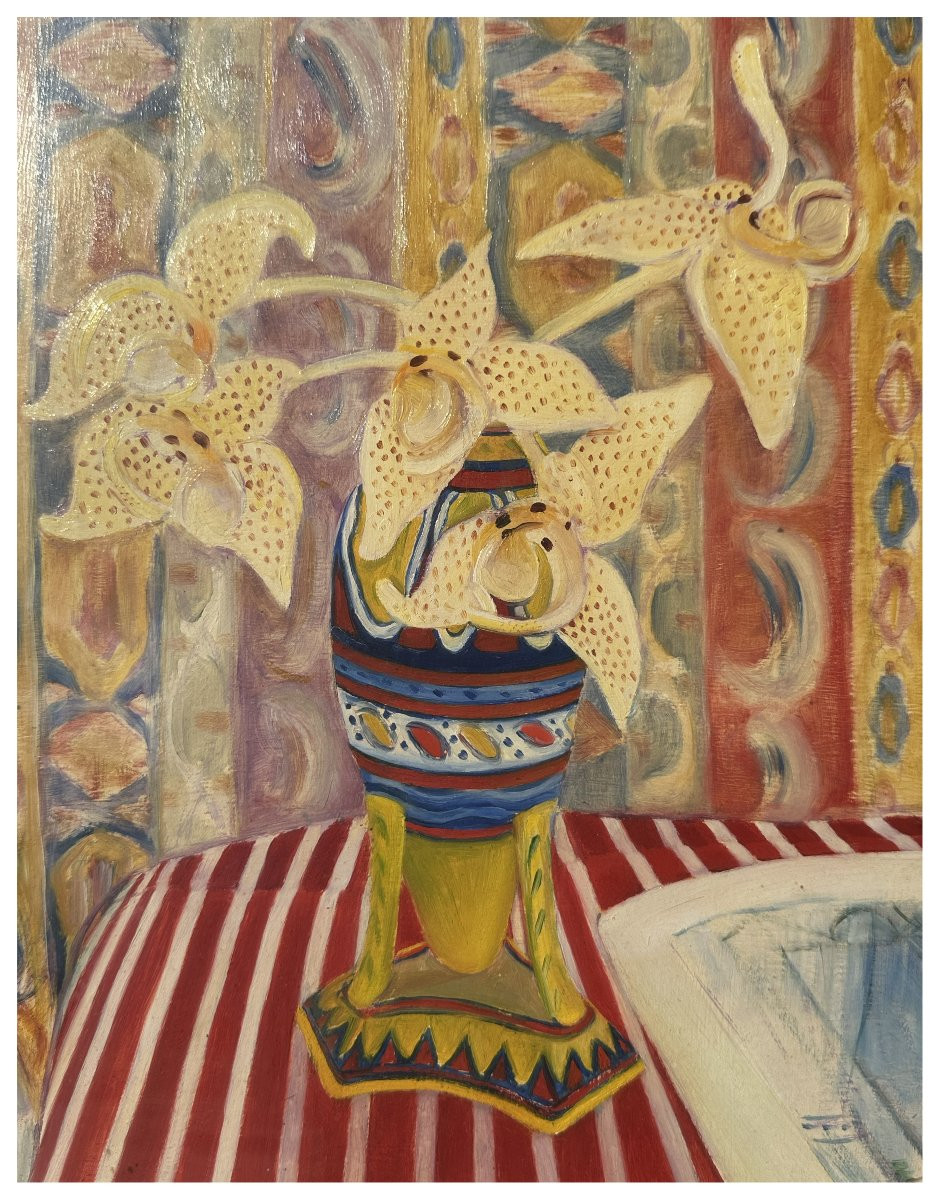
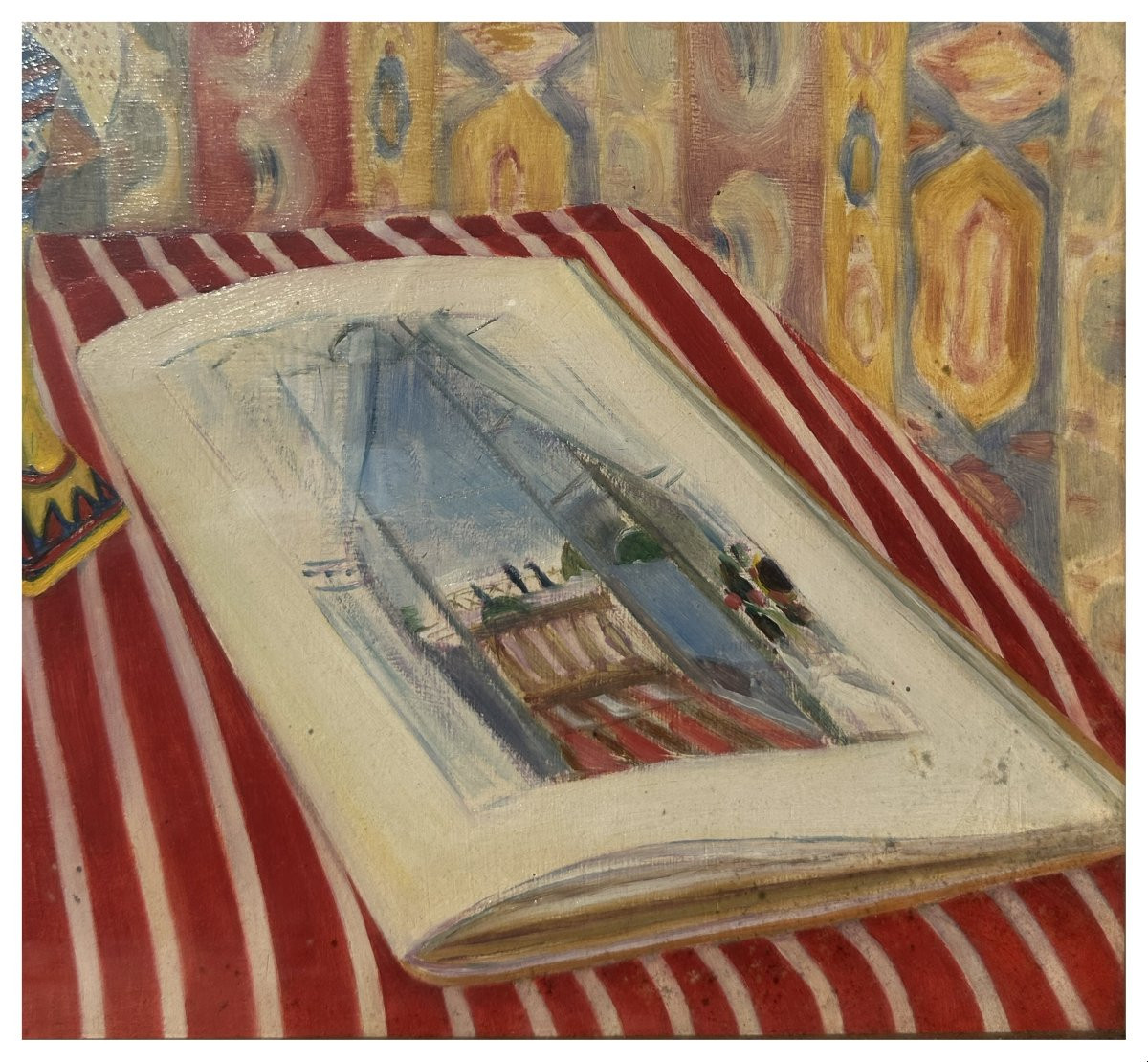
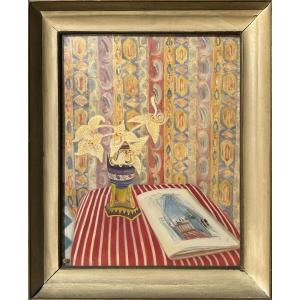
The paintingThe panel depicts an indoor still life ofextraordinary chromatic vibrancy: on a table covered by a tablecloth withred and white stripes stands a vase decorated with flowers featuring whiteand yellow speckled petals—stylized orchids—while a sketchbookwith an illustration of an urban-port scene lies open on the tabletop. In the background,covering the entire wall, is a patterned tapestry in yellow, red, and blue withOriental-style decorative motifs alternating with moiré columns, in thefullest sense of the term, reminiscent of Matisse.
The composition is intentionally a dialoguefrom a distance with Henri Matisse, whose still lifes from the 1920s Fasan hadstudied in depth—particularly the Nice series featuring striped tables,arabesque fabrics, and vases of flowers against sumptuous decorative backgrounds such as Vase ofFlowers (1924, MFA Boston), Still Life on a Table (1925,Philadelphia Museum of Art), and the paintings from the apartment on PlaceCharles-Félix—masterpieces in which the French master dissolves spatial depthinto an arabesque of pure colors and contrasting planes.
Fasan’s Homageechoes this compositional scheme with his own mastery and inventive freedom.The date marked in pencil on the front (942,i.e., 1942) and that on the label on the back (1943) suggest thatthe work was begun in 1942 and completed—or deemed definitive—the following year.
The painterAntonio Fasan was born in Padua on May 12, 1902,to Rodolfo and Amalia Lancerotti. After earning his commercial diploma,he worked at his father’s bakery in Piazza della Frutta in Padua, wherehe spent much of his life. In his spare time, he began paintinghis first watercolors, studying Venetian art, and collecting monographs onthe French masters of the 18th and 19th centuries.It was around 1926, thanks to artist friendshe met in the White Room of Caffè Pedrocchi (A. Morato, A. Dal Prà, G.Dandolo, and D. Lazzaro) and his meeting with R. M. Mazzacurati, that Fasan beganto devote himself seriously to painting, developing a soft and vibrant colorismand a taste for solid, full forms and for bright, soft hues.
Admired and collected during his lifetime by figures such as GiòPonti and De Pisis, Fasan is universally described as a contemplative child whoemerges from the flour in the oven: during the twenty years of Fascist rule, he spent his timeinventing Sunday-like colors—confident and anti-Fascist—“saturating the mostpious, childlike, and serene colors to invent peace in times of war.”
In the early 1940s, his paintingachieved significant results: together with Campigli, De Pisis, Ferrazzi, Funi,Martini, Ponti, Saetti, and Severini, he was commissioned in 1941 to decorate the Universityof Padua. In 1941 he exhibited for the first time at the Gian Ferrari Gallery inMilan; the following year at the First National Art Exhibition in Verona; in 1943he participated in the Bergamo Prize; and in 1944 he held two major solo exhibitions atthe Il Cavallino Gallery in Venice and the Le Tre Venezie Gallery in Padua.
The series of portraits, landscapes, and still lifes fromthis period partly recall Matisse’s painting of the 1920s; our1943 Homage to Matisse is unquestionably one of the most representative works of thisperiod.
He died in Padua on November 26, 1985.
In 1982, on theoccasion of the major retrospective at the Palazzo della Ragione in Padua,he received the city’s medal with its seal.ProvenancePrivate Collection, Padua (as per label on theverso)
Notes
on the reverseOn the reverse of the panel there is a secondautograph painting, signed and dated Fasan 937 (1937), depicting alarge farmhouse, evidence of a common practice in earlyearly 20th century to reuse previously used supports. The number 25 visiblein the upper left corner is likely a catalog or exhibition number.
Padua, 1902 – Padua, 1985
Homage to Matisse
Oil on panel, 67 × 53 cm
Signed and dated in pencil upper right: Fasan 942
On the reverse: painting signed and dated Fasan 937 depicting a largefarmhouse;
handwritten label in the lower right with the following information: Antonio Fasan /Dimensions: 53 × 64 / Work: Homage to Matisse / Date: 1943 / Technique: oil onwood / Collection: (...)
The paintingThe panel depicts an indoor still life ofextraordinary chromatic vibrancy: on a table covered by a tablecloth withred and white stripes stands a vase decorated with flowers featuring whiteand yellow speckled petals—stylized orchids—while a sketchbookwith an illustration of an urban-port scene lies open on the tabletop. In the background,covering the entire wall, is a patterned tapestry in yellow, red, and blue withOriental-style decorative motifs alternating with moiré columns, in thefullest sense of the term, reminiscent of Matisse.
The composition is intentionally a dialoguefrom a distance with Henri Matisse, whose still lifes from the 1920s Fasan hadstudied in depth—particularly the Nice series featuring striped tables,arabesque fabrics, and vases of flowers against sumptuous decorative backgrounds such as Vase ofFlowers (1924, MFA Boston), Still Life on a Table (1925,Philadelphia Museum of Art), and the paintings from the apartment on PlaceCharles-Félix—masterpieces in which the French master dissolves spatial depthinto an arabesque of pure colors and contrasting planes.
Fasan’s Homageechoes this compositional scheme with his own mastery and inventive freedom.The date marked in pencil on the front (942,i.e., 1942) and that on the label on the back (1943) suggest thatthe work was begun in 1942 and completed—or deemed definitive—the following year.
The painterAntonio Fasan was born in Padua on May 12, 1902,to Rodolfo and Amalia Lancerotti. After earning his commercial diploma,he worked at his father’s bakery in Piazza della Frutta in Padua, wherehe spent much of his life. In his spare time, he began paintinghis first watercolors, studying Venetian art, and collecting monographs onthe French masters of the 18th and 19th centuries.It was around 1926, thanks to artist friendshe met in the White Room of Caffè Pedrocchi (A. Morato, A. Dal Prà, G.Dandolo, and D. Lazzaro) and his meeting with R. M. Mazzacurati, that Fasan beganto devote himself seriously to painting, developing a soft and vibrant colorismand a taste for solid, full forms and for bright, soft hues.
Admired and collected during his lifetime by figures such as GiòPonti and De Pisis, Fasan is universally described as a contemplative child whoemerges from the flour in the oven: during the twenty years of Fascist rule, he spent his timeinventing Sunday-like colors—confident and anti-Fascist—“saturating the mostpious, childlike, and serene colors to invent peace in times of war.”
In the early 1940s, his paintingachieved significant results: together with Campigli, De Pisis, Ferrazzi, Funi,Martini, Ponti, Saetti, and Severini, he was commissioned in 1941 to decorate the Universityof Padua. In 1941 he exhibited for the first time at the Gian Ferrari Gallery inMilan; the following year at the First National Art Exhibition in Verona; in 1943he participated in the Bergamo Prize; and in 1944 he held two major solo exhibitions atthe Il Cavallino Gallery in Venice and the Le Tre Venezie Gallery in Padua.
The series of portraits, landscapes, and still lifes fromthis period partly recall Matisse’s painting of the 1920s; our1943 Homage to Matisse is unquestionably one of the most representative works of thisperiod.
He died in Padua on November 26, 1985.
In 1982, on theoccasion of the major retrospective at the Palazzo della Ragione in Padua,he received the city’s medal with its seal.ProvenancePrivate Collection, Padua (as per label on theverso)
Notes
on the reverseOn the reverse of the panel there is a secondautograph painting, signed and dated Fasan 937 (1937), depicting alarge farmhouse, evidence of a common practice in earlyearly 20th century to reuse previously used supports. The number 25 visiblein the upper left corner is likely a catalog or exhibition number.
2 500 €
Period: 20th century
Style: Art Deco
Condition: Good condition
Material: Oil painting on wood
Width: 53 cm.
Height: 67 cm.
Reference (ID): 1750119
Availability: In stock
Print