




Table Clock With Rotating Dial. Bronze, Marble. After Models By Augustin Pajou.
A table clock with a rotating dial. Bronze and marble. After models by Augustin Pajou (France, 1730-1809).
The mechanism is in working order.
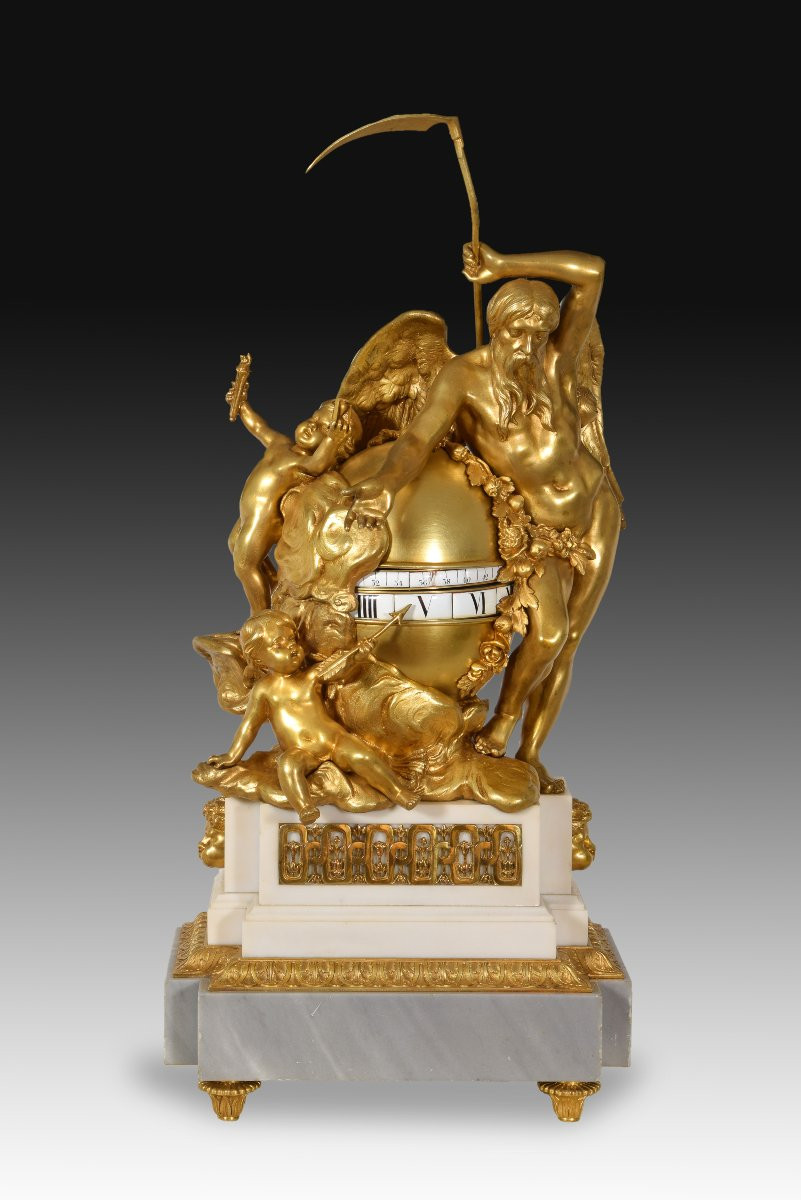
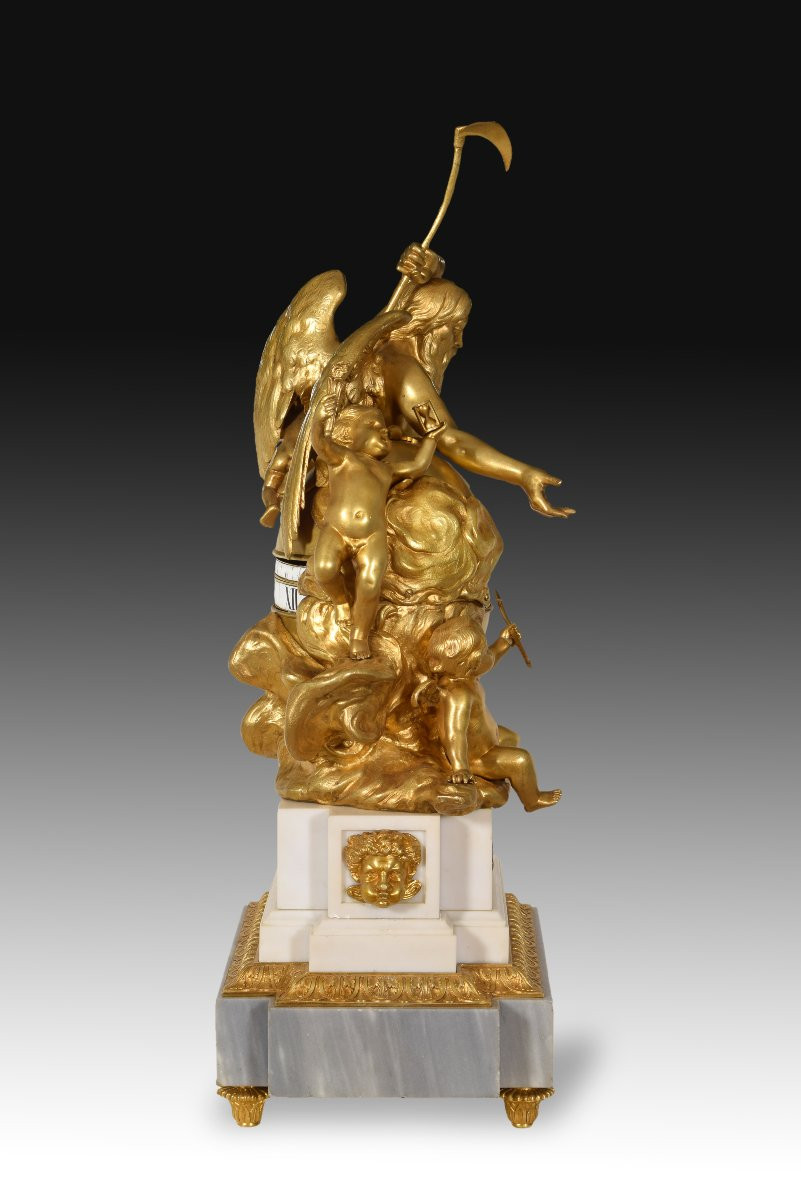
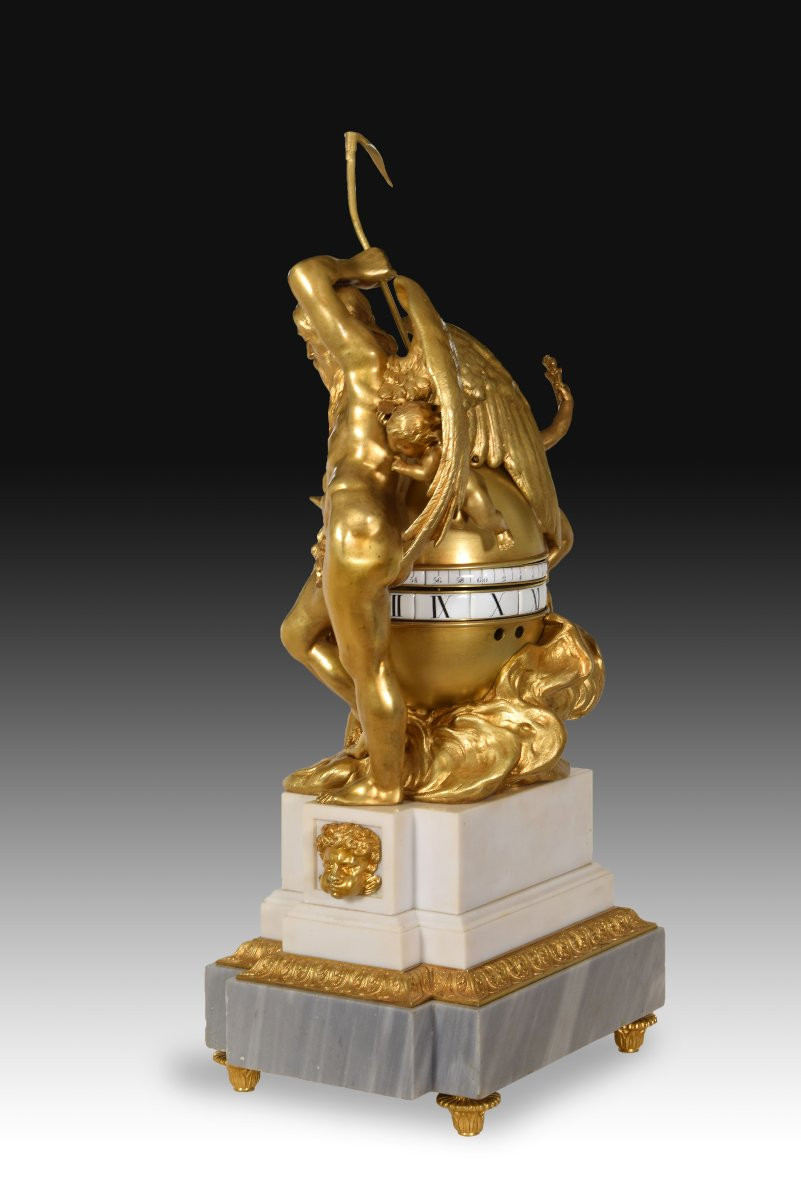
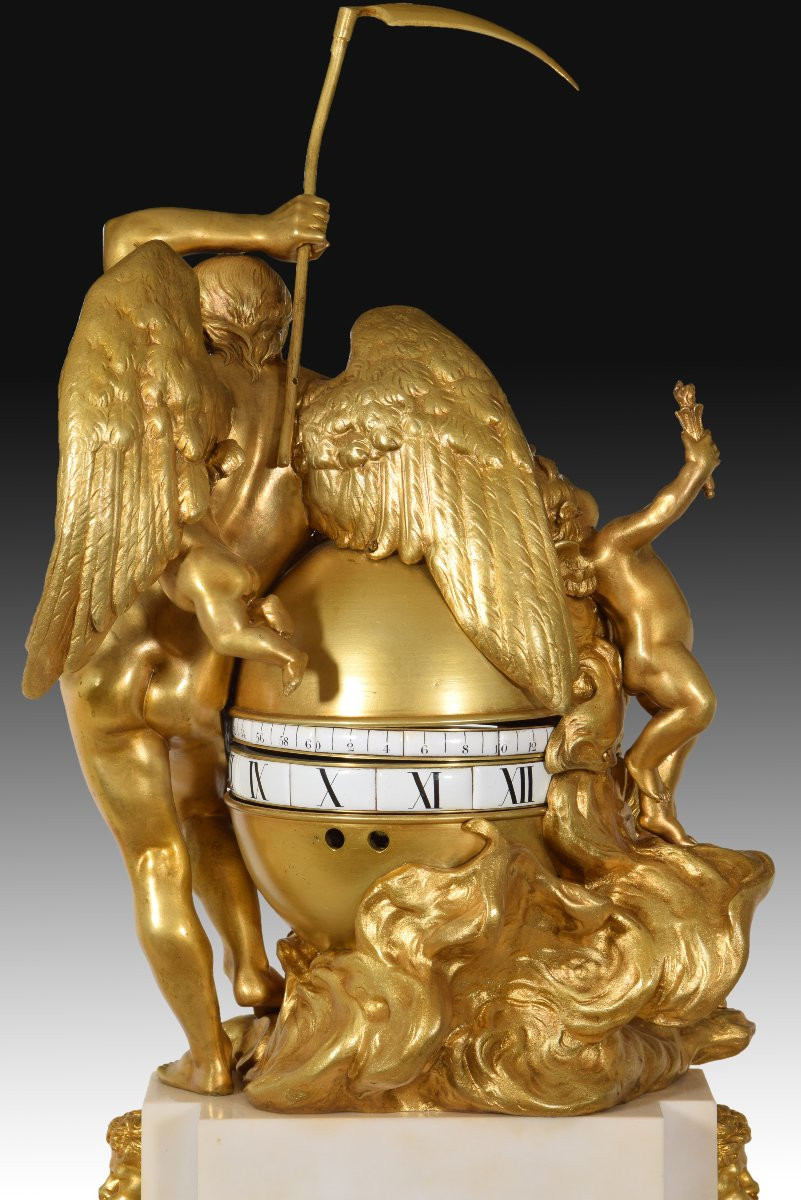
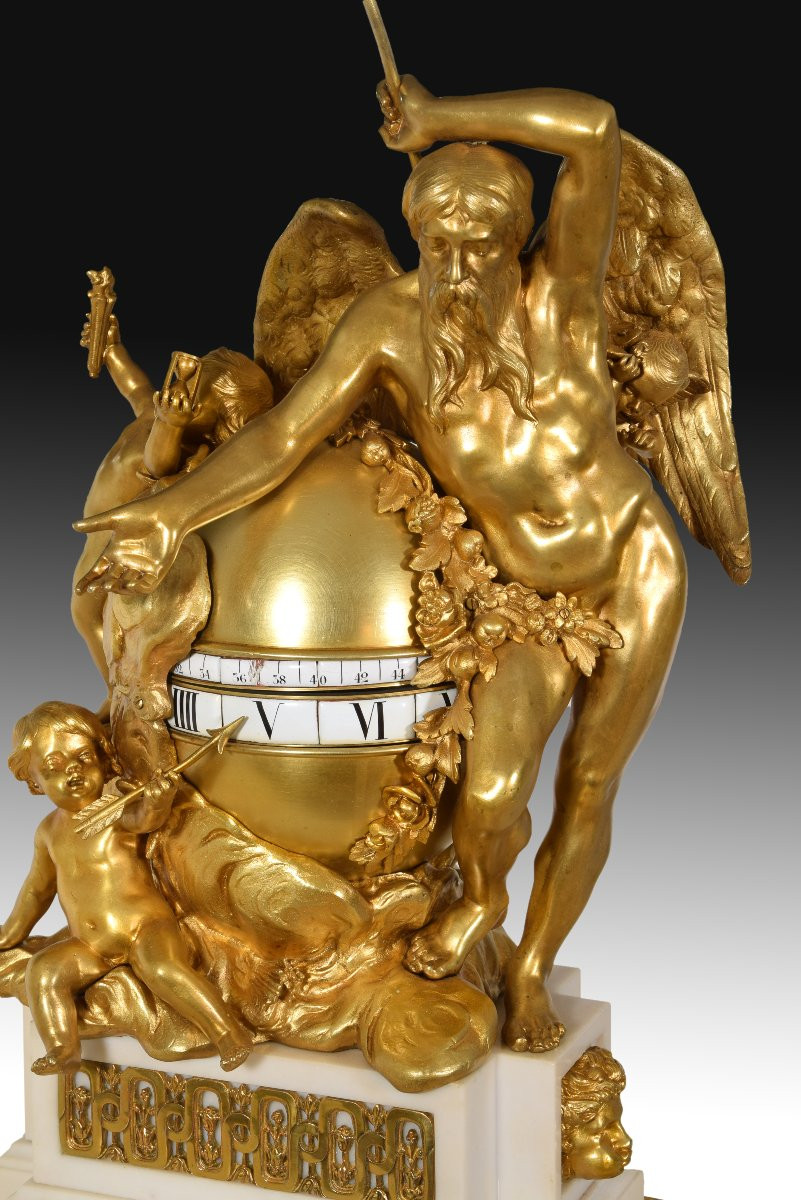
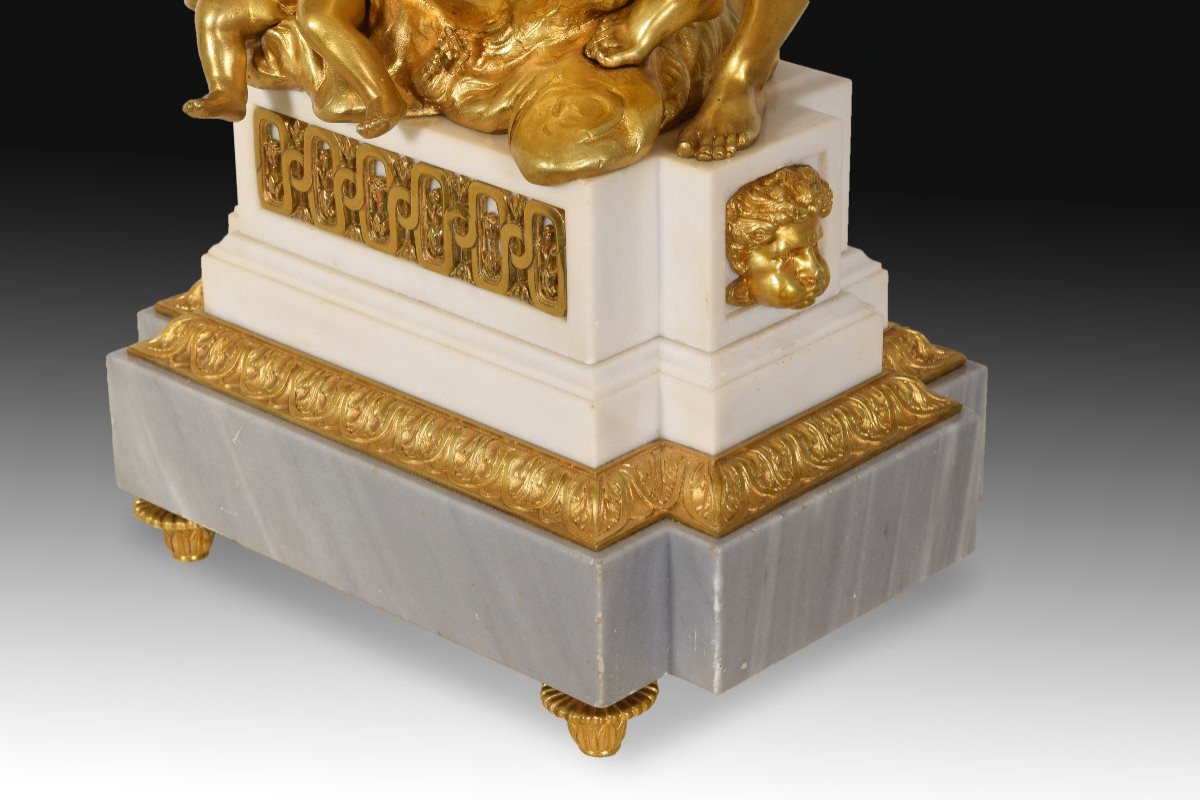
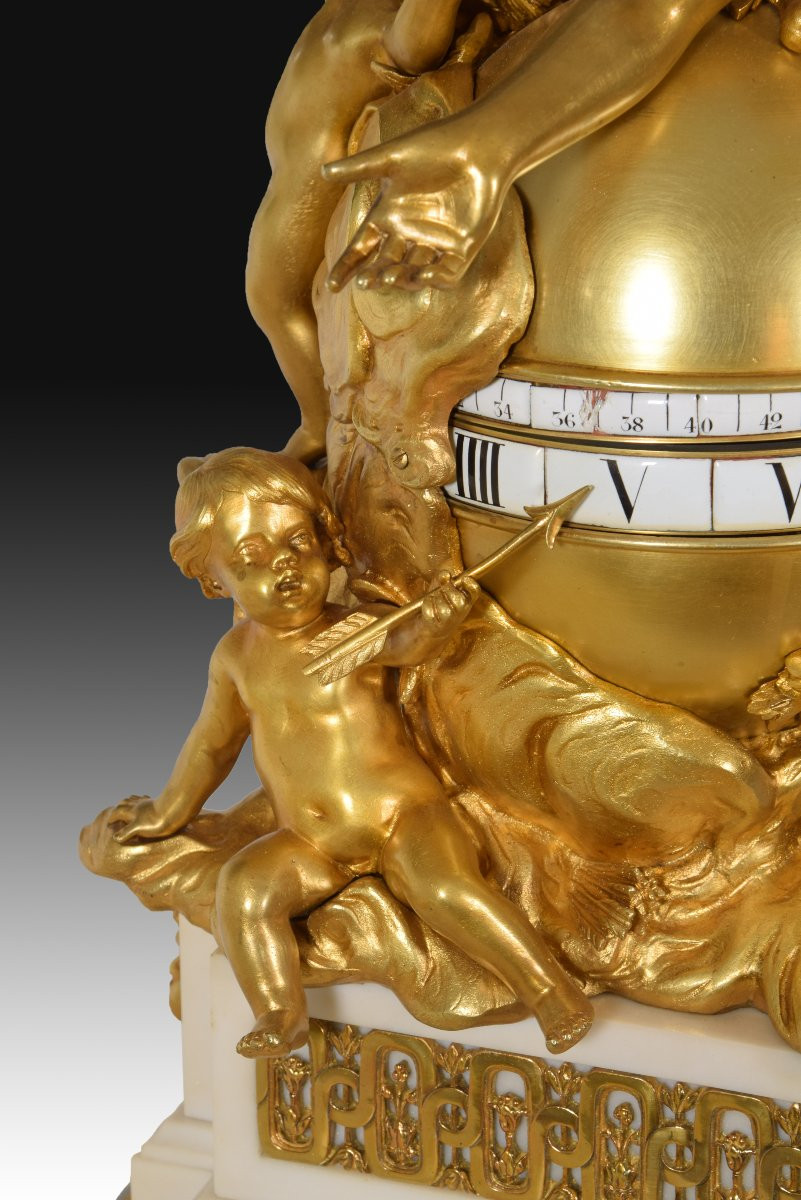
The table clock consists of a stepped base of carved stone, adorned with classically inspired gilt-bronze elements and resting on feet, as well as a gilt-bronze composition depicting several mythological figures. On one side, a bearded old man brandishes a scythe, with a winged child on his back; on the other side of the dial appear two winged children, one holding an arrow and the other an hourglass and a torch. This dial houses the clock movement, with the hours and minutes displayed on two white bands, according to the system known as "rotating circles" or "rotating dial." The old man is Cronus (the Greek god of Time, who was eventually assimilated to the Roman Saturn; some errors or identifications with other deities led to the personification of time as "Father Time," depicted as an old man with hourglasses, wings, a scythe, etc.), and he appears accompanied by Eros (the Roman Cupid, primordial god of sexual attraction, love, and desire) with his arrows, and Hymen (or Hymen, god of marriage ceremonies, holding a torch), who seems to have taken the hourglass from the god of Time. One could therefore say that this hourglass symbolizes the triumph of Love (legitimate or proper, hence the allusion to marriage) over Time, or that when love arrives, time stands still. This piece should be compared to a Louis XVI clock in the Halim Time & Glass Museum (Evanston, Illinois, USA), known as "The Triumph of Love over Time," made in France around 1780. The bronzes of this clock have been attributed to Étienne Martincourt, who was inspired by a design by the sculptor Augustin Pajou, while the movement is the work of Gabriel Courieult (signed on the base). Several similar examples are known in private collections. Also worth mentioning is a table clock in the Wallace Collection in London, on which this "Father Time" is patinated rather than gilded, and which rests on a porphyry base (inv. F264), dated around 1780 and also linked to the founder Étienne Martincourt (active 1763–1791) and the design of Augustin Pajou (1730–1809). This piece may be a version of a larger work commissioned by the Duchess of Mazarin. The present clock features iconography very similar to these examples, depicting the same figures; however, several differences are present. The mechanism is in working order.
Weight: 43 kg. Dimensions: 32 x 25 x 68 cm
The mechanism is in working order.
The table clock consists of a stepped base of carved stone, adorned with classically inspired gilt-bronze elements and resting on feet, as well as a gilt-bronze composition depicting several mythological figures. On one side, a bearded old man brandishes a scythe, with a winged child on his back; on the other side of the dial appear two winged children, one holding an arrow and the other an hourglass and a torch. This dial houses the clock movement, with the hours and minutes displayed on two white bands, according to the system known as "rotating circles" or "rotating dial." The old man is Cronus (the Greek god of Time, who was eventually assimilated to the Roman Saturn; some errors or identifications with other deities led to the personification of time as "Father Time," depicted as an old man with hourglasses, wings, a scythe, etc.), and he appears accompanied by Eros (the Roman Cupid, primordial god of sexual attraction, love, and desire) with his arrows, and Hymen (or Hymen, god of marriage ceremonies, holding a torch), who seems to have taken the hourglass from the god of Time. One could therefore say that this hourglass symbolizes the triumph of Love (legitimate or proper, hence the allusion to marriage) over Time, or that when love arrives, time stands still. This piece should be compared to a Louis XVI clock in the Halim Time & Glass Museum (Evanston, Illinois, USA), known as "The Triumph of Love over Time," made in France around 1780. The bronzes of this clock have been attributed to Étienne Martincourt, who was inspired by a design by the sculptor Augustin Pajou, while the movement is the work of Gabriel Courieult (signed on the base). Several similar examples are known in private collections. Also worth mentioning is a table clock in the Wallace Collection in London, on which this "Father Time" is patinated rather than gilded, and which rests on a porphyry base (inv. F264), dated around 1780 and also linked to the founder Étienne Martincourt (active 1763–1791) and the design of Augustin Pajou (1730–1809). This piece may be a version of a larger work commissioned by the Duchess of Mazarin. The present clock features iconography very similar to these examples, depicting the same figures; however, several differences are present. The mechanism is in working order.
Weight: 43 kg. Dimensions: 32 x 25 x 68 cm
30 000 €
Period: 19th century
Style: Other Style
Condition: En l'etat
Material: Other
Width: 32 cm
Height: 68 cm
Depth: 25 cm
Reference (ID): 1726315
Availability: In stock
Print