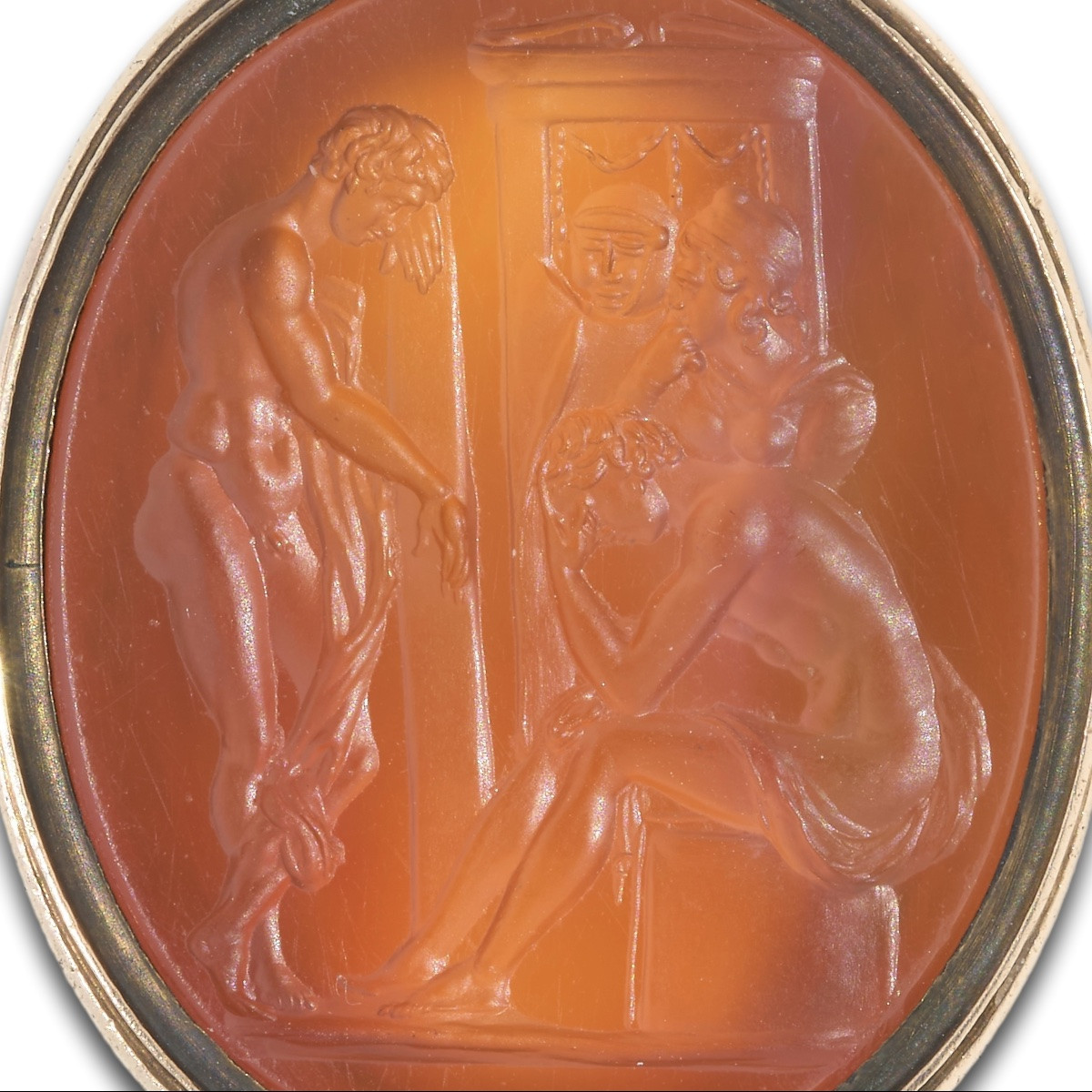
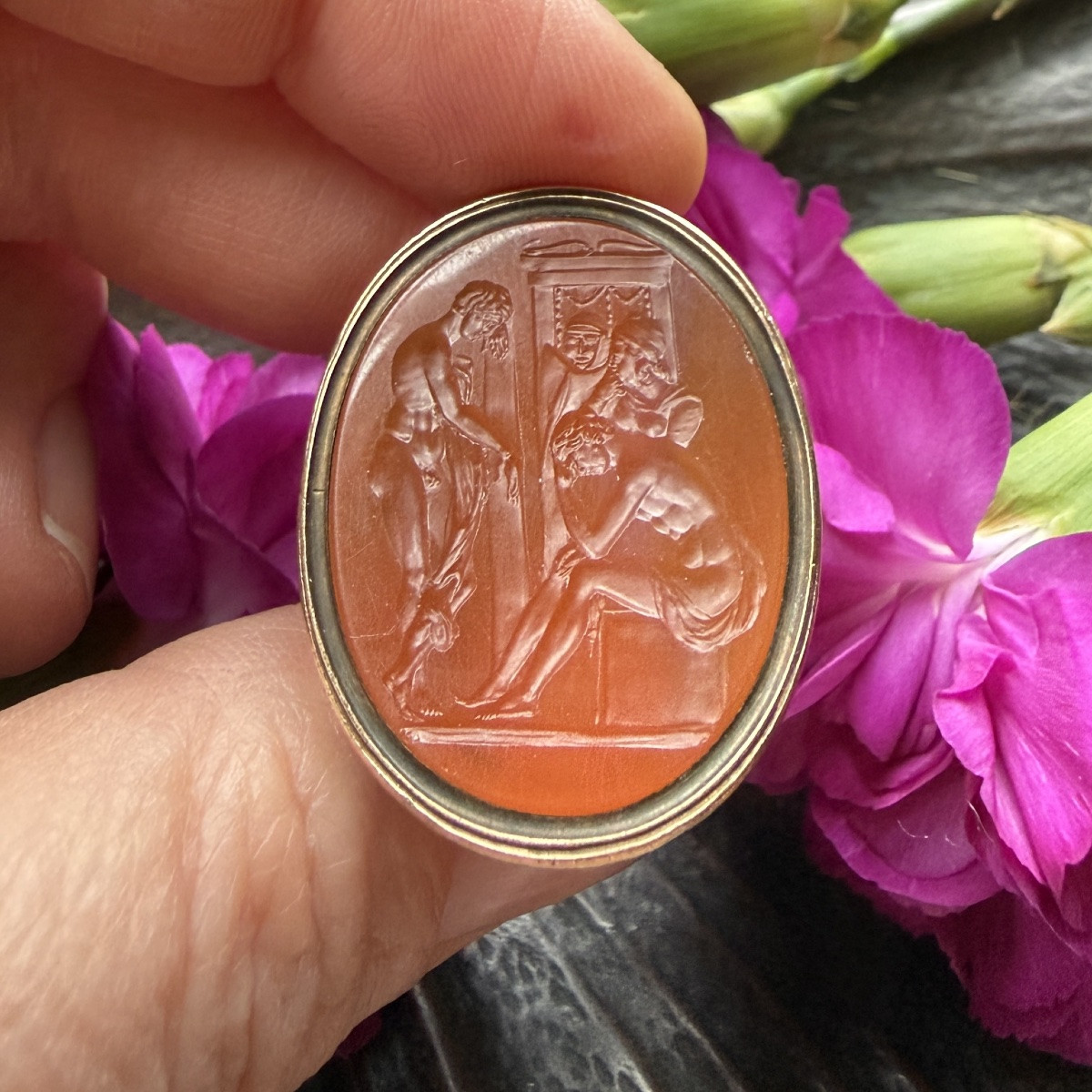
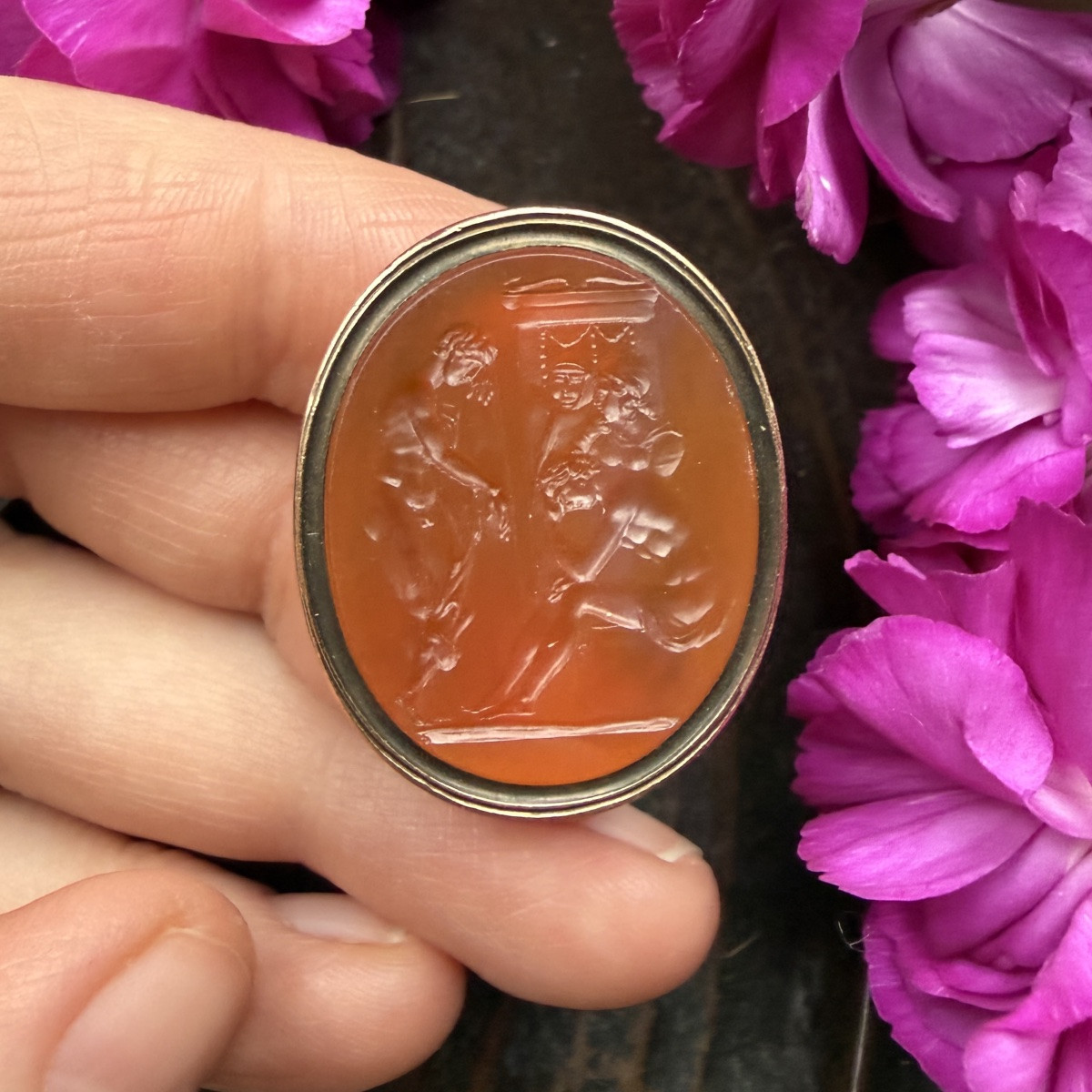

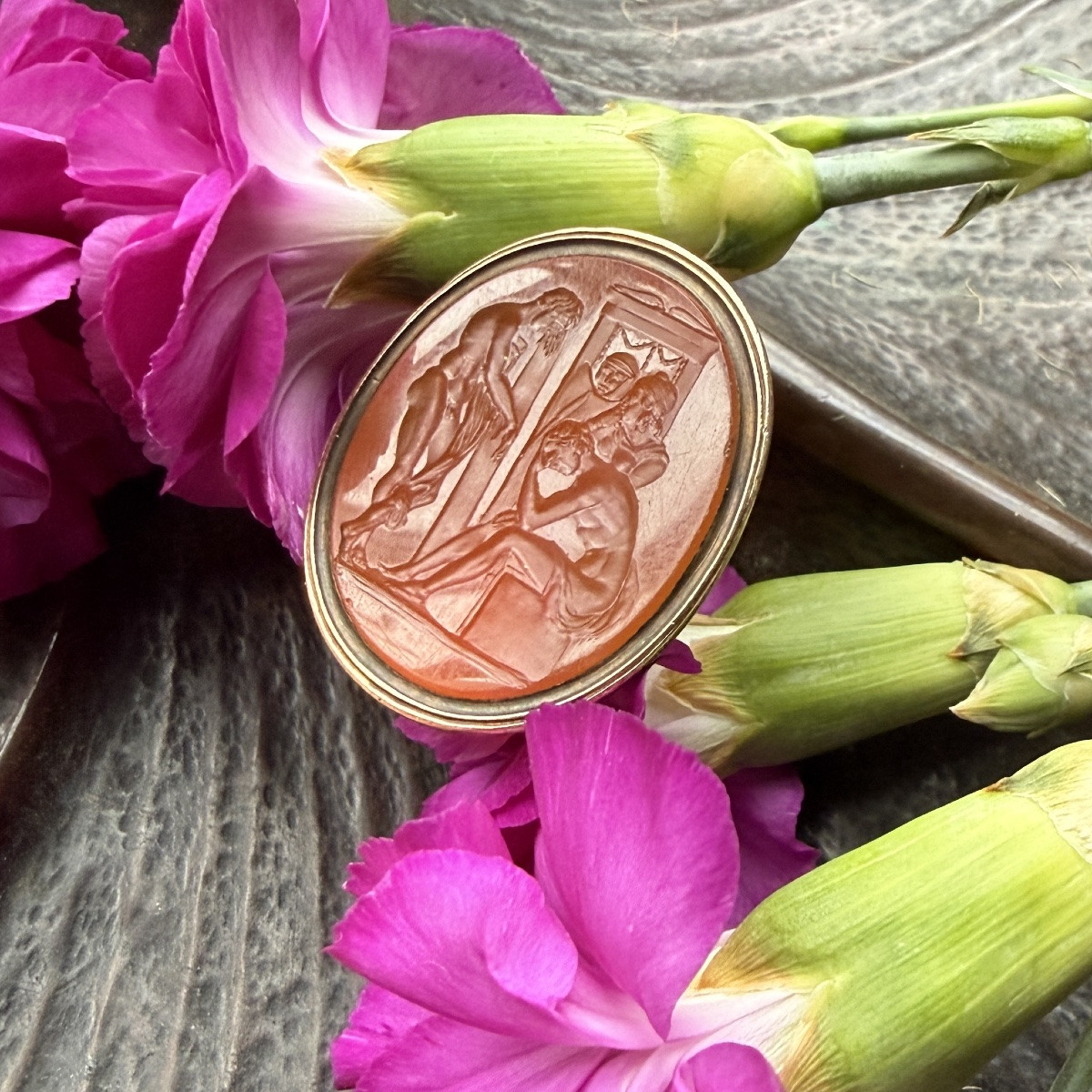
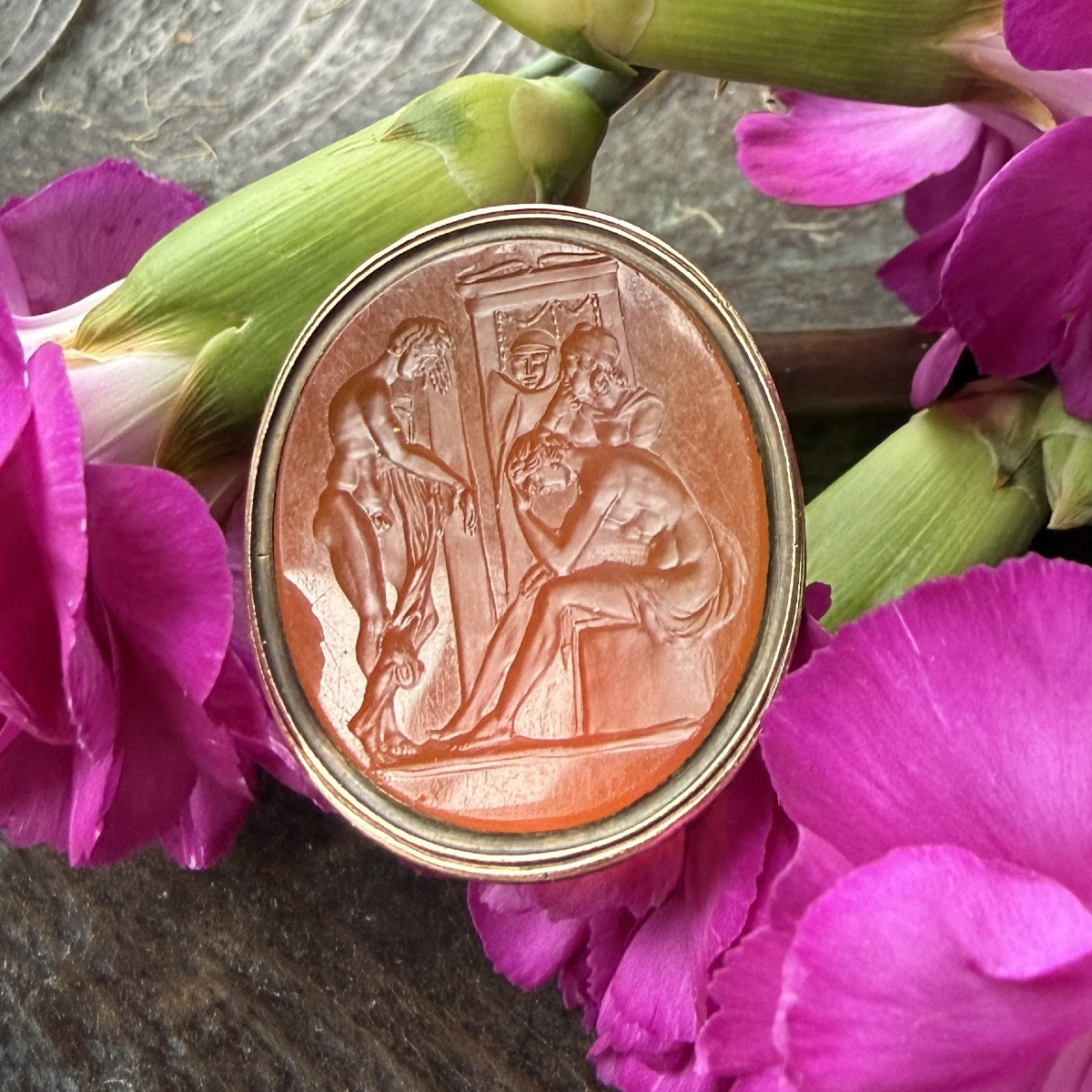

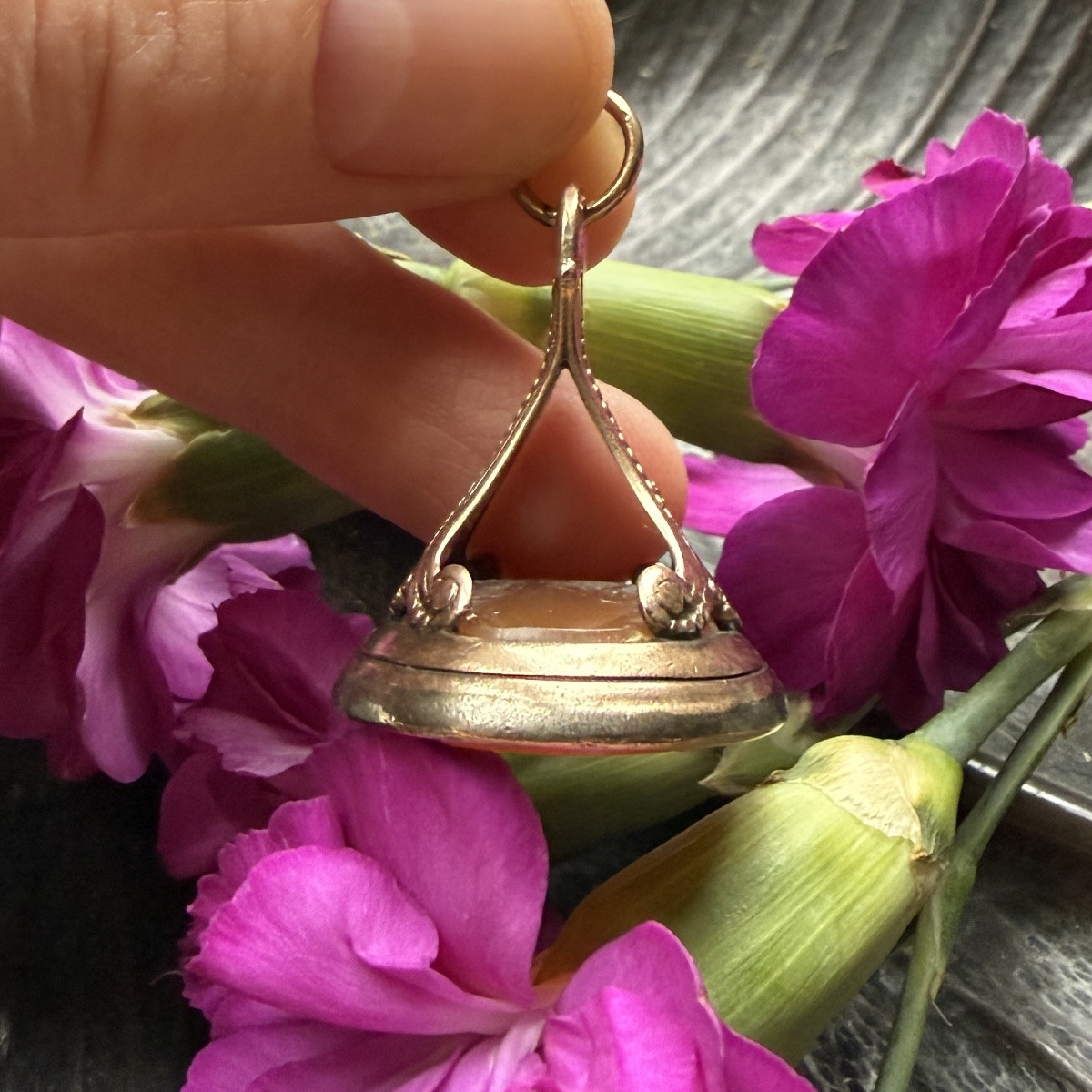
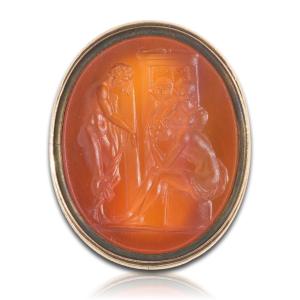


Seal With An Intaglio Of Achilles Mourning Patroclus. English, 18th Century.
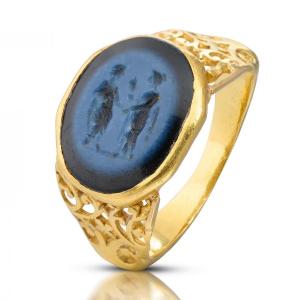
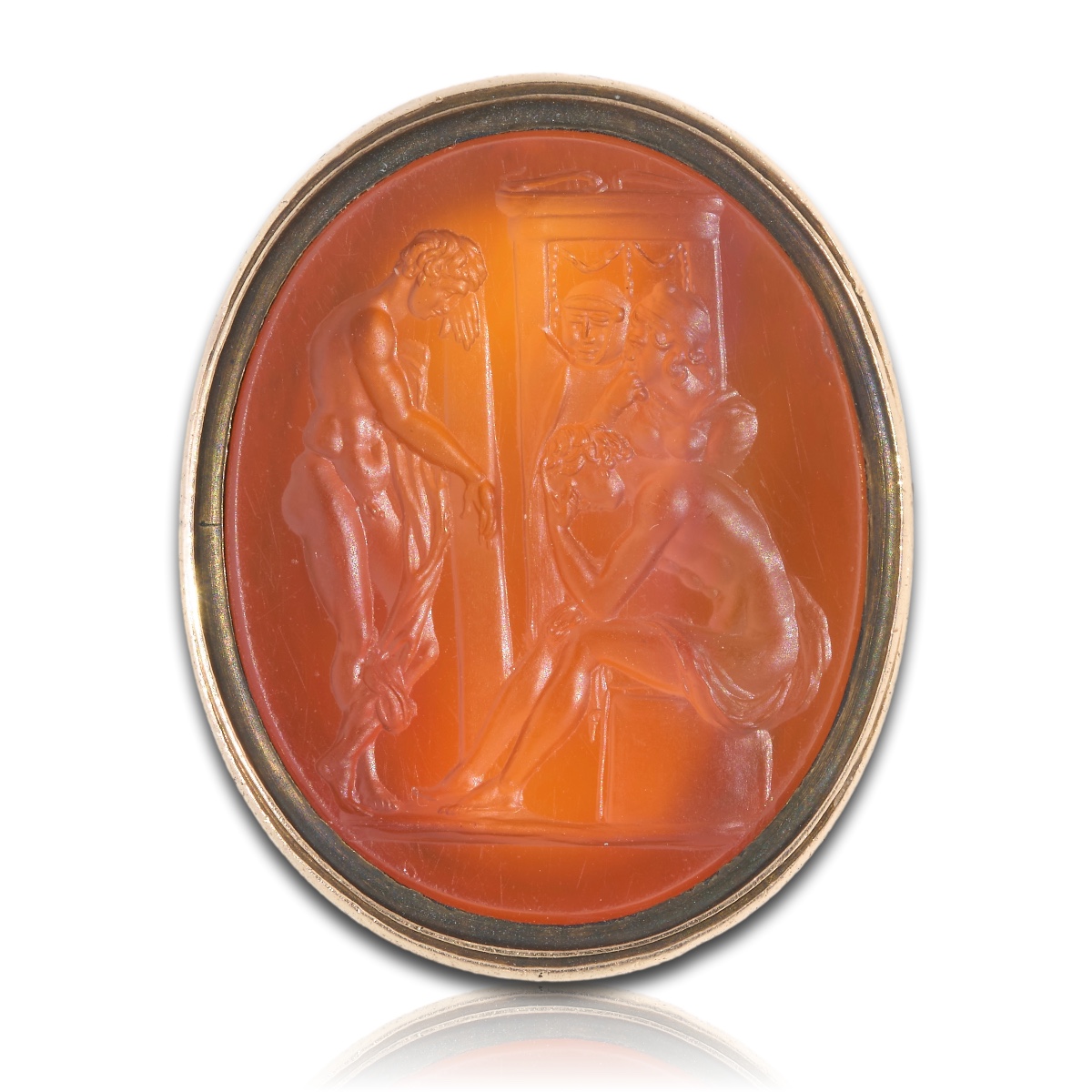
Fob seal with an intaglio of Achilles mourning the death of Patroclus.
English, late 18th century.
Measurements
Intaglio: 2.7 × 2.2 cm.
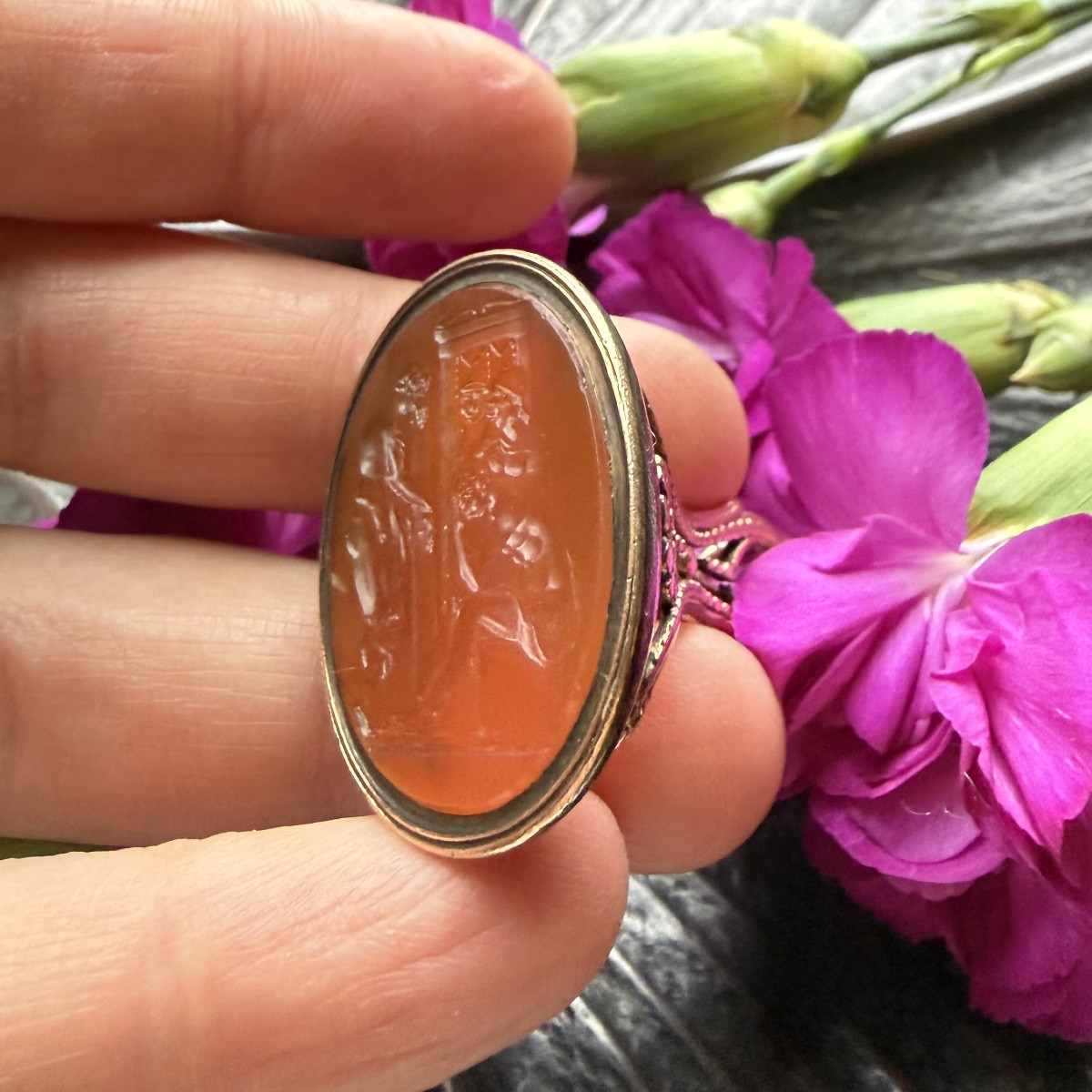
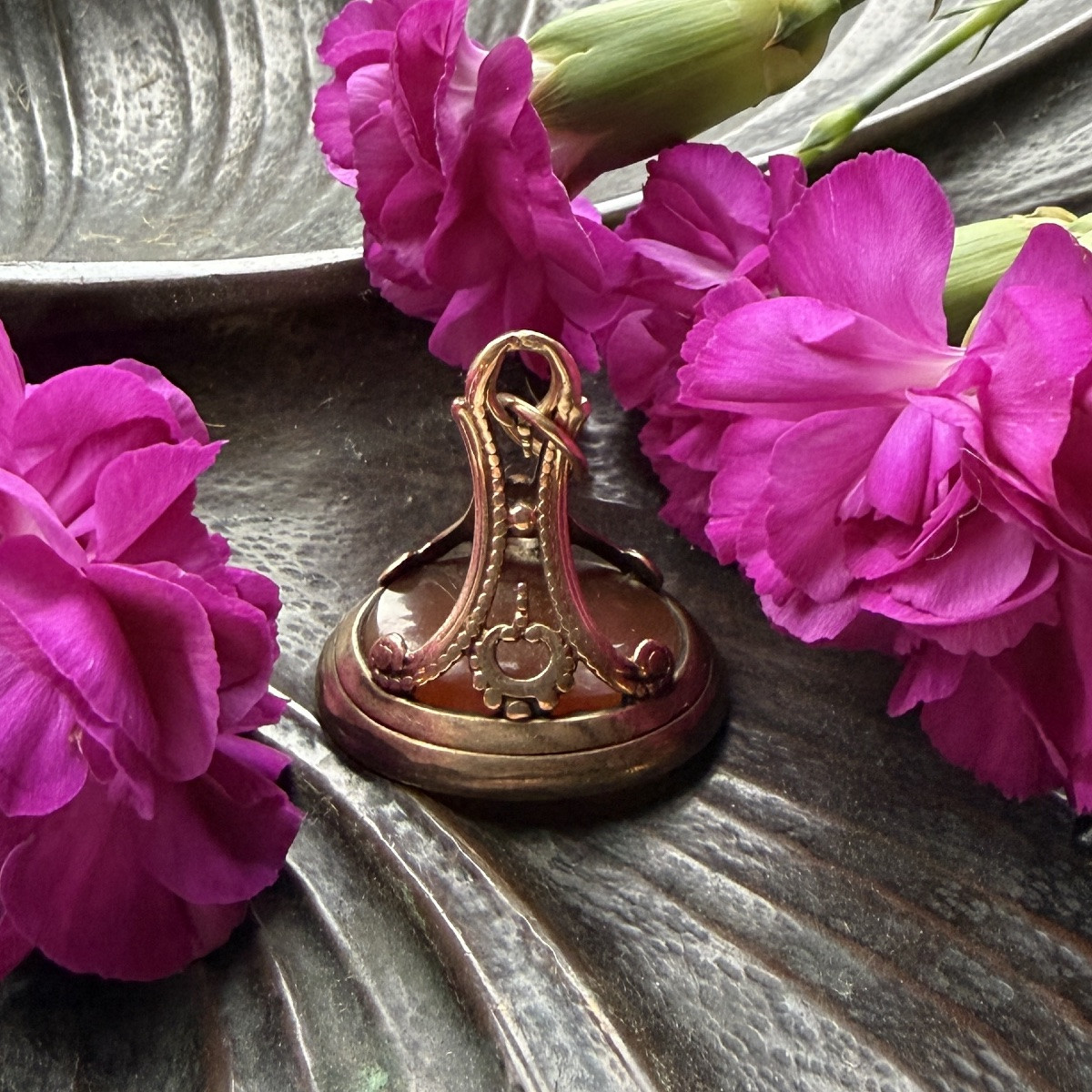
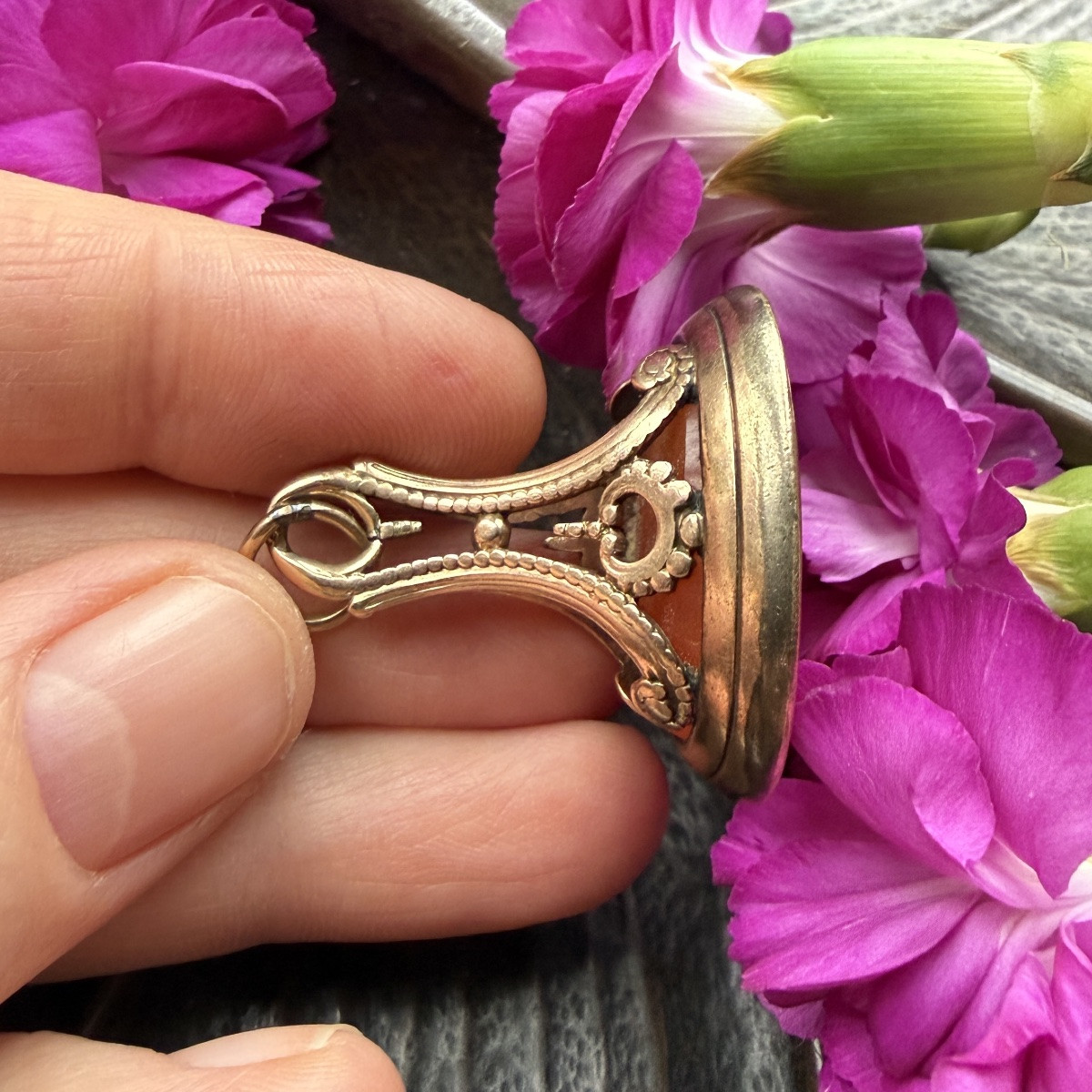
Gold-cased fob seal: 3.1 × 3.0 × 2.5 cm (excluding loose bail).
A finely carved carnelian intaglio set into a gold-cased fob seal, executed in the Neoclassical manner and intended for impression as a private seal. The composition shows the emotive climax of the Homeric narrative—Achilles in the act of mourning Patroclus—rendered with tight, incisive drilling and delicate modelling of hair and musculature that recall late-18th-century gem engraving conventions.
The design is after a celebrated engraved gem recorded in the late eighteenth century and closely associated with the work of Nathaniel Marchant (1739–1816), who produced numerous impressions from gems and published a well-known catalogue of his impressions. Marchant’s practice of adapting celebrated classical and Renaissance prototypes for engraved gems is well documented.
Notes
The present intaglio appears to reproduce the same prototype as the engraved gem for which impressions by Marchant survive in museum collections; one such impression is held in the British Museum’s collection (Museum number 1799,0521.83.a). The original gem by Nathaniel Marchant has been recorded as lost or destroyed during World War II in the Blitz, c. 1941; an impression of the engraved intaglio nevertheless survives in institutional holdings. The present composition derives from Nathaniel Marchant’s intaglio of The Grief of Achilles upon the Death of Patroclus (Dalton 1915, no. 817; Raspe 1791, no. 9238), itself based on a celebrated fragmentary Renaissance cameo, later in the Albani collection and now in the Museum of Fine Arts, Boston. In his 1792 catalogue, Marchant stated that the damaged prototype required restoration, and the right-hand figure is generally taken to be his addition. Though often linked with the Palazzo Mattei relief, Marchant’s composition does not correspond exactly to that source. Widely circulated through casts and impressions, it became the model for later versions, including examples by Siriès, Burch, and Amastini. Marchant’s original intaglio was destroyed during the Second World War, though a Tassie impression and a plaster cast are preserved in the British Museum.
Bibliography
Nathaniel Marchant, A Catalogue of One Hundred Impressions from Gems engraved by Nathaniel Marchant, London, 1792.
English, late 18th century.
Measurements
Intaglio: 2.7 × 2.2 cm.
Gold-cased fob seal: 3.1 × 3.0 × 2.5 cm (excluding loose bail).
A finely carved carnelian intaglio set into a gold-cased fob seal, executed in the Neoclassical manner and intended for impression as a private seal. The composition shows the emotive climax of the Homeric narrative—Achilles in the act of mourning Patroclus—rendered with tight, incisive drilling and delicate modelling of hair and musculature that recall late-18th-century gem engraving conventions.
The design is after a celebrated engraved gem recorded in the late eighteenth century and closely associated with the work of Nathaniel Marchant (1739–1816), who produced numerous impressions from gems and published a well-known catalogue of his impressions. Marchant’s practice of adapting celebrated classical and Renaissance prototypes for engraved gems is well documented.
Notes
The present intaglio appears to reproduce the same prototype as the engraved gem for which impressions by Marchant survive in museum collections; one such impression is held in the British Museum’s collection (Museum number 1799,0521.83.a). The original gem by Nathaniel Marchant has been recorded as lost or destroyed during World War II in the Blitz, c. 1941; an impression of the engraved intaglio nevertheless survives in institutional holdings. The present composition derives from Nathaniel Marchant’s intaglio of The Grief of Achilles upon the Death of Patroclus (Dalton 1915, no. 817; Raspe 1791, no. 9238), itself based on a celebrated fragmentary Renaissance cameo, later in the Albani collection and now in the Museum of Fine Arts, Boston. In his 1792 catalogue, Marchant stated that the damaged prototype required restoration, and the right-hand figure is generally taken to be his addition. Though often linked with the Palazzo Mattei relief, Marchant’s composition does not correspond exactly to that source. Widely circulated through casts and impressions, it became the model for later versions, including examples by Siriès, Burch, and Amastini. Marchant’s original intaglio was destroyed during the Second World War, though a Tassie impression and a plaster cast are preserved in the British Museum.
Bibliography
Nathaniel Marchant, A Catalogue of One Hundred Impressions from Gems engraved by Nathaniel Marchant, London, 1792.
1 900 €
Period: 18th century
Style: English Style
Condition: Good condition
Material: Semi precious stone
Reference (ID): 1725097
Availability: In stock
Print